Recognition: unknown
Stable Localized Conformal Prediction via Transduction
Pith reviewed 2026-05-09 18:06 UTC · model grok-4.3
The pith
Transfer learning from source tasks produces more stable conformal prediction sets with limited calibration data.
A machine-rendered reading of the paper's core claim, the machinery that carries it, and where it could break.
Core claim
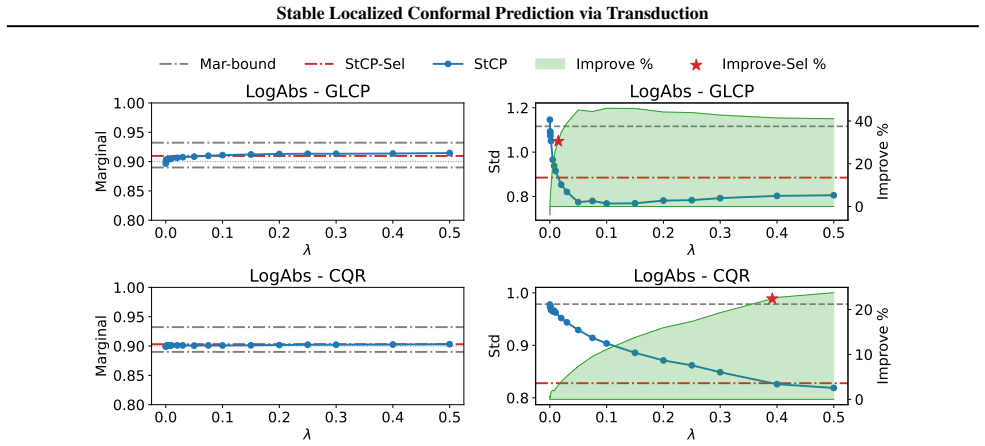
We propose Stable Conformal Prediction (StCP), a transfer learning approach that utilizes labeled source-task data and unlabeled target data. We characterize the marginal coverage and stability of StCP; empirically, it delivers more stable prediction sets than standard conformal prediction methods, especially for those with localization, when calibration data are limited.
What carries the argument
The StCP transduction procedure that incorporates labeled source data through unlabeled target samples to reduce variance in conformal set sizes.
If this is right
- Marginal coverage on the target task remains valid.
- Variability of prediction set size conditional on calibration data is reduced.
- Stability gains are largest for localized conformal methods.
- No additional target-task labels beyond the usual calibration set are needed.
Where Pith is reading between the lines
- Similar transduction could be tested on other uncertainty methods that suffer from small-sample instability.
- Domains with abundant related source data but scarce target labels may achieve reliable localized intervals with smaller calibration budgets.
- Empirical studies across more task pairs would map the similarity conditions that produce the largest stability improvements.
Load-bearing premise
Source-task data must be related enough to the target task that the transferred labels improve stability without breaking marginal coverage.
What would settle it
An experiment that repeatedly draws small calibration sets from the target distribution and checks whether StCP fails to produce lower variance in set sizes than standard conformal prediction while still achieving nominal coverage.
Figures



read the original abstract
Existing evaluations of conformal prediction, such as prediction efficiency and test-conditional coverage, are defined in expectation over the calibration data. In practice, when only one calibration set of limited size is available, prediction sets often exhibit high variability in size, especially for methods with localization. We formalize this concern as set stability, defined as the variance of the conditional expectation of the set size given the calibration data. To improve stability without requiring additional target-task labels, we propose Stable Conformal Prediction (StCP), a transfer learning approach that utilizes labeled source-task data and unlabeled target data. Theoretically, we characterize the marginal coverage and stability of StCP; empirically, it delivers more stable prediction sets than standard conformal prediction methods, especially for those with localization, when calibration data are limited.
Editorial analysis
A structured set of objections, weighed in public.
Referee Report
Summary. The paper proposes Stable Conformal Prediction (StCP), a transduction-based transfer learning approach that combines labeled source-task data with unlabeled target-task data to reduce the variance of prediction set sizes (formalized as set stability) in conformal prediction, especially for localized methods under limited calibration data. It claims to characterize the marginal coverage and stability of StCP theoretically and demonstrates empirically that it yields more stable sets than standard conformal prediction baselines.
Significance. If the central claims hold, the work addresses a practically relevant limitation of conformal prediction—the high variability of set sizes with small calibration sets—by leveraging transfer learning without requiring extra target labels. The theoretical characterization of both coverage and stability, together with the empirical focus on localized methods, represents a clear strength and could influence downstream applications in settings with heterogeneous data sources.
major comments (2)
- [§3.2 and Theorem 1] §3.2 (Transduction step) and Theorem 1: The marginal coverage guarantee is derived under an implicit assumption that the source and target score distributions are sufficiently related for the combined calibration set to preserve the quantile properties. However, the paper does not quantify the allowable shift (e.g., via total variation or density ratio bounds) nor show that coverage degradation remains controlled when this relatedness is only approximate; the mixture of source and target scores can alter the effective quantile, undermining the claimed exact marginal coverage.
- [§4] §4 (Stability analysis): The variance reduction claim for Var(E[set size | calibration set]) is shown under the transduction construction, but the derivation does not bound the additional variability introduced by the source-target mismatch. When the source distribution differs in local density, the stability gain can become negative, yet no sensitivity analysis or worst-case bound is provided to support the central stability improvement claim.
minor comments (3)
- [§3.1] The notation for the transduction weights in Eq. (7) is introduced without an explicit statement of how they are estimated from the unlabeled target data; a short algorithmic box would improve clarity.
- [Table 2] Table 2: The reported standard deviations for set size are computed over only 10 random splits; increasing this to 50–100 would better substantiate the stability comparison.
- [§1.2] Related work on transfer conformal prediction (e.g., methods using importance weighting) is cited but not compared in the experiments; a brief discussion of why transduction was chosen over reweighting would help readers.
Simulated Author's Rebuttal
We thank the referee for their constructive comments, which identify key points for clarifying our theoretical results on coverage and stability. We respond point by point below.
read point-by-point responses
-
Referee: [§3.2 and Theorem 1] §3.2 (Transduction step) and Theorem 1: The marginal coverage guarantee is derived under an implicit assumption that the source and target score distributions are sufficiently related for the combined calibration set to preserve the quantile properties. However, the paper does not quantify the allowable shift (e.g., via total variation or density ratio bounds) nor show that coverage degradation remains controlled when this relatedness is only approximate; the mixture of source and target scores can alter the effective quantile, undermining the claimed exact marginal coverage.
Authors: Theorem 1 establishes exact marginal coverage under the assumption that the combined calibration scores (from source and target) are exchangeable with the test score. This holds precisely when the nonconformity scores share the same distribution, which is ensured by the relatedness between source and target tasks as formalized in the transduction construction of §3.2. We did not include explicit shift bounds because the result is stated for the exact-exchangeability case. We will revise the statement of Theorem 1 and the surrounding discussion in §3.2 to make the exchangeability assumption explicit and add a remark noting that coverage becomes approximate under distribution shift, with a brief reference to how total-variation distance between score distributions would control the deviation. revision: yes
-
Referee: [§4] §4 (Stability analysis): The variance reduction claim for Var(E[set size | calibration set]) is shown under the transduction construction, but the derivation does not bound the additional variability introduced by the source-target mismatch. When the source distribution differs in local density, the stability gain can become negative, yet no sensitivity analysis or worst-case bound is provided to support the central stability improvement claim.
Authors: The variance reduction in §4 is derived for the specific transduction estimator that augments the target calibration set with source scores. We agree that large mismatches in local density can offset or reverse the stability gain. The analysis focuses on the regime where source and target are related enough for the empirical gains shown in the experiments. We will add a sensitivity subsection to §4 that provides a first-order bound on the extra variability induced by score-distribution mismatch (via the difference in local densities) and states the conditions under which the net stability improvement remains positive. revision: partial
Circularity Check
No circularity: new transduction method with independent theoretical characterization
full rationale
The paper introduces StCP as a transfer-learning extension of conformal prediction that combines labeled source data with unlabeled target data to stabilize set sizes. Its central claims rest on a fresh definition of set stability (variance of conditional expected set size) and a new transduction procedure whose marginal coverage and stability are derived from first principles under the stated exchangeability assumptions. No equation reduces a prediction or coverage guarantee to a fitted parameter or prior self-citation by construction; the derivation chain is self-contained and externally falsifiable via the usual conformal coverage arguments plus the explicit source-target relatedness assumption.
Axiom & Free-Parameter Ledger
axioms (1)
- domain assumption Standard assumptions for conformal prediction such as exchangeability of data points
Reference graph
Works this paper leans on
-
[1]
Langley , title =
P. Langley , title =. Proceedings of the 17th International Conference on Machine Learning (ICML 2000) , address =. 2000 , pages =
2000
-
[2]
Journal of Machine Learning Research , volume=
Stability and generalization , author=. Journal of Machine Learning Research , volume=
-
[3]
2010 , publisher=
Clustering stability , author=. 2010 , publisher=
2010
-
[4]
T. M. Mitchell. The Need for Biases in Learning Generalizations. 1980
1980
-
[5]
M. J. Kearns , title =
-
[6]
Machine Learning: An Artificial Intelligence Approach, Vol. I. 1983
1983
-
[7]
R. O. Duda and P. E. Hart and D. G. Stork. Pattern Classification. 2000
2000
-
[8]
Suppressed for Anonymity , author=
-
[9]
Newell and P
A. Newell and P. S. Rosenbloom. Mechanisms of Skill Acquisition and the Law of Practice. Cognitive Skills and Their Acquisition. 1981
1981
-
[10]
A. L. Samuel. Some Studies in Machine Learning Using the Game of Checkers. IBM Journal of Research and Development. 1959
1959
-
[11]
2014 , publisher=
Understanding machine learning: From theory to algorithms , author=. 2014 , publisher=
2014
-
[12]
Advances in Neural Information Processing Systems , volume=
Generalization bounds for uniformly stable algorithms , author=. Advances in Neural Information Processing Systems , volume=
-
[13]
Journal of the American Statistical Association , number=
Conformal prediction for network-assisted regression , author=. Journal of the American Statistical Association , number=. 2025 , publisher=
2025
-
[14]
Journal of Machine Learning Research , volume=
Community detection in sparse latent space models , author=. Journal of Machine Learning Research , volume=
-
[15]
Biometrika , volume=
Localized conformal prediction: A generalized inference framework for conformal prediction , author=. Biometrika , volume=. 2023 , publisher=
2023
-
[16]
Journal of the Royal Statistical Society Series B: Statistical Methodology , volume=
Conformal prediction with local weights: randomization enables robust guarantees , author=. Journal of the Royal Statistical Society Series B: Statistical Methodology , volume=. 2025 , publisher=
2025
-
[17]
Journal of the Royal Statistical Society Series B: Statistical Methodology , pages=
Conformal prediction with conditional guarantees , author=. Journal of the Royal Statistical Society Series B: Statistical Methodology , pages=. 2025 , publisher=
2025
-
[18]
Progress in Artificial Intelligence , volume=
Event labeling combining ensemble detectors and background knowledge , author=. Progress in Artificial Intelligence , volume=. 2014 , publisher=
2014
-
[19]
2009 , howpublished =
Redmond, Michael , title =. 2009 , howpublished =
2009
-
[20]
Harvard Dataverse , volume=
Tennessee’s student teacher achievement ratio (STAR) project , author=. Harvard Dataverse , volume=
-
[21]
IEEE 18th International Symposium on Biomedical Imaging (ISBI) , pages=
MedMNIST Classification Decathlon: A Lightweight AutoML Benchmark for Medical Image Analysis , author=. IEEE 18th International Symposium on Biomedical Imaging (ISBI) , pages=
-
[22]
Cement and Concrete research , volume=
Modeling of strength of high-performance concrete using artificial neural networks , author=. Cement and Concrete research , volume=. 1998 , publisher=
1998
-
[23]
UCI Machine Learning Repository , year=
Physicochemical properties of protein tertiary structure data set , author=. UCI Machine Learning Repository , year=
-
[24]
Advances in Neural Information Processing Systems , volume=
Conformalized quantile regression , author=. Advances in Neural Information Processing Systems , volume=
-
[25]
International Conference on Machine Learning , pages=
One-shot federated conformal prediction , author=. International Conference on Machine Learning , pages=. 2023 , organization=
2023
-
[26]
Advances in Neural Information Processing Systems , volume=
Conformal prediction using conditional histograms , author=. Advances in Neural Information Processing Systems , volume=
-
[27]
Journal of the Royal Statistical Society Series B: Statistical Methodology , pages=
SymmPI: predictive inference for data with group symmetries , author=. Journal of the Royal Statistical Society Series B: Statistical Methodology , pages=. 2025 , publisher=
2025
-
[28]
Proceedings of the National Academy of Sciences , volume =
Victor Chernozhukov and Kaspar Wüthrich and Yinchu Zhu , title =. Proceedings of the National Academy of Sciences , volume =
-
[29]
The Annals of Statistics , volume=
Testing conditional moment restrictions , author=. The Annals of Statistics , volume=. 2003 , publisher=
2003
-
[30]
Conformal prediction after data-dependent model selection
Conformal prediction after efficiency-oriented model selection , author=. arXiv preprint arXiv:2408.07066 , year=
work page internal anchor Pith review Pith/arXiv arXiv
-
[31]
Advances in neural information processing systems , volume=
Conformal prediction under covariate shift , author=. Advances in neural information processing systems , volume=
-
[32]
2005 , publisher=
Algorithmic learning in a random world , author=. 2005 , publisher=
2005
-
[33]
The Thirty-ninth Annual Conference on Neural Information Processing Systems , year=
Personalized Federated Conformal Prediction with Localization , author=. The Thirty-ninth Annual Conference on Neural Information Processing Systems , year=
-
[34]
2019 , publisher=
High-dimensional statistics: A non-asymptotic viewpoint , author=. 2019 , publisher=
2019
-
[35]
Bernoulli , number =
Johannes Lederer and Sara van de Geer , title =. Bernoulli , number =
-
[36]
International conference on machine learning , pages=
Learning theory and algorithms for revenue optimization in second price auctions with reserve , author=. International conference on machine learning , pages=. 2014 , organization=
2014
-
[37]
International Conference on Learning Representations (ICLR) , year=
Batch Multivalid Conformal Prediction , author=. International Conference on Learning Representations (ICLR) , year=
-
[38]
, author=
Distribution-Free Prediction Sets. , author=. Journal of the American Statistical Association , volume=
-
[39]
International conference on machine learning , pages=
Train faster, generalize better: Stability of stochastic gradient descent , author=. International conference on machine learning , pages=. 2016 , organization=
2016
-
[40]
Science , volume=
Prediction-powered inference , author=. Science , volume=. 2023 , publisher=
2023
-
[41]
Foundations and Trends
Conformal Prediction: A Gentle Introduction , author=. Foundations and Trends. 2023 , publisher=
2023
-
[42]
ACM Computing Surveys , year=
Conformal prediction: A data perspective , author=. ACM Computing Surveys , year=
-
[43]
Symposium on conformal and probabilistic prediction with applications , pages=
Criteria of efficiency for conformal prediction , author=. Symposium on conformal and probabilistic prediction with applications , pages=. 2016 , organization=
2016
-
[44]
Journal of the Royal Statistical Society Series B: Statistical Methodology , volume=
Distribution-free prediction bands for non-parametric regression , author=. Journal of the Royal Statistical Society Series B: Statistical Methodology , volume=. 2014 , publisher=
2014
-
[45]
ASTIN Bulletin: The Journal of the IAA , volume=
On a class of measures of dispersion with application to optimal reinsurance , author=. ASTIN Bulletin: The Journal of the IAA , volume=. 1969 , publisher=
1969
-
[46]
Journal of the American Statistical Association , volume=
Selection and aggregation of conformal prediction sets , author=. Journal of the American Statistical Association , volume=. 2025 , publisher=
2025
-
[47]
Advances in Neural Information Processing Systems , volume=
Length optimization in conformal prediction , author=. Advances in Neural Information Processing Systems , volume=
-
[48]
arXiv preprint arXiv:2505.13432 , year=
Synthetic-Powered Predictive Inference , author=. arXiv preprint arXiv:2505.13432 , year=
-
[49]
International Conference on Machine Learning , pages=
Few-shot conformal prediction with auxiliary tasks , author=. International Conference on Machine Learning , pages=. 2021 , organization=
2021
-
[50]
IEEE Transactions on Pattern Analysis and Machine Intelligence , volume=
Few-shot calibration of set predictors via meta-learned cross-validation-based conformal prediction , author=. IEEE Transactions on Pattern Analysis and Machine Intelligence , volume=. 2023 , publisher=
2023
-
[51]
Journal of the American Statistical Association , volume =
Jing Lei and James Robins and Larry Wasserman , title =. Journal of the American Statistical Association , volume =. 2013 , publisher =
2013
-
[52]
NPJ Digital Medicine , volume=
Second opinion needed: communicating uncertainty in medical machine learning , author=. NPJ Digital Medicine , volume=. 2021 , publisher=
2021
-
[53]
Journal of Machine Learning Research , volume=
A Tutorial on Conformal Prediction , author=. Journal of Machine Learning Research , volume=
-
[54]
Distributional conformal prediction , booktitle =
Chernozhukov, Victor and W. Distributional conformal prediction , booktitle =. 2021 , publisher=
2021
-
[55]
IEEE Transactions on Knowledge and Data Engineering , volume=
A survey on transfer learning , author=. IEEE Transactions on Knowledge and Data Engineering , volume=. 2009 , publisher=
2009
-
[56]
IEEE Transactions on Pattern Analysis and Machine Intelligence , volume=
Meta-learning in neural networks: A survey , author=. IEEE Transactions on Pattern Analysis and Machine Intelligence , volume=. 2021 , publisher=
2021
-
[57]
Federated learning: Opportunities and challenges , author=. arXiv preprint arXiv:2101.05428 , year=
-
[58]
Machine learning , volume=
A survey on semi-supervised learning , author=. Machine learning , volume=. 2020 , publisher=
2020
-
[59]
Electronic Journal of Statistics , volume=
Training-conditional coverage for distribution-free predictive inference , author=. Electronic Journal of Statistics , volume=. 2023 , publisher=
2023
-
[60]
The Annals of Statistics , volume=
Algorithmic stability implies training-conditional coverage for distribution-free prediction methods , author=. The Annals of Statistics , volume=. 2025 , publisher=
2025
-
[61]
Econometrics and Statistics , volume=
Rage against the mean--a review of distributional regression approaches , author=. Econometrics and Statistics , volume=. 2023 , publisher=
2023
-
[62]
International Conference on Artificial Intelligence and Statistics , pages=
Improving adaptive conformal prediction using self-supervised learning , author=. International Conference on Artificial Intelligence and Statistics , pages=. 2023 , organization=
2023
-
[63]
IEEE Transactions on Pattern Analysis and Machine Intelligence , year=
Semi-supervised risk control via prediction-powered inference , author=. IEEE Transactions on Pattern Analysis and Machine Intelligence , year=
-
[64]
Biometrika , volume=
Semi-supervised distribution learning , author=. Biometrika , volume=. 2025 , publisher=
2025
-
[65]
Proceedings of Machine Learning Research , volume=
Calibrating Without Labels: Source-Free Conformal Prediction Using Pseudo-Labels , author=. Proceedings of Machine Learning Research , volume=
-
[66]
Journal of the Royal Statistical Society Series B: Statistical Methodology , pages=
Engression: extrapolation through the lens of distributional regression , author=. Journal of the Royal Statistical Society Series B: Statistical Methodology , pages=. 2024 , publisher=
2024
discussion (0)
Sign in with ORCID, Apple, or X to comment. Anyone can read and Pith papers without signing in.