Recognition: unknown
Speckle Interferometry at SOAR in 2024 and 2025
Pith reviewed 2026-05-09 18:14 UTC · model grok-4.3
The pith
Speckle interferometry at SOAR yields 5316 new binary star position measurements and orbital elements for 202 systems.
A machine-rendered reading of the paper's core claim, the machinery that carries it, and where it could break.
Core claim
We present 5316 measurements of relative positions and magnitude differences in 3532 pairs (including 524 unpublished measures made before 2024) with median and minimum separations of 0.19 arcsec and 12 mas, respectively; non-resolutions of 1723 stars are documented as well. More than 400 pairs have been resolved here for the first time and not resolved by Gaia; among those are 222 TESS objects of interest, 46 inner subsystems in known wider binaries within 100 pc, and 43 subdwarfs. Positional measurements are used to compute or improve binary orbits; elements of 202 orbits with meaningful errors are given here, while preliminary and tentative orbits are published elsewhere. Of special note
What carries the argument
Speckle interferometry at the SOAR 4.1 m telescope, which records short-exposure images to measure binary separations and magnitude differences down to 12 mas, followed by fitting of accumulated position data to derive orbital elements.
If this is right
- The 202 orbits supply mass and period constraints for systems including pre-main sequence binaries.
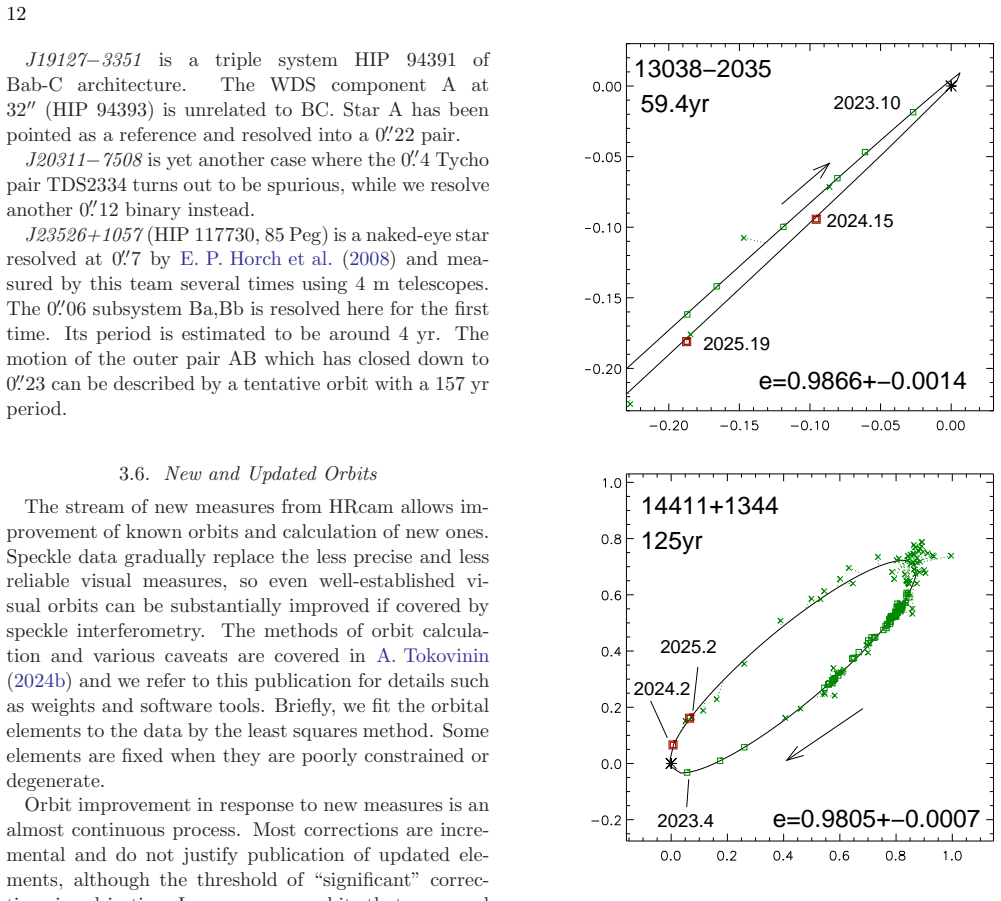
- High-eccentricity examples such as e = 0.9866 provide direct data points for testing dynamical evolution models.
- First-time resolutions of 222 TESS objects of interest supply companion information relevant to exoplanet candidate validation.
- The 46 newly resolved inner subsystems clarify the architecture of hierarchical multiples within 100 pc.
- Parameters of 86 calibration binaries support ongoing and future use of the instrument for consistent pixel scale and orientation.
Where Pith is reading between the lines
- These optical measurements could be combined with future Gaia or other astrometric releases to tighten orbital solutions for the same systems.
- The catalog of non-resolutions offers statistical upper limits on companion fractions at small separations for population studies.
- The dataset of resolved subdwarfs and young binaries may help anchor age and metallicity relations when masses become available from the orbits.
- Continued monitoring of the high-eccentricity systems could reveal whether periastron passages produce observable activity or mass transfer.
Load-bearing premise
The speckle measurements contain no significant unaccounted systematic errors at the stated precision and the available observation epochs permit robust determination of orbital elements.
What would settle it
Independent position measurements of several reported binaries, obtained at a different facility or epoch, that fall outside the error ranges predicted by the published orbital elements.
Figures


read the original abstract
Results of speckle interferometry observations at the 4.1 m SOuthern Astrophysical Research (SOAR) telescope obtained during 2024-2025 are presented. We present 5316 measurements of relative positions and magnitude differences in 3532 pairs (including 524 unpublished measures made before 2024) with median and minimum separations of 0.19" and 12 mas, respectively; non-resolutions of 1723 stars are documented as well. More than 400 pairs have been resolved here for the first time and not resolved by Gaia; among those are 222 TESS objects of interest, 46 inner subsystems in known wider binaries within 100 pc, and 43 subdwarfs. Positional measurements are used to compute or improve binary orbits; elements of 202 orbits with meaningful errors are given here, while preliminary and tentative orbits are published elsewhere. Of special note are orbits with large and accurately measured eccentricties (e.g. e=0.9866+/-0.0014 for J13038-2035) and orbits of pre-main sequence binaries. Appendix contains parameters of 86 binaries used for calibration of pixel scale and orientation.
Editorial analysis
A structured set of objections, weighed in public.
Referee Report
Summary. The manuscript reports speckle interferometry results from the SOAR 4.1 m telescope in 2024–2025. It presents 5316 measurements of relative positions and magnitude differences for 3532 pairs (including 524 pre-2024 measures), with median and minimum separations of 0.19 arcsec and 12 mas; 1723 non-resolutions are also documented. More than 400 pairs are resolved for the first time (including 222 TESS objects of interest). Elements of 202 orbits with meaningful errors are derived from the new and prior data, with an appendix listing parameters for 86 calibration binaries.
Significance. If the positional accuracies and orbit fits hold, the work substantially augments the high-resolution binary catalog, particularly for nearby systems, pre-main-sequence stars, and TESS targets. The large volume of new measurements and the provision of 202 orbits with uncertainties directly support improved dynamical studies and multiplicity statistics.
major comments (2)
- [§3] §3 (Observations and Data Reduction): The claimed minimum resolution of 12 mas and median precision are central to the data-release value, yet the section provides no quantitative error budget (e.g., contributions from atmospheric speckle, detector noise, or residual calibration uncertainty) that would allow independent verification of the stated accuracies.
- [§5] §5 (Orbit Computation): The highlighted orbit for J13038-2035 (e = 0.9866 ± 0.0014) is presented as having meaningful errors, but the text does not report the number of epochs, time baseline, or reduced χ² of the fit; without these, it is impossible to judge whether the small eccentricity uncertainty is robust or sensitive to sparse sampling near periastron.
minor comments (3)
- [Abstract] Abstract: the statement that 202 orbits have “meaningful errors” would be clearer if it distinguished newly computed orbits from those merely refined by the new data.
- [Appendix A] Appendix A: the table of 86 calibration binaries lists pixel-scale and orientation values but omits the individual residuals or formal uncertainties on the derived calibration parameters.
- [Tables of orbital elements] Tables of orbital elements: inclusion of a column for the number of observations and the observational time span per orbit would allow readers to assess fit reliability without consulting external catalogs.
Simulated Author's Rebuttal
We thank the referee for the positive assessment of our manuscript and the constructive comments. We address each major comment below and will revise the paper to incorporate the requested information.
read point-by-point responses
-
Referee: [§3] §3 (Observations and Data Reduction): The claimed minimum resolution of 12 mas and median precision are central to the data-release value, yet the section provides no quantitative error budget (e.g., contributions from atmospheric speckle, detector noise, or residual calibration uncertainty) that would allow independent verification of the stated accuracies.
Authors: We agree that a quantitative error budget would improve the manuscript and allow independent verification. In the revised version, we will expand §3 to include a detailed error budget, breaking down contributions from atmospheric speckle, detector noise, and residual calibration uncertainties based on our data analysis. revision: yes
-
Referee: [§5] §5 (Orbit Computation): The highlighted orbit for J13038-2035 (e = 0.9866 ± 0.0014) is presented as having meaningful errors, but the text does not report the number of epochs, time baseline, or reduced χ² of the fit; without these, it is impossible to judge whether the small eccentricity uncertainty is robust or sensitive to sparse sampling near periastron.
Authors: We acknowledge the omission of these fit details. We will revise §5 to include the number of epochs, time baseline, and reduced χ² for the J13038-2035 orbit, enabling readers to assess the robustness of the eccentricity uncertainty. revision: yes
Circularity Check
No significant circularity
full rationale
This is a standard observational catalog paper reporting new speckle interferometry measurements of binary stars, including positions, magnitude differences, and non-resolutions, plus derived orbit elements computed from those measurements. The derivation chain proceeds from raw observations through standard calibration (using an appendix list of reference binaries) to orbit fitting without any self-definitional loops, fitted inputs renamed as predictions, or load-bearing self-citations that reduce the reported results to the inputs by construction. The work is self-contained against external benchmarks such as Gaia non-resolutions and prior orbit catalogs.
Axiom & Free-Parameter Ledger
free parameters (1)
- pixel scale and orientation
Reference graph
Works this paper leans on
-
[1]
2023, title Gaia Data Release 3
Andrae , R., Fouesneau , M., Sordo , R., et al. 2023, title Gaia Data Release 3. Analysis of the Gaia BP/RP spectra using the General Stellar Parameterizer from Photometry , , 674, A27, 10.1051/0004-6361/202243462
-
[2]
J., Chanam \'e , J., & Ag \"u eros , M
Andrews , J. J., Chanam \'e , J., & Ag \"u eros , M. A. 2017, title Wide binaries in Tycho-Gaia: search method and the distribution of orbital separations , , 472, 675, 10.1093/mnras/stx2000
-
[3]
2023, title The CORALIE survey for southern extrasolar planets
Barbato , D., S \'e gransan , D., Udry , S., et al. 2023, title The CORALIE survey for southern extrasolar planets. XIX. Brown dwarfs and stellar companions unveiled by radial velocity and astrometry , , 674, A114, 10.1051/0004-6361/202345874
-
[4]
Bouy , H., Mart \' n , E. L., Brandner , W., et al. 2006, title Multiplicity of very low-mass objects in the Upper Scorpius OB association: a possible wide binary population , , 451, 177, 10.1051/0004-6361:20054252
-
[5]
2017, title New Binaries in the ɛ Cha Association , , 154, 195, 10.3847/1538-3881/aa8e9b
Brice \ n o , C., & Tokovinin , A. 2017, title New Binaries in the ɛ Cha Association , , 154, 195, 10.3847/1538-3881/aa8e9b
-
[6]
Clark , C. A., van Belle , G. T., Horch , E. P., et al. 2024, title The POKEMON Speckle Survey of Nearby M Dwarfs. II. Observations of 1125 Targets , , 167, 56, 10.3847/1538-3881/ad0bfd
-
[7]
A., Leinert , C., et al
Duquennoy , A., Tokovinin , A. A., Leinert , C., et al. 1996, title Spectroscopic and speckle interferometric orbit of Gliese 692.1. , , 314, 846
1996
-
[8]
M., Tokovinin , A., Vieira , T., et al
Faes , D. M., Tokovinin , A., Vieira , T., et al. 2018, in Society of Photo-Optical Instrumentation Engineers (SPIE) Conference Series, Vol. 10703, Adaptive Optics Systems VI, ed. L. M. Close , L. Schreiber , & D. Schmidt , 107033C, 10.1117/12.2312205
-
[9]
Fekel , F. C. 1975, title The triple system psi Sagittarii. , , 80, 844, 10.1086/111820
-
[10]
Gaia Collaboration , Brown , A. G. A., Vallenari , A., et al. 2021 a , title Gaia Early Data Release 3. Summary of the contents and survey properties , , 649, A1, 10.1051/0004-6361/202039657
-
[11]
Gaia Collaboration , Brown , A. G. A., Vallenari , A., et al. 2016, title Gaia Data Release 1. Summary of the astrometric, photometric, and survey properties , , 595, A2, 10.1051/0004-6361/201629512
-
[12]
Gaia Collaboration , Smart , R. L., Sarro , L. M., et al. 2021 b , title Gaia Early Data Release 3. The Gaia Catalogue of Nearby Stars , , 649, A6, 10.1051/0004-6361/202039498
-
[13]
Griffin , R. F. 1979, title Spectroscopic binary orbits from photoelectric radial velocities. Paper 25: HD 179558 , The Observatory, 99, 36
1979
-
[14]
Griffin , R. F. 2012, title Photoelectric Radial Velocities, Paper XVIII Spectroscopic Orbits for Another 52 Binaries in the Hyades Field , Journal of Astrophysics and Astronomy, 33, 29, 10.1007/s12036-012-9137-5
-
[15]
Hartkopf , W. I., Mason , B. D., & Worley , C. E. 2001, title The 2001 US Naval Observatory Double Star CD-ROM. II. The Fifth Catalog of Orbits of Visual Binary Stars , , 122, 3472, 10.1086/323921
-
[16]
I., Tokovinin , A., & Mason , B
Hartkopf , W. I., Tokovinin , A., & Mason , B. D. 2012, title Speckle Interferometry at SOAR in 2010 and 2011: Measures, Orbits, and Rectilinear Fits , , 143, 42, 10.1088/0004-6256/143/2/42
-
[17]
D., van Belle , G., L \'e pine , S., Everett , M
Hartman , Z. D., van Belle , G., L \'e pine , S., Everett , M. E., & Medan , I. 2025, title Resolving the Unresolved: Using NESSI to Search for Unresolved Companions in Low-mass Disk Wide Binaries , , 170, 91, 10.3847/1538-3881/add7d3
-
[18]
Horch , E. P., van Altena , W. F., Cyr , Jr., W. M., et al. 2008, title Charge-Coupled Device Speckle Observations of Binary Stars with the WIYN Telescope. V. Measures During 2001-2006 , , 136, 312, 10.1088/0004-6256/136/1/312
-
[19]
Horch , E. P., van Altena , W. F., Demarque , P., et al. 2015, title Observations of Binary Stars with the Differential Speckle Survey Instrument. V. Toward an Empirical Metal-Poor Mass-Luminosity Relation , , 149, 151, 10.1088/0004-6256/149/5/151
-
[20]
Horch , E. P., Casetti-Dinescu , D. I., Camarata , M. A., et al. 2017, title Observations of Binary Stars with the Differential Speckle Survey Instrument. VII. Measures from 2010 September to 2012 February at the WIYN Telescope , , 153, 212, 10.3847/1538-3881/aa6749
-
[21]
Horch , E. P., Tokovinin , A., Weiss , S. A., et al. 2019, title Observations of Binary Stars with the Differential Speckle Survey Instrument. VIII. Measures of Metal-poor and Triple Stars from 2015 to 2018 , , 157, 56, 10.3847/1538-3881/aaf87e
-
[22]
Horch , E. P., Broderick , K. G., Casetti-Dinescu , D. I., et al. 2021, title Observations with the Differential Speckle Survey Instrument. X. Preliminary Orbits of K-dwarf Binaries and Other Stars , , 161, 295, 10.3847/1538-3881/abf9a8
-
[23]
Howell , S. B., Scott , N. J., Matson , R. A., et al. 2021, title The NASA High-Resolution Speckle Interferometric Imaging Program: Validation and Characterization of Exoplanets and Their Stellar Hosts , Frontiers in Astronomy and Space Sciences, 8, 10, 10.3389/fspas.2021.635864
-
[24]
2012, title The AstraLux Large M-dwarf Multiplicity Survey , , 754, 44, 10.1088/0004-637X/754/1/44
Janson , M., Hormuth , F., Bergfors , C., et al. 2012, title The AstraLux Large M-dwarf Multiplicity Survey , , 754, 44, 10.1088/0004-637X/754/1/44
-
[25]
Properties and validation of the radial velocities
Katz , D., Sartoretti , P., Guerrier , A., et al. 2023, title Gaia Data Release 3. Properties and validation of the radial velocities , , 674, A5, 10.1051/0004-6361/202244220
-
[26]
Kostov , V. B., Powell , B. P., Rappaport , S. A., et al. 2022, title Ninety-seven Eclipsing Quadruple Star Candidates Discovered in TESS Full-frame Images , , 259, 66, 10.3847/1538-4365/ac5458
-
[27]
Kounkel , M., Covey , K. R., Stassun , K. G., et al. 2021, title Double-lined Spectroscopic Binaries in the APOGEE DR16 and DR17 Data , , 162, 184, 10.3847/1538-3881/ac1798
-
[28]
Lester , K. V., Howell , S. B., Matson , R. A., et al. 2023, title Visual Orbits and Alignments of Planet-hosting Binary Systems , , 166, 166, 10.3847/1538-3881/acf563
-
[29]
Lindegren , L., Klioner , S. A., Hern \'a ndez , J., et al. 2021, title Gaia Early Data Release 3. The astrometric solution , , 649, A2, 10.1051/0004-6361/202039709
-
[30]
Majewski , S. R., Davidson Jr. , J. W., Wilson , R. F., et al. 2025, title Characterizing TESS-Identified Quadruple and Higher Order Eclipsing Binaries: I. Speckle Imaging with DSSI and HRCam , arXiv e-prints, arXiv:2511.07554. 2511.07554
-
[31]
Mann , A. W., Dupuy , T., Kraus , A. L., et al. 2019, title How to Constrain Your M Dwarf. II. The Mass-Luminosity-Metallicity Relation from 0.075 to 0.70 Solar Masses , , 871, 63, 10.3847/1538-4357/aaf3bc
-
[32]
Mason , B. D., & Hartkopf , W. I. 2026, title Unreported ICCD Speckle Interferometry Measures of Double Stars , , 171, 149, 10.3847/1538-3881/ae3748
-
[33]
Mason , B. D., Hartkopf , W. I., Gies , D. R., Henry , T. J., & Helsel , J. W. 2009, title The High Angular Resolution Multiplicity of Massive Stars , , 137, 3358, 10.1088/0004-6256/137/2/3358
-
[34]
D., Tokovinin , A., Mendez , R
Mason , B. D., Tokovinin , A., Mendez , R. A., & Costa , E. 2023, title Speckle Interferometry at SOAR in 2022 , , 166, 139, 10.3847/1538-3881/acedaf
-
[35]
Mason , B. D., Wycoff , G. L., Hartkopf , W. I., Douglass , G. G., & Worley , C. E. 2001, title The 2001 US Naval Observatory Double Star CD-ROM. I. The Washington Double Star Catalog , , 122, 3466, 10.1086/323920
-
[36]
McAlister , H. A., Mason , B. D., Hartkopf , W. I., & Shara , M. M. 1993, title ICCD Speckle Observations of Binary Stars. X. A Further Survey for Duplicity Among the Bright Stars , , 106, 1639, 10.1086/116753
-
[37]
Mendez , R. A., Claver \' a , R. M., & Costa , E. 2021, title Orbits and Masses of Binaries from Speckle Interferometry at SOAR , , 161, 155, 10.3847/1538-3881/abdb28
-
[38]
A., Tokovinin , A., Costa , E., & Dirk , M
Mendez , R. A., Tokovinin , A., Costa , E., & Dirk , M. 2025, title Southern Binaries with the Zorro Speckle Camera @ Gemini South , , 169, 226, 10.3847/1538-3881/adbbb4
-
[39]
Merle , T., Hamers , A. S., Van Eck , S., et al. 2022, title A spectroscopic quadruple as a possible progenitor of sub-Chandrasekhar type Ia supernovae , Nature Astronomy, 6, 681, 10.1038/s41550-022-01664-5
-
[40]
2021, title Speckle Interferometry of Nearby Multiple Stars
Mitrofanova , A., Dyachenko , V., Beskakotov , A., et al. 2021, title Speckle Interferometry of Nearby Multiple Stars. II. 2007-2020 Positional Measurements and Orbits of Sixteen Objects , , 162, 156, 10.3847/1538-3881/ac1a78
-
[41]
Offner , S. S. R., Moe , M., Kratter , K. M., et al. 2023, in Astronomical Society of the Pacific Conference Series, Vol. 534, Protostars and Planets VII, ed. S. Inutsuka , Y. Aikawa , T. Muto , K. Tomida , & M. Tamura , 275, 10.48550/arXiv.2203.10066
work page internal anchor Pith review Pith/arXiv arXiv doi:10.48550/arxiv.2203.10066 2023
-
[42]
Penoyre , Z., Belokurov , V., & Evans , N. W. 2022, title Astrometric identification of nearby binary stars - II. Astrometric binaries in the Gaia Catalogue of Nearby Stars , , 513, 5270, 10.1093/mnras/stac1147
-
[43]
Powell , B. P., Kostov , V. B., & Tokovinin , A. 2023, title A Hunting Expedition For High-Order Hierarchies , , 524, 4296, 10.1093/mnras/stad2065
-
[44]
Raghavan , D., McAlister , H. A., Henry , T. J., et al. 2010, title A Survey of Stellar Families: Multiplicity of Solar-type Stars , , 190, 1, 10.1088/0067-0049/190/1/1
-
[45]
Recio-Blanco , A., de Laverny , P., Palicio , P. A., et al. 2023, title Gaia Data Release 3. Analysis of RVS spectra using the General Stellar Parametriser from spectroscopy , , 674, A29, 10.1051/0004-6361/202243750
-
[46]
Simon , M., Guilloteau , S., Beck , T. L., et al. 2019, title Masses and Implications for Ages of Low-mass Pre-main-sequence Stars in Taurus and Ophiuchus , , 884, 42, 10.3847/1538-4357/ab3e3b
-
[47]
2019, title Spectroscopic orbits of nearby stars , , 626, A31, 10.1051/0004-6361/201935346
Sperauskas , J., Deveikis , V., & Tokovinin , A. 2019, title Spectroscopic orbits of nearby stars , , 626, A31, 10.1051/0004-6361/201935346
-
[48]
Tokovinin , A. 2012, title Speckle Interferometry and Orbits of ``Fast'' Visual Binaries , , 144, 56, 10.1088/0004-6256/144/2/56
-
[49]
Tokovinin , A. 2018 a , title Ten Years of Speckle Interferometry at SOAR , , 130, 035002, 10.1088/1538-3873/aaa7d9
-
[50]
Tokovinin , A. 2018 b , title Dancing Twins: Stellar Hierarchies That Formed Sequentially? , , 155, 160, 10.3847/1538-3881/aab102
-
[51]
Tokovinin , A. 2021, title Architecture of Hierarchical Stellar Systems and Their Formation , Universe, 7, 352, 10.3390/universe7090352
-
[52]
Tokovinin , A. 2023 a , title Exploring Thousands of Nearby Hierarchical Systems with Gaia and Speckle Interferometry , , 165, 180, 10.3847/1538-3881/acc464
-
[53]
2023 b , title Dynamics of Four Triple Systems , , 165, 165, 10.3847/1538-3881/acbf32
Tokovinin , A. 2023 b , title Dynamics of Four Triple Systems , , 165, 165, 10.3847/1538-3881/acbf32
-
[54]
2023 c , title Spectroscopic Orbits of Subsystems in Multiple Stars
Tokovinin , A. 2023 c , title Spectroscopic Orbits of Subsystems in Multiple Stars. IX , , 165, 160, 10.3847/1538-3881/acbe42
-
[55]
2024 a , title Performance of the SOAR Speckle Instrument , , 168, 125, 10.3847/1538-3881/ad6153
Tokovinin , A. 2024 a , title Performance of the SOAR Speckle Instrument , , 168, 125, 10.3847/1538-3881/ad6153
-
[56]
Tokovinin , A. 2024 b , title Orbits of Binary Stars: from Visual Measures to Speckle Interferometry , , 168, 190, 10.3847/1538-3881/ad72e5
-
[57]
2025 a , title Orbits of Six Triple Systems , , 169, 124, 10.3847/1538-3881/ada3c6
Tokovinin , A. 2025 a , title Orbits of Six Triple Systems , , 169, 124, 10.3847/1538-3881/ada3c6
-
[58]
2025 b , title Spectroscopic Orbits of Subsystems in Multiple Stars
Tokovinin , A. 2025 b , title Spectroscopic Orbits of Subsystems in Multiple Stars. XI , , 170, 143, 10.3847/1538-3881/adee23
-
[59]
2026 a , title Orbits of Twelve Multiple Stars , , 171, 109, 10.3847/1538-3881/ae2fe6
Tokovinin , A. 2026 a , title Orbits of Twelve Multiple Stars , , 171, 109, 10.3847/1538-3881/ae2fe6
-
[60]
Tokovinin , A. 2026 b , title Mutual Orbit Alignment in Resolved Triple Systems , , 998, 151, 10.3847/1538-4357/ae3682
-
[61]
Tokovinin , A., Cantarutti , R., Tighe , R., et al. 2016 a , title SOAR Adaptive Module (SAM): Seeing Improvement with a UV Laser , , 128, 125003, 10.1088/1538-3873/128/970/125003
-
[62]
Tokovinin , A., Cantarutti , R., Tighe , R., et al. 2010 a , title High-Resolution Imaging at the SOAR Telescope , , 122, 1483, 10.1086/657903
-
[63]
Tokovinin , A., Mason , B. D., & Hartkopf , W. I. 2010 b , title Speckle Interferometry at the Blanco and SOAR Telescopes in 2008 and 2009 , , 139, 743, 10.1088/0004-6256/139/2/743
-
[64]
Tokovinin , A., Mason , B. D., & Hartkopf , W. I. 2014, title Speckle Interferometry at SOAR in 2012 and 2013 , , 147, 123, 10.1088/0004-6256/147/5/123
-
[65]
Tokovinin , A., Mason , B. D., Hartkopf , W. I., Mendez , R. A., & Horch , E. P. 2015, title Speckle Interferometry at SOAR in 2014 , , 150, 50, 10.1088/0004-6256/150/2/50
-
[66]
Tokovinin , A., Mason , B. D., Hartkopf , W. I., Mendez , R. A., & Horch , E. P. 2016 b , title Speckle Interferometry at SOAR in 2015 , , 151, 153, 10.3847/0004-6256/151/6/153
-
[67]
Tokovinin , A., Mason , B. D., Hartkopf , W. I., Mendez , R. A., & Horch , E. P. 2018, title Speckle Interferometry at SOAR in 2016 and 2017 , , 155, 235, 10.3847/1538-3881/aabf8d
-
[68]
Tokovinin , A., Mason , B. D., Mendez , R. A., & Costa , E. 2022, title Speckle Interferometry at SOAR in 2021 , , 164, 58, 10.3847/1538-3881/ac78e7
-
[69]
Tokovinin , A., Mason , B. D., Mendez , R. A., & Costa , E. 2024, title Speckle Interferometry at SOAR Telescope in 2023 , , 168, 28, 10.3847/1538-3881/ad4d56
-
[70]
Tokovinin , A., Mason , B. D., Mendez , R. A., Costa , E., & Horch , E. P. 2020, title Speckle Interferometry at SOAR in 2019 , , 160, 7, 10.3847/1538-3881/ab91c1
-
[71]
Tokovinin , A., Mason , B. D., Mendez , R. A., et al. 2021, title Speckle Interferometry at SOAR in 2020 , , 162, 41, 10.3847/1538-3881/ac00bd
-
[72]
Tokovinin , A., Mason , B. D., Mendez , R. A., Horch , E. P., & Brice \ n o , C. 2019, title Speckle Interferometry at SOAR in 2018 , , 158, 48, 10.3847/1538-3881/ab24e4
-
[73]
Torres , G., Schaefer , G. H., Monnier , J. D., et al. 2022, title The Orbits and Dynamical Masses of the Castor System , , 941, 8, 10.3847/1538-4357/ac9d8d
-
[74]
Vrijmoet , E. H., Tokovinin , A., Henry , T. J., et al. 2022, title The Solar Neighborhood. XLIX. New Discoveries and Orbits of M-dwarf Multiples with Speckle Interferometry at SOAR , , 163, 178, 10.3847/1538-3881/ac52f6
-
[75]
H., Tokovinin , A., Henry , T
Vrijmoet , E. H., Tokovinin , A., Henry , T. J., et al. 2026, title The Solar Neighborhood LIV. Orbits of M dwarf Multiples within 30 parsecs with Speckle Interferometry at SOAR , , 171, XXX, TBD
2026
-
[76]
Ziegler , C., Tokovinin , A., Brice \ n o , C., et al. 2020, title SOAR TESS Survey. I. Sculpting of TESS Planetary Systems by Stellar Companions , , 159, 19, 10.3847/1538-3881/ab55e9
-
[77]
2021, AJ, 162, 192, doi: 10.3847/1538-3881/ac17f6
Ziegler , C., Tokovinin , A., Latiolais , M., et al. 2021, title SOAR TESS Survey. II. The Impact of Stellar Companions on Planetary Populations , , 162, 192, 10.3847/1538-3881/ac17f6
discussion (0)
Sign in with ORCID, Apple, or X to comment. Anyone can read and Pith papers without signing in.