Recognition: unknown
On the Radial Evolution of the Solar Wind : The Source Alignment Method Applied to Parker Solar Probe and Solar Orbiter Observations
Pith reviewed 2026-05-09 18:01 UTC · model grok-4.3
The pith
Solar wind parcels accelerate by 45 percent per radial decade even after leaving the corona.
A machine-rendered reading of the paper's core claim, the machinery that carries it, and where it could break.
Core claim
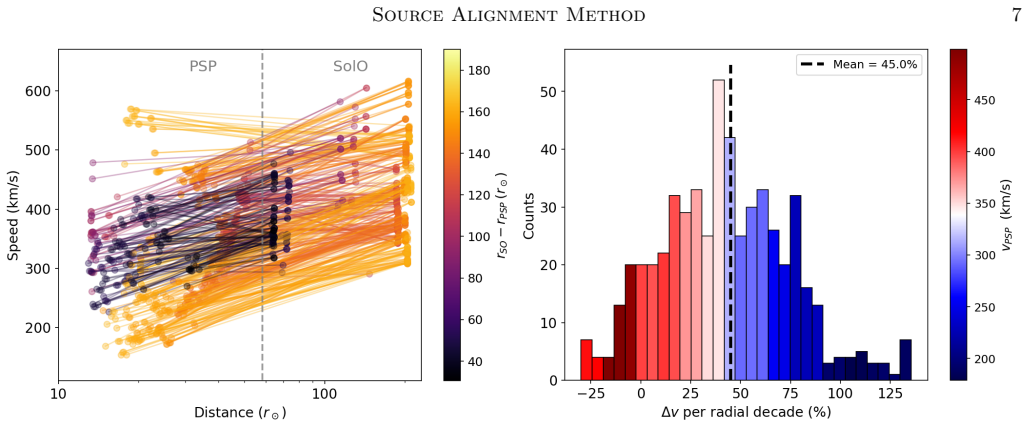
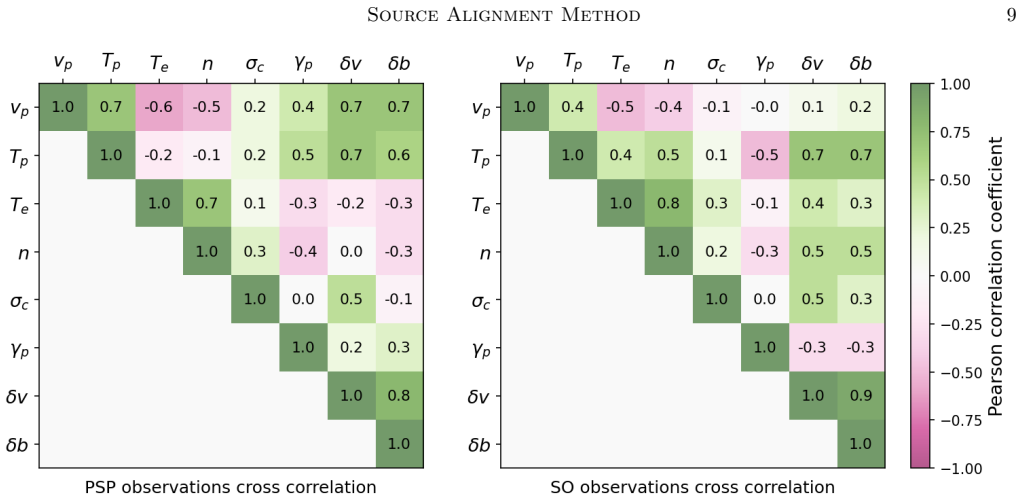
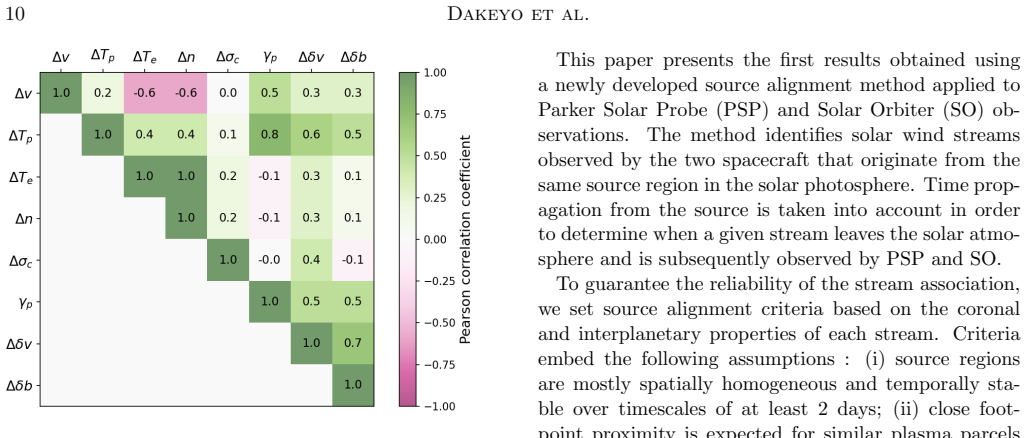
By applying the source alignment method to associate similar solar wind streams observed at different radial distances, the analysis of 548 intervals finds that the solar wind speed increases by an average of 45% per radial decade, or approximately 147 km/s, between the observations. This demonstrates significant ongoing acceleration in the inner heliosphere compared to processes below 15 solar radii, with the radial evolution of electron temperature and plasma density showing the strongest anti-correlation to the velocity increase.
What carries the argument
The source alignment method, which identifies matching solar wind parcels by the proximity of their photospheric footpoints determined through magnetic backmapping, supplemented by in-situ similarity criteria.
If this is right
- Solar wind acceleration in the inner heliosphere is significant and not limited to regions below 15 solar radii.
- Electron temperature and plasma density exhibit the strongest anti-correlation with increases in solar wind bulk velocity.
- Statistical studies of radial evolution become feasible with a much larger sample of alignments than previously possible.
- Other plasma parameters can be examined for their radial changes using this expanded dataset.
Where Pith is reading between the lines
- Models of solar wind formation may need to incorporate mechanisms for continued acceleration at larger distances.
- Similar alignment techniques could be applied to other pairs of spacecraft or future missions to extend the radial coverage.
- The observed anti-correlations suggest that thermal energy is being converted into bulk kinetic energy during expansion.
Load-bearing premise
The method correctly pairs observations of the same solar wind parcel by assuming accurate magnetic backmapping to photospheric footpoints and reliable in-situ similarity criteria.
What would settle it
Finding a set of alignments where the solar wind speed shows no increase or decrease with radial distance despite confirmed matching footpoints and similar stream properties would contradict the average acceleration result.
Figures



read the original abstract
The properties of the solar wind, as measured in situ throughout the heliosphere, depend both on the characteristics of its coronal source and on the intrinsic processes governing its interplanetary evolution. Recently, radial and Parker spiral alignment techniques have been applied to Parker Solar Probe (PSP) and Solar Orbiter (SO) observations to investigate the radial evolution of the same solar wind parcel. These studies have shown that the solar wind can undergo significant acceleration even beyond its primary acceleration region (i.e., above 15 solar radii). However, such radial and Parker spiral alignments are rare in practice, which limits the statistical significance and general applicability of the results. We introduce a new source alignment technique designed to overcome these limitations. Using magnetic backmapping, we associate similar solar wind streams observed by the two spacecraft based on the proximity of their photospheric footpoints, combined with additional in-situ stream similarity criteria. Applying the source alignment method to PSP and SO observations, we identify a total of 548 alignment intervals, each lasting 30 minutes. By constructing statistics over all alignments, we find that the solar wind speed increases by an average of 45% per radial decade (approximately 147 km/s) between the two probes. This result demonstrates that solar wind acceleration in the inner heliosphere remains significant compared to that occurring below 15 solar radii. Among the different studied plasma parameters, the radial evolution of the electron temperature and plasma density, show the strongest anti-correlation with the increase in bulk velocity.
Editorial analysis
A structured set of objections, weighed in public.
Referee Report
Summary. The manuscript introduces a source alignment method that associates solar wind streams observed by Parker Solar Probe and Solar Orbiter by combining magnetic backmapping to photospheric footpoints with in-situ stream similarity criteria. From a sample of 548 thirty-minute alignment intervals, the authors report that solar wind speed increases by an average of 45% per radial decade (approximately 147 km/s) between the probes, indicating that acceleration remains significant in the inner heliosphere beyond 15 solar radii. They additionally find that the radial evolution of electron temperature and plasma density exhibits the strongest anti-correlation with the observed velocity increase.
Significance. If the alignments reliably identify the same solar wind parcels, the result supplies a statistically grounded observational constraint from a sizable sample of 548 intervals on ongoing acceleration in the inner heliosphere. The data-driven approach, which yields a direct statistical measurement rather than a fitted model, strengthens the case that radial evolution must be accounted for in heliospheric models. This addresses the statistical limitations of prior rare radial or Parker-spiral alignment studies and provides a concrete benchmark (45% speed increase per radial decade) for comparison with theory.
major comments (3)
- [§3] §3 (Source Alignment Method): The in-situ stream similarity criteria are described only qualitatively, without explicit quantitative thresholds (e.g., minimum cross-correlation coefficient for velocity or density time series, or maximum allowed difference in proton temperature). Because the selection of the 548 intervals rests directly on these criteria, the absence of thresholds and associated sensitivity tests leaves open the possibility that differential stream selection, rather than true radial evolution, contributes to the reported 45% speed increase per radial decade.
- [§4] §4 (Results and Statistical Analysis): The central statistic—an average 45% speed increase per radial decade (~147 km/s)—is presented without reported uncertainties, bootstrap errors, or robustness checks against variations in backmapping parameters (PFSS source-surface radius, assumed propagation speed). This omission is load-bearing, as even modest contamination by misaligned streams could systematically bias the velocity-change distribution.
- [§4.2] §4.2 (Plasma Parameter Evolution): The reported anti-correlations between velocity increase and electron temperature/density are not accompanied by a clear description of how radial separation is normalized across intervals or how the “per radial decade” scaling is computed for each pair; without this, the strength and interpretation of these correlations cannot be fully assessed.
minor comments (2)
- [Abstract] Abstract and §3: The phrase “additional in-situ stream similarity criteria” should be expanded with at least one concrete example metric and threshold so that readers can immediately understand the selection process.
- [Figures] Figure captions (e.g., those illustrating example alignments): Include quantitative measures of footpoint separation and in-situ similarity scores for the displayed intervals to allow visual assessment of alignment quality.
Simulated Author's Rebuttal
We thank the referee for their constructive and detailed review. The comments highlight important aspects of methodological clarity and statistical robustness that we will address in the revised manuscript. Below we respond point by point to the major comments.
read point-by-point responses
-
Referee: [§3] §3 (Source Alignment Method): The in-situ stream similarity criteria are described only qualitatively, without explicit quantitative thresholds (e.g., minimum cross-correlation coefficient for velocity or density time series, or maximum allowed difference in proton temperature). Because the selection of the 548 intervals rests directly on these criteria, the absence of thresholds and associated sensitivity tests leaves open the possibility that differential stream selection, rather than true radial evolution, contributes to the reported 45% speed increase per radial decade.
Authors: We agree that the original description of the in-situ similarity criteria was qualitative and that explicit thresholds plus sensitivity tests are needed for full reproducibility. In the revised manuscript we will specify quantitative thresholds (e.g., minimum cross-correlation coefficient of 0.65 for the velocity time series and maximum relative difference of 20% in proton temperature) and will add a dedicated sensitivity analysis showing that the reported 45% speed increase per radial decade remains stable when these thresholds are varied within reasonable ranges. revision: yes
-
Referee: [§4] §4 (Results and Statistical Analysis): The central statistic—an average 45% speed increase per radial decade (~147 km/s)—is presented without reported uncertainties, bootstrap errors, or robustness checks against variations in backmapping parameters (PFSS source-surface radius, assumed propagation speed). This omission is load-bearing, as even modest contamination by misaligned streams could systematically bias the velocity-change distribution.
Authors: We accept that uncertainties and robustness checks against backmapping assumptions are essential. The revised version will include bootstrap-derived uncertainties on the mean speed increase and will report results from sensitivity tests in which the PFSS source-surface radius and the assumed solar-wind propagation speed used for backmapping are varied. These tests will quantify any systematic bias that could arise from residual misalignments. revision: yes
-
Referee: [§4.2] §4.2 (Plasma Parameter Evolution): The reported anti-correlations between velocity increase and electron temperature/density are not accompanied by a clear description of how radial separation is normalized across intervals or how the “per radial decade” scaling is computed for each pair; without this, the strength and interpretation of these correlations cannot be fully assessed.
Authors: We will clarify the normalization procedure in §4.2. For each alignment interval the velocity change is scaled to a per-radial-decade value using Δv / log₁₀(r_SO/r_PSP), where r denotes the heliocentric distance of each spacecraft. The same logarithmic normalization is applied to the changes in electron temperature and density before computing the reported anti-correlations. This explicit description and the associated formulas will be added to the revised text. revision: yes
Circularity Check
No significant circularity; result is direct empirical statistic from aligned intervals
full rationale
The paper introduces a source alignment method (magnetic backmapping to photospheric footpoints plus in-situ similarity criteria) and applies it to PSP/SO data to select 548 intervals. The central result—an average 45% solar wind speed increase per radial decade—is computed as a straightforward statistical mean over those selected pairs. No equation or derivation reduces the output to a fitted parameter, self-definition, or self-citation chain; the computation is a direct aggregation of observed quantities. The method's accuracy is an external assumption about backmapping fidelity, but that does not create circularity in the reported measurement itself. This is a standard observational analysis with no load-bearing internal reduction.
Axiom & Free-Parameter Ledger
axioms (2)
- domain assumption Magnetic field lines can be traced from spacecraft locations back to photospheric footpoints to identify source proximity
- domain assumption In-situ plasma parameters can serve as reliable additional criteria to confirm that two observations sample the same solar wind stream
Reference graph
Works this paper leans on
-
[1]
Diagnostics of Non-Maxwellian Electron Distributions in Solar Active Regions from Fe XII Lines Observed by the Hinode Extreme Ultraviolet Imaging Spectrometer and Interface Region Imaging Spectrograph. , keywords =. doi:10.3847/1538-4357/ac6174 , adsurl =
-
[2]
Non-Maxwellian Analysis of the Transition-region Line Profiles Observed by the Interface Region Imaging Spectrograph. , keywords =. doi:10.3847/1538-4357/aa71a8 , archivePrefix =. 1705.02104 , primaryClass =
-
[3]
Differential emission measure analysis of active region cores and quiet Sun for the non-Maxwellian -distributions. , keywords =. doi:10.1051/0004-6361/201323054 , adsurl =
-
[4]
The non-Maxwellian continuum in the X-ray, UV, and radio range. , keywords =. doi:10.1051/0004-6361/201118345 , adsurl =
-
[5]
Whittlesey, Phyllis and Larson, Davin E. and Rahmati, Ali , title =. 2020 , copyright =. doi:10.48322/8YNC-7P95 , url =
-
[6]
Livi, Roberto and Larson, Davin E. and Rahmati, Ali , title =. 2020 , copyright =. doi:10.48322/YPYH-S325 , url =
-
[7]
Kasper, Justin C. and Stevens, M. L. and Case, A. W. and Korreck, K. E. , title =. 2020 , copyright =. doi:10.48322/49WE-TR31 , url =
-
[8]
Bale, Stuart D. and MacDowall, Robert J. and Koval, Andriy and Pulupa, Marc and Quinn, Timothy and Schroeder, Peter , title =. 2020 , copyright =. doi:10.48322/0YY0-BA92 , url =
-
[9]
The FIELDS Instrument Suite for Solar Probe Plus. Measuring the Coronal Plasma and Magnetic Field, Plasma Waves and Turbulence, and Radio Signatures of Solar Transients. , keywords =. doi:10.1007/s11214-016-0244-5 , adsurl =
-
[10]
The Solar Probe Cup on the Parker Solar Probe. , keywords =. doi:10.3847/1538-4365/ab5a7b , archivePrefix =. 1912.02581 , primaryClass =
-
[11]
Measurements of Flow Speeds in the Corona Between 2 and 30 R _. , keywords =. doi:10.1086/304338 , adsurl =
-
[12]
Cooling of solar wind electrons inside 0.3 AU. , keywords =. doi:10.1029/JA094iA06p06893 , adsurl =
-
[13]
Journal of Geophysical Research (Space Physics) , keywords =
Implications of the observed anticorrelation between solar wind speed and coronal electron temperature. Journal of Geophysical Research (Space Physics) , keywords =. doi:10.1029/2002JA009286 , adsurl =
-
[14]
Solar System and its Exploration , year = 1981, editor =
HELIOS mission: Mission objectives, mission verification, selected results. Solar System and its Exploration , year = 1981, editor =
1981
-
[15]
Two-dimensional electron density in the solar corona from inversion of white light images - Application to SOHO/LASCO-C2 observations. , keywords =. doi:10.1051/0004-6361:20021019 , adsurl =
-
[16]
, keywords =
Measurement of the electron temperature gradient in a solar coronal hole. , keywords =
-
[17]
Measurement of Hydrogen Velocity Distributions in the Extended Solar Corona. , keywords =. doi:10.1086/310145 , adsurl =
-
[18]
The Solar Probe Plus Mission: Humanity's First Visit to Our Star. , keywords =. doi:10.1007/s11214-015-0211-6 , adsurl =
-
[19]
Journal of Geophysical Research (Space Physics) , keywords =
Heating and cooling of protons in the fast solar wind between 0.3 and 1 AU: Helios revisited. Journal of Geophysical Research (Space Physics) , keywords =. doi:10.1029/2011JA016674 , adsurl =
-
[20]
Spectroscopic Constraints on Models of Ion Cyclotron Resonance Heating in the Polar Solar Corona and High-Speed Solar Wind. , keywords =. doi:10.1086/307330 , adsurl =
-
[21]
Journal of Geophysical Research (Space Physics) , keywords =
Proton thermal energetics in the solar wind: Helios reloaded. Journal of Geophysical Research (Space Physics) , keywords =. doi:10.1002/jgra.50107 , adsurl =
-
[22]
Solar wind proton temperature-velocity relationship. , keywords =. doi:10.1029/JA091iA02p01701 , adsurl =
-
[23]
Journal of Geophysical Research (Space Physics) , keywords =
Temporal and radial variation of the solar wind temperature-speed relationship. Journal of Geophysical Research (Space Physics) , keywords =. doi:10.1029/2011JA017125 , adsurl =
-
[24]
Electrons in the Young Solar Wind: First Results from the Parker Solar Probe. , keywords =. doi:10.3847/1538-4365/ab4cec , archivePrefix =. 1912.02216 , primaryClass =
-
[25]
Journal of Geophysical Research (Space Physics) , keywords =
Electron energetics in the expanding solar wind via Helios observations. Journal of Geophysical Research (Space Physics) , keywords =. doi:10.1002/2015JA021368 , adsurl =
-
[26]
Empirical Constraints on Proton and Electron Heating in the Fast Solar Wind. , keywords =. doi:10.1088/0004-637X/702/2/1604 , archivePrefix =. 0907.2650 , primaryClass =
-
[27]
An empirical determination of the polytropic index for the free-streaming solar wind using Helios 1 data. , keywords =. doi:10.1029/94JA02420 , adsurl =
-
[28]
, year = 1960, month = nov, volume =
The Hydrodynamic Theory of Solar Corpuscular Radiation and Stellar Winds. , year = 1960, month = nov, volume =. doi:10.1086/146985 , adsurl =
-
[29]
The radial evolution of a single solar wind plasma parcel. , keywords =. doi:10.1029/JA088iA12p09919 , adsurl =
-
[30]
Anticorrelation between the Bulk Speed and the Electron Temperature in the Pristine Solar Wind: First Results from the Parker Solar Probe and Comparison with Helios. , keywords =. doi:10.3847/1538-4365/ab61fc , adsurl =
-
[31]
Why Do Temperature and Velocity Have Different Relationships in the Solar Wind and in Interplanetary Coronal Mass Ejections?. , keywords =. doi:10.1007/s11207-009-9338-5 , adsurl =
-
[32]
Solar Wind Electrons Alphas and Protons (SWEAP) Investigation: Design of the Solar Wind and Coronal Plasma Instrument Suite for Solar Probe Plus. , keywords =. doi:10.1007/s11214-015-0206-3 , adsurl =
-
[33]
, year = 2002, month = aug, volume =
Coronal Holes and the High-Speed Solar Wind. , year = 2002, month = aug, volume =. doi:10.1023/A:1020840004535 , adsurl =
-
[34]
Journal of Geophysical Research (Space Physics) , keywords =
Radial evolution of nonthermal electron populations in the low-latitude solar wind: Helios, Cluster, and Ulysses Observations. Journal of Geophysical Research (Space Physics) , keywords =. doi:10.1029/2008JA013883 , adsurl =
-
[35]
Raumfahrtforschung , keywords =
Das Plasmaexperiment auf Helios (E1). Raumfahrtforschung , keywords =
-
[36]
Hot protons in the inner corona and their effect on the flow properties of the solar wind. , keywords =. doi:10.1029/97JA00065 , adsurl =
-
[37]
Statistical Analysis of the Radial Evolution of the Solar Winds between 0.1 and 1 au and Their Semiempirical Isopoly Fluid Modeling. , keywords =. doi:10.3847/1538-4357/ac9b14 , archivePrefix =. 2207.03898 , primaryClass =
-
[38]
Astronomy and Astrophysics , author =
Radial evolution of the accuracy of ballistic solar wind backmapping. , keywords =. doi:10.1051/0004-6361/202348892 , adsurl =
-
[39]
Testing the flux tube expansion factor -- solar wind speed relation with Solar Orbiter data. arXiv e-prints , keywords =. doi:10.48550/arXiv.2408.06155 , archivePrefix =. 2408.06155 , primaryClass =
-
[40]
Generalized Two Thermal Regimes Approach : Bipoly Fluid Modeling. arXiv e-prints , keywords =. doi:10.48550/arXiv.2503.01782 , archivePrefix =. 2503.01782 , primaryClass =
-
[41]
The Solar Orbiter Solar Wind Analyser (SWA) suite. , keywords =. doi:10.1051/0004-6361/201937259 , adsurl =
-
[42]
The Sun , year = 1953, editor =
The Chromosphere and the Corona. The Sun , year = 1953, editor =
1953
-
[43]
Smithsonian Contributions to Astrophysics , year = 1957, month = jan, volume =
Notes on the Solar Corona and the Terrestrial Ionosphere. Smithsonian Contributions to Astrophysics , year = 1957, month = jan, volume =
1957
-
[44]
Expansion of a Model Solar Corona
Interplanetary Gas.II. Expansion of a Model Solar Corona. , year = 1960, month = jan, volume =. doi:10.1086/146805 , adsurl =
-
[45]
, year = 1958, month = nov, volume =
Dynamics of the Interplanetary Gas and Magnetic Fields. , year = 1958, month = nov, volume =. doi:10.1086/146579 , adsurl =
-
[46]
, year = 1966, month = oct, volume =
Mariner 2 Observations of the Solar Wind, 1, Average Properties. , year = 1966, month = oct, volume =. doi:10.1029/JZ071i019p04469 , adsurl =
-
[47]
Reviews of Geophysics and Space Physics , year = 1973, month = jan, volume =
Kinetic models of the solar and polar winds. Reviews of Geophysics and Space Physics , year = 1973, month = jan, volume =. doi:10.1029/RG011i002p00427 , adsurl =
-
[48]
, keywords =
A kinetic model of the solar wind with Kappa distribution functions in the corona. , keywords =
-
[49]
A Transonic Collisionless Model of the Solar Wind. , keywords =. doi:10.1086/382866 , archivePrefix =. astro-ph/0402358 , primaryClass =
-
[50]
Dynamics of coronal hole regions. I. Steady polytropic flows with multiple critical points. , keywords =. doi:10.1007/BF00221484 , adsurl =
-
[51]
Reviews of Geophysics and Space Physics , keywords =
Coronal holes and high-speed wind streams. Reviews of Geophysics and Space Physics , keywords =. doi:10.1029/RG015i003p00257 , adsurl =
-
[52]
Solar Wind Speed and Coronal Flux-Tube Expansion. , keywords =. doi:10.1086/168805 , adsurl =
-
[53]
Quasi-separatrix layers in solar flares. II. Observed magnetic configurations. , keywords =
-
[54]
Improvement in the prediction of solar wind conditions using near-real time solar magnetic field updates. , keywords =. doi:10.1029/1999JA000262 , adsurl =
-
[55]
Journal of Geophysical Research (Space Physics) , keywords =
The very slow solar wind: Properties, origin and variability. Journal of Geophysical Research (Space Physics) , keywords =. doi:10.1002/2016JA022433 , adsurl =
-
[56]
, year = 1967, month = apr, volume =
The Angular Momentum of the Solar Wind. , year = 1967, month = apr, volume =. doi:10.1086/149138 , adsurl =
-
[57]
The effect of viscosity and anisotropy in the pressure on the azimuthal motion of the solar wind. , keywords =. doi:10.1029/JA075i013p02419 , adsurl =
-
[58]
Validation of the Alfv \'e n Wave Solar Atmosphere Model (AWSoM) with Observations from the Low Corona to 1 au. , keywords =. doi:10.3847/1538-4357/ab4f5e , archivePrefix =. 1910.08110 , primaryClass =
-
[59]
The Role of Alfv \'e n Wave Dynamics on the Large-scale Properties of the Solar Wind: Comparing an MHD Simulation with Parker Solar Probe E1 Data. , keywords =. doi:10.3847/1538-4365/ab4fef , archivePrefix =. 1912.03777 , primaryClass =
-
[60]
AGU Fall Meeting Abstracts , year = 2022, volume =
Radial Evolution and Energy Budget of Thermal and Suprathermal Electron Populations in the Slow Solar Wind from 0.13 to 0.5 AU : Parker Solar Probe observations. AGU Fall Meeting Abstracts , year = 2022, volume =
2022
-
[61]
A Multiple Flux-tube Solar Wind Model. , keywords =. doi:10.3847/1538-4357/aa6398 , archivePrefix =. 1611.08744 , primaryClass =
-
[62]
The Radial Evolution of the Solar Wind as Organized by Electron Distribution Parameters. , keywords =. doi:10.3847/1538-4357/ac85b8 , archivePrefix =. 2207.06563 , primaryClass =
-
[63]
A statistical evaluation of ballistic backmapping for the slow solar wind: the interplay of solar wind acceleration and corotation. , keywords =. doi:10.1093/mnras/stab2965 , adsurl =
-
[64]
A model of interplanetary and coronal magnetic fields. , keywords =. doi:10.1007/BF00146478 , adsurl =
-
[65]
A Coronal Hole and Its Identification as the Source of a High Velocity Solar Wind Stream. , keywords =. doi:10.1007/BF00150828 , adsurl =
-
[66]
, year = 1992, month = jan, volume =
The ULYSSES Mission. , year = 1992, month = jan, volume =
1992
-
[67]
Journal of Geophysical Research (Space Physics) , keywords =
Magnetic Connectivity in the Corona as a Source of Structure in the Solar Wind. Journal of Geophysical Research (Space Physics) , keywords =. doi:10.1029/2018JA026132 , adsurl =
-
[68]
Relating Streamer Flows to Density and Magnetic Structures at the Parker Solar Probe. , keywords =. doi:10.3847/1538-4365/ab579a , archivePrefix =. 2001.01993 , primaryClass =
-
[69]
Source-dependent Properties of Two Slow Solar Wind States. , keywords =. doi:10.3847/1538-4357/abe309 , archivePrefix =. 2102.06568 , primaryClass =
-
[70]
Magnetic Connectivity of the Ecliptic Plane within 0.5 au: Potential Field Source Surface Modeling of the First Parker Solar Probe Encounter. , keywords =. doi:10.3847/1538-4365/ab4da7 , archivePrefix =. 1912.02244 , primaryClass =
-
[71]
SHINE 2022 Workshop , year = 2022, month = jun, eid =
Estimating uncertainties in the back-mapping of the fast solar wind. SHINE 2022 Workshop , year = 2022, month = jun, eid =. doi:10.48550/arXiv.2212.11553 , archivePrefix =. 2212.11553 , primaryClass =
-
[72]
Twelfth International Solar Wind Conference , year = 2010, editor =
Kinetic and Hydrodynamic Representations of Coronal Expansion and The Solar Wind. Twelfth International Solar Wind Conference , year = 2010, editor =. doi:10.1063/1.3395887 , adsurl =
-
[73]
, year = 1922, month = jul, volume =
Ionization in stellar atmospheres (Errata: 2 24). , year = 1922, month = jul, volume =
1922
-
[74]
, year = 1924, month = jun, volume =
Electrical state of a star. , year = 1924, month = jun, volume =. doi:10.1093/mnras/84.9.720 , adsurl =
-
[75]
Large-Scale Structure of the Interplanetary Medium, I: High Coronal Source Longitude of the Quiet-Time Solar Wind. , keywords =. doi:10.1007/BF00152395 , adsurl =
-
[76]
, year = 2021, month = dec, volume =
Parker Solar Probe Enters the Magnetically Dominated Solar Corona. , year = 2021, month = dec, volume =. doi:10.1103/PhysRevLett.127.255101 , adsurl =
-
[77]
An extended and fragmented Alfv \'e n zone in the Young Solar Wind. , keywords =. doi:10.1093/mnras/stac779 , archivePrefix =. 2201.08422 , primaryClass =
-
[78]
On the Generation and Evolution of Switchbacks and the Morphology of the Alfv \'e nic Transition: Low Mach-number Boundary Layers. , keywords =. doi:10.3847/1538-4357/acb345 , archivePrefix =. 2301.05829 , primaryClass =
-
[79]
Journal of Geophysical Research (Space Physics) , keywords =
Prediction and Verification of Parker Solar Probe Solar Wind Sources at 13.3 R _. Journal of Geophysical Research (Space Physics) , keywords =. doi:10.1029/2023JA031359 , archivePrefix =. 2303.04852 , primaryClass =
-
[80]
The Solar Origin of Small Interplanetary Transients. , keywords =. doi:10.1088/0004-637X/734/1/7 , adsurl =
discussion (0)
Sign in with ORCID, Apple, or X to comment. Anyone can read and Pith papers without signing in.