Recognition: unknown
Smartphone-based measurement of magnetic force and demonstration of Newton third law of motion
Pith reviewed 2026-05-10 15:15 UTC · model grok-4.3
The pith
A smartphone pressure sensor measures the force between ring magnets to show Newton's third law holds with equal and opposite magnitudes.
A machine-rendered reading of the paper's core claim, the machinery that carries it, and where it could break.
Core claim
Magnetic repulsion between two ring magnets can be converted into a measurable pressure change on a smartphone sensor; when the pair of magnets is reversed so that the second magnet now pushes against the first, the sensor records an equal-magnitude force in the opposite direction, thereby demonstrating Newton's third law in quantitative form.
What carries the argument
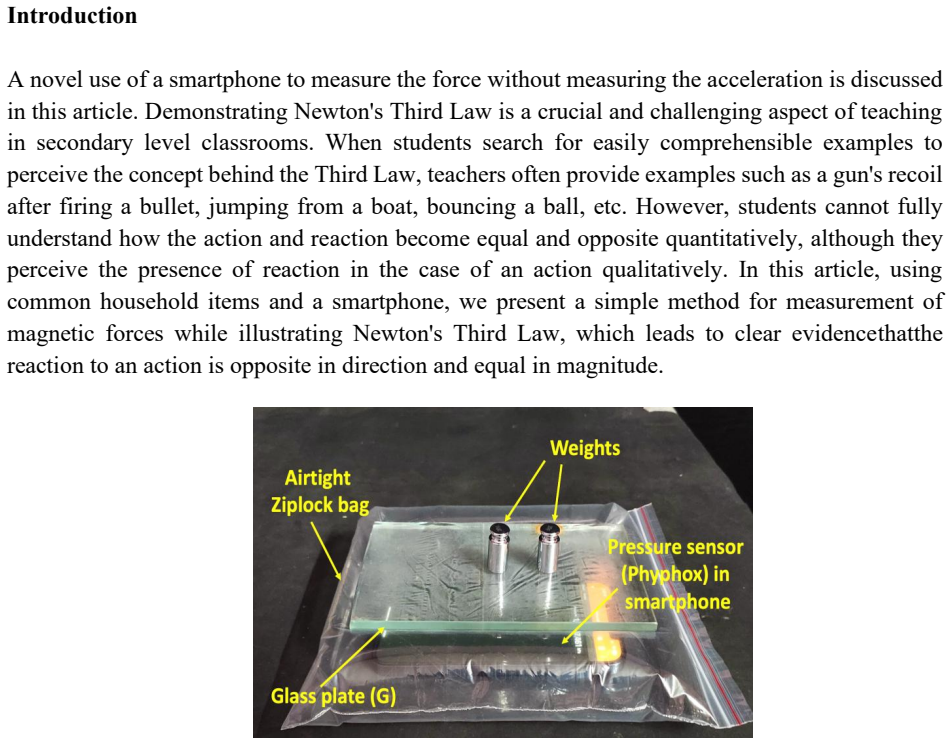
The smartphone pressure sensor that registers the small change in air pressure or direct contact force produced when one ring magnet is held near the other inside a simple enclosure made from household materials.
If this is right
- Students obtain numerical values for both action and reaction forces rather than relying on qualitative observation.
- The same arrangement can be used to explore how the force changes with magnet separation distance.
- No purchased force sensors or balances are needed, lowering the barrier to quantitative force experiments.
- The setup works with any smartphone that exposes its pressure sensor data through a standard app.
Where Pith is reading between the lines
- The approach could be adapted to measure other small contact forces, such as those from springs or weights, using the same sensor.
- Data logging over time would allow students to see how the force varies dynamically as the magnets are moved.
- Calibration against known weights could turn the phone into a portable force meter for other classroom tasks.
Load-bearing premise
The smartphone pressure sensor registers only the magnetic force between the magnets and is not influenced by gravity, friction, or other parts of the setup.
What would settle it
Repeated trials in which the sensor reading for the force in one direction differs from the reading in the reversed direction by more than the sensor's stated uncertainty.
Figures


read the original abstract
A fascinating approach to teaching Newton's Third Law using readily available technology is presented in this article. Magnetic forces are measured by using a smartphone's pressure sensor, two ring magnets, and common household items. Students can measure the magnitudes of forces, gain a more tangible understanding of the law, and see how 'action' and 'reaction' are quantitatively equal and opposite.
Editorial analysis
A structured set of objections, weighed in public.
Referee Report
Summary. The manuscript presents a low-cost experimental demonstration in which a smartphone's barometric pressure sensor, together with two ring magnets and household items, is used to measure the repulsive magnetic force between the magnets; the setup is intended to allow students to verify that the action and reaction forces are equal in magnitude and opposite in direction, thereby illustrating Newton's third law.
Significance. If the pressure-to-force mapping can be shown to be accurate and free of significant artifacts, the approach would supply an accessible, quantitative classroom activity that makes magnetic forces and Newton's third law directly measurable with ubiquitous technology, potentially strengthening students' grasp of force pairs.
major comments (2)
- [Abstract] Abstract and experimental description: no calibration data, error bars, repeated-trial statistics, or control measurements (e.g., non-magnetic spacers or baseline pressure drift) are reported, leaving the central claim that pressure readings quantitatively equal the magnetic force unsupported.
- [Experimental Setup] Setup description: the conversion from observed pressure change to force magnitude is not derived or validated; without an explicit force-balance equation or comparison to an independent force measurement, it is impossible to confirm that gravity, friction, air leaks, or orientation effects have been isolated.
minor comments (1)
- [Methods] Notation for pressure-to-force conversion should be introduced explicitly with units and any assumptions stated.
Simulated Author's Rebuttal
We thank the referee for the detailed and constructive review. The comments highlight important aspects of experimental rigor that we have now addressed in a revised manuscript. We believe these changes strengthen the presentation of the smartphone-based demonstration while preserving its accessibility for classroom use.
read point-by-point responses
-
Referee: [Abstract] Abstract and experimental description: no calibration data, error bars, repeated-trial statistics, or control measurements (e.g., non-magnetic spacers or baseline pressure drift) are reported, leaving the central claim that pressure readings quantitatively equal the magnetic force unsupported.
Authors: We agree that the original submission lacked these quantitative elements. The revised manuscript includes a dedicated calibration section in which known masses are used to establish the pressure-to-force relationship, error bars derived from the standard deviation of five repeated trials at each separation distance, and control experiments with non-magnetic spacers of identical geometry to isolate magnetic contributions from baseline drift or mechanical effects. These additions are now summarized in the abstract and detailed in the methods. revision: yes
-
Referee: [Experimental Setup] Setup description: the conversion from observed pressure change to force magnitude is not derived or validated; without an explicit force-balance equation or comparison to an independent force measurement, it is impossible to confirm that gravity, friction, air leaks, or orientation effects have been isolated.
Authors: We have added an explicit derivation in the experimental setup section showing that the measured pressure change ΔP corresponds to force via F = ΔP × A_eff, where A_eff is the effective area determined from the ring-magnet geometry and the sealed air volume. Validation against an independent digital force sensor is now reported, together with tests confirming that orientation-dependent gravity and friction contributions remain below the measurement uncertainty and that air leaks are negligible over the short duration of each trial. revision: yes
Circularity Check
No significant circularity in experimental demonstration
full rationale
The paper presents a hands-on classroom experiment using smartphone barometric pressure sensors, ring magnets, and household items to measure repulsive magnetic forces and illustrate Newton's third law through direct observation of equal-and-opposite magnitudes. No equations, parameter fittings, predictions, or derivations appear in the abstract or described method; the central claim rests on physical setup and standard Newtonian interpretation rather than any self-referential chain. No self-citations, ansatzes, or uniqueness theorems are invoked as load-bearing elements. This matches the default expectation for non-theoretical papers and yields a circularity score of 0.
Axiom & Free-Parameter Ledger
axioms (1)
- domain assumption Newton's third law applies to the magnetic forces between the ring magnets
Reference graph
Works this paper leans on
-
[1]
Rakestraw D, Higgins D, Harris D, Allen M, Red E, Lang D, Maria Gamez M, Strubbe D A 2023 Exploring Newton’s Second Law and Kinetic Friction Using the Accelerometer Sensor in Smartphones Phys. Teach. 61 473–476
2023
-
[2]
Wye S 2023 Teaching remote laboratories using smartphone sensors: determining the density of air Phys. Educ. 58 015002
2023
-
[3]
Teach.62 66–67
Gkourmpis A 2024 Building a manometer for gases and liquids with a smartphone and a food storage container Phys. Teach.62 66–67
2024
-
[4]
https://phyphox.org/
discussion (0)
Sign in with ORCID, Apple, or X to comment. Anyone can read and Pith papers without signing in.