Recognition: unknown
Entanglement dynamics after quenches with inhomogeneous Hamiltonians
Pith reviewed 2026-05-09 17:34 UTC · model grok-4.3
The pith
The long-time entanglement entropy after quenches in inhomogeneous Hamiltonians is determined by the quasiparticle transmission coefficient at the interface.
A machine-rendered reading of the paper's core claim, the machinery that carries it, and where it could break.
Core claim
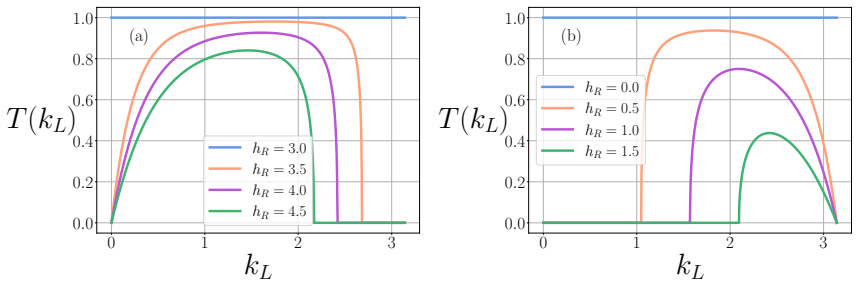
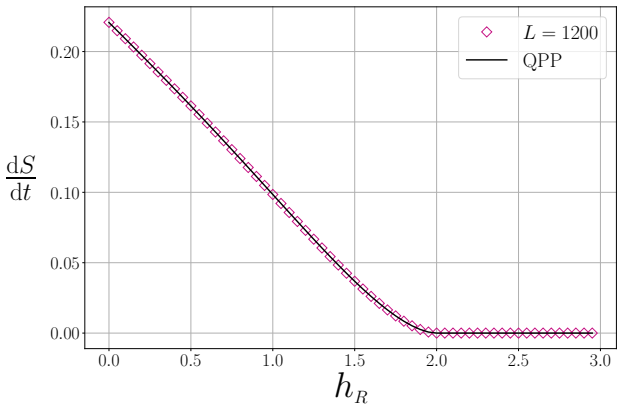
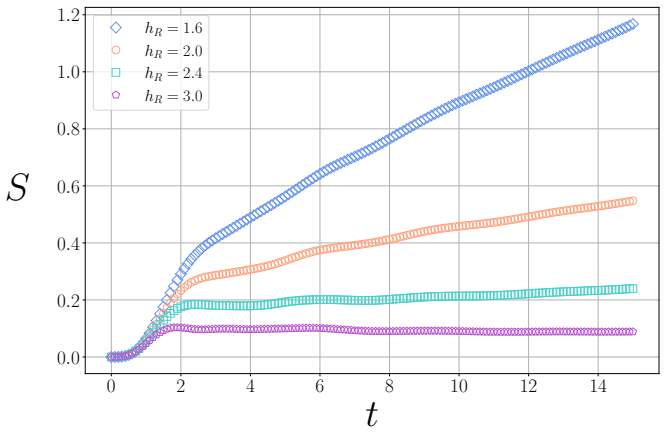
In the hydrodynamic limit of long times, fermions or spins incident on the interface between two regions with different homogeneous Hamiltonians scatter, and the entanglement entropy is controlled by the transmission coefficient obtained analytically from the stationary lattice Schrödinger equation. This quasiparticle scattering picture applies to the XX chain and the transverse-field Ising chain, leading to suppressed entanglement growth under strong inhomogeneity due to the finite bandwidth of the dispersion. Numerical checks confirm the analytics, and tDMRG simulations of the interacting XXZ chain show similar suppression of entanglement growth when transport is blocked, though some time-
What carries the argument
The transmission coefficient obtained by solving the stationary lattice Schrödinger equation, which dictates the fraction of quasiparticles that transmit and thereby generate entanglement between reflected and transmitted modes.
Load-bearing premise
That the entanglement can be fully described by independent quasiparticles scattering at the interface according to the transmission coefficient, even in the long-time limit of the inhomogeneous system.
What would settle it
A numerical time evolution of the XX chain with a strong inhomogeneity where the measured entanglement entropy growth rate differs from the value predicted by the analytical transmission coefficient formula at large times.
Figures




read the original abstract
We investigate entanglement dynamics in bipartite systems governed by inhomogeneous Hamiltonians of the form $H = H_L + H_R$, where $H_{L/R}$ acts only on the left or right region and is homogeneous within each region. Focusing on the XX chain and the transverse-field Ising chain, we derive analytical formulas for the entanglement entropy between the two regions in the hydrodynamic limit of long times. In this regime, fermions incident on the interface undergo scattering, generating entanglement between reflected and transmitted modes. The resulting quasiparticle picture is controlled by the transmission coefficient, which we obtain analytically by solving the stationary lattice Schr\"odinger equation. Due to the bounded dispersion, strong inhomogeneity suppresses both transport and entanglement growth. We benchmark our analytical predictions against numerical simulations in paradigmatic setups. Finally, we extend the analysis to the interacting XXZ chain using tDMRG. The numerical data show qualitative agreement with the quadratic case: entanglement growth remains suppressed in the strongly inhomogeneous limit. Notably, however, entanglement continues to increase even when transport is suppressed, at least at intermediate times.
Editorial analysis
A structured set of objections, weighed in public.
Referee Report
Summary. The paper investigates entanglement dynamics after quenches in bipartite spin chains with inhomogeneous Hamiltonians of the form H = H_L + H_R, where each half is homogeneous internally. For quadratic models (XX and transverse-field Ising chains), analytical formulas for the long-time entanglement entropy between left and right regions are derived in the hydrodynamic limit via a quasiparticle picture in which scattering at the interface is controlled by the transmission coefficient T(k) obtained from the exact solution of the stationary lattice Schrödinger equation. These predictions are benchmarked against numerical simulations; the analysis is extended to the interacting XXZ chain via tDMRG, where entanglement growth is found to remain suppressed for strong inhomogeneity (though it continues at intermediate times even when transport is suppressed).
Significance. If the results hold, the work supplies a controlled analytical framework for entanglement spreading across interfaces in inhomogeneous integrable systems, directly linking the transmission coefficient to the hydrodynamic entanglement growth and explaining its suppression by bounded dispersion. The derivation of explicit analytical expressions for free models together with direct numerical benchmarks constitutes a clear strength; the qualitative consistency observed in the interacting case broadens the potential relevance to non-integrable dynamics.
minor comments (3)
- The hydrodynamic limit is invoked repeatedly for the validity of the quasiparticle formula; a brief explicit statement of the time and length scales (relative to the inhomogeneity strength) at which the reduction to T(k) becomes accurate would improve clarity.
- In the XXZ section, the statement that entanglement 'continues to increase even when transport is suppressed, at least at intermediate times' would benefit from a quantitative indication of the time window relative to system size or light-cone arrival.
- Figure captions and the main text should consistently label the inhomogeneity parameter (e.g., the ratio of couplings or fields across the interface) so that readers can directly map the plotted curves to the analytic T(k) expressions.
Simulated Author's Rebuttal
We thank the referee for their positive and constructive report, which accurately summarizes our main results on entanglement suppression due to interface scattering in inhomogeneous quenches. We appreciate the recommendation for minor revision and will incorporate any suggested clarifications or minor improvements in the revised manuscript.
Circularity Check
No significant circularity; derivation uses independent single-particle scattering solution
full rationale
The central derivation computes the transmission coefficient T(k) by directly solving the stationary lattice Schrödinger equation at the interface, an independent single-particle problem unrelated to the many-body entanglement formula. The hydrodynamic entanglement entropy is then expressed via the standard quasiparticle picture in terms of this T(k), with explicit benchmarking against numerical tDMRG and exact diagonalization data. No parameters are fitted from entanglement observables, no self-citations form a load-bearing chain, and no step reduces to another by definition or renaming. The approach remains self-contained for the free models and shows only qualitative extension to the interacting case.
Axiom & Free-Parameter Ledger
axioms (2)
- domain assumption The quasiparticle picture with scattering of fermions into reflected and transmitted modes at the interface remains valid for inhomogeneous Hamiltonians.
- domain assumption The hydrodynamic limit of long times applies, allowing entanglement to be determined by the transmission coefficient alone.
Reference graph
Works this paper leans on
-
[1]
Polkovnikov, K
A. Polkovnikov, K. Sengupta, A. Silva, and M. Vengalattore,Colloquium: Nonequilibrium dynamics of closed interacting quantum systems,Rev. Mod. Phys.83(Aug, 2011) 863–883
2011
-
[2]
V. Alba, B. Bertini, M. Fagotti, L. Piroli, and P. Ruggiero,Generalized-hydrodynamic approach to inhomogeneous quenches: correlations, entanglement and quantum effects, Journal of Statistical Mechanics: Theory and Experiment2021(Nov, 2021) 114004
2021
-
[3]
Bertini, M
B. Bertini, M. Fagotti, L. Piroli, and P. Calabrese,Entanglement evolution and gener- alised hydrodynamics: noninteracting systems,Journal of Physics A: Mathematical and Theoretical51(9, 2018) 39LT01. 16 0 5 10 15 20 25 t 0.00 0.05 0.10 0.15 0.20 0.25 0.30 0.35 S hR = 3.0, χ = 800 hR = 3.0, χ = 1200 hR = 3.0, χ = 1600 hR = 3.0, χ = 2500 hR = 5.0, χ = 400 ...
2018
-
[4]
Alba,Entanglement and quantum transport in integrable systems,Phys
V. Alba,Entanglement and quantum transport in integrable systems,Phys. Rev. B97 (Jun, 2018) 245135
2018
-
[5]
V. Alba, B. Bertini, and M. Fagotti,Entanglement evolution and generalised hydrody- namics: interacting integrable systems,SciPost Phys.7(2019) 5
2019
-
[6]
Kehrein,Page curve entanglement dynamics in an analytically solvable model,Phys
S. Kehrein,Page curve entanglement dynamics in an analytically solvable model,Phys. Rev. B109(Jun, 2024) 224308
2024
-
[7]
M. Saha, M. Kulkarni, and A. Dhar,Generalized hydrodynamic description of the page curve–like dynamics of a freely expanding fermionic gas,Phys. Rev. Lett.133(Dec, 2024) 230402
2024
-
[8]
L. H. Li, S. Kehrein, and S. Gopalakrishnan,Sharp page transitions in generic hamiltonian dynamics,Phys. Rev. B112(Jul, 2025) 014307
2025
-
[9]
Calabrese and J
P. Calabrese and J. Cardy,Evolution of entanglement entropy in one-dimensional systems, Journal of Statistical Mechanics: Theory and Experiment2005(Apr, 2005) P04010
2005
-
[10]
Fagotti and P
M. Fagotti and P. Calabrese,Evolution of entanglement entropy following a quantum 17 quench: Analytic results for thexy chain in a transverse magnetic field,Phys. Rev. A78 (Jul, 2008) 010306
2008
-
[11]
Alba and P
V. Alba and P. Calabrese,Entanglement and thermodynamics after a quantum quench in integrable systems,Proceedings of the National Academy of Sciences114(2017) 7947–7951, https://www.pnas.org/content/114/30/7947.full.pdf
2017
-
[12]
Klobas, B
K. Klobas, B. Bertini, and L. Piroli,Exact Thermalization Dynamics in the “Rule 54” Quantum Cellular Automaton,Phys. Rev. Lett.126(Apr, 2021) 160602
2021
-
[13]
Bertini, K
B. Bertini, K. Klobas, V. Alba, G. Lagnese, and P. Calabrese,Growth of Rényi Entropies in Interacting Integrable Models and the Breakdown of the Quasiparticle Picture,Phys. Rev. X12(Jul, 2022) 031016
2022
-
[14]
Takahashi,Thermodynamics of One-Dimensional Solvable Models
M. Takahashi,Thermodynamics of One-Dimensional Solvable Models. Cambridge Univer- sity Press, 1999
1999
-
[15]
Eisler and I
V. Eisler and I. Peschel,On entanglement evolution across defects in critical chains, Europhysics Letters99(Jul, 2012) 20001
2012
-
[16]
Peschel and V
I. Peschel and V. Eisler,Exact results for the entanglement across defects in critical chains, Journal of Physics A: Mathematical and Theoretical45(Mar, 2012) 155301
2012
- [17]
-
[18]
Caceffo and V
F. Caceffo and V. Alba,Fate of entanglement in quadratic markovian dissipative systems, Phys. Rev. A113(Apr, 2026) 042436
2026
-
[19]
Schollwöck,The density-matrix renormalization group in the age of matrix product states,Annals of Physics326(2011) 96–192
U. Schollwöck,The density-matrix renormalization group in the age of matrix product states,Annals of Physics326(2011) 96–192. January 2011 Special Issue
2011
-
[20]
Paeckel, T
S. Paeckel, T. Köhler, A. Swoboda, S. R. Manmana, U. Schollwöck, and C. Hubig, Time-evolution methods for matrix-product states,Annals of Physics411(2019) 167998
2019
-
[21]
Calabrese, F
P. Calabrese, F. H. L. Essler, and G. Mussardo,Introduction to ‘quantum integrability in out of equilibrium systems’,Journal of Statistical Mechanics: Theory and Experiment 2016(Jun, 2016) 064001
2016
-
[22]
Vidmar and M
L. Vidmar and M. Rigol,Generalized gibbs ensemble in integrable lattice models,Journal of Statistical Mechanics: Theory and Experiment2016(Jun, 2016) 064007
2016
-
[23]
C. N. Yang and C. P. Yang,Thermodynamics of a one-dimensional system of bosons with repulsive delta-function interaction,Journal of Mathematical Physics10(07, 1969) 1115–1122
1969
-
[24]
Bertini, E
B. Bertini, E. Tartaglia, and P. Calabrese,Entanglement and diagonal entropies after a quench with no pair structure,Journal of Statistical Mechanics: Theory and Experiment 2018(Jun, 2018) 063104
2018
-
[25]
Caceffo and V
F. Caceffo and V. Alba,Negative tripartite mutual information after quantum quenches in integrable systems,Phys. Rev. B108(Oct, 2023) 134434
2023
-
[26]
Peschel and V
I. Peschel and V. Eisler,Reduced density matrices and entanglement entropy in free lattice models,Journal of physics a: mathematical and theoretical42(2009) 504003. 18
2009
-
[27]
Ljubotina, S
M. Ljubotina, S. Sotiriadis, and T. Prosen,Non-equilibrium quantum transport in presence of a defect: the non-interacting case,SciPost Phys.6(2019) 004
2019
-
[28]
Alba,Unbounded entanglement production via a dissipative impurity,SciPost Phys
V. Alba,Unbounded entanglement production via a dissipative impurity,SciPost Phys. 12(2022) 11
2022
-
[29]
Capizzi, S
L. Capizzi, S. Scopa, F. Rottoli, and P. Calabrese,Domain wall melting across a defect, Europhysics Letters141(Jan, 2023) 31002
2023
-
[30]
Alba and F
V. Alba and F. Carollo,Noninteracting fermionic systems with localized losses: Exact results in the hydrodynamic limit,Phys. Rev. B105(Feb, 2022) 054303
2022
-
[31]
Caceffo and V
F. Caceffo and V. Alba,Entanglement negativity in a fermionic chain with dissipative defects: exact results,Journal of Statistical Mechanics: Theory and Experiment2023 (Feb, 2023) 023102
2023
-
[32]
Alba and F
V. Alba and F. Carollo,Logarithmic negativity in out-of-equilibrium open free-fermion chains: An exactly solvable case,SciPost Phys.15(2023) 124
2023
-
[33]
F. Carollo and V. Alba,Entangled multiplets and unusual spreading of quantum correla- tions in a continuously monitored tight-binding chain,2022.https://arxiv.org/abs/ 2206.07806
-
[34]
Bertini, M
B. Bertini, M. Collura, J. De Nardis, and M. Fagotti,Transport in Out-of-Equilibrium XXZ Chains: Exact Profiles of Charges and Currents,Phys. Rev. Lett.117(Nov, 2016) 207201
2016
-
[35]
O. A. Castro-Alvaredo, B. Doyon, and T. Yoshimura,Emergent Hydrodynamics in Integrable Quantum Systems Out of Equilibrium,Phys. Rev. X6(Dec, 2016) 041065
2016
-
[36]
Bastianello, V
A. Bastianello, V. Alba, and J.-S. Caux,Generalized hydrodynamics with space-time inhomogeneous interactions,Phys. Rev. Lett.123(Sep, 2019) 130602
2019
-
[37]
Gruber and V
M. Gruber and V. Eisler,Time evolution of entanglement negativity across a defect, Journal of Physics A: Mathematical and Theoretical53(2020) 205301
2020
-
[38]
Fraenkel and M
S. Fraenkel and M. Goldstein,Entanglement measures in a nonequilibrium steady state: Exact results in one dimension,SciPost Phys.11(2021) 085
2021
-
[39]
Fraenkel and M
S. Fraenkel and M. Goldstein,Extensive long-range entanglement in a nonequilibrium steady state,SciPost Phys.15(2023) 134. 19
2023
discussion (0)
Sign in with ORCID, Apple, or X to comment. Anyone can read and Pith papers without signing in.