Recognition: unknown
MHD simulations on the large-scale propagation of high-speed solar wind streams
Pith reviewed 2026-05-09 17:41 UTC · model grok-4.3
The pith
High-speed solar wind streams do not preserve individual plasma parcels as they travel from the Sun to Earth.
A machine-rendered reading of the paper's core claim, the machinery that carries it, and where it could break.
Core claim
High-speed streams are not parcel-preserving structures: commonly used diagnostics such as peak velocity, density, or temperature do not trace fixed plasma elements, and feature-based radial trends can therefore misrepresent the true evolution. Velocity-based relationships provide a more robust framework for linking plasma parcels across heliocentric distances. Stream evolution is dominated by interaction regions, where compression leads to deceleration of fast wind, acceleration of slow wind, and significant heating. A boundary layer forms close to the Sun and can dominate narrow streams, biasing in-situ measurements toward lower apparent velocities.
What carries the argument
Three-dimensional magnetohydrodynamic simulations that simultaneously track global stream structure and individual plasma parcels to connect in-situ measurements to underlying plasma evolution.
Load-bearing premise
The MHD simulations correctly capture the large-scale propagation without missing important small-scale or non-ideal effects that could alter parcel evolution and interaction dynamics.
What would settle it
Simultaneous multi-spacecraft observations at several radial distances that follow the same plasma using velocity signatures and check whether the location of peak velocity remains attached to that plasma or shifts because of interactions.
Figures


read the original abstract
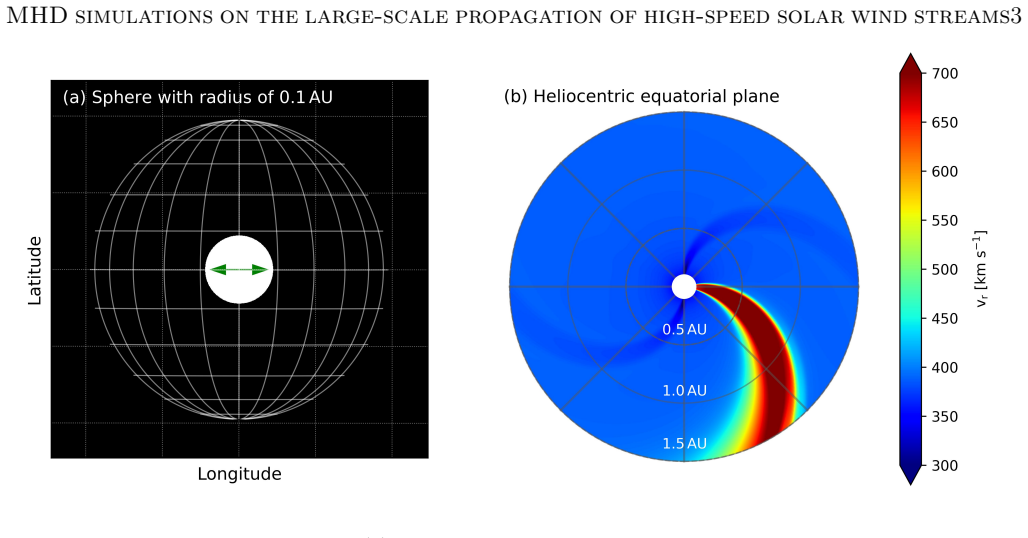
We investigate the propagation of high-speed solar wind streams from their origin near the Sun to 1 AU using three-dimensional magnetohydrodynamic simulations. By tracking both global stream structure and individual plasma parcels, we assess how local in-situ measurements relate to the underlying plasma evolution. We find that high-speed streams are not parcel-preserving structures: commonly used diagnostics such as peak velocity, density, or temperature do not trace fixed plasma elements, and feature-based radial trends can therefore misrepresent the true evolution. Instead, velocity-based relationships provide a more robust framework for linking plasma parcels across heliocentric distances. Stream evolution is dominated by interaction regions, where compression leads to deceleration of fast wind, acceleration of slow wind, and significant heating. A boundary layer forms close to the Sun and can dominate narrow streams, biasing in-situ measurements toward lower apparent velocities. We show that three-dimensional transport, in particular latitudinal flows, redistributes mass and magnetic flux and reduces center-to-flank contrasts. While radial magnetic flux is conserved, the total field strength is not in spherical sampling geometries due to non-radial components. Finally, observed stream properties and geoeffectivity depend strongly on sampling location, stream geometry, and latitudinal magnetic deflection, introducing systematic variability and asymmetries in geomagnetic response.
Editorial analysis
A structured set of objections, weighed in public.
Referee Report
Summary. The paper presents 3D ideal MHD simulations of high-speed solar wind stream propagation from near the Sun to 1 AU. By advecting passive scalars to track individual plasma parcels alongside the global stream structure, the authors show that streams are not parcel-preserving: peak velocity, density, and temperature at a given radial distance do not correspond to the same plasma elements as they evolve, owing to compression in interaction regions, latitudinal flows, and boundary-layer effects. Velocity-based diagnostics are argued to be more reliable for connecting parcels across distance. Additional results include conservation of radial magnetic flux (but not total |B| in spherical sampling), strong dependence of observed properties on sampling latitude and stream geometry, and the formation of a boundary layer that can bias narrow streams toward lower velocities.
Significance. If the simulations are adequately resolved and validated, the non-preservation result would be a substantive correction to how radial evolution of streams is inferred from in-situ data, with direct consequences for space-weather modeling and the interpretation of stream–stream interaction signatures. The explicit parcel tracking and flux-conservation checks are strengths that allow the central claim to be tested directly from the dynamics rather than assumed.
major comments (3)
- [§2 (Numerical Methods)] §2 (Numerical Methods): No grid resolution, cell size, or convergence tests are reported. Because the headline claim rests on the accurate separation of parcel trajectories from feature peaks inside interaction regions, numerical diffusion or under-resolved shear layers could artificially enhance mixing and produce the reported non-preservation; this information is load-bearing.
- [§3 (Initial Conditions and Validation)] §3 (Initial Conditions and Validation): The manuscript contains no direct comparison of simulated velocity, density, or magnetic-field profiles at 1 AU against spacecraft observations (e.g., ACE, Wind, or STEREO). Without such validation or at least a quantitative metric of agreement, it is unclear whether the simulated parcel evolution reproduces the observed large-scale structure or is an artifact of the chosen inner-boundary driving.
- [§4.3 (Boundary-Layer and Geometry Effects)] §4.3 (Boundary-Layer and Geometry Effects): The claim that a boundary layer “can dominate narrow streams” is presented without a parameter study varying stream width or latitudinal extent. The abstract treats this as a general result, yet the effect’s magnitude and radial onset appear to depend on the specific geometry chosen; a modest sensitivity test would be required to establish how broadly the bias applies.
minor comments (3)
- [Abstract] The abstract is lengthy and contains multiple distinct findings; a bulleted summary of the principal results would improve readability.
- [Figures] Figure captions for the 3-D renderings should explicitly state the color scale for the passive scalar and the viewing angles used, to allow readers to assess the latitudinal redistribution effect.
- [Table 1] A short table summarizing the range of stream widths, speeds, and magnetic-field strengths explored would help readers judge the generality of the reported trends.
Simulated Author's Rebuttal
We thank the referee for the constructive and detailed report. The comments highlight important aspects of numerical robustness, observational grounding, and generality that will improve the manuscript. We address each major comment below and indicate the revisions we will make.
read point-by-point responses
-
Referee: §2 (Numerical Methods): No grid resolution, cell size, or convergence tests are reported. Because the headline claim rests on the accurate separation of parcel trajectories from feature peaks inside interaction regions, numerical diffusion or under-resolved shear layers could artificially enhance mixing and produce the reported non-preservation; this information is load-bearing.
Authors: We agree that explicit documentation of resolution and convergence is essential to support the parcel-tracking results. The original submission omitted these details. In the revised manuscript we will expand §2 with the adopted grid (radial, latitudinal, and longitudinal cell counts), the radially varying cell sizes, and the outcomes of resolution-doubling convergence tests. These tests show that the reported non-preservation of parcels, the formation of the boundary layer, and the separation between parcel trajectories and feature peaks remain unchanged at higher resolution, confirming that the effect is dynamical rather than numerical. revision: yes
-
Referee: §3 (Initial Conditions and Validation): The manuscript contains no direct comparison of simulated velocity, density, or magnetic-field profiles at 1 AU against spacecraft observations (e.g., ACE, Wind, or STEREO). Without such validation or at least a quantitative metric of agreement, it is unclear whether the simulated parcel evolution reproduces the observed large-scale structure or is an artifact of the chosen inner-boundary driving.
Authors: We acknowledge the importance of demonstrating that the simulated large-scale structure is consistent with observations. Our inner-boundary conditions follow standard coronal-hole-driven solar-wind setups used in the literature. In the revision we will add to §3 a direct comparison of the simulated radial velocity, density, and |B| profiles at 1 AU against representative high-speed-stream intervals from ACE and Wind, including quantitative metrics such as peak speed, compression ratio, and magnetic-field magnitude. This will show that the model reproduces the observed bulk properties while the parcel-tracking analysis reveals the underlying dynamical evolution. revision: yes
-
Referee: §4.3 (Boundary-Layer and Geometry Effects): The claim that a boundary layer “can dominate narrow streams” is presented without a parameter study varying stream width or latitudinal extent. The abstract treats this as a general result, yet the effect’s magnitude and radial onset appear to depend on the specific geometry chosen; a modest sensitivity test would be required to establish how broadly the bias applies.
Authors: The boundary-layer bias is demonstrated for the narrow-stream geometry chosen in the simulation, which is representative of many observed streams. A full parameter sweep over width and latitude would require additional expensive 3D runs. In the revised §4.3 we will (i) qualify the abstract and main text to state that the dominance occurs for narrow streams, (ii) provide a scaling argument based on the existing run and boundary-layer theory, and (iii) note that the effect weakens for wider streams. We believe these clarifications address the generality concern without new simulations. revision: partial
Circularity Check
No significant circularity identified
full rationale
The paper derives its central claim—that high-speed streams are not parcel-preserving structures—from independent forward 3D MHD simulations that explicitly track both global stream geometry and individual plasma parcels via passive scalars. The non-preservation result emerges directly from the simulated interaction regions, compression, latitudinal flows, and flux redistribution, without any reduction to fitted parameters, self-definitional relations, or load-bearing self-citations. All reported trends (velocity-based linking, boundary-layer effects, sampling variability) are outputs of the dynamical evolution under standard ideal MHD assumptions, not inputs renamed as predictions. The derivation chain is therefore self-contained against external benchmarks.
Axiom & Free-Parameter Ledger
axioms (1)
- domain assumption Ideal MHD equations apply to the solar wind plasma over the scales considered
Reference graph
Works this paper leans on
-
[1]
C., Ho, G
Allen, R. C., Ho, G. C., Mason, G. M., et al. 2021, Geophys. Res. Lett., 48, e91376
2021
-
[2]
1977, SoPh, 51, 345
Harvey, J. 1977, SoPh, 51, 345
1977
-
[3]
Altschuler, M. D. & Newkirk, Jr., G. 1969, SoPh, 9, 131
1969
-
[4]
Cranmer, S. R. 2002, SSRv, 101, 229 D’Amicis, R., Sorriso-Valvo, L., Benella, S., et al. 2026, A&A, 706, A153
2002
-
[5]
J., Velli, M
Fox, N. J., Velli, M. C., Bale, S. D., et al. 2016, SSRv, 204, 7
2016
-
[6]
2022, SoPh, 297, 82
Lockwood, M. 2022, SoPh, 297, 82
2022
-
[7]
D., Joselyn, J
Gonzalez, W. D., Joselyn, J. A., Kamide, Y., et al. 1994, J. Geophys. Res., 99, 5771
1994
-
[8]
Gonzalez, W. D. & Tsurutani, B. T. 1987, Planet. Space Sci., 35, 1101 32Hofmeister et al
1987
-
[9]
Feldman, W. C. 1978, J. Geophys. Res., 83, 1401
1978
-
[10]
A., Filwett, R
Henderson, S. A., Filwett, R. J., Lee, C. O., et al. 2025, ApJ, 992, 34
2025
-
[11]
J., Asvestari, E., Guo, J., et al
Hofmeister, S. J., Asvestari, E., Guo, J., et al. 2022, A&A, 659, A190
2022
-
[12]
C., Klein, K
Kasper, J. C., Klein, K. G., Lichko, E., et al. 2021, PhRvL, 127, 255101
2021
-
[13]
S., Timothy, A
Krieger, A. S., Timothy, A. F., & Roelof, E. C. 1973, SoPh, 29, 505
1973
-
[14]
Levine, R. H. 1977, ApJ, 218, 291 M¨ uller, D., St. Cyr, O. C., Zouganelis, I., et al. 2020, A&A, 642, A1 O’Brien, T. P. & McPherron, R. L. 2000, J. Geophys. Res., 105, 7707
1977
-
[15]
Parker, E. N. 1958, ApJ, 128, 664
1958
-
[16]
Parker, E. N. 1965, SSRv, 4, 666
1965
-
[17]
2022, A&A, 668, A189
Perrone, D., Perri, S., Bruno, R., et al. 2022, A&A, 668, A189
2022
-
[18]
2019, MNRAS, 483, 3730
Matteini, L. 2019, MNRAS, 483, 3730
2019
-
[19]
& Poedts, S
Pomoell, J. & Poedts, S. 2018, Journal of Space Weather and Space Climate, 8, A35
2018
-
[20]
Richardson, I. G. 2018, Living Reviews in Solar Physics, 15, 1
2018
-
[21]
Russell, C. T. & McPherron, R. L. 1973, J. Geophys. Res., 78, 92
1973
-
[22]
T., Gonzalez, W
Tsurutani, B. T., Gonzalez, W. D., Gonzalez, A. L. C., et al. 2006, Journal of Geophysical Research (Space Physics), 111, A07S01
2006
-
[23]
Vasyliunas, V. M. 2006, Journal of Geophysical Research (Space Physics), 111, A07S04
2006
-
[24]
Weber, E. J. & Davis, Jr., L. 1967, ApJ, 148, 217
1967
-
[25]
Wiegelmann, T., Petrie, G. J. D., & Riley, P. 2017, SSRv, 210, 249
2017
-
[26]
& Solanki, S
Wiegelmann, T. & Solanki, S. K. 2004, SoPh, 225, 227
2004
-
[27]
Zirker, J. B. 1977, Reviews of Geophysics and Space Physics, 15, 257
1977
discussion (0)
Sign in with ORCID, Apple, or X to comment. Anyone can read and Pith papers without signing in.