Recognition: unknown
Exact Loop Controllers for ReLU Realization of Homogeneous Curve Refinements
Pith reviewed 2026-05-09 17:08 UTC · model grok-4.3
The pith
Homogeneous curve refinement operators admit exact ReLU realizations with fixed width and depth linear in the iteration count.
A machine-rendered reading of the paper's core claim, the machinery that carries it, and where it could break.
Core claim
The iterates V^n γ of a homogeneous refinement operator (Vγ)(t) = sum A_j γ(Mt - j) admit exact ReLU realizations of fixed width and depth O(n). The central mechanism is an exact loop controller that transports the residual orbit as a forward-exact state on a polygonal loop; scalar factors and digit selectors are recovered from this state by complementary continuous piecewise linear readouts. Any remaining seam ambiguity is isolated to the final readout stage and does not affect the result because the scalar atom is supported away from the seam. Affine forcing is handled by expanding iterates into finite sums of homogeneous terms, yielding exact fixed-width realizations of depth O(n^2). The
What carries the argument
The exact loop controller for residual dynamics, which maintains the residual orbit as a forward-exact state on a polygonal loop and recovers scalars and selectors via complementary continuous piecewise linear readouts.
Load-bearing premise
The refinement operator has finitely many nonzero matrices and acts on compactly supported continuous piecewise linear curves, with loop seam ambiguity confined to the final readout stage where it remains harmless.
What would settle it
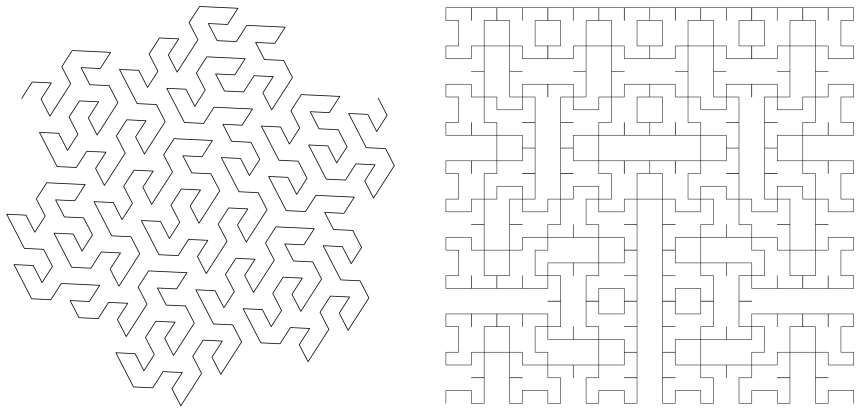
For the dragon-curve refinement matrices, construct the explicit ReLU network for n=2 and verify that its output coincides exactly with the twice-refined curve at every point, up to machine precision.
Figures



read the original abstract
We study homogeneous refinement operators \((V\gamma)(t)=\sum_{j\in\mathbb Z}A_j\gamma(Mt-j)\), acting on compactly supported continuous piecewise linear curves \(\gamma:\mathbb R\to\mathbb R^p\), where \(M\ge2\) and only finitely many matrices \(A_j\in\mathbb R^{p\times p}\) are nonzero. We prove that the iterates \(V^n\gamma\) admit exact ReLU realizations of fixed width and depth \(O(n)\). The main new ingredient is an exact loop controller for the residual dynamics. Instead of propagating scalar residual surrogates, the construction transports the residual orbit by a forward-exact state on a polygonal loop. Scalar factors and digit selectors are then recovered from this loop state by complementary CPwL readouts. The loop seam is not removed, but its remaining ambiguity is confined to the final readout/selector stage, where it is harmless because the scalar atom is supported away from the seam. This gives a homogeneous \(M\)-ary vector-valued extension of the scalar binary refinable-function construction with a more geometric controller architecture. We also record crude exponential bounds on the network weights and biases. Affine forcing terms are handled by expanding affine iterates into finite sums of homogeneous iterates, giving exact fixed-width realizations with depth \(O(n^2)\), and anchored open curves reduce to compactly supported defects with affine anchor mismatch. We also describe homogeneous polygonal generators, including dragon-type examples and a self-intersecting Hilbert-type prototype in arbitrary dimension. The extended version includes stage-dependent forcing, finite-state stacking reductions, and further geometric constructions such as Koch-, Gosper-, Morton-, and connector-based Hilbert-type variants.
Editorial analysis
A structured set of objections, weighed in public.
Referee Report
Summary. The paper proves that iterates V^n γ of homogeneous refinement operators Vγ(t) = ∑ A_j γ(Mt - j), acting on compactly supported continuous piecewise-linear curves γ : ℝ → ℝ^p with finitely many nonzero matrices A_j, admit exact ReLU realizations of fixed width and depth O(n). The central construction introduces an exact loop controller that transports residual orbits via a forward-exact polygonal state; scalar factors and digit selectors are recovered by complementary CPwL readouts whose seam ambiguity is confined to the final stage and rendered harmless by support separation. The result extends prior scalar binary work to the vector-valued M-ary setting, supplies crude exponential weight bounds, reduces affine forcing to depth O(n^2), and illustrates the method with dragon-type and self-intersecting Hilbert-type polygonal generators.
Significance. If the central construction holds, the work supplies a geometrically explicit, parameter-free route to exact fixed-width ReLU realizations of subdivision iterates, strengthening the theory of neural-network expressivity for self-similar and fractal curves. The loop-controller architecture and the clean separation of seam ambiguity constitute a genuine technical advance over scalar surrogates; the supplied examples (dragon, Hilbert) and the reduction of affine and open-curve cases further increase utility. The absence of circularity and the standard assumptions on the refinement operator are positive features.
major comments (2)
- [Abstract / Main theorem] Abstract and the statement of the main theorem: the claim that the loop controller yields depth exactly O(n) with fixed width rests on the forward-exactness of the polygonal state and the support separation that makes seam ambiguity harmless; the provided sketch does not exhibit the explicit state-transition matrices or the readout functions that realize the digit selectors, so the O(n) bound cannot yet be verified from the text alone.
- [Affine forcing paragraph] The reduction of affine forcing to a finite sum of homogeneous iterates (yielding depth O(n^2)) is asserted but the precise expansion and the manner in which the homogeneous controllers are stacked without width growth are not displayed; this step is load-bearing for the affine case and requires an explicit formula or inductive argument.
minor comments (2)
- [Introduction] The notation for the refinement operator and the loop state could be introduced with a small concrete example (e.g., the dragon curve) immediately after the abstract to improve readability.
- [Weight bounds] Crude exponential bounds on weights and biases are mentioned; a short table or explicit dependence on M, p and the spectral radius of the A_j would make the statement more precise.
Simulated Author's Rebuttal
We thank the referee for the positive assessment of the paper's significance and for identifying the points where the presentation of the constructions requires greater explicitness. We address both major comments below and will incorporate the requested details into the revised manuscript.
read point-by-point responses
-
Referee: [Abstract / Main theorem] Abstract and the statement of the main theorem: the claim that the loop controller yields depth exactly O(n) with fixed width rests on the forward-exactness of the polygonal state and the support separation that makes seam ambiguity harmless; the provided sketch does not exhibit the explicit state-transition matrices or the readout functions that realize the digit selectors, so the O(n) bound cannot yet be verified from the text alone.
Authors: We agree that the current manuscript presents the loop controller primarily through a descriptive sketch. In the revision we will supply the explicit state-transition matrices that realize the forward-exact polygonal state on the residual orbit, together with the complementary CPwL readout functions that recover the scalar factors and digit selectors. These formulas will make the fixed-width property (constant across all n) and the O(n) depth bound directly verifiable from the text, while preserving the geometric separation of seam ambiguity at the final readout stage. revision: yes
-
Referee: [Affine forcing paragraph] The reduction of affine forcing to a finite sum of homogeneous iterates (yielding depth O(n^2)) is asserted but the precise expansion and the manner in which the homogeneous controllers are stacked without width growth are not displayed; this step is load-bearing for the affine case and requires an explicit formula or inductive argument.
Authors: We acknowledge that the affine reduction is stated at a high level. The revised manuscript will include the explicit finite-sum expansion of each affine iterate in terms of homogeneous refinement operators, followed by an inductive construction showing how the corresponding loop controllers are applied sequentially. The induction will demonstrate that width remains fixed (reusing the same controller architecture at each summand) while depth accumulates to O(n^2). revision: yes
Circularity Check
No significant circularity; construction is self-contained
full rationale
The paper's central result is a direct mathematical construction proving that homogeneous refinement iterates admit exact fixed-width ReLU networks of depth O(n) via a polygonal loop controller for residual dynamics. This is built from the given operator matrices A_j, the compact support and CPwL assumptions on the input curves, and explicit CPwL readouts for scalar factors and selectors. The loop seam ambiguity is confined and neutralized by support separation, with no reduction to fitted parameters, self-referential definitions, or unverified self-citations. The mention of extending prior scalar binary work is a contextual reference rather than a load-bearing premise; the vector-valued M-ary geometric controller and its depth bounds are derived independently and illustrated with concrete examples. Affine and open-curve cases reduce to the homogeneous compact case by finite expansions, preserving independence from the target result.
Axiom & Free-Parameter Ledger
axioms (2)
- standard math ReLU networks realize continuous piecewise linear functions
- domain assumption Homogeneous refinement operators with finite nonzero matrices preserve compact support and continuity of CPwL curves
invented entities (1)
-
exact loop controller
no independent evidence
Forward citations
Cited by 1 Pith paper
-
Exact ReLU realization of tensor-product refinement iterates
Tensor-product dyadic refinement iterates on compactly supported continuous piecewise linear functions in R^2 admit exact ReLU realizations with fixed width and depth O(n).
Reference graph
Works this paper leans on
-
[1]
Daubechies, R
I. Daubechies, R. DeVore, S. Foucart, B. Hanin, and G. Petrova,Nonlinear Approximation and (Deep) ReLU Networks, Constr. Approx.55(2022), no. 1, 127–172
2022
-
[2]
R. DeVore, B. Hanin, and G. Petrova,Neural Network Approximation, Acta Numerica30 (2021), 327–444. DOI: 10.1017/S0962492921000052
-
[3]
I. Daubechies, R. DeVore, N. Dym, S. Faigenbaum-Golovin, S. Z. Kovalsky, K.-C. Lin, J. Park, G. Petrova, and B. Sober,Neural Network Approximation of Refinable Functions, IEEE Trans. Inform. Theory69(2023), no. 1, 482–495. DOI: 10.1109/TIT.2022.3199601
-
[4]
N. Dym, B. Sober, and I. Daubechies,Expression of Fractals Through Neural Network Functions, IEEE J. Sel. Areas Inf. Theory1(2020), no. 1, 57–66. DOI: 10.1109/JSAIT.2020.2991422
-
[5]
J. He, L. Li, J. Xu, and C. Zheng,ReLU deep neural networks and linear finite elements, J. Comput. Math.38(2020), no. 3, 502–527. DOI: 10.4208/jcm.1901-m2018-0160
-
[6]
Hilbert,Ueber die stetige Abbildung einer Linie auf ein Fl¨ achenst¨ uck, Mathematische Annalen38(1891), 459–460
D. Hilbert,Ueber die stetige Abbildung einer Linie auf ein Fl¨ achenst¨ uck, Mathematische Annalen38(1891), 459–460. 38
-
[7]
Takagi,A simple example of the continuous function without derivative, Proc
T. Takagi,A simple example of the continuous function without derivative, Proc. Phys.-Math. Soc. Japan1(1903), 176–177
1903
-
[8]
von Koch,Sur une courbe continue sans tangente, obtenue par une construction g´ eom´ etrique ´ el´ ementaire, Arkiv f¨ or Matematik1(1904), 681–704
H. von Koch,Sur une courbe continue sans tangente, obtenue par une construction g´ eom´ etrique ´ el´ ementaire, Arkiv f¨ or Matematik1(1904), 681–704
1904
-
[9]
Lebesgue,Le¸ cons sur l’int´ egration et la recherche des fonctions primitives, Gauthier-Villars, Paris, 1904
H. Lebesgue,Le¸ cons sur l’int´ egration et la recherche des fonctions primitives, Gauthier-Villars, Paris, 1904
1904
-
[10]
Knopp,Ein einfaches Verfahren zur Bildung stetiger nirgends differenzierbarer Funktionen, Math
K. Knopp,Ein einfaches Verfahren zur Bildung stetiger nirgends differenzierbarer Funktionen, Math. Z.2(1918), 1–26
1918
-
[11]
L´ evy,Les courbes planes ou gauches et les surfaces compos´ ees de parties semblables au tout, Journal de l’ ´Ecole Polytechnique (1938), 227–247, 249–291
P. L´ evy,Les courbes planes ou gauches et les surfaces compos´ ees de parties semblables au tout, Journal de l’ ´Ecole Polytechnique (1938), 227–247, 249–291
1938
-
[12]
G. M. Morton,A Computer-Oriented Geodetic Data Base and a New Technique in File Sequencing, Technical report, IBM Ltd., Ottawa, Canada, 1966
1966
-
[13]
Davis and D
C. Davis and D. E. Knuth,Number Representations and Dragon Curves, Journal of Recreational Mathematics3(1970), 66–81, 133–149
1970
-
[14]
B. B. Mandelbrot,The Fractal Geometry of Nature, W. H. Freeman, New York, 1983
1983
-
[15]
M. F. Barnsley,Fractal functions and interpolation, Constr. Approx.2(1986), 303–329. DOI: 10.1007/BF01893434 39
discussion (0)
Sign in with ORCID, Apple, or X to comment. Anyone can read and Pith papers without signing in.