Recognition: unknown
Numerical Validation of a MOSFET-Based Control Circuit for High-Power Intelligent Reflecting Surfaces for Wireless Power Transfer Applications
Pith reviewed 2026-05-09 16:42 UTC · model grok-4.3
The pith
A back-to-back MOSFET circuit with capacitors lets IRS unit cells maintain 180-degree phase control at powers above 1 W.
A machine-rendered reading of the paper's core claim, the machinery that carries it, and where it could break.
Core claim
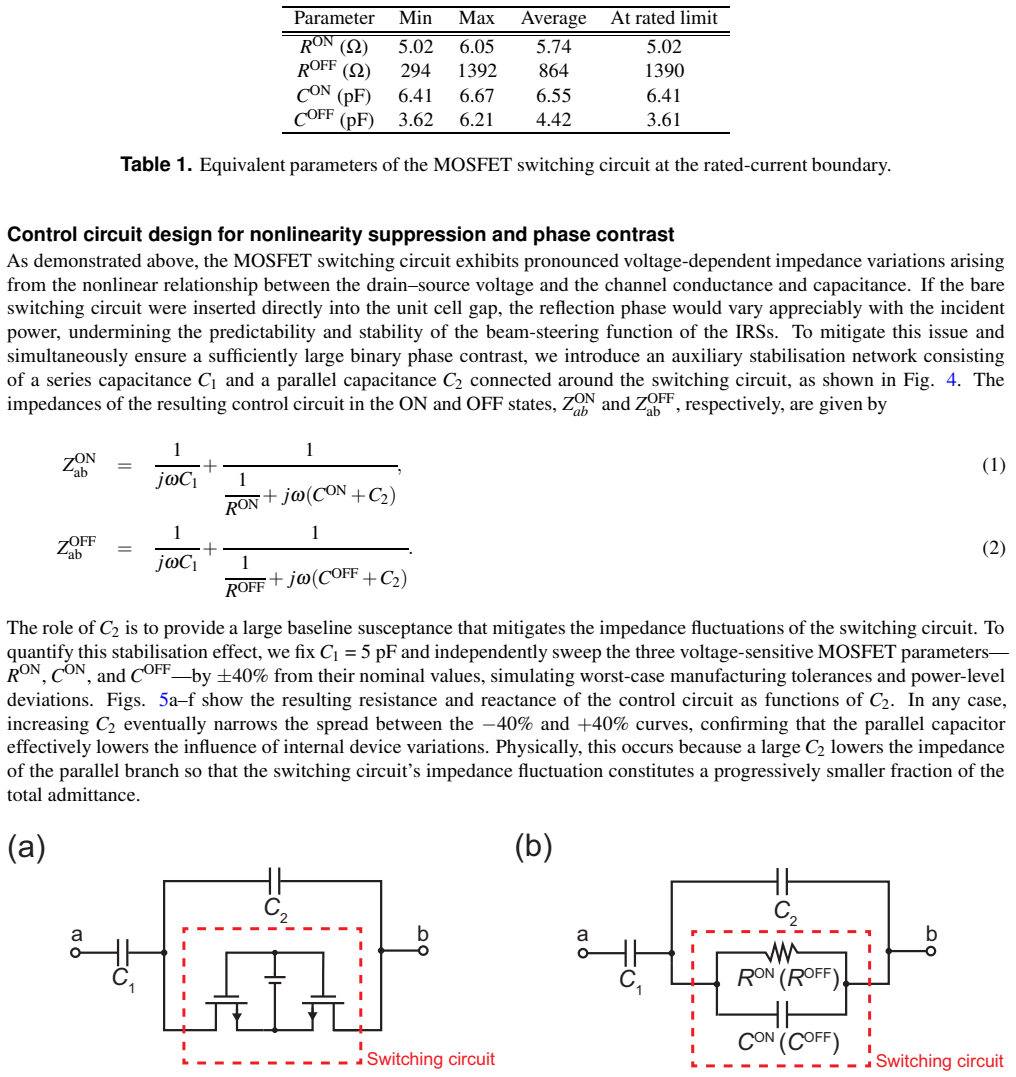
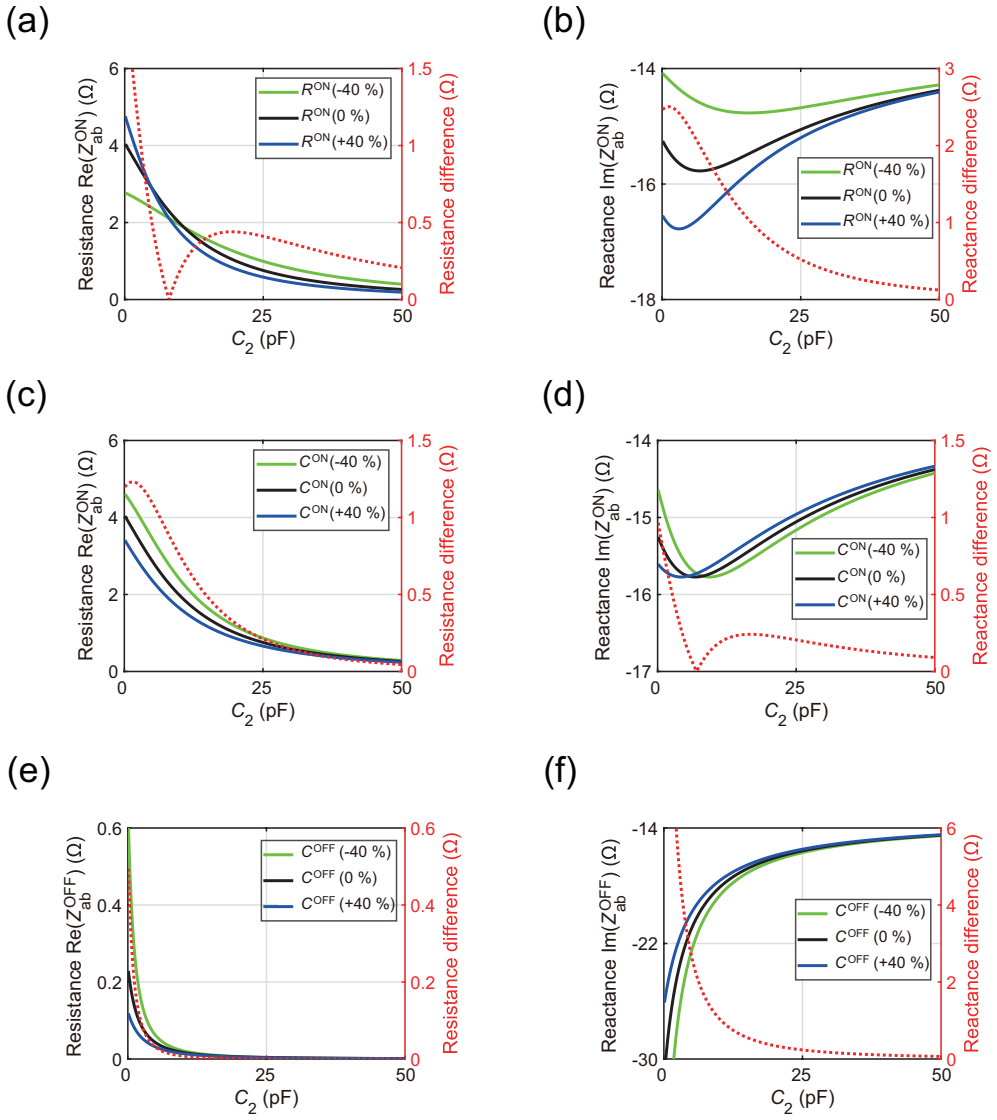
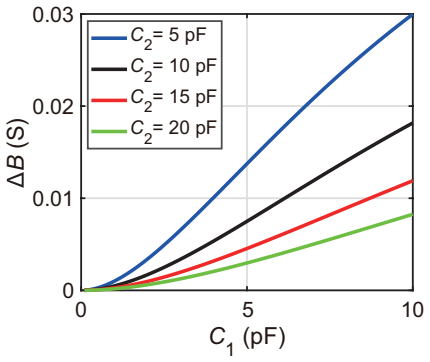
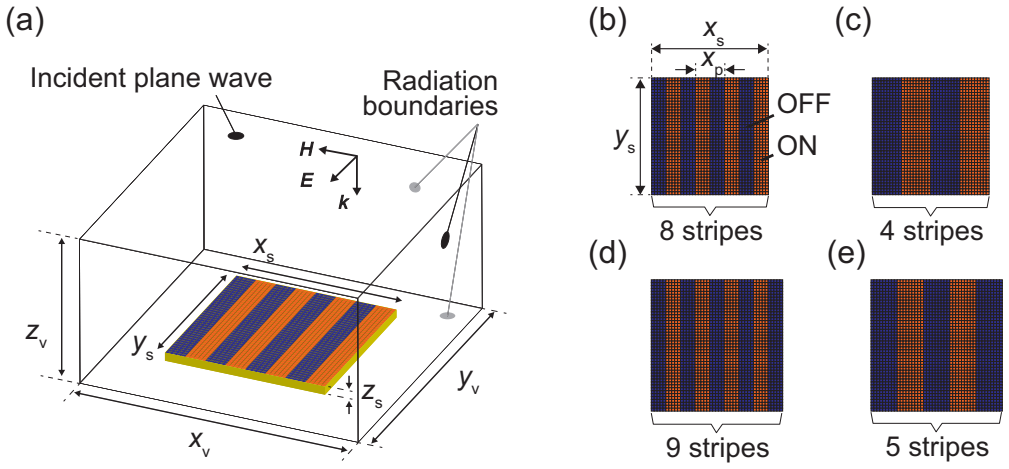
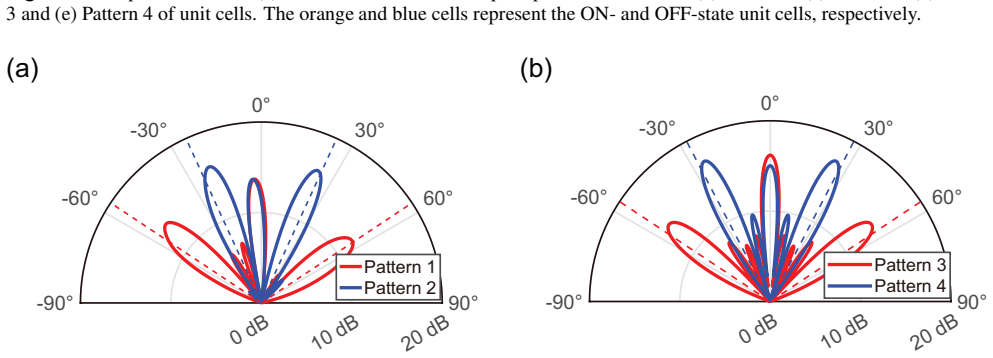
The central claim is that a MOSFET-based binary control circuit for 2.4 GHz IRS unit cells can withstand input powers exceeding 1 W while preserving an approximately 180-degree reflection phase difference between its two states. The design uses a back-to-back MOSFET topology augmented with series and parallel capacitors to suppress impedance variations caused by device nonlinearity. A transmission-line theoretical model is validated against full-wave electromagnetic co-simulations that incorporate nonlinear SPICE device models. Dynamic-range checks against rated current and phase difference confirm stable behavior up to 1.25 W, and supercell-level simulations demonstrate active beam steering
What carries the argument
Back-to-back MOSFET switching topology with series and parallel capacitors that holds reflection-phase difference near 180 degrees by limiting nonlinear impedance drift.
If this is right
- IRS arrays can be deployed in wireless power transfer without per-cell power limits below 1 W.
- Binary phase control remains usable for beam steering even when each cell receives more than 1 W.
- Switching-pattern reconfiguration produces controllable far-field reflection angles at high power.
- The transmission-line model plus nonlinear SPICE co-simulation accurately predicts circuit behavior up to 1.25 W.
Where Pith is reading between the lines
- The same capacitor-compensated topology could be scaled to other frequencies by retuning the lumped elements.
- Hardware prototypes would be needed to check whether thermal effects or packaging parasitics alter the simulated stability.
- Similar compensation might allow other nonlinear RF switches to serve in high-power IRS applications.
- Integration into full WPT systems would require verifying that the reflected beam still delivers usable power to a target receiver.
Load-bearing premise
The added capacitors and back-to-back MOSFET arrangement will keep impedance variations small enough that the reflection phase difference stays close to 180 degrees when input power exceeds 1 W.
What would settle it
Direct measurement of the reflected phase difference at 1.25 W input power showing a deviation larger than a few degrees from 180 degrees between ON and OFF states would disprove stable high-power operation.
Figures




read the original abstract
Intelligent reflecting surfaces (IRSs) have attracted considerable attention because of their ability to dynamically control electromagnetic wave propagation. While most existing IRSs have been developed for low-power communication and sensing applications, their extension to high-power wireless power transfer (WPT) environments remains largely unexplored, as the high induced currents can damage or saturate the sensitive control elements, disrupting their tuning functionality. Here, we propose a metal-oxide-semiconductor field-effect transistor-based (MOSFET-based) binary control circuit for IRSs operating at 2.4 GHz that can withstand input power levels exceeding 1 W per unit cell. The control circuit employs a back-to-back MOSFET switching topology with series and parallel capacitors to suppress impedance variations arising from device nonlinearity while maintaining a reflection phase difference of approximately 180 degrees between the ON and OFF states. A theoretical model based on transmission lines is developed and validated against full-wave co-simulations incorporating nonlinear SPICE device models. The dynamic range is evaluated with respect to both the rated current and the reflection phase difference, demonstrating stable operation up to 1.25 W. Supercell-level beam steering is further demonstrated through far-field simulations, confirming active control of the reflection angle via switching pattern reconfiguration. These results establish a foundation for the deployment of IRSs in high-power WPT scenarios.
Editorial analysis
A structured set of objections, weighed in public.
Referee Report
Summary. The manuscript proposes a MOSFET-based binary control circuit for intelligent reflecting surfaces (IRS) in high-power wireless power transfer (WPT) at 2.4 GHz. It employs a back-to-back MOSFET switching topology augmented with series and parallel capacitors to suppress device nonlinearity effects and maintain an approximately 180-degree reflection phase difference between ON and OFF states. A transmission-line theoretical model is developed and validated via full-wave electromagnetic co-simulations incorporating nonlinear SPICE device models. The dynamic range is assessed with respect to rated current and phase difference, showing stable operation up to 1.25 W per unit cell, with additional far-field simulations demonstrating supercell-level beam steering through switching pattern reconfiguration.
Significance. If the numerical results hold, this work provides a practical foundation for extending IRS technology to high-power WPT scenarios, where induced currents typically damage or saturate control elements in conventional low-power designs. The back-to-back topology with capacitor compensation represents a targeted engineering solution to nonlinearity, and the combination of transmission-line modeling with nonlinear co-simulations offers a reproducible validation pathway. This could enable active beam control in wireless charging systems operating above 1 W per cell.
major comments (2)
- [Dynamic range evaluation / results] The dynamic range evaluation (results section) reports stable operation up to 1.25 W based on the transmission-line model and nonlinear SPICE co-simulations, but provides no quantitative error bars on the reflection phase difference or current, nor details on the number of parameter sweeps or device-to-device variations considered; this weakens the robustness claim for the 180-degree phase maintenance under nonlinearity.
- [Co-simulation validation] In the full-wave co-simulation setup and validation against the transmission-line model, the fidelity of the nonlinear SPICE MOSFET models (including bias-dependent capacitances and harmonic generation) at input powers above 1 W is assumed without sensitivity analysis or cross-check against measured device data at 2.4 GHz; if these models deviate from physical behavior (e.g., due to package inductance), the simulated phase stability does not necessarily translate to hardware.
minor comments (2)
- [Abstract and circuit description] The abstract states 'approximately 180 degrees' for the phase difference; the main text should report the exact simulated values (with and without capacitors) for both ON and OFF states to allow direct assessment of the suppression efficacy.
- [Supercell beam steering simulations] The far-field beam-steering demonstration would benefit from quantitative metrics such as the achieved steering angle error or sidelobe levels as a function of the switching pattern.
Simulated Author's Rebuttal
We thank the referee for the positive assessment and recommendation for minor revision. We address each major comment below with targeted revisions to strengthen the robustness and validation claims where feasible.
read point-by-point responses
-
Referee: The dynamic range evaluation (results section) reports stable operation up to 1.25 W based on the transmission-line model and nonlinear SPICE co-simulations, but provides no quantitative error bars on the reflection phase difference or current, nor details on the number of parameter sweeps or device-to-device variations considered; this weakens the robustness claim for the 180-degree phase maintenance under nonlinearity.
Authors: The presented results rely on deterministic simulations with fixed manufacturer SPICE models. To strengthen the claim, the revised manuscript now includes a sensitivity study with 200 Monte Carlo trials varying MOSFET parameters (V_th ±10%, C_gs/C_gd ±20%, R_on ±15%) within datasheet tolerances. Error bars are added to the phase-difference and current plots, showing the 180° difference is maintained within ±5° up to 1.25 W with <3% current deviation, confirming robustness under realistic variations. revision: yes
-
Referee: In the full-wave co-simulation setup and validation against the transmission-line model, the fidelity of the nonlinear SPICE MOSFET models (including bias-dependent capacitances and harmonic generation) at input powers above 1 W is assumed without sensitivity analysis or cross-check against measured device data at 2.4 GHz; if these models deviate from physical behavior (e.g., due to package inductance), the simulated phase stability does not necessarily translate to hardware.
Authors: A sensitivity analysis varying package inductance (±30%), bias-dependent capacitances, and harmonic-generation parameters has been performed and will be added; results show phase stability is preserved. However, direct comparison to measured MOSFET data at 2.4 GHz and >1 W is not available, as this is a numerical validation study relying on vendor SPICE models. The revised text will explicitly discuss this model limitation and recommend experimental verification. revision: partial
- Direct cross-validation of the nonlinear SPICE MOSFET models against measured device data at 2.4 GHz and input powers above 1 W, which was not performed in this numerical study.
Circularity Check
No significant circularity detected
full rationale
The paper develops a transmission-line theoretical model for the back-to-back MOSFET control circuit with added capacitors and validates its predictions (reflection phase difference near 180 degrees and stable operation up to 1.25 W) against independent full-wave electromagnetic co-simulations that incorporate external nonlinear SPICE device models. No load-bearing equation or claim reduces the reported power-handling limit or phase stability to a parameter fitted from the same simulation outputs, nor does any step rely on self-citation chains or imported uniqueness theorems. The derivation remains self-contained against external benchmarks.
Axiom & Free-Parameter Ledger
axioms (2)
- domain assumption Nonlinear SPICE device models accurately capture MOSFET behavior at 2.4 GHz and input powers up to 1.25 W.
- domain assumption Transmission-line equivalent-circuit representation remains valid for the unit cell under the stated power levels.
Reference graph
Works this paper leans on
-
[1]
& Palaniswami, M
Gubbi, J., Buyya, R., Marusic, S. & Palaniswami, M. Internet of things (iot): A vision, architectural elements, and futu re directions. Futur. generation computer systems 29, 1645–1660 (2013). 15/17
2013
-
[2]
Internet of things: a comprehensive overview , architectures, applications, simulation tools, challen ges and future directions
Choudhary, A. Internet of things: a comprehensive overview , architectures, applications, simulation tools, challen ges and future directions. Discov. Internet Things 4, 31 (2024)
2024
-
[3]
Lu, X., Wang, P ., Niyato, D., Kim, D. I. & Han, Z. Wireless charging technologies: Fundamentals, standards, and network applications. IEEE Commun. Surv. Tutor .18, 1413–1452 (2015)
2015
-
[4]
Sasatani, T., Sample, A. P . & Kawahara, Y . Room-scale magnetoquasistatic wireless power transfer using a cavity-based multimode resonator. Nat. Electron. 4, 689–697 (2021)
2021
-
[5]
Alabsi, A. et al. Wireless power transfer technologies, applications, and f uture trends: A review. IEEE Trans. Sustain. Comput. 10, 1–17 (2025)
2025
-
[6]
Suzuki, K. et al. Experimental and numerical validation of tape-based metas urfaces in guiding high-frequency surface waves for efficient power transfer. Appl. Phys. Lett. 125, 181701 (2024)
2024
- [7]
-
[8]
Sievenpiper, D., Zhang, L., Broas, R. F. J., Alex´ opolous, N . G. & Y ablonovitch, E. High-impedance electromagnetic surfaces with a forbidden frequency band. IEEE Trans. Microw. Theory T ech.47, 2059–2074 (1999)
2059
-
[9]
& Ziolkowski, R
Engheta, N. & Ziolkowski, R. Metamaterials: Physics and Engineering Explorations (IEEE Press, John Wiley & Sons, Piscataway, NJ, 2006)
2006
-
[10]
& Capasso, F
Y u, N. & Capasso, F. Flat optics with designer metasurfaces. Nat. Mater .13, 139–150 (2014)
2014
-
[11]
& Soukoulis, C
Smith, D., Vier, D., Koschny, T. & Soukoulis, C. Electromagnetic parameter retrieval from inhomogeneous metamaterials. Phys. Rev. E 71, 036617 (2005)
2005
-
[12]
L., Mohamed, M
Holloway, C. L., Mohamed, M. A., Kuester, E. F. & Dienstfrey, A. Reflection and transmission properties of a metafilm: With an application to a controllable surface composed of re sonant particles. IEEE Trans. Electromagn. Compat. 47, 853–865 (2005)
2005
-
[13]
& Grbic, A
Pfeiffer, C. & Grbic, A. Metamaterial huygens’ surfaces: ta iloring wave fronts with reflectionless sheets. Phys. Rev. Lett. 110, 197401 (2013)
2013
-
[14]
A., Homma, H., Sugiura, S
Fathnan, A. A., Homma, H., Sugiura, S. & Wakatsuchi, H. Metho d for extracting the equivalent admittance from time- varying metasurfaces and its application to self-tuned spa tiotemporal wave manipulation. J. Phys. D Appl. Phys. 56, 015304 (2023)
2023
-
[15]
R., Padilla, W
Smith, D. R., Padilla, W . J., Vier, D. C., Nemat-Nasser, S. C. & Schultz, S. Composite medium with simultaneously negative permeability and permittivity. Phys. Rev. Lett. 84, 4184–4187 (2000)
2000
-
[16]
A., Smith, D
Shelby, R. A., Smith, D. R. & Schultz, S. Experimental verific ation of a negative index of refraction. Science 292, 77–79 (2001)
2001
-
[17]
Pendry, J. B. Negative refraction makes a perfect lens. Phys. Rev. Lett. 85, 3966–3969 (2000)
2000
-
[18]
& Zhang, X
Liu, Z., Lee, H., Xiong, Y ., Sun, C. & Zhang, X. Far–field optic al hyperlens magnifying sub–diffraction–limited objects . Science 315, 1686 (2007)
2007
-
[19]
I., Sajuyigbe, S., Mock, J
Landy, N. I., Sajuyigbe, S., Mock, J. J., Smith, D. R. & Padill a, W . J. Perfect metamaterial absorber. Phys. Rev. Lett. 100, 207402 (2008)
2008
-
[20]
& Paul, J
Wakatsuchi, H., Greedy, S., Christopoulos, C. & Paul, J. Cus tomised broadband metamaterial absorbers for arbitrary polarisation. Opt. Express 18, 22187–22198 (2010)
2010
-
[21]
Schurig, D. et al. Metamaterial electromagnetic cloak at microwave frequenc ies. Science 314, 977–980 (2006)
2006
-
[22]
B., Schurig, D
Pendry, J. B., Schurig, D. & Smith, D. R. Controlling electro magnetic fields. Science 312, 1780–1782 (2006)
2006
-
[23]
Y u, N. et al. Light propagation with phase discontinuities: generalize d laws of reflection and refraction. Science 334, 333–337 (2011)
2011
-
[24]
Omori, E. et al. An experimental validation of reconfigurable intelligent s urfaces achieving pulse-width-modulated sin- gular reflection angles without external power sources. IEEE Trans. V eh. T echnol.(2026)
2026
-
[25]
J., Qi, M
Cui, T. J., Qi, M. Q., Wan, X., Zhao, J. & Cheng, Q. Coding metam aterials, digital metamaterials and programmable metamaterials. Light. Sci. Appl. 3, e218 (2014)
2014
-
[26]
Zhang, L. et al. Space-time-coding digital metasurfaces. Nat. Commun. 9, 4334 (2018). 16/17
2018
-
[27]
& Nallanathan, A
Zhou, G., Pan, C., Ren, H., Wang, K. & Nallanathan, A. Intelli gent reflecting surface aided multigroup multicast miso communication systems. IEEE Trans. Signal Process. 68, 3236–3251 (2020)
2020
-
[28]
& Zhang, R
Shao, X., Y ou, C., Ma, W ., Chen, X. & Zhang, R. Target sensing w ith intelligent reflecting surface: Architecture and performance. IEEE J. Sel. Areas Commun. 40, 2070–2084 (2022)
2070
-
[29]
& Cui, T
Jiang, Y ., Gao, F., Liu, Y ., Jin, S. & Cui, T. Near-field comput ational imaging with ris generated virtual masks. IEEE Trans. Antennas Propag. 72, 4383–4398 (2024)
2024
-
[30]
& Sievenpiper, D
Li, A., Luo, Z., Wakatsuchi, H., Kim, S. & Sievenpiper, D. F. N onlinear, active, and tunable metasurfaces for advanced electromagnetics applications. IEEE Access 5, 27439–27452 (2017)
2017
-
[31]
Huang, J. et al. Switchable coding metasurface for flexible manipulation of terahertz wave based on dirac semimetal. Results Phys. 33, 105204 (2022)
2022
-
[32]
High–impedance electromagnetic surfaces
Sievenpiper, D. High–impedance electromagnetic surfaces . PhD. dissertation, Dept. Elect. Eng., Univ. California at Los Angeles, Los Angeles, CA (1999)
1999
-
[33]
R., Monorchio, A
Luukkonen, O., Costa, F., Simovski, C. R., Monorchio, A. & Tr etyakov, S. A. A thin electromagnetic absorber for wide incidence angles and both polarizations. IEEE Trans. Antennas Propag. 57, 3119–3125 (2009)
2009
-
[34]
Su, J. et al. Uneven-layered coding metamaterial tile for ultra-wideba nd rcs reduction and diffuse scattering. Sci. Rep. 8, 8182 (2018)
2018
-
[35]
Passive time-varying waveform-selective metasurfaces fo r attainment of magnetic property control
Kunitomo, Y .et al. Passive time-varying waveform-selective metasurfaces fo r attainment of magnetic property control. APL Mater. 12, 111104 (2024). Acknowledgements This study was supported by the Japan Science and Technology Agency (JST) under Adopting Sustainable Partnerships for Innovative Research Ecosystem (ASPIRE) (Nos. JPMJAP2431 a nd JPMJAP2432) ...
2024
discussion (0)
Sign in with ORCID, Apple, or X to comment. Anyone can read and Pith papers without signing in.