Recognition: unknown
Data-driven time-frequency tessellation for signals with oscillatory amplitude envelopes and instantaneous frequency, with application to photoplethysmograhy
Pith reviewed 2026-05-09 16:48 UTC · model grok-4.3
The pith
TETRIS recovers respiratory signals from PPG by tessellating the time-frequency plane along the cardiac instantaneous frequency.
A machine-rendered reading of the paper's core claim, the machinery that carries it, and where it could break.
Core claim
The central claim is that, for signals obeying a generalized adaptive non-harmonic model, tessellating the time-frequency plane along the estimated instantaneous frequency of the primary component and then applying integrated shifting and adaptive processing to each resulting partition produces a refined representation that more effectively recovers the secondary oscillatory modulations governing amplitude and frequency, thereby enabling improved direct reconstruction of multiple surrogate respiratory signals from PPG data.
What carries the argument
TETRIS (Tessellation-based Ensembled Time-Frequency Representation via Integrated Shifting), which partitions the time-frequency plane along the estimated instantaneous frequency of the cardiac component and adaptively processes each partition to enhance the visibility of respiratory modulations.
If this is right
- Multiple surrogate respiratory signals can be reconstructed directly from PPG data.
- The tessellation produces a refined time-frequency representation that better isolates respiratory modulation of the cardiac amplitude.
- Theoretical justification supports the adaptive processing applied within each time-frequency partition.
- Performance gains are confirmed through validation on semi-synthetic signals that follow the model.
- The same framework can be applied to other signals obeying the generalized adaptive non-harmonic model.
Where Pith is reading between the lines
- The tessellation strategy could be tested on other physiological recordings that contain nested oscillatory dynamics, such as certain blood-pressure or EEG traces.
- Making the partitioning step fully data-driven without an initial frequency estimate might broaden the method to signals where the primary instantaneous frequency is harder to locate first.
- Real-time versions running on wearable PPG hardware could support continuous extraction of breathing information in ambulatory settings.
Load-bearing premise
The observed signals obey a generalized adaptive non-harmonic model in which both the amplitude and instantaneous frequency of the primary component are themselves governed by additional oscillatory dynamics.
What would settle it
A side-by-side test on real PPG recordings in which the respiratory signals recovered by TETRIS do not match independent reference breathing measurements more accurately than those obtained from standard non-tessellated time-frequency methods would falsify the claimed improvement.
Figures




read the original abstract
Biomedical signals often comprise multiple non-sinusoidal oscillatory components whose amplitude modulation (AM) and instantaneous frequency (IF) may themselves be governed by additional (second-order) oscillatory dynamics with time-varying amplitude and frequency. We introduce a novel time-frequency (TF) analysis framework, {\em Tessellation-based Ensembled Time-Frequency Representation via Integrated Shifting} (TETRIS), designed based on the proposed generalized adaptive non-harmonic model to leverage second-order oscillatory information in this class of signals. We present the model and algorithm using the photoplethysmogram (PPG) as a canonical example, whose cardiac component is known to encode respiratory information in both AM and IF, and demonstrate how respiratory signals can be recovered from PPG. The central idea of TETRIS is to partition the TF plane along the estimated IF of the cardiac component and to process each partition adaptively to enhance representation quality. This tessellation enables a refined time-frequency representation (TFR), allowing more effective recovery of the respiratory modulation governing the AM of the cardiac component. We provide theoretical justification for the proposed method and validate its performance on semi-synthetic signals. Finally, we demonstrate that TETRIS enables improved reconstruction of multiple surrogate respiratory signals directly from PPG data. While the model and algorithm are developed with a focus on PPG, the framework is flexible and has potential to be applied to other signals.
Editorial analysis
A structured set of objections, weighed in public.
Referee Report
Summary. The paper introduces TETRIS, a time-frequency tessellation framework based on a generalized adaptive non-harmonic model in which both amplitude and instantaneous frequency of the primary oscillatory component are themselves governed by additional (second-order) oscillatory dynamics. Using PPG as the canonical example, it claims theoretical justification for partitioning the TF plane along the estimated cardiac IF, adaptive processing of partitions to refine the TFR, and improved recovery of multiple surrogate respiratory signals directly from PPG, supported by semi-synthetic validation and a demonstration on real data.
Significance. If the model assumptions hold and the reported gains are robust, the work could meaningfully advance non-invasive respiratory monitoring from single-channel PPG by leveraging second-order structure in AM/IF; the explicit theoretical justification and semi-synthetic validation are strengths that distinguish it from purely empirical approaches.
major comments (2)
- [Abstract and model section] Abstract and model section: the central performance claims (improved respiratory reconstruction) rest on the assumption that observed PPG signals obey the proposed generalized adaptive non-harmonic model with second-order oscillatory AM/IF; the manuscript provides no explicit diagnostics or checks (e.g., spectral analysis of estimated IF/AM on real data) confirming this structure holds beyond the semi-synthetic cases, which is load-bearing for the generalizability claim.
- [Validation section] Validation section: semi-synthetic tests are described as generated from the model family, but without reported details on data-generation parameters, noise models, or exclusion criteria, it remains unclear whether reconstruction gains would persist for real PPG exhibiting non-oscillatory modulations or irregular breathing that violates the second-order assumption.
minor comments (2)
- [Algorithm description] Clarify the precise definition of the tessellation boundaries and the integrated-shifting operator (including any tuning parameters of the underlying IF estimator) to support reproducibility.
- [Results] Add a brief comparison table of reconstruction metrics against standard TFR methods (e.g., synchrosqueezing) on the same semi-synthetic and real datasets.
Simulated Author's Rebuttal
We thank the referee for their constructive and detailed comments, which help clarify the presentation and strengthen the manuscript. We address each major comment point by point below.
read point-by-point responses
-
Referee: [Abstract and model section] Abstract and model section: the central performance claims (improved respiratory reconstruction) rest on the assumption that observed PPG signals obey the proposed generalized adaptive non-harmonic model with second-order oscillatory AM/IF; the manuscript provides no explicit diagnostics or checks (e.g., spectral analysis of estimated IF/AM on real data) confirming this structure holds beyond the semi-synthetic cases, which is load-bearing for the generalizability claim.
Authors: We agree that the manuscript would benefit from explicit verification that the second-order oscillatory structure is present in real PPG recordings. The semi-synthetic experiments are constructed from the model family using parameters informed by observed PPG statistics, and the real-data demonstration shows improved surrogate respiratory signal recovery, but we did not include spectral diagnostics (such as periodograms or coherence analysis) of the extracted AM and IF on the real recordings. In the revised version we will add a dedicated subsection providing such spectral analysis on the real PPG dataset to directly support the model assumptions and generalizability. revision: yes
-
Referee: [Validation section] Validation section: semi-synthetic tests are described as generated from the model family, but without reported details on data-generation parameters, noise models, or exclusion criteria, it remains unclear whether reconstruction gains would persist for real PPG exhibiting non-oscillatory modulations or irregular breathing that violates the second-order assumption.
Authors: We acknowledge that the current description of the semi-synthetic data generation is insufficiently detailed for full reproducibility and assessment of robustness. The manuscript states that signals are generated from the model family but omits specific parameter ranges, noise models, and selection/exclusion rules. We will expand the validation section to report these details explicitly (e.g., ranges for second-order frequencies and amplitudes, SNR levels, and any filtering or exclusion criteria applied). On the question of performance when the second-order assumption is violated, the real-data results already reflect typical PPG variability; we will add a brief limitations paragraph discussing expected behavior under strong violations such as highly irregular breathing. revision: yes
Circularity Check
No significant circularity in the TETRIS derivation chain
full rationale
The paper proposes a new generalized adaptive non-harmonic model for signals with second-order oscillatory AM and IF, then derives the TETRIS tessellation framework directly from that model to partition the TF plane along the cardiac IF and enhance respiratory modulation recovery. Theoretical justification follows from the model's assumptions, and validation uses semi-synthetic signals plus real PPG demonstrations. No load-bearing step reduces by construction to a fitted input, self-citation, or renamed known result; the central reconstruction claim rests on the independent model and algorithm rather than tautological redefinition of inputs. The derivation is therefore self-contained.
Axiom & Free-Parameter Ledger
axioms (1)
- domain assumption Biomedical signals of interest can be represented as a sum of components whose amplitude and instantaneous frequency are themselves modulated by second-order oscillatory processes.
Reference graph
Works this paper leans on
-
[1]
Photoplethysmography and its application in clinical physiological measurement
John Allen. Photoplethysmography and its application in clinical physiological measurement. Physiological measurement, 28(3):R1–R39, 2007
2007
-
[2]
Cyclostationarity by examples.Mechanical Systems and Signal Processing, 23(4):987–1036, 2009
J´ erˆ ome Antoni. Cyclostationarity by examples.Mechanical Systems and Signal Processing, 23(4):987–1036, 2009
2009
-
[3]
Heart rate variability: origins, methods, and interpretive caveats.Psychophysiology, 34(6):623–648, 1997
Gary G Berntson, J Thomas Bigger Jr, Dwain L Eckberg, Paul Grossman, Peter G Kauf- mann, Marek Malik, Haikady N Nagaraja, Stephen W Porges, J Philip Saul, Peter H Stone, et al. Heart rate variability: origins, methods, and interpretive caveats.Psychophysiology, 34(6):623–648, 1997
1997
-
[4]
The functional role of cross-frequency coupling.Trends in cognitive sciences, 14(11):506–515, 2010
Ryan T Canolty and Robert T Knight. The functional role of cross-frequency coupling.Trends in cognitive sciences, 14(11):506–515, 2010
2010
-
[5]
Shrikant Chand, James Nolen, and Hau-Tieng Wu. On spectral interference of the short-time fourier transform and its nonlinear variations.arXiv preprint arXiv:2601.10910, 2026
-
[6]
In (b), the blue curve is the traditional RIIV (tRIIV) and the ma- genta curve is the traditional RIAV (tRIAV)
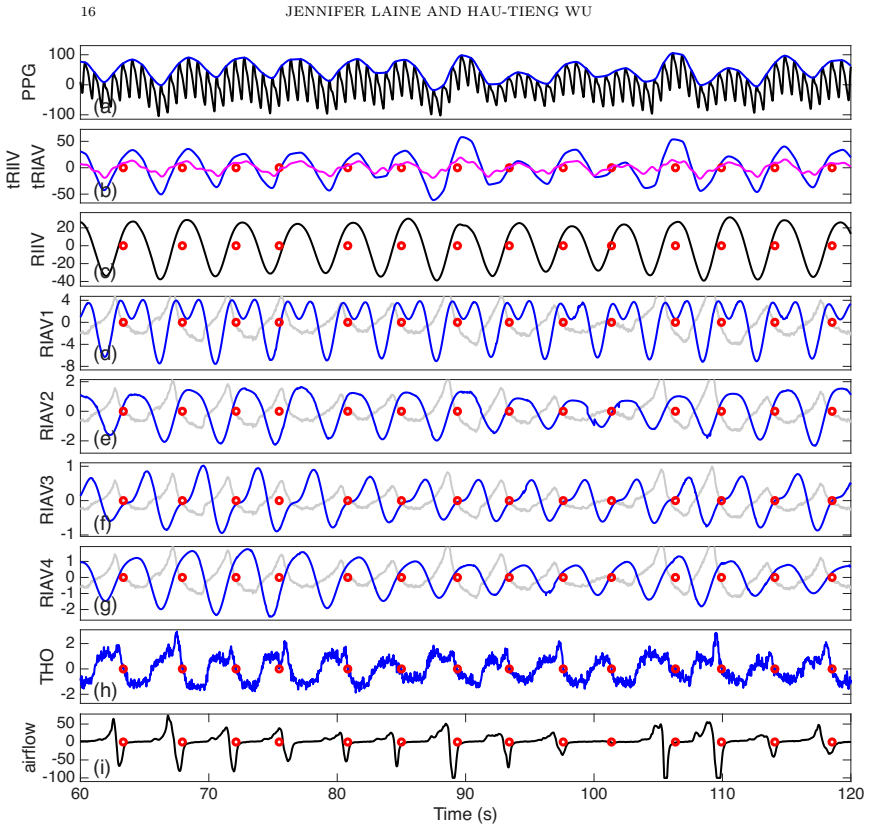
Peter H Charlton, Drew A Birrenkott, Timothy Bonnici, Marco AF Pimentel, Alistair EW Johnson, Jordi Alastruey, Lionel Tarassenko, Peter J Watkinson, Richard Beale, and David A 16 JENNIFER LAINE AND HAU-TIENG WU PPG -100 0 100 (a) tRIIVtRIAV -50 0 50 (b) RIIV -40-20020 (c) RIAV1 -8-40 4 (d) RIAV2 -2 0 2 (e) RIAV3 -1 0 1 (f) RIAV4 -2-101 (g) THO -202 (h) Ti...
2017
-
[7]
Validation of a fingertip home sleep apnea testing system using deep learning ai and a temporal event localization analysis.Sleep, 48(5):zsae317, 2025
Ke-Wei Chen, Chun-Hsien Tseng, Hsin-Chien Lee, Wen-Te Liu, Kun-Ta Chou, and Hau- Tieng Wu. Validation of a fingertip home sleep apnea testing system using deep learning ai and a temporal event localization analysis.Sleep, 48(5):zsae317, 2025
2025
-
[8]
Micro-doppler effect in radar: phenom- enon, model, and simulation study.IEEE Transactions on Aerospace and electronic systems, 42(1):2–21, 2006
Victor C Chen, Fayin Li, S-S Ho, and Harry Wechsler. Micro-doppler effect in radar: phenom- enon, model, and simulation study.IEEE Transactions on Aerospace and electronic systems, 42(1):2–21, 2006. 17
2006
-
[9]
How nonlinear-type time-frequency analysis can help in sensing instantaneous heart rate and instantaneous respiratory rate from photoplethysmog- raphy in a reliable way.Front
Antonio Cicone and Hau-Tieng Wu. How nonlinear-type time-frequency analysis can help in sensing instantaneous heart rate and instantaneous respiratory rate from photoplethysmog- raphy in a reliable way.Front. Physiol., 8:701, 2017
2017
-
[10]
Decomposing non-stationary signals with time- varying wave-shape functions.IEEE Trans
Marcelo A Colominas and Hau-Tieng Wu. Decomposing non-stationary signals with time- varying wave-shape functions.IEEE Trans. Signal Process, 69:5094–5104, 2021
2021
-
[11]
Synchrosqueezed wavelet transforms: an empirical mode decomposition-like tool.Appl
Ingrid Daubechies, Jianfeng Lu, and Hau-Tieng Wu. Synchrosqueezed wavelet transforms: an empirical mode decomposition-like tool.Appl. Comput. Harmon. Anal., 30(2):243–261, 2011
2011
-
[12]
Rapid extraction of respiratory waveforms from photoplethysmography: A deep corr-encoder approach.Biomed
Harry J Davies and Danilo P Mandic. Rapid extraction of respiratory waveforms from photoplethysmography: A deep corr-encoder approach.Biomed. Signal Process. Control, 85:104992, 2023
2023
-
[13]
Extracting instantaneous respiratory rate from multiple photoplethysmogram respiratory- induced variations.Front
Parastoo Dehkordi, Ainara Garde, Behnam Molavi, J Mark Ansermino, and Guy A Dumont. Extracting instantaneous respiratory rate from multiple photoplethysmogram respiratory- induced variations.Front. Physiol., 9:948, 2018
2018
-
[14]
Springer Science & Business Media, 2012
Neville H Fletcher and Thomas D Rossing.The physics of musical instruments. Springer Science & Business Media, 2012
2012
-
[15]
Photoplethysmography-based respiratory rate estimation algorithm for health monitoring applications.J
Talha Iqbal, Adnan Elahi, Sandra Ganly, William Wijns, and Atif Shahzad. Photoplethysmography-based respiratory rate estimation algorithm for health monitoring applications.J. Med. Biol. Eng., 42(2):242–252, 2022
2022
-
[16]
Wave-shape function analysis–when cepstrum meets time-frequency analysis.J
Chen-Yun Lin, Li Su, and Hau-Tieng Wu. Wave-shape function analysis–when cepstrum meets time-frequency analysis.J. Fourier Anal. Appl., 24(2):451–505, 2018
2018
-
[17]
Pearson Educaci´ on, 1997
Alan V Oppenheim, Alan S Willsky, and Syed Hamid Nawab.Signals & systems. Pearson Educaci´ on, 1997
1997
-
[18]
Toward a robust estimation of respira- tory rate from pulse oximeters.IEEE Trans
Marco AF Pimentel, Alistair EW Johnson, Peter H Charlton, Drew Birrenkott, Peter J Watkinson, Lionel Tarassenko, and David A Clifton. Toward a robust estimation of respira- tory rate from pulse oximeters.IEEE Trans. Biomed. Eng., 64(8):1914–1923, 2016
1914
-
[19]
Temporal information in speech: acoustic, auditory and linguistic aspects
Stuart Rosen. Temporal information in speech: acoustic, auditory and linguistic aspects. Philosophical Transactions of the Royal Society of London. Series B: Biological Sciences, 336(1278):367–373, 1992
1992
-
[20]
Wave-shape function model order estimation by trigonometric regression.Signal Processing, 197:108543, 2022
Joaquin Ruiz and Marcelo A Colominas. Wave-shape function model order estimation by trigonometric regression.Signal Processing, 197:108543, 2022
2022
-
[21]
Realtime ppg based respiration rate estima- tion for remote health monitoring applications.Biomed
K Selvakumar, E Vinodh Kumar, M Sailesh, Mamtani Varun, Anbu Allan, Nanda Biswajit, Panga Namrata, and Sivaramakrishnan Upasana. Realtime ppg based respiration rate estima- tion for remote health monitoring applications.Biomed. Signal Process. Control, 77:103746, 2022
2022
-
[22]
Photoplethysmography: beyond the calculation of arterial oxygen saturation and heart rate.Anesthesia & Analgesia, 105(6):S31–S36, 2007
Kirk H Shelley. Photoplethysmography: beyond the calculation of arterial oxygen saturation and heart rate.Anesthesia & Analgesia, 105(6):S31–S36, 2007
2007
-
[23]
The use of joint time frequency analysis to quantify the effect of ventilation on the pulse oximeter waveform
Kirk H Shelley, Aymen A Awad, Robert G Stout, and David G Silverman. The use of joint time frequency analysis to quantify the effect of ventilation on the pulse oximeter waveform. J Clin Monit Comput, 20(2):81–87, 2006
2006
-
[24]
The detection of peripheral ve- nous pulsation using the pulse oximeter as a plethysmograph.Journal of clinical monitoring, 9(4):283–287, 1993
Kirk H Shelley, Marc Dickstein, and Steven M Shulman. The detection of peripheral ve- nous pulsation using the pulse oximeter as a plethysmograph.Journal of clinical monitoring, 9(4):283–287, 1993
1993
-
[25]
What is the best site for measuring the effect of ventilation on the pulse oximeter waveform?Anesthesia & Analgesia, 103(2):372–377, 2006
Kirk H Shelley, Denis H Jablonka, Aymen A Awad, Robert G Stout, Hoda Rezkanna, and David G Silverman. What is the best site for measuring the effect of ventilation on the pulse oximeter waveform?Anesthesia & Analgesia, 103(2):372–377, 2006
2006
-
[26]
PPG2RespNet: a deep learning model for respirational signal synthesis and monitoring from photoplethysmography (PPG) signal.Phys
Md Nazmul Islam Shuzan, Moajjem Hossain Chowdhury, Saadia Binte Alam, Mamun Bin Ibne Reaz, Muhammad Salman Khan, M Murugappan, and Muhammad EH Chowd- hury. PPG2RespNet: a deep learning model for respirational signal synthesis and monitoring from photoplethysmography (PPG) signal.Phys. Eng. Sci. Med., 47(4):1705–1722, 2024
2024
-
[27]
Machine learning-based respiration rate and blood oxygen saturation estimation using photoplethysmogram signals.Bioengineering, 10(2):167, 2023
Md Nazmul Islam Shuzan, Moajjem Hossain Chowdhury, Muhammad EH Chowdhury, Mu- rugappan Murugappan, Enamul Hoque Bhuiyan, Mohamed Arslane Ayari, and Amith Khan- dakar. Machine learning-based respiration rate and blood oxygen saturation estimation using photoplethysmogram signals.Bioengineering, 10(2):167, 2023
2023
-
[28]
Continuous patient-independent estimation of respiratory rate and blood pressure using robust spectro-temporal features derived from photoplethysmogram only.IEEE Open J
Muhammad Ahmad Sultan and Wala Saadeh. Continuous patient-independent estimation of respiratory rate and blood pressure using robust spectro-temporal features derived from photoplethysmogram only.IEEE Open J. Eng. Med. Biol., 5:637–649, 2023. 18 JENNIFER LAINE AND HAU-TIENG WU
2023
-
[29]
H.-T. Wu. Instantaneous frequency and wave shape functions (I).Appl. Comput. Harmon. Anal., 35:181–199, 2013
2013
-
[30]
Hau-Tieng Wu and Zhou Zhou. Uncertainty quantification of synchrosqueezing transform under complicated nonstationary noise.arXiv preprint arXiv:2506.00779, 2025
-
[31]
Respiratory rate estimation from photoplethysmogram baseline wandering by harmonic analysis and sequential fusion.Biomed
Chi Zhang, Shaoming Wei, Ge Dong, Yajun Zeng, Guohun Zhu, Xujuan Zhou, and Feng Liu. Respiratory rate estimation from photoplethysmogram baseline wandering by harmonic analysis and sequential fusion.Biomed. Signal Process. Control, 100:107006, 2025. Department of Mathematics, Yale University, New Haven, 06520, CT, USA Courant Institute of Mathematical Sci...
2025
discussion (0)
Sign in with ORCID, Apple, or X to comment. Anyone can read and Pith papers without signing in.