Topological Ising superconductivity in two-dimensional p-wave magnet
Pith reviewed 2026-05-09 17:20 UTC · model grok-4.3
The pith
Superconductivity in a p-wave magnet forms a mixed s plus p_x Ising state that turns nodal topological with Majorana edge modes once the triplet gap exceeds the singlet one.
A machine-rendered reading of the paper's core claim, the machinery that carries it, and where it could break.
Core claim
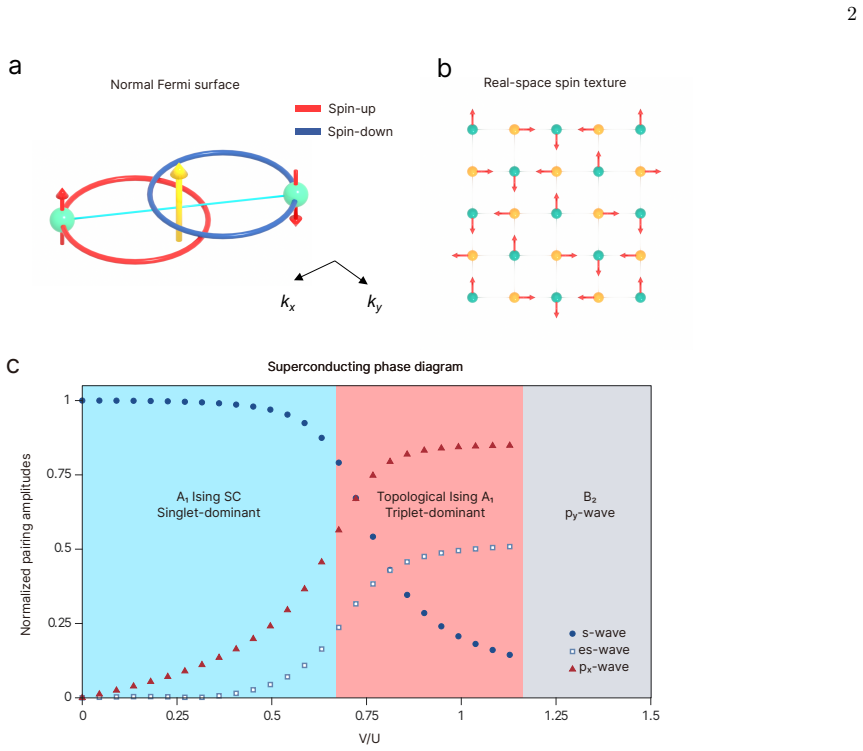
The central claim is that the superconducting ground state of the p-wave magnet is a mixed singlet-triplet Ising pairing whose balance is tunable by interaction range; once the triplet gap surpasses the singlet gap this state undergoes a transition into a nodal topological superconductor whose Majorana edge modes are protected by momentum-resolved winding numbers. The mixing is made possible because the odd-parity exchange field eliminates inversion symmetry while preserving a single A1 irreducible representation for the order parameter.
What carries the argument
The odd-parity exchange field of the p-wave magnet, which spin-splits the bands and removes inversion symmetry so that singlet and triplet order parameters can mix inside one A1 symmetry channel.
If this is right
- Strengthening nearest-neighbor attraction relative to onsite attraction continuously increases the triplet weight and drives the system through the nodal topological transition.
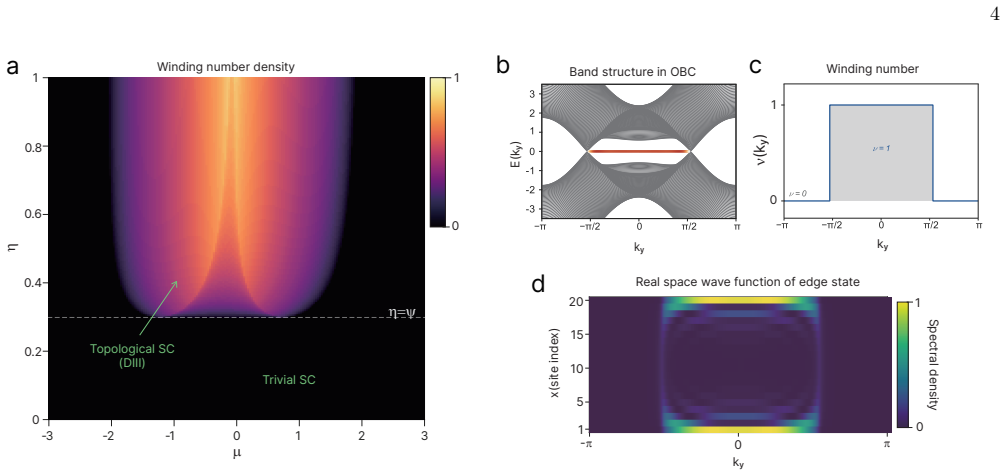
- The topological phase supports Majorana edge modes that exist over finite momentum intervals bounded by the surface projections of the bulk point nodes.
- A Zeeman field applied perpendicular to the exchange field induces a Z2 topological superconducting state even when a single gap component dominates.
- Topological superconductivity arises here from non-relativistic exchange splitting rather than from strong spin-orbit coupling.
Where Pith is reading between the lines
- Candidate materials with p-wave magnetic order could be tuned across the singlet-triplet transition by doping or pressure to test the appearance of edge modes.
- The momentum-resolved winding numbers imply that the edge modes occupy specific intervals in momentum space and might be mapped by angle-resolved probes.
- The same symmetry-allowed mixing could appear in other magnets whose exchange field is odd under inversion, suggesting a broader class of exchange-field-driven topological superconductors.
Load-bearing premise
The odd-parity exchange field of the p-wave magnet removes inversion symmetry in the spin-split electronic structure, thereby allowing singlet and triplet order parameters to mix within a single A1 symmetry channel.
What would settle it
Observation of a fully gapped edge spectrum with no Majorana modes in a material realizing the p-wave magnet, even after the nearest-neighbor attraction is strengthened enough that the triplet gap should exceed the singlet gap.
Figures


read the original abstract
Fermi-surface spin splitting generated by non-relativistic exchange fields provides a new route to topological superconductivity without relying on strong spin-orbit coupling. Here, we study superconducting instabilities of a square-lattice $p$-wave magnet with onsite and nearest-neighbour attractive interactions. The odd-parity exchange field removes inversion symmetry in the spin-split electronic structure, allowing singlet and triplet order parameters to mix within a single $A_1$ symmetry channel. The leading instability is a coupled $s+p_x$ Ising state, whose singlet-triplet balance is continuously tunable by the relative strength of the nearest-neighbour attraction. When the triplet gap amplitude exceeds the singlet one, this Ising state undergoes a transition into a nodal topological superconducting phase with Majorana edge modes protected by momentum-resolved winding numbers. These modes extend over finite momentum intervals bounded by the surface projections of bulk point nodes. We further show that a Zeeman field perpendicular to the exchange field can induce a $Z_2$ topological superconducting phase, even in the regime where a single gap dominates.
Editorial analysis
A structured set of objections, weighed in public.
Referee Report
Summary. The manuscript examines superconducting instabilities in a square-lattice p-wave magnet with onsite and nearest-neighbor attractive interactions. The odd-parity exchange field is shown to remove inversion symmetry from the spin-split bands, allowing singlet and triplet order parameters to mix inside a single A1 channel. The leading instability is a coupled s + p_x Ising state whose singlet-triplet ratio is continuously tunable by the relative strength of the nearest-neighbor attraction. When the triplet amplitude exceeds the singlet amplitude the state becomes nodal and topologically nontrivial, hosting Majorana edge modes protected by momentum-resolved winding numbers over finite momentum intervals. An additional perpendicular Zeeman field is shown to drive a Z2 topological superconducting phase even in the single-gap-dominated regime.
Significance. If the central claims are verified, the work supplies a concrete, interaction-tunable route to topological superconductivity that relies only on non-relativistic p-wave exchange fields rather than strong spin-orbit coupling. The continuous singlet-triplet tuning, the explicit nodal-to-topological transition, and the Zeeman-induced Z2 phase constitute falsifiable predictions that could guide experiments in candidate p-wave magnets. The reliance on standard group-theory classification and bulk-boundary correspondence for winding numbers is a strength; no ad-hoc parameters beyond the stated interaction ratio are introduced.
minor comments (2)
- The abstract states that the gap vanishes on finite arcs when |Δ_t| > |Δ_s|, but a brief sentence clarifying the precise scaling with Fermi velocity would remove any ambiguity for readers unfamiliar with the square-lattice dispersion.
- A single figure summarizing the phase diagram versus nearest-neighbor attraction strength and Zeeman field would make the tunability and the two distinct topological regimes immediately visible.
Simulated Author's Rebuttal
We thank the referee for their careful reading of the manuscript, for the accurate summary of our results, and for recommending acceptance. We are pleased that the central claims regarding the tunable singlet-triplet Ising state, the nodal topological transition, and the Zeeman-induced Z2 phase were viewed as clear and falsifiable.
Circularity Check
No circularity detected; derivation is self-contained
full rationale
The paper derives the leading A1-channel s+px Ising instability and its nodal topological transition directly from the momentum dependence of the gap functions on the square-lattice Fermi surface, combined with standard group-theoretic classification of singlet-triplet mixing permitted by the odd-parity exchange field breaking inversion. Momentum-resolved winding numbers and bulk-boundary correspondence for the Majorana arcs follow from conventional topological band theory without any reduction to fitted parameters, self-citations that bear the central load, or ansatzes smuggled in from prior work. The Zeeman-field-induced Z2 phase is likewise obtained from explicit symmetry analysis. No step in the chain is equivalent to its inputs by construction.
Axiom & Free-Parameter Ledger
free parameters (1)
- relative strength of nearest-neighbour attraction
axioms (1)
- domain assumption The odd-parity exchange field removes inversion symmetry in the spin-split electronic structure, allowing singlet and triplet order parameters to mix within a single A1 symmetry channel.
Reference graph
Works this paper leans on
-
[1]
Qi and S.-C
X.-L. Qi and S.-C. Zhang, Topological insulators and su- perconductors, Rev. Mod. Phys.83, 1057 (2011)
2011
-
[2]
Sato and Y
M. Sato and Y. Ando, Topological superconductors: A review, Rep. Prog. Phys.80, 076501 (2017)
2017
-
[3]
Y. Oreg, G. Refael, and F. von Oppen, Helical liquids and majorana bound states in quantum wires, Phys. Rev. Lett.105, 177002 (2010)
2010
-
[4]
S. M. Albrecht, A. P. Higginbotham, M. Madsen, F. Kuemmeth, T. S. Jespersen, J. Nyg˚ ard, P. Krogstrup, and C. M. Marcus, Exponential protection of zero modes in majorana islands, Nature531, 206 (2016)
2016
-
[5]
Fu and C
L. Fu and C. L. Kane, Superconducting proximity effect and majorana fermions at the surface of a topological insulator, Phys. Rev. Lett.100, 096407 (2008)
2008
-
[6]
Nadj-Perge, I
S. Nadj-Perge, I. K. Drozdov, J. Li, H. Chen, S. Jeon, J. Seo, A. H. MacDonald, B. A. Bernevig, and A. Yaz- dani, Observation of majorana fermions in ferromagnetic atomic chains on a superconductor, Science346, 602 (2014)
2014
-
[7]
A. P. Mackenzie and Y. Maeno, The superconductivity of sr 2ruo4 and the physics of spin-triplet pairing, Rev. Mod. Phys.75, 657 (2003)
2003
-
[8]
S. R. Elliott and M. Franz, Colloquium: Majorana fermions in nuclear, particle, and solid-state physics, Rev. Mod. Phys.87, 137 (2015)
2015
-
[9]
ˇSmejkal, J
L. ˇSmejkal, J. Sinova, and T. Jungwirth, Emerging re- search landscape of altermagnetism, Phys. Rev. X12, 040501 (2022)
2022
-
[10]
S. A. A. Ghorashi, T. L. Hughes, and J. Cano, Altermag- netic routes to majorana modes in zero net magnetiza- tion, Physical Review Letters133, 106601 (2024)
2024
-
[11]
L. V. Pupim and M. S. Scheurer, Adatom engineer- ing magnetic order in superconductors: Applications to altermagnetic superconductivity, Phys. Rev. Lett.134, 146001 (2025)
2025
-
[12]
Sim and J
G. Sim and J. Knolle, Pair density waves and super- current diode effect in altermagnets, Phys. Rev. B112, L020502 (2025)
2025
-
[13]
Soto-Garrido and E
R. Soto-Garrido and E. Fradkin, Pair-density-wave su- perconducting states and electronic liquid-crystal phases, Physical Review B89, 165126 (2014)
2014
-
[14]
Chakraborty and A
D. Chakraborty and A. M. Black-Schaffer, Constraints on superconducting pairing in altermagnets, Phys. Rev. B112, 014516 (2025)
2025
-
[15]
Chakraborty and A
D. Chakraborty and A. M. Black-Schaffer, Zero-field finite-momentum and field-induced superconductivity in altermagnets, Phys. Rev. B110, L060508 (2024)
2024
-
[16]
Parthenios, P
N. Parthenios, P. M. Bonetti, R. Gonz´ alez-Hern´ andez, W. H. Campos, L. ˇSmejkal, and L. Classen, Spin and pair density waves in two-dimensional altermagnetic metals, Physical Review B112, 214410 (2025)
2025
-
[17]
Monkman, J
K. Monkman, J. Weng, N. Heinsdorf, A. Nocera, Y. Bar- las, and M. Franz, Persistent spin currents in supercon- ducting altermagnets, Phys. Rev. X16, 011057 (2026)
2026
-
[18]
Heinsdorf and M
N. Heinsdorf and M. Franz, Proximitizing altermagnets with conventional superconductors, Phys. Rev. B113, L020501 (2026)
2026
-
[19]
A. Bose, S. Vadnais, and A. Paramekanti, Altermag- netism and superconductivity in a multiorbitalt−j model, Phys. Rev. B110, 205120 (2024)
2024
-
[20]
H. Hu, Z. Liu, and X.-J. Liu, Unconventional supercon- ductivity of an altermagnetic metal: Polarized bcs and in- homogeneous fflo states, Physical Review B112, 184501 (2025)
2025
-
[21]
Z. Liu, H. Hu, and X.-J. Liu, Fulde-ferrell-larkin- ovchinnikov states and topological bogoliubov fermi sur- faces in altermagnets: An analytical study, Physical Re- view B113, 024518 (2026)
2026
- [22]
-
[23]
S. B. Hong, M. J. Park, and K.-M. Kim, Superconducting instabilities in altermagnets, Phys. Rev. B111, 054501 (2025)
2025
-
[24]
Zhu, Z.-Y
D. Zhu, Z.-Y. Zhuang, Z. Wu, and Z. Yan, Topological superconductivity in two-dimensional altermagnetic met- als, Phys. Rev. B108, 184505 (2023)
2023
-
[25]
Brekke, A
B. Brekke, A. Brataas, and A. Sudbø, Two-dimensional altermagnets: Superconductivity in a minimal micro- scopic model, Phys. Rev. B108, 224421 (2023)
2023
-
[26]
A. B. Hellenes, T. Jungwirth, R. Jaeschke-Ubiergo, A. Chakraborty, J. Sinova, and L. ˇSmejkal,p-wave mag- nets, Phys. Rev. X (2024), arXiv:2309.01607 [cond- mat.mes-hall]
work page Pith review arXiv 2024
-
[27]
Chakraborty, A
A. Chakraborty, A. Birk Hellenes, R. Jaeschke-Ubiergo, T. Jungwirth, L. ˇSmejkal, and J. Sinova, Highly efficient non-relativistic edelstein effect in nodal p-wave magnets, Nat. Commun.16, 7270 (2025)
2025
-
[28]
Brekke, P
B. Brekke, P. Sukhachov, H. G. Giil, A. Brataas, and J. Linder, Minimal models and transport properties of unconventionalp-wave magnets, Phys. Rev. Lett.133, 236703 (2024)
2024
-
[29]
Y. Yu, M. B. Lyngby, T. Shishidou, M. Roig, A. Kreisel, M. Weinert, B. M. Andersen, and D. F. Agterberg, Odd- parity magnetism driven by antiferromagnetic exchange, Phys. Rev. Lett.135, 046701 (2025)
2025
- [30]
- [31]
-
[32]
Ezawa, Topological insulators and superconductors based onp-wave magnets: Electrical control and detec- tion of a domain wall, Phys
M. Ezawa, Topological insulators and superconductors based onp-wave magnets: Electrical control and detec- tion of a domain wall, Phys. Rev. B110, 165429 (2024)
2024
-
[33]
Z.-T. Sun, X. Feng, Y.-M. Xie, B. T. Zhou, J.-X. Hu, and K. T. Law, Pseudo-ising superconductivity induced byp-wave magnetism, Phys. Rev. B112, 214504 (2025)
2025
-
[34]
Nagae, L
Y. Nagae, L. Katayama, and S. Ikegaya, Flat-band zero- energy states and anomalous proximity effects inp-wave magnet–superconductor hybrid systems, Phys. Rev. B 111, 174519 (2025)
2025
-
[35]
L. P. Gor’kov and E. I. Rashba, Superconducting 2d system with lifted spin degeneracy: Mixed singlet-triplet state, Phys. Rev. Lett.87, 037004 (2001)
2001
-
[36]
Khodas et al.,Nonrelativistic-Ising superconductivity in p-wave magnets, arXiv:2601.19829 (2026)
M. Khodas, L. ˇSmejkal, and I. I. Mazin, Nonrelativistic- Ising superconductivity inp-wave magnets, arXiv preprint (2026), arXiv:2601.19829 [cond-mat.supr-con]
-
[37]
Wickramaratne and I
D. Wickramaratne and I. I. Mazin, Ising superconductiv- ity: A first-principles perspective, Appl. Phys. Lett.122, 240503 (2023)
2023
-
[38]
Topological Ising superconductivity in two-dimensionalp-wave magnet
R. M. Lutchyn, J. D. Sau, and S. Das Sarma, Ma- jorana fermions and a topological phase transition in semiconductor-superconductor heterostructures, Phys. Rev. Lett.105, 077001 (2010). 10 Supplemental Material for “Topological Ising superconductivity in two-dimensionalp-wave magnet” Kyoung-Min Kim, Gibaik Sim, and Moon Jip Park CONTENTS I. Introduction 1 ...
2010
discussion (0)
Sign in with ORCID, Apple, or X to comment. Anyone can read and Pith papers without signing in.