Distributional Causal Mediation via Conditional Generative Modeling
Pith reviewed 2026-05-09 17:11 UTC · model grok-4.3
The pith
Distributional Causal Mediation Analysis learns conditional generative models to reconstruct full interventional outcome distributions transmitted through multiple mediators.
A machine-rendered reading of the paper's core claim, the machinery that carries it, and where it could break.
Core claim
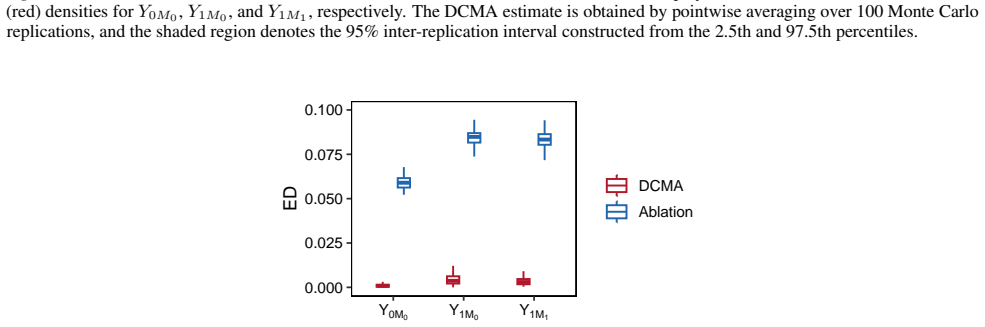
DCMA learns conditional generative models for the mediators and the outcome, recovering the relevant conditional distributions from observational data. Leveraging the identification formulas, it reconstructs interventional outcome distributions via Monte Carlo forward simulation by noise resampling, enabling the capture of both classical summary effects and rich distributional contrasts such as energy distance and the Wasserstein distance.
What carries the argument
Conditional generative models for mediators and outcome combined with Monte Carlo forward simulation by noise resampling to reconstruct interventional distributions.
If this is right
- Enables measurement of treatment effects on entire outcome distributions rather than just means.
- Supports computation of distributional contrasts including energy distance and Wasserstein distance.
- Provides analytical error bounds that decompose propagation from model estimation errors to final distributional estimates.
- Handles multiple mediators simultaneously in the generative simulation.
Where Pith is reading between the lines
- The simulation approach could be adapted to settings with time-varying mediators by extending the generative models to sequential conditioning.
- Integration with sensitivity analysis tools might quantify robustness to the no-unmeasured-confounding assumption in practice.
- Policy applications could shift from optimizing average outcomes to minimizing tail risks or inequality in full distributions.
Load-bearing premise
The learned conditional generative models must accurately recover the true conditional distributions from observational data without unmeasured confounding or model misspecification.
What would settle it
A controlled simulation or randomized experiment where the true interventional outcome distribution is known independently; if DCMA's Monte Carlo reconstructions deviate substantially from this known distribution, the method fails.
Figures


read the original abstract
Mediation analysis has traditionally focused on outcome-level summary contrasts, such as mean effects, which may obscure substantial distributional changes induced by complex and nonlinear causal mechanisms. We propose Distributional Causal Mediation Analysis (DCMA), a generative learning framework for identifying and estimating treatment effects on entire outcome distributions transmitted through multiple mediators. DCMA learns conditional generative models for the mediators and the outcome, recovering the relevant conditional distributions from observational data. Leveraging the identification formulas, it reconstructs interventional outcome distributions via Monte Carlo forward simulation by noise resampling, enabling the capture of both classical summary effects and rich distributional contrasts such as energy distance and the Wasserstein distance. Analytical error bounds are derived to decompose how estimation errors in the learned conditional models propagate to the reconstructed interventional outcome distributions. The empirical effectiveness of DCMA is demonstrated through numerical experiments and real-world data applications.
Editorial analysis
A structured set of objections, weighed in public.
Referee Report
Summary. The paper proposes Distributional Causal Mediation Analysis (DCMA), a generative learning framework that learns conditional generative models for multiple mediators and the outcome from observational data. It reconstructs interventional outcome distributions under treatment via Monte Carlo forward simulation by resampling noise through the fitted conditionals, enabling estimation of both classical summary effects and distributional contrasts such as energy distance and Wasserstein distance. Analytical error bounds are derived to quantify propagation of estimation errors from the learned models to the reconstructed distributions, with validation via numerical experiments and real-world applications.
Significance. If the identification, reconstruction, and error bounds hold under the stated assumptions, the work would extend mediation analysis from mean effects to full distributional contrasts using modern conditional generative models, which could be valuable in applications where heterogeneity or tail behavior matters. The Monte Carlo approach and explicit error decomposition are strengths when the generative models are reliable; however, significance is tempered by the dependence on unverified recovery of the true observational conditionals.
major comments (2)
- [Abstract and error bounds section] The analytical error bounds (described in the abstract and presumably §4) decompose propagation under an oracle approximation error but do not address model misspecification or finite-sample bias in the generative training step itself. Since the Monte Carlo reconstruction of interventional distributions relies on the fitted models converging to the true P(M|A,X) and P(Y|M,A,X), any systematic mismatch directly biases all reported contrasts; this is load-bearing for the central claim of valid distributional estimation.
- [Identification and method sections] The identification step invokes standard formulas but the manuscript must explicitly state and justify the sequential ignorability / no unmeasured confounding assumptions for the full mediator chain (including how they interact with the generative modeling of multiple mediators); without this, the claim that the method 'identifies' the interventional distributions cannot be evaluated.
minor comments (2)
- [Notation and definitions] Clarify notation distinguishing the true conditional distributions from the learned generative approximations throughout the text.
- [Experiments section] The description of numerical experiments lacks detail on model architectures, training objectives, hyperparameter selection, and sensitivity analyses; add these to support reproducibility.
Simulated Author's Rebuttal
We thank the referee for the careful reading and constructive comments. We address the two major comments point by point below and describe the revisions we will make to strengthen the manuscript.
read point-by-point responses
-
Referee: [Abstract and error bounds section] The analytical error bounds (described in the abstract and presumably §4) decompose propagation under an oracle approximation error but do not address model misspecification or finite-sample bias in the generative training step itself. Since the Monte Carlo reconstruction of interventional distributions relies on the fitted models converging to the true P(M|A,X) and P(Y|M,A,X), any systematic mismatch directly biases all reported contrasts; this is load-bearing for the central claim of valid distributional estimation.
Authors: Our error bounds in §4 are derived to quantify propagation of approximation errors from the fitted conditional generative models to the Monte Carlo-reconstructed interventional distributions, with an explicit decomposition separating generative-model error from simulation error. They are stated under the assumption that the learned models approximate the true conditionals P(M|A,X) and P(Y|M,A,X). We acknowledge that the bounds do not themselves bound finite-sample training error or address model misspecification. In revision we will add a clarifying paragraph in §4 that states these scope limitations, notes the dependence on accurate generative-model training, and recommends practical diagnostics (e.g., held-out likelihood or posterior predictive checks) to assess model adequacy before applying the bounds. revision: partial
-
Referee: [Identification and method sections] The identification step invokes standard formulas but the manuscript must explicitly state and justify the sequential ignorability / no unmeasured confounding assumptions for the full mediator chain (including how they interact with the generative modeling of multiple mediators); without this, the claim that the method 'identifies' the interventional distributions cannot be evaluated.
Authors: We agree that the identifying assumptions require explicit statement. The manuscript currently invokes the standard identification formulas for distributional mediation but does not spell them out for the multi-mediator case. In the revised version we will insert a dedicated subsection (new §3.1) that states the sequential ignorability assumptions for treatment, the ordered mediators, and the outcome, together with the no-unmeasured-confounding conditions. We will justify how these assumptions license the use of the learned conditional generative models to identify the interventional distributions and how they interact with the Monte Carlo forward-simulation procedure. revision: yes
Circularity Check
No significant circularity; derivation relies on standard identification and simulation
full rationale
The paper applies established causal mediation identification formulas to learn conditional generative models P(M|A,X) and P(Y|M,A,X) from observational data, then reconstructs interventional distributions P(Y|do(A=a)) via Monte Carlo noise resampling. This simulation step produces the target distributional contrasts (energy distance, Wasserstein) as downstream quantities rather than redefining them as the fitted parameters themselves. Analytical error bounds decompose propagation of model estimation error under oracle assumptions but do not equate the interventional estimates to the training loss or fitted conditionals by construction. No self-citations, uniqueness theorems, or ansatzes are invoked as load-bearing premises. The method remains falsifiable against external benchmarks of causal identification and generative model recovery.
Axiom & Free-Parameter Ledger
Reference graph
Works this paper leans on
-
[1]
Identifiability and exchangeability for direct and indirect effects , author=. Epidemiology , volume=. 1992 , publisher=
work page 1992
- [2]
-
[3]
Epidemiologic methods , volume=
Mediation analysis with multiple mediators , author=. Epidemiologic methods , volume=. 2014 , publisher=
work page 2014
- [4]
-
[5]
wiley interdisciplinary reviews: Computational statistics , volume=
Energy distance , author=. wiley interdisciplinary reviews: Computational statistics , volume=. 2016 , publisher=
work page 2016
-
[6]
Journal of the American Statistical Association , volume=
A deep generative approach to conditional sampling , author=. Journal of the American Statistical Association , volume=. 2023 , publisher=
work page 2023
-
[7]
Journal of the Royal Statistical Society Series B: Statistical Methodology , pages=
Wasserstein generative regression , author=. Journal of the Royal Statistical Society Series B: Statistical Methodology , pages=. 2025 , publisher=
work page 2025
-
[8]
Journal of the Royal Statistical Society Series B: Statistical Methodology , volume=
Engression: extrapolation through the lens of distributional regression , author=. Journal of the Royal Statistical Society Series B: Statistical Methodology , volume=. 2025 , publisher=
work page 2025
-
[9]
Interventional effects for mediation analysis with multiple mediators , author=. Epidemiology , volume=. 2017 , publisher=
work page 2017
-
[10]
Journal of Causal Inference , volume=
Interventional approach for path-specific effects , author=. Journal of Causal Inference , volume=. 2017 , publisher=
work page 2017
- [11]
-
[12]
Journal of the Royal Statistical Society Series B: Statistical Methodology , volume=
Mediation analysis with time varying exposures and mediators , author=. Journal of the Royal Statistical Society Series B: Statistical Methodology , volume=. 2017 , publisher=
work page 2017
-
[13]
Nonlinear mediation analysis with high-dimensional mediators whose causal structure is unknown , author=. Biometrics , volume=. 2022 , publisher=
work page 2022
-
[14]
Statistical Methods in Medical Research , volume=
Mediation effects that emulate a target randomised trial: simulation-based evaluation of ill-defined interventions on multiple mediators , author=. Statistical Methods in Medical Research , volume=. 2021 , publisher=
work page 2021
-
[15]
Journal of Causal Inference , volume=
Nonparametric inference for interventional effects with multiple mediators , author=. Journal of Causal Inference , volume=. 2021 , publisher=
work page 2021
-
[16]
arXiv preprint arXiv:2506.14019 , year=
Causal Mediation Analysis with Multiple Mediators: A Simulation Approach , author=. arXiv preprint arXiv:2506.14019 , year=
-
[17]
Effect decomposition in the presence of an exposure-induced mediator-outcome confounder , author=. Epidemiology , volume=. 2014 , publisher=
work page 2014
- [18]
-
[19]
arXiv preprint arXiv:2506.05945 , year=
On Efficient Estimation of Distributional Treatment Effects under Covariate-Adaptive Randomization , author=. arXiv preprint arXiv:2506.05945 , year=
-
[20]
Journal of the American statistical Association , volume=
Strictly proper scoring rules, prediction, and estimation , author=. Journal of the American statistical Association , volume=. 2007 , publisher=
work page 2007
-
[21]
International conference on machine learning , pages=
Wasserstein generative adversarial networks , author=. International conference on machine learning , pages=. 2017 , organization=
work page 2017
-
[22]
Advances in neural information processing systems , volume=
Improved training of wasserstein gans , author=. Advances in neural information processing systems , volume=
-
[23]
The annals of statistics , pages=
Equivalence of distance-based and RKHS-based statistics in hypothesis testing , author=. The annals of statistics , pages=. 2013 , publisher=
work page 2013
-
[24]
Journal of the American Statistical Association , volume=
De-confounding causal inference using latent multiple-mediator pathways , author=. Journal of the American Statistical Association , volume=. 2024 , publisher=
work page 2024
discussion (0)
Sign in with ORCID, Apple, or X to comment. Anyone can read and Pith papers without signing in.