Recognition: unknown
Neural Decision-Propagation for Answer Set Programming
Pith reviewed 2026-05-10 15:08 UTC · model grok-4.3
The pith
Decision-propagation computes stable models by alternating falsity decisions and truth propagations, and its neural version learns to do so efficiently.
A machine-rendered reading of the paper's core claim, the machinery that carries it, and where it could break.
Core claim
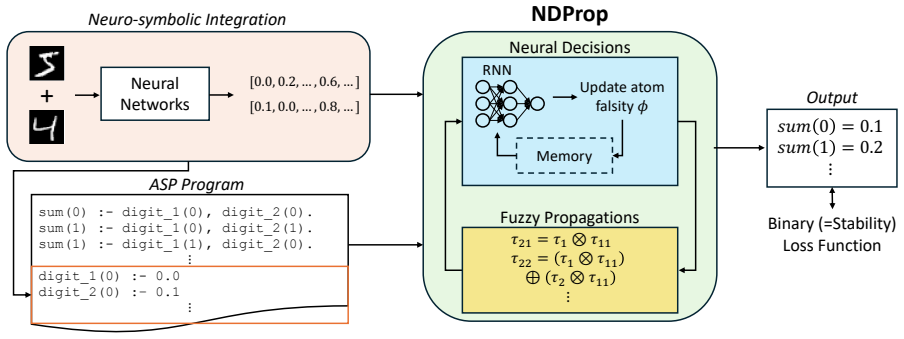
The paper shows that successful decision-propagation computations, which alternate falsity decisions and truth propagations, capture the stable model semantics of an answer set program. It then presents Neural DProp, a differentiable extension that replaces the decisions with neural computation and the propagations with fuzzy evaluation, and demonstrates that this version can be trained to compute stable models efficiently while improving accuracy and scalability on neuro-symbolic benchmarks.
What carries the argument
Decision-propagation (DProp): the procedure that alternates falsity decisions with truth propagations to derive stable models.
If this is right
- NDProp learns decision heuristics that compute stable models efficiently.
- The approach improves accuracy and scalability compared with prior neuro-symbolic ASP methods.
- Reasoning pipelines can integrate ASP directly with neural networks without calling classical solvers.
- End-to-end differentiability enables training on the combined neural-symbolic system.
Where Pith is reading between the lines
- Training on small programs might generalize to larger instances if the learned heuristics capture structural patterns.
- The same propagation structure could be adapted to other non-monotonic reasoning formalisms.
- Fuzzy propagation opens a route to handling uncertain or probabilistic variants of answer set programs.
Load-bearing premise
Neural decisions combined with fuzzy propagations can approximate exact stable-model computation closely enough to preserve correctness and generalize beyond the training distribution.
What would settle it
A counter-example in which NDProp returns an interpretation that violates the stable-model condition on a program outside the training set, or fails to produce any stable model on programs larger than those used in the reported benchmarks.
Figures

read the original abstract
Integration of Answer Set Programming (ASP) with neural networks has emerged as a promising tool in Neuro-symbolic AI. While existing approaches extend the capabilities of ASP to real world domains, their reasoning pipelines depend on classical solvers, which is a bottleneck for scalability. To tackle this problem, we propose a new method to compute stable models, called decision-propagation (DProp), which alternates falsity decisions and truth propagations. Successful DProp computations are shown to capture the stable model semantics. We then develop Neural DProp (NDProp), a differentiable extension of DProp with neural computation for decisions and fuzzy evaluation for propagations. We evaluate the capabilities of NDProp for learning decision heuristics as well as neuro-symbolic integration, and compare it with existing neuro-symbolic approaches. The results show that NDProp can learn to efficiently compute stable models, and it improves accuracy and scalability on neuro-symbolic benchmarks.
Editorial analysis
A structured set of objections, weighed in public.
Referee Report
Summary. The paper proposes Decision-Propagation (DProp), an iterative procedure that alternates falsity decisions with truth propagations to compute stable models of answer set programs, claiming that successful runs capture the stable-model semantics. It then introduces Neural DProp (NDProp), a differentiable variant that replaces decisions with a neural network and propagations with fuzzy logic, enabling learning of decision heuristics. The work evaluates NDProp on neuro-symbolic benchmarks, reporting gains in accuracy and scalability over prior neuro-symbolic ASP approaches.
Significance. If the central claims hold, the work offers a promising direction for scalable neuro-symbolic integration by avoiding reliance on classical ASP solvers. The DProp procedure provides an intuitive, non-backtracking view of stable-model computation, and the empirical results on learning heuristics and benchmark tasks indicate practical utility. Strengths include the explicit separation of decision and propagation steps and the end-to-end differentiability of NDProp, which could support further integration with gradient-based methods.
major comments (3)
- [§3] §3: The manuscript establishes that successful DProp executions match stable-model semantics through alternating falsity decisions and truth propagations, yet provides no completeness argument showing that every consistent program admits at least one successful DProp path that recovers all stable models. Without this, the claim that DProp 'captures the stable model semantics' remains partial.
- [§4.2] §4.2: NDProp substitutes classical propagations with fuzzy logic and decisions with a learned network to obtain differentiability. No formal invariant is supplied that relates the resulting fuzzy fixed point back to the classical reduct or guarantees that learned heuristics avoid non-successful branches, so correctness of NDProp rests entirely on the reported empirical results.
- [§5] §5: The experimental section asserts that NDProp improves accuracy and scalability on neuro-symbolic benchmarks, but supplies neither error bars, details on random seeds or data splits, nor statistical significance tests for the reported gains. This absence makes it difficult to assess whether the observed improvements are robust or reproducible.
minor comments (3)
- [§4] The definition of the fuzzy operators used in the propagation step (Eq. 7) would benefit from an explicit comparison table against the classical Boolean operators to clarify the approximation introduced.
- [§5] Figure 3 (benchmark scalability plots) lacks y-axis scaling details and confidence intervals; adding these would improve interpretability of the runtime comparisons.
- [§2] A short related-work subsection contrasting DProp with existing propagation-based ASP algorithms (e.g., unit propagation in CDCL solvers) would help situate the contribution.
Simulated Author's Rebuttal
We are grateful to the referee for the constructive comments, which help improve the clarity and rigor of our work. Below, we provide point-by-point responses to the major comments and outline the revisions we plan to make in the next version of the manuscript.
read point-by-point responses
-
Referee: §3: The manuscript establishes that successful DProp executions match stable-model semantics through alternating falsity decisions and truth propagations, yet provides no completeness argument showing that every consistent program admits at least one successful DProp path that recovers all stable models. Without this, the claim that DProp 'captures the stable model semantics' remains partial.
Authors: We thank the referee for this observation. Section 3 provides a proof that any successful execution of DProp produces a stable model, establishing soundness with respect to the stable model semantics. However, we acknowledge that we do not present a completeness argument demonstrating that for every consistent program and every stable model, there exists a sequence of decisions leading to it via DProp. We will revise the abstract and Section 3 to state that 'successful DProp computations correspond to stable models' rather than claiming to fully 'capture the stable model semantics'. We will also add a remark that establishing completeness is an interesting direction for future work. revision: partial
-
Referee: §4.2: NDProp substitutes classical propagations with fuzzy logic and decisions with a learned network to obtain differentiability. No formal invariant is supplied that relates the resulting fuzzy fixed point back to the classical reduct or guarantees that learned heuristics avoid non-successful branches, so correctness of NDProp rests entirely on the reported empirical results.
Authors: We agree with this assessment. NDProp is designed as a differentiable, learned approximation to DProp, and we do not provide formal guarantees that the fuzzy fixed points correspond to classical stable models or that the learned heuristics always lead to successful branches. The end-to-end differentiability is intended to facilitate learning effective heuristics from data. We will expand Section 4.2 to explicitly state that the correctness of NDProp is supported by the empirical results on the benchmarks, and clarify the approximate nature of the fuzzy propagation. revision: yes
-
Referee: §5: The experimental section asserts that NDProp improves accuracy and scalability on neuro-symbolic benchmarks, but supplies neither error bars, details on random seeds or data splits, nor statistical significance tests for the reported gains. This absence makes it difficult to assess whether the observed improvements are robust or reproducible.
Authors: We appreciate this feedback on the experimental reporting. In the revised manuscript, we will include error bars computed over multiple independent runs with different random seeds, provide details on the data splits and preprocessing, and report statistical significance tests (such as Student's t-test) comparing NDProp against the baselines to substantiate the improvements in accuracy and scalability. revision: yes
Circularity Check
No significant circularity in derivation chain
full rationale
The paper defines DProp as an independent alternating procedure of falsity decisions and truth propagations, then states that successful executions capture stable model semantics (a separate proof claim). NDProp is introduced as a differentiable extension using neural decisions and fuzzy propagations, with learning of heuristics evaluated empirically on external neuro-symbolic benchmarks. No equations reduce a prediction to a fitted parameter by construction, no self-citation bears the load of the central semantics claim, and no ansatz or uniqueness result is smuggled in. The derivation remains self-contained against the stated benchmarks.
Axiom & Free-Parameter Ledger
Reference graph
Works this paper leans on
-
[1]
Artur d'Avila Garcez and Lu. Neurosymbolic. Artif. Intell. Rev. , volume =. 2023 , url =. doi:10.1007/S10462-023-10448-W , timestamp =
-
[2]
NeurASP: Embracing Neural Networks into Answer Set Programming , booktitle =
Zhun Yang and Adam Ishay and Joohyung Lee , editor =. NeurASP: Embracing Neural Networks into Answer Set Programming , booktitle =. 2020 , url =. doi:10.24963/IJCAI.2020/243 , timestamp =
-
[3]
Robin Manhaeve and Sebastijan Dumancic and Angelika Kimmig and Thomas Demeester and Luc De Raedt , title =. Artif. Intell. , volume =. 2021 , url =. doi:10.1016/J.ARTINT.2021.103504 , timestamp =
-
[4]
Richard Evans and Edward Grefenstette , title =. J. Artif. Intell. Res. , volume =. 2018 , url =. doi:10.1613/JAIR.5714 , timestamp =
-
[5]
What Is Answer Set Programming? , booktitle =
Vladimir Lifschitz , editor =. What Is Answer Set Programming? , booktitle =. 2008 , url =
2008
-
[6]
Gerhard Brewka and Thomas Eiter and Miroslaw Truszczynski , title =. Commun. 2011 , url =. doi:10.1145/2043174.2043195 , timestamp =
-
[7]
Graph-Based Attention for Differentiable Max
Sota Moriyama and Katsumi Inoue , booktitle=. Graph-Based Attention for Differentiable Max. 2025 , url=
2025
-
[8]
Learning a
Daniel Selsam and Matthew Lamm and Benedikt B. Learning a. 7th International Conference on Learning Representations,. 2019 , url =
2019
-
[9]
Graph Neural Networks for Maximum Constraint Satisfaction , journal =
Jan T. Graph Neural Networks for Maximum Constraint Satisfaction , journal =. 2020 , url =. doi:10.3389/FRAI.2020.580607 , timestamp =
-
[10]
Answer Set Computation of Negative Two-Literal Programs Based on Graph Neural Networks: Preliminary Results , booktitle =
Antonio Ielo and Francesco Ricca , editor =. Answer Set Computation of Negative Two-Literal Programs Based on Graph Neural Networks: Preliminary Results , booktitle =. 2021 , url =
2021
-
[11]
Deep Learning for the Generation of Heuristics in Answer Set Programming:
Carmine Dodaro and Davide Ilardi and Luca Oneto and Francesco Ricca , editor =. Deep Learning for the Generation of Heuristics in Answer Set Programming:. Logic Programming and Nonmonotonic Reasoning - 16th International Conference,. 2022 , url =. doi:10.1007/978-3-031-15707-3\_12 , timestamp =
-
[12]
Kewen Wang and Lian Wen and Kedian Mu , title =. Theory Pract. Log. Program. , volume =. 2015 , url =. doi:10.1017/S1471068414000611 , timestamp =
-
[13]
Stable Models and Non-Determinism in Logic Programs with Negation , booktitle =
Domenico Sacc. Stable Models and Non-Determinism in Logic Programs with Negation , booktitle =. 1990 , url =. doi:10.1145/298514.298572 , timestamp =
-
[14]
Fran. A New Fixpoint Semantics for General Logic Programs Compared with the Well-Founded and the Stable Model Semantics , journal =. 1991 , url =. doi:10.1007/BF03037172 , timestamp =
-
[15]
Embedding Negation as Failure into a Model Generation Theorem Prover , booktitle =
Katsumi Inoue and Miyuki Koshimura and Ryuzo Hasegawa , editor =. Embedding Negation as Failure into a Model Generation Theorem Prover , booktitle =. 1992 , url =. doi:10.1007/3-540-55602-8\_180 , timestamp =
-
[16]
Katsumi Inoue and Chiaki Sakama , title =. J. Log. Program. , volume =. 1996 , url =. doi:10.1016/0743-1066(95)00119-0 , timestamp =
-
[17]
Yasuyuki Shirai and Ryuzo Hasegawa , title =. 2004 , url =. doi:10.1007/978-3-540-28633-2\_7 , timestamp =
-
[18]
Theory Solving Made Easy with Clingo 5 , booktitle =
Martin Gebser and Roland Kaminski and Benjamin Kaufmann and Max Ostrowski and Torsten Schaub and Philipp Wanko , editor =. Theory Solving Made Easy with Clingo 5 , booktitle =. 2016 , url =. doi:10.4230/OASICS.ICLP.2016.2 , timestamp =
-
[19]
Nicola Leone and Gerald Pfeifer and Wolfgang Faber and Thomas Eiter and Georg Gottlob and Simona Perri and Francesco Scarcello , title =. 2006 , url =. doi:10.1145/1149114.1149117 , timestamp =
-
[20]
Logic Programming and Nonmonotonic Reasoning, 12th International Conference,
Mario Alviano and Carmine Dodaro and Wolfgang Faber and Nicola Leone and Francesco Ricca , editor =. Logic Programming and Nonmonotonic Reasoning, 12th International Conference,. 2013 , url =. doi:10.1007/978-3-642-40564-8\_6 , timestamp =
-
[21]
Lampert and Bernt Schiele and Zeynep Akata , title =
Yongqin Xian and Christoph H. Lampert and Bernt Schiele and Zeynep Akata , title =. 2019 , url =. doi:10.1109/TPAMI.2018.2857768 , timestamp =
-
[22]
Teodor C. Przymusinski , title =. Artif. Intell. , volume =. 1991 , url =. doi:10.1016/0004-3702(91)90013-A , timestamp =
-
[23]
Melvin Fitting , title =. Theor. Comput. Sci. , volume =. 2002 , url =. doi:10.1016/S0304-3975(00)00330-3 , timestamp =
-
[24]
Approximations, Stable Operators, Well-Founded Fixpoints and Applications in Nonmonotonic Reasoning
Denecker, Marc and Marek, Victor and Truszczy \' n ski, Miros aw. Approximations, Stable Operators, Well-Founded Fixpoints and Applications in Nonmonotonic Reasoning. Logic-Based Artificial Intelligence. 2000. doi:10.1007/978-1-4615-1567-8_6
-
[25]
Akihiro Takemura and Katsumi Inoue , title =. 2024 , url =. doi:10.3233/FAIA240628 , timestamp =
-
[26]
Taisuke Sato and Akihiro Takemura and Katsumi Inoue , title =. CoRR , volume =. 2023 , url =. doi:10.48550/ARXIV.2306.06821 , note =. 2306.06821 , timestamp =
-
[27]
Renato Lui Geh and Jonas Gon. Proceedings of the 21st International Conference on Principles of Knowledge Representation and Reasoning,. 2024 , url =. doi:10.24963/KR.2024/69 , timestamp =
-
[28]
ASPeRiX, a first-order forward chaining approach for answer set computing , journal =
Claire Lef. ASPeRiX, a first-order forward chaining approach for answer set computing , journal =. 2017 , url =. doi:10.1017/S1471068416000569 , timestamp =
-
[29]
Fuzzy Answer Set Programming , booktitle =
Davy Van Nieuwenborgh and Martine De Cock and Dirk Vermeir , editor =. Fuzzy Answer Set Programming , booktitle =. 2006 , url =. doi:10.1007/11853886\_30 , timestamp =
-
[30]
Fuzzy answer sets approximations , journal =
Mario Alviano and Rafael Pe. Fuzzy answer sets approximations , journal =. 2013 , url =. doi:10.1017/S1471068413000471 , timestamp =
-
[31]
Allen. The Well-Founded Semantics for General Logic Programs , journal =. 1991 , url =. doi:10.1145/116825.116838 , timestamp =
-
[32]
Arseny Skryagin and Daniel Ochs and Devendra Singh Dhami and Kristian Kersting , title =. J. Artif. Intell. Res. , volume =. 2023 , url =. doi:10.1613/JAIR.1.15027 , timestamp =
-
[33]
Alessandro. Fundam. Informaticae , volume =. 2009 , url =. doi:10.3233/FI-2009-180 , timestamp =
-
[34]
Lengning Liu and Enrico Pontelli and Tran Cao Son and Miroslaw Truszczynski , title =. Artif. Intell. , volume =. 2010 , url =. doi:10.1016/J.ARTINT.2009.11.016 , timestamp =
-
[35]
Fuzzy Description Logic Programs under the Answer Set Semantics for the Semantic Web , booktitle =
Thomas Lukasiewicz , editor =. Fuzzy Description Logic Programs under the Answer Set Semantics for the Semantic Web , booktitle =. 2006 , url =. doi:10.1109/RULEML.2006.12 , timestamp =
-
[36]
Answer Set Programming Phase Transition:
Yuting Zhao and Fangzhen Lin , editor =. Answer Set Programming Phase Transition:. Logic Programming, 19th International Conference,. 2003 , url =. doi:10.1007/978-3-540-24599-5\_17 , timestamp =
-
[37]
Answer Set Programming and Neurosymbolic AI: Applications and Future Perspectives (Invited Talk)
Borroto, Manuel and Ielo, Antonio and Mazzotta, Giuseppe and Ricca, Francesco. Answer Set Programming and Neurosymbolic AI: Applications and Future Perspectives (Invited Talk). Hybrid Models for Coupling Deductive and Inductive Reasoning. 2025
2025
-
[38]
Wenguan Wang and Yi Yang and Fei Wu , title =. 2025 , url =. doi:10.1109/TPAMI.2024.3483273 , timestamp =
-
[39]
Thomas Eiter and Nelson Higuera and Johannes Oetsch and Michael Pritz , title =. Theory Pract. Log. Program. , volume =. 2022 , url =. doi:10.1017/S1471068422000229 , timestamp =
-
[40]
Vito Barbara and Massimo Guarascio and Nicola Leone and Giuseppe Manco and Alessandro Quarta and Francesco Ricca and Ettore Ritacco , title =. Theory Pract. Log. Program. , volume =. 2023 , url =. doi:10.1017/S1471068423000170 , timestamp =
-
[41]
Tenenbaum and Jiajun Wu , title =
Jiayuan Mao and Chuang Gan and Pushmeet Kohli and Joshua B. Tenenbaum and Jiajun Wu , title =. 7th International Conference on Learning Representations,. 2019 , url =
2019
-
[42]
Michael K. Chen , title =. CoRR , volume =. 2025 , url =. doi:10.48550/ARXIV.2508.03366 , eprinttype =. 2508.03366 , timestamp =
-
[43]
Maarten H. van Emden and Robert A. Kowalski , title =. J. 1976 , url =. doi:10.1145/321978.321991 , timestamp =
-
[44]
The Alternating Fixpoint of Logic Programs with Negation , journal =
Allen. The Alternating Fixpoint of Logic Programs with Negation , journal =. 1993 , url =. doi:10.1016/0022-0000(93)90024-Q , timestamp =
-
[45]
Improving the Alternating Fixpoint: The Transformation Approach , booktitle =
Ulrich Zukowski and Burkhard Freitag and Stefan Brass , editor =. Improving the Alternating Fixpoint: The Transformation Approach , booktitle =. 1997 , url =. doi:10.1007/3-540-63255-7\_4 , timestamp =
-
[46]
Krzysztof R. Apt and Howard A. Blair and Adrian Walker , editor =. Towards a Theory of Declarative Knowledge , booktitle =. 1988 , url =. doi:10.1016/B978-0-934613-40-8.50006-3 , timestamp =
-
[47]
Gaunt and Marc Brockschmidt and Nate Kushman and Daniel Tarlow , editor =
Alexander L. Gaunt and Marc Brockschmidt and Nate Kushman and Daniel Tarlow , editor =. Differentiable Programs with Neural Libraries , booktitle =. 2017 , url =
2017
-
[48]
Hospedales and Loizos Michael , title =
Efthymia Tsamoura and Timothy M. Hospedales and Loizos Michael , title =. Thirty-Fifth. 2021 , url =. doi:10.1609/AAAI.V35I6.16639 , timestamp =
-
[49]
Differentiable
Matthias Nickles , editor =. Differentiable. Proceedings of the 5th International Workshop on Probabilistic Logic Programming,. 2018 , url =
2018
discussion (0)
Sign in with ORCID, Apple, or X to comment. Anyone can read and Pith papers without signing in.