Recognition: unknown
Contextual Wireless Video Semantic Communication in MIMO-OFDM Systems
Pith reviewed 2026-05-09 15:53 UTC · model grok-4.3
The pith
M-CVST aligns video feature context to MIMO subcarriers and uses recursive sampling of past channel data to improve semantic video transmission over multi-path channels.
A machine-rendered reading of the paper's core claim, the machinery that carries it, and where it could break.
Core claim
By constructing a context-subcarrier correlation map that pairs video feature context with groups of MIMO subcarriers and pairing it with a recursive subcarrier sampling method that embeds time-correlated reference information, the M-CVST system improves channel state awareness inside the entropy coding model and thereby achieves superior reconstruction quality over multi-path MIMO channels compared with other semantic and traditional separated transmission schemes.
What carries the argument
The context-subcarrier correlation map that aligns video feature context with groups of MIMO subcarriers, together with recursive subcarrier sampling that re-uses time-correlated reference embeddings from prior samples.
Load-bearing premise
The context-subcarrier correlation map and recursive sampling method can be realized with modest overhead and that simulation results will translate to performance gains in actual time-varying multi-path MIMO channels.
What would settle it
Measurements in a live multi-path MIMO testbed where M-CVST shows no reduction in video distortion relative to a well-tuned separated source-channel scheme at the same rate and SNR would falsify the claimed superiority.
Figures


read the original abstract
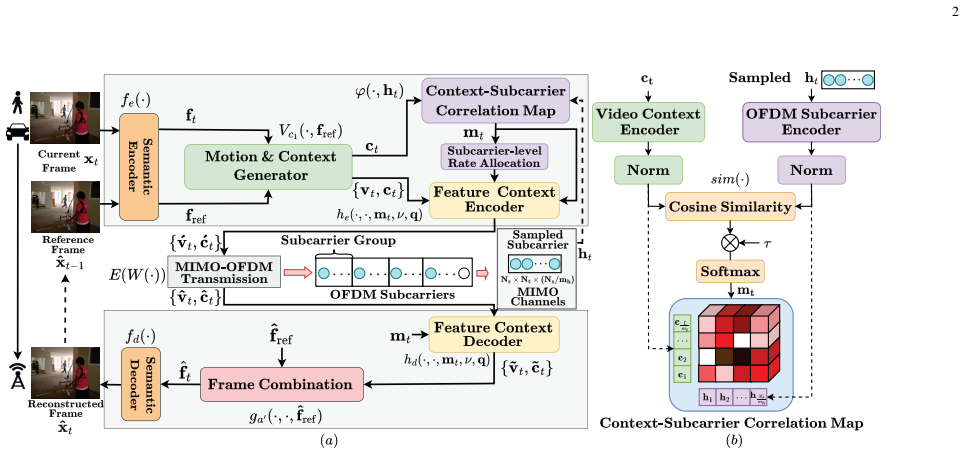
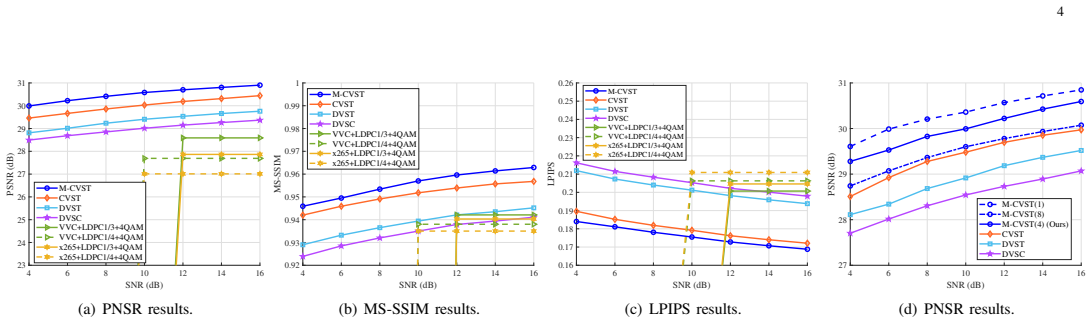
This paper proposes a MIMO-OFDM-based context video semantic transmission framework, namely M-CVST, for robust video communication over multi-path multiple-input multiple-output (MIMO) channels. It introduces a context-subcarrier correlation map that aligns video feature context with groups of MIMO subcarriers. To leverage the time-correlated nature of multi-path channels, a recursive subcarrier sampling method paired with time-correlated reference embedding is designed, enabling the use of previously sampled MIMO subcarrier CSI to enhance channel state awareness in the entropy coding model. Numerical results verify the superiority of proposed M-CVST over MIMO multi-path channels compared to other semantic schemes and traditional separated schemes.
Editorial analysis
A structured set of objections, weighed in public.
Referee Report
Summary. The manuscript proposes M-CVST, a MIMO-OFDM-based context video semantic transmission framework. It introduces a context-subcarrier correlation map to align video feature context with groups of MIMO subcarriers and a recursive subcarrier sampling method paired with time-correlated reference embedding to reuse prior MIMO CSI in the entropy coder, exploiting time-correlated multi-path channels. Numerical results are presented to claim superiority over other semantic schemes and traditional separated schemes.
Significance. If the numerical gains prove robust, the framework could contribute to semantic communications by combining context alignment with channel-state reuse in MIMO-OFDM, potentially improving rate-distortion performance for video under bandwidth-limited wireless conditions. The recursive sampling idea directly addresses time-varying channels, which is a relevant direction, though its value hinges on validation beyond idealized correlation assumptions.
major comments (2)
- [Abstract] Abstract: the superiority claim rests entirely on numerical results, yet no simulation parameters, mobility models (Doppler spread or coherence time), baselines, error bars, or statistical significance tests are described. Without these, it is impossible to determine whether reported gains over semantic and separated schemes are reproducible or regime-specific.
- [Recursive subcarrier sampling method] Recursive subcarrier sampling method (as described in the abstract): the approach assumes multi-path channel realizations remain sufficiently correlated across the recursive window so that stale CSI improves entropy coding. In MIMO-OFDM, coherence time is governed by Doppler spread; no analysis or results are provided for high-mobility regimes where coherence time falls below the sampling interval, raising the risk that the claimed advantage is an artifact of low-mobility traces.
minor comments (1)
- [Abstract] The abstract would be clearer if it explicitly named the performance metrics (e.g., PSNR, semantic similarity, throughput) used to demonstrate superiority.
Simulated Author's Rebuttal
We thank the referee for the constructive comments on our manuscript. We address each major comment point by point below and indicate the revisions we will make.
read point-by-point responses
-
Referee: [Abstract] Abstract: the superiority claim rests entirely on numerical results, yet no simulation parameters, mobility models (Doppler spread or coherence time), baselines, error bars, or statistical significance tests are described. Without these, it is impossible to determine whether reported gains over semantic and separated schemes are reproducible or regime-specific.
Authors: We agree that the abstract, due to its brevity, omits these details. We will revise the abstract to include key simulation parameters such as the MIMO-OFDM setup, mobility model with Doppler spread values, the baselines considered, and a note that results are averaged over multiple runs with error bars shown in the figures. We will also add statistical significance tests to the results section in the revised manuscript to strengthen the claims. revision: yes
-
Referee: [Recursive subcarrier sampling method] Recursive subcarrier sampling method (as described in the abstract): the approach assumes multi-path channel realizations remain sufficiently correlated across the recursive window so that stale CSI improves entropy coding. In MIMO-OFDM, coherence time is governed by Doppler spread; no analysis or results are provided for high-mobility regimes where coherence time falls below the sampling interval, raising the risk that the claimed advantage is an artifact of low-mobility traces.
Authors: We agree that the recursive sampling method relies on sufficient channel correlation over the window and that the manuscript does not analyze high-mobility cases where coherence time is short. We will add a discussion of the coherence time assumption in the revised manuscript along with new numerical results for higher Doppler spread values to show the performance boundary and when the advantage of time-correlated reference embedding holds. revision: yes
Circularity Check
No significant circularity; claims rest on numerical verification of proposed framework
full rationale
The paper introduces M-CVST with a context-subcarrier correlation map and recursive subcarrier sampling to leverage channel time-correlation, but the abstract and available text contain no equations, derivations, or self-referential definitions that reduce any result to its inputs by construction. The superiority claim is explicitly tied to numerical results comparing against baselines, which constitutes independent empirical verification rather than a tautological fit or self-citation chain. No load-bearing steps match the enumerated circularity patterns, and the derivation chain is self-contained against external benchmarks.
Axiom & Free-Parameter Ledger
axioms (1)
- domain assumption Multi-path MIMO-OFDM channels exhibit sufficient time correlation to make past CSI useful for current entropy coding
invented entities (1)
-
context-subcarrier correlation map
no independent evidence
Reference graph
Works this paper leans on
-
[1]
Overview of t he high efficiency video coding (HEVC) standard,
G. Sullivan, J. Ohm, W. Han, and T. Wiegand, “Overview of t he high efficiency video coding (HEVC) standard,” IEEE Trans. Circuits Syst. Video Technol., vol. 22, no. 12, pp. 1649-1668, Dec. 2012
2012
-
[2]
Overview of the versatile video cod ing (VVC) standard and its applications,
B. Benjamin, et al., “Overview of the versatile video cod ing (VVC) standard and its applications,” IEEE Trans. Circuits Syst. Video Technol., vol. 31, no.10, pp. 3736-3764, Aug. 2021
2021
-
[3]
Wireless Video Semantic Communication wi th Decoupled Diffusion Multi-frame Compensation,
B. Xie et al., “Wireless Video Semantic Communication wi th Decoupled Diffusion Multi-frame Compensation,” IEEE Trans. Commun. , vol. 74, pp. 987-1002, Nov. 2025
2025
-
[4]
Compression Ratio Allocation for Probab ilistic Semantic Communication With RSMA,
Z. Zhao et al., “Compression Ratio Allocation for Probab ilistic Semantic Communication With RSMA,” IEEE Trans. Commun. , vol. 73, no. 9, pp. 7304-7318, Sept. 2025
2025
-
[5]
Deep learning ena bled video semantic transmission against multi-dimensional no ise,
H. Niu, L. Wang, Z. Lu, K. Du, and X. Wen, “Deep learning ena bled video semantic transmission against multi-dimensional no ise,” in Proc. IEEE Glob. Commun. Conf. W orkshops (GLOBECOM W orkshops) , Kuala Lumpur, Malaysia, pp. 1267-1272, Dec. 2023
2023
-
[6]
Wireless Deep Video Semantic Transmissi on,
S. Wang et al., “Wireless Deep Video Semantic Transmissi on,” IEEE J. Select. Areas Commun. , vol. 41, no. 1, pp. 214-229, Jan. 2023
2023
-
[7]
Context Video Semantic Transmission with V ariable Length and Rate Coding over MIMO Channels,
B. Xie et al., “Context Video Semantic Transmission with V ariable Length and Rate Coding over MIMO Channels,” Dec. 2025. [Onli ne]. Available: https://arxiv.org/abs/2601.06059
-
[8]
Common Test Conditions and Software Re ference Configurations,
F. Bossen et al., “Common Test Conditions and Software Re ference Configurations,” document JCTVC-L1100, vol. 12, no. 7, 2013
2013
-
[9]
Robu st image semantic coding with learnable CSI fusion masking ove r MIMO fading channels,
B. Xie, Y . Wu, Y . Shi, W. Zhang, S. Cui, and M. Debbah, “Robu st image semantic coding with learnable CSI fusion masking ove r MIMO fading channels,” IEEE Trans. Wireless Commun. , vol. 23, no. 10, pp. 14155-14170, Oct. 2024
2024
-
[10]
Sionna: An Open-Source Library for Next-Generation Physical Layer Research,
H., Jakob, et al., “Sionna: An open-source library for n ext-generation physical layer research,” Mar. 2022. [Online]. Available: https://arxiv. org/abs/2203.11854
-
[11]
VV enC: An open and optimized VVC encode r imple- mentation,
W. Adam, et al., “VV enC: An open and optimized VVC encode r imple- mentation,” in IEEE Int. Conf. Multimedia Expo W orkshops , Shenzhen, China, Jun. 2021
2021
-
[12]
Converting video formats with FFmpeg,
S. Tomar, “Converting video formats with FFmpeg,” Linux J., vol. 2006, no. 146, Jun. 2006
2006
discussion (0)
Sign in with ORCID, Apple, or X to comment. Anyone can read and Pith papers without signing in.