Recognition: unknown
Koopman Representations for Early Outbreak Warning and Minimal Counterfactual Intervention in Multi-Agent Epidemic Simulations
Pith reviewed 2026-05-09 16:27 UTC · model grok-4.3
The pith
Koopman representations of early epidemic trajectories enable accurate prediction of major outbreaks and identification of minimal interventions that can prevent them.
A machine-rendered reading of the paper's core claim, the machinery that carries it, and where it could break.
Core claim
Aggregate daily observables from early trajectory windows are encoded into a low-dimensional Koopman latent space whose approximately linear evolution supports short-horizon forecasting and outbreak risk estimation. These representations combined with a random forest classifier predict whether the final attack rate exceeds a major outbreak threshold, and counterfactual analysis shows that minimal interventions such as keeping a single selected agent at home for one day can reduce attack rates and often shift the trajectory below the outbreak threshold.
What carries the argument
The Koopman latent space derived from aggregate daily observables, which approximates the nonlinear epidemic dynamics with linear evolution to enable forecasting and risk classification.
If this is right
- Early trajectory data suffices for reliable outbreak risk estimation in near-critical regimes.
- Single-agent, one-day interventions can frequently alter epidemic outcomes below threshold levels.
- Koopman-derived features enhance the separation between outbreak and non-outbreak classes in classifiers.
- Minimal counterfactual interventions become identifiable through analysis in the latent space.
Where Pith is reading between the lines
- If the Koopman approximation holds, similar techniques could extend to other multi-agent systems exhibiting threshold behaviors, such as opinion dynamics or resource allocation.
- Real-world application would require mapping observable aggregates like case counts or mobility to the simulation variables.
- The low-dimensional latent space suggests potential for scalable monitoring in large populations without full individual tracking.
Load-bearing premise
Aggregate daily observables from early trajectory windows can be effectively encoded into a Koopman latent space that supports accurate short-horizon forecasting and risk estimation in near-critical regimes.
What would settle it
Conducting additional simulations near the tipping points and finding that the random forest classifier's accuracy in predicting major outbreaks drops significantly below the reported strong performance, or that the identified single-agent interventions fail to shift trajectories below the threshold in a majority of cases.
Figures




read the original abstract
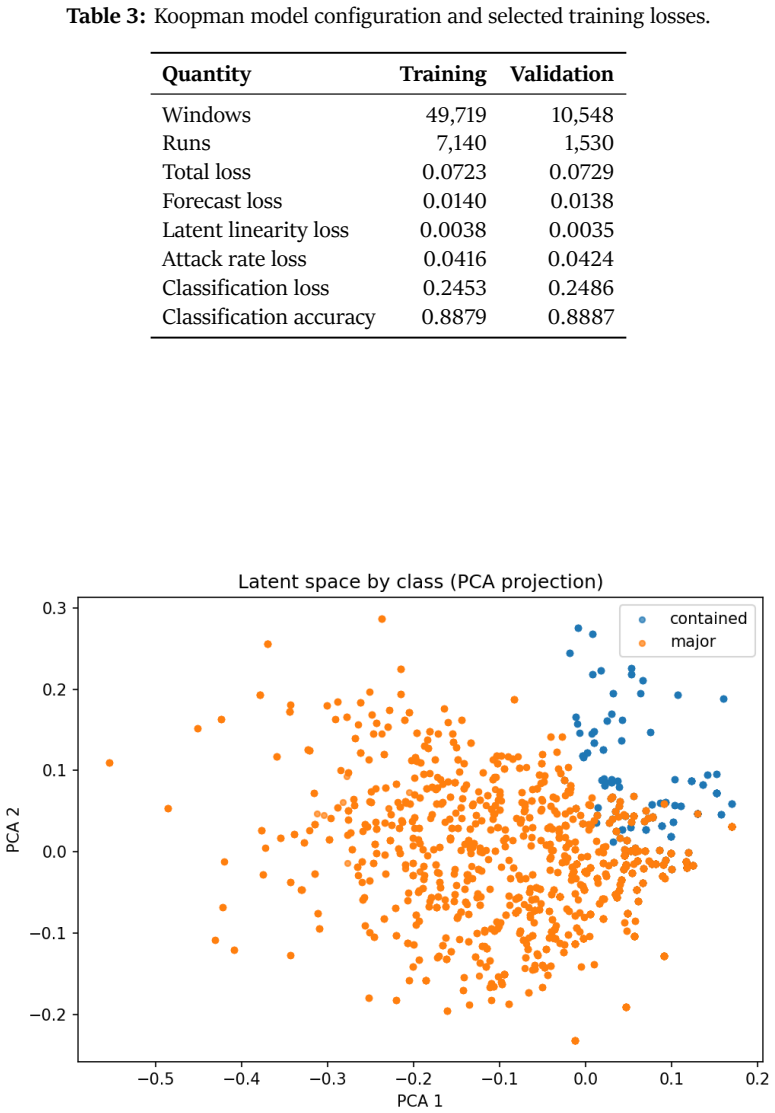
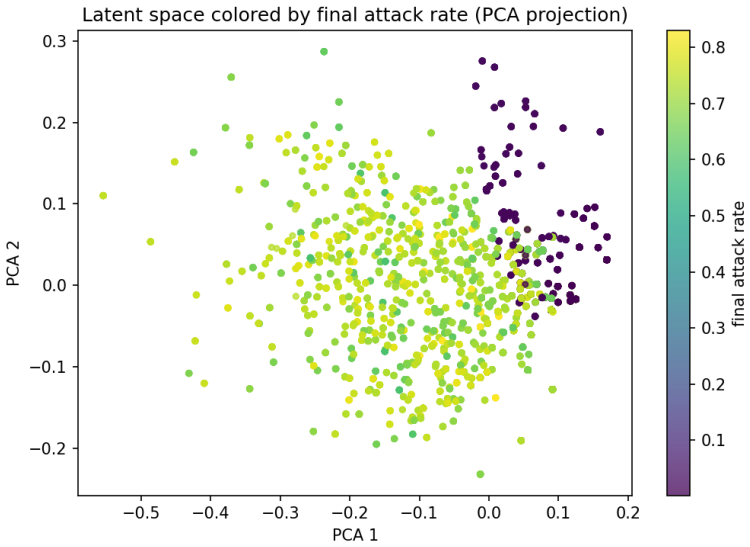
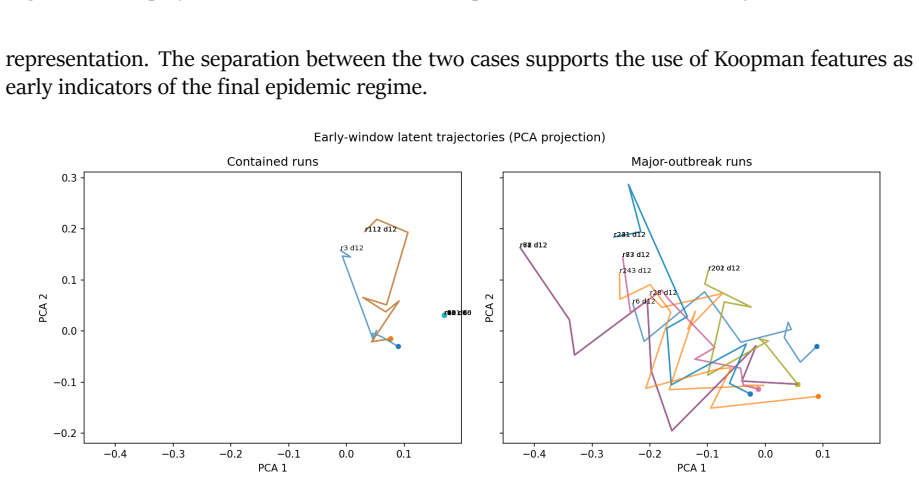
This paper presents a Koopman-based framework for early outbreak detection and intervention selection in a multi-agent epidemic simulation. Agents exhibit mobility patterns, heterogeneous susceptibility, immunity-dependent viral load progression, and local transmission through co-location. The goal of the simulation is to study near-critical epidemic regimes in which small changes in exposure or timing can alter the final outcome. Aggregate daily observables from early trajectory windows are encoded into a low-dimensional Koopman latent space whose approximately linear evolution supports short-horizon forecasting and outbreak risk estimation. These representations are combined with a random forest classifier trained to predict whether the final attack rate exceeds a major outbreak threshold. Experiments near the system tipping points show strong early warning performance, with Koopman-derived features contributing to class separation. Counterfactual analysis further shows that minimal interventions, such as keeping a single selected agent at home for one day, can reduce attack rates and, often, shift the trajectory below the outbreak threshold.
Editorial analysis
A structured set of objections, weighed in public.
Referee Report
Summary. The paper proposes a Koopman operator framework to encode early-window aggregate daily observables from multi-agent epidemic simulations (with mobility, heterogeneous susceptibility, immunity-dependent progression, and co-location transmission) into a low-dimensional latent space with approximately linear dynamics. This representation supports short-horizon forecasting and is combined with a random forest classifier trained on simulation trajectories to predict whether the final attack rate exceeds a major-outbreak threshold. Experiments near tipping points are reported to yield strong early-warning performance with Koopman features aiding class separation, while counterfactual analysis indicates that minimal single-agent interventions (e.g., one-day home isolation of a selected agent) can reduce attack rates and often shift trajectories below the outbreak threshold.
Significance. If validated with quantitative evidence, the work would demonstrate a promising data-driven approach for applying Koopman linearization to stochastic multi-agent systems near criticality, potentially enabling interpretable early-warning signals and minimal-intervention strategies in epidemic modeling. It integrates latent-space representations with supervised classification and counterfactual reasoning, which could inform real-time public-health decision tools. The focus on near-tipping-point regimes and single-agent perturbations is a notable strength, though the simulation-only setting and absence of reported metrics limit immediate claims of practical impact.
major comments (2)
- [Abstract] Abstract: the central claims of 'strong early warning performance' and effective minimal interventions are asserted without any quantitative metrics (e.g., AUC, precision-recall, comparison to baselines, or error bars), validation details, or error analysis, rendering the support for the claims unverifiable from the provided information.
- [Counterfactual analysis] Counterfactual analysis description: the claim that a Koopman latent-space perturbation corresponding to a single-agent one-day home isolation reliably maps to the true post-intervention distribution is load-bearing for the intervention result, yet the paper provides no explicit validation that the operator learned on unperturbed aggregate trajectories generalizes to such local perturbations; near criticality, aggregate observables average away the co-location heterogeneity that the intervention exploits, creating a risk that the linear embedding produces artifacts rather than accurate counterfactuals.
minor comments (2)
- The choice of Koopman latent-space dimension and the major-outbreak attack-rate threshold are listed as free parameters but receive no sensitivity analysis or justification for their selected values.
- Details on how the Koopman operator is learned (e.g., DMD variant, dictionary functions, training data split) and how the random forest is trained and evaluated (cross-validation, feature importance) are not specified in the abstract-level description.
Simulated Author's Rebuttal
We thank the referee for their constructive comments, which have helped us identify areas for improvement in our manuscript. Below, we provide a point-by-point response to the major comments and outline the revisions we intend to make.
read point-by-point responses
-
Referee: [Abstract] Abstract: the central claims of 'strong early warning performance' and effective minimal interventions are asserted without any quantitative metrics (e.g., AUC, precision-recall, comparison to baselines, or error bars), validation details, or error analysis, rendering the support for the claims unverifiable from the provided information.
Authors: We acknowledge that the abstract, as currently written, does not include quantitative metrics to support the claims of strong early-warning performance and effective interventions. This was an oversight in the presentation. In the revised version, we will update the abstract to include key quantitative results, such as AUC values for the classifier, performance comparisons to baseline methods, and error bars where applicable. We will also reference the specific sections in the manuscript where detailed validation and error analysis are provided. revision: yes
-
Referee: [Counterfactual analysis] Counterfactual analysis description: the claim that a Koopman latent-space perturbation corresponding to a single-agent one-day home isolation reliably maps to the true post-intervention distribution is load-bearing for the intervention result, yet the paper provides no explicit validation that the operator learned on unperturbed aggregate trajectories generalizes to such local perturbations; near criticality, aggregate observables average away the co-location heterogeneity that the intervention exploits, creating a risk that the linear embedding produces artifacts rather than accurate counterfactuals.
Authors: This is a valid concern, particularly given the stochastic and heterogeneous nature of the multi-agent system near criticality. The current manuscript relies on the assumption that the learned Koopman operator can be applied to perturbed states for counterfactual prediction, but does not include a direct comparison between the predicted post-intervention trajectories and those obtained from re-running the simulation with the intervention applied. To address this, we will add an explicit validation experiment in the revised manuscript. This will involve selecting a subset of trajectories, applying the single-agent intervention in the full simulation, and comparing the resulting attack rates and trajectories to those predicted via the Koopman perturbation. We will report quantitative discrepancies and discuss any limitations arising from the averaging of co-location effects in the aggregate observables. revision: yes
Circularity Check
No significant circularity; standard supervised feature extraction and classification on simulation trajectories
full rationale
The derivation proceeds by applying the Koopman operator approximation to early-window aggregate observables to obtain a latent representation, then training a random forest on those features (plus possibly raw observables) to classify whether final attack rate exceeds threshold. This is a conventional supervised pipeline: labels are the simulation outcomes, features are computed from initial segments, and performance is reported on held-out or cross-validated trajectories near tipping points. Counterfactuals are described via minimal single-agent interventions whose effects are measured in the simulator. No equation reduces to its input by definition, no fitted parameter is relabeled as an independent prediction, and no load-bearing claim rests on self-citation. The mapping from early aggregates to late outcomes is learned and empirically testable rather than tautological.
Axiom & Free-Parameter Ledger
free parameters (2)
- Koopman latent space dimension
- Major outbreak threshold for attack rate
axioms (2)
- domain assumption Epidemic dynamics admit a Koopman operator representation that is approximately linear in the latent space
- domain assumption The random forest classifier can effectively separate outbreak classes using Koopman features
Reference graph
Works this paper leans on
-
[1]
, title =
Watts, Duncan J. , title =. Proceedings of the National Academy of Sciences , year =
-
[2]
, title =
Das, Subir K. , title =. 2023 , eprint =
2023
-
[3]
Farahi, Zahra and Kamandi, Ali and Abedian, Rooholah and Rocha, Luis E. C. , title =. 2024 , eprint =
2024
-
[4]
International Journal of Advanced Robotic Systems , year =
Zhu, Qiuguo and Wu, Jun and Xiong, Rong , title =. International Journal of Advanced Robotic Systems , year =
-
[5]
Statistical Analysis of Tipping Pathways in Agent-based Models , journal =
Helfmann, Luzie and Heitzig, Jobst and Koltai, P. Statistical Analysis of Tipping Pathways in Agent-based Models , journal =. 2021 , volume =
2021
-
[6]
and Martin-Linares, Cristina P
Fabiani, Gianluca and Evangelou, Nikolaos and Cui, Tianqi and Bello-Rivas, Juan M. and Martin-Linares, Cristina P. and Siettos, Constantinos and Kevrekidis, Ioannis G. , title =. Nature Communications , year =
-
[7]
and Makeev, Alexei and Kevrekidis, Ioannis G
Evangelou, Nikolaos and Cui, Tianqi and Bello-Rivas, Juan M. and Makeev, Alexei and Kevrekidis, Ioannis G. , title =. Chaos: An Interdisciplinary Journal of Nonlinear Science , year =
-
[8]
Physica A: Statistical Mechanics and its Applications , year =
Peng, Xiaoyi and Zhao, Yi and Small, Michael , title =. Physica A: Statistical Mechanics and its Applications , year =
-
[9]
Chaos: An Interdisciplinary Journal of Nonlinear Science , year =
Patel, Dhruvit and Ott, Edward , title =. Chaos: An Interdisciplinary Journal of Nonlinear Science , year =
-
[10]
Extrapolating Tipping Points and Simulating Non-stationary Dynamics of Complex Systems Using Efficient Machine Learning , journal =
K. Extrapolating Tipping Points and Simulating Non-stationary Dynamics of Complex Systems Using Efficient Machine Learning , journal =. 2024 , volume =
2024
-
[11]
Applied Koopmanism , journal =
Budi. Applied Koopmanism , journal =. 2012 , volume =
2012
-
[12]
and Kevrekidis, Ioannis G
Williams, Matthew O. and Kevrekidis, Ioannis G. and Rowley, Clarence W. , title =. Journal of Nonlinear Science , year =
-
[13]
Nathan and Brunton, Steven L
Lusch, Bethany and Kutz, J. Nathan and Brunton, Steven L. , title =. Nature Communications , year =
-
[14]
and Brunton, Bingni W
Brunton, Steven L. and Brunton, Bingni W. and Proctor, Joshua L. and Kutz, J. Nathan , title =. PLOS ONE , year =
-
[15]
Exploring the Latent Space of Autoencoders with Interventional Assays , booktitle =
Leeb, Felix and Bauer, Stefan and Besserve, Michel and Sch. Exploring the Latent Space of Autoencoders with Interventional Assays , booktitle =. 2022 , volume =
2022
-
[16]
2024 , eprint =
Chen, Jianming and Wang, Yawen and Wang, Junjie and Xie, Xiaofei and Hu, Jun and Wang, Qing and Xu, Fanjiang , title =. 2024 , eprint =
2024
-
[17]
Steven L. Brunton, Bingni W. Brunton, Joshua L. Proctor, and J. Nathan Kutz. Koopman invariant subspaces and finite linear representations of nonlinear dynamical systems for control. PLOS ONE, 11 0 (2): 0 e0150171, 2016. doi:10.1371/journal.pone.0150171
-
[18]
Marko Budi s i \'c , Ryan Mohr, and Igor Mezi \'c . Applied koopmanism. Chaos: An Interdisciplinary Journal of Nonlinear Science, 22 0 (4): 0 047510, 2012. doi:10.1063/1.4772195
-
[19]
Understanding individual agent importance in multi-agent system via counterfactual reasoning, 2024
Jianming Chen, Yawen Wang, Junjie Wang, Xiaofei Xie, Jun Hu, Qing Wang, and Fanjiang Xu. Understanding individual agent importance in multi-agent system via counterfactual reasoning, 2024
2024
-
[20]
Subir K. Das. Finite-size behavior in phase transitions and scaling in the progress of an epidemic, 2023
2023
-
[21]
Bello-Rivas, Alexei Makeev, and Ioannis G
Nikolaos Evangelou, Tianqi Cui, Juan M. Bello-Rivas, Alexei Makeev, and Ioannis G. Kevrekidis. Tipping points of evolving epidemiological networks: Machine learning-assisted, data-driven effective modeling. Chaos: An Interdisciplinary Journal of Nonlinear Science, 34 0 (6): 0 063128, 2024. doi:10.1063/5.0187511
-
[22]
Gianluca Fabiani, Nikolaos Evangelou, Tianqi Cui, Juan M. Bello-Rivas, Cristina P. Martin-Linares, Constantinos Siettos, and Ioannis G. Kevrekidis. Task-oriented machine learning surrogates for tipping points of agent-based models. Nature Communications, 15 0 (1): 0 4117, 2024. doi:10.1038/s41467-024-48024-7
-
[23]
Zahra Farahi, Ali Kamandi, Rooholah Abedian, and Luis E. C. Rocha. Critical node detection in temporal social networks, based on global and semi-local centrality measures, 2024
2024
-
[24]
u rgen Kurths, and Christof Sch \
Luzie Helfmann, Jobst Heitzig, P \'e ter Koltai, J \"u rgen Kurths, and Christof Sch \"u tte. Statistical analysis of tipping pathways in agent-based models. The European Physical Journal Special Topics, 230 0 (16--17): 0 3249--3271, 2021. doi:10.1140/epjs/s11734-021-00191-0
-
[25]
Daniel K \"o glmayr and Christoph R \"a th. Extrapolating tipping points and simulating non-stationary dynamics of complex systems using efficient machine learning. Scientific Reports, 14: 0 507, 2024. doi:10.1038/s41598-023-50726-9
-
[26]
Exploring the latent space of autoencoders with interventional assays
Felix Leeb, Stefan Bauer, Michel Besserve, and Bernhard Sch \"o lkopf. Exploring the latent space of autoencoders with interventional assays. In Advances in Neural Information Processing Systems, volume 35. Curran Associates, Inc., 2022
2022
-
[27]
Bethany Lusch, J. Nathan Kutz, and Steven L. Brunton. Deep learning for universal linear embeddings of nonlinear dynamics. Nature Communications, 9: 0 4950, 2018. doi:10.1038/s41467-018-07210-0
-
[28]
Dhruvit Patel and Edward Ott. Using machine learning to anticipate tipping points and extrapolate to post-tipping dynamics of non-stationary dynamical systems. Chaos: An Interdisciplinary Journal of Nonlinear Science, 33 0 (2): 0 023143, 2023. doi:10.1063/5.0131787
-
[29]
Xiaoyi Peng, Yi Zhao, and Michael Small. Identification and prediction of bifurcation tipping points using complex networks based on quasi-isometric mapping. Physica A: Statistical Mechanics and its Applications, 560: 0 125108, 2020. doi:10.1016/j.physa.2020.125108
-
[30]
Duncan J. Watts. A simple model of global cascades on random networks. Proceedings of the National Academy of Sciences, 99 0 (9): 0 5766--5771, 2002. doi:10.1073/pnas.082090499
-
[31]
Alexander D Wilson, Joshua A Schultz, and Todd D Murphey
Matthew O. Williams, Ioannis G. Kevrekidis, and Clarence W. Rowley. A data-driven approximation of the koopman operator: Extending dynamic mode decomposition. Journal of Nonlinear Science, 25 0 (6): 0 1307--1346, 2015. doi:10.1007/s00332-015-9258-5
-
[32]
Disturbance rejection of a class of discrete-time multi-agent systems with pinning control
Qiuguo Zhu, Jun Wu, and Rong Xiong. Disturbance rejection of a class of discrete-time multi-agent systems with pinning control. International Journal of Advanced Robotic Systems, 16 0 (6): 0 1729881419881542, 2019. doi:10.1177/1729881419881542
discussion (0)
Sign in with ORCID, Apple, or X to comment. Anyone can read and Pith papers without signing in.