Recognition: unknown
Cross-Domain Adversarial Augmentation: Stabilizing GANs for Medical and Handwriting Data Scarcity
Pith reviewed 2026-05-10 15:10 UTC · model grok-4.3
The pith
Generative augmentation with stabilized GANs improves classifier performance on scarce medical and handwriting datasets.
A machine-rendered reading of the paper's core claim, the machinery that carries it, and where it could break.
Core claim
The central claim is that generative augmentation via stabilized DCGAN-style models trained on limited real samples produces synthetic images whose addition to the training set measurably raises sample diversity and yields consistent improvements in classifier accuracy for both Bangla handwriting recognition and chest X-ray classification tasks.
What carries the argument
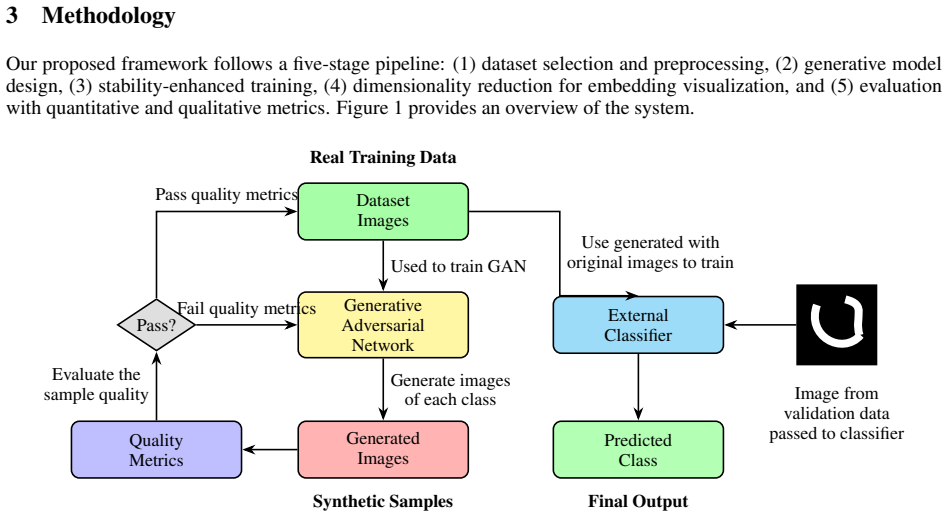
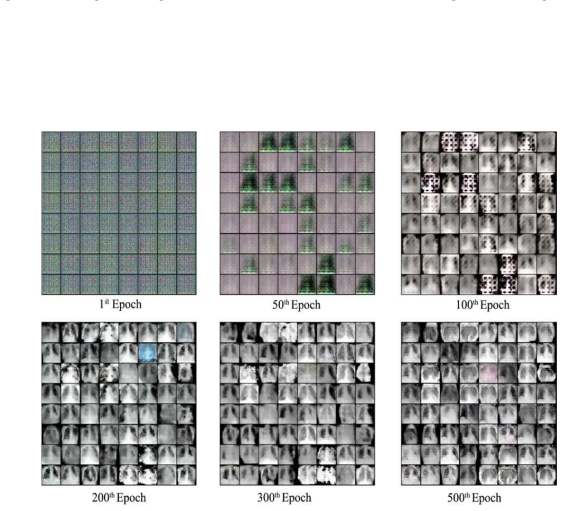
Stabilized DCGAN training with gradient-penalized objectives and spectral normalization that generates 64x64 synthetic images for mixing with scarce real data at varying ratios.
If this is right
- Classifiers achieve higher accuracy when trained on mixtures of real and GAN-generated samples than on real samples alone in limited-data regimes.
- Ablations on synthetic-to-real ratios and sample filtering provide practical guidance for choosing how much generated data to add.
- The same stabilization methods improve training reliability across the two dissimilar domains of medical radiographs and handwritten scripts.
- The protocol offers a simple, reproducible baseline for applying generative augmentation to other resource-constrained imaging problems.
Where Pith is reading between the lines
- If the fidelity assumption holds, the approach could reduce reliance on large labeled medical datasets and thereby lower privacy exposure.
- The cross-domain consistency suggests the stabilization techniques may transfer to additional low-data vision tasks such as rare-disease detection.
- Future work could test whether the same augmentation protocol improves performance on other script families or non-chest medical modalities.
Load-bearing premise
The generated synthetic images must be sufficiently high-fidelity and free of systematic biases so that classifiers trained on them gain genuine generalization rather than learning artifacts.
What would settle it
A controlled test in which classifiers trained on real-plus-synthetic data show lower accuracy on a held-out set of real medical or handwriting images than classifiers trained on real data alone, or visual inspection revealing systematic artifacts in the synthetic chest X-rays that correlate with specific misclassifications.
Figures




read the original abstract
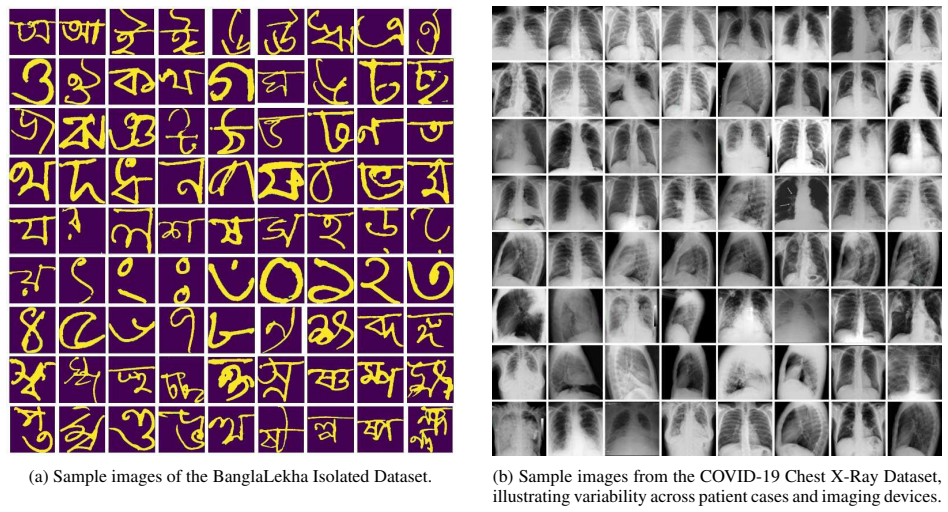
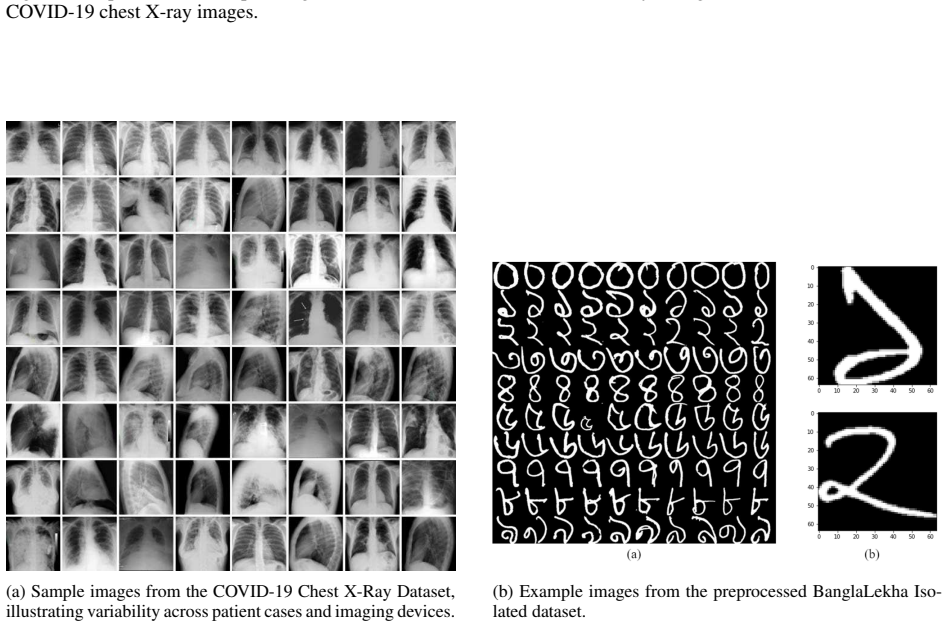
Generative Adversarial Networks (GANs) offer a pragmatic route to mitigate data scarcity in vision tasks. We study generative augmentation across two low-resource domains: Bangla handwritten characters and chest X-ray imaging using DCGAN-style models trained at 64x64 resolution. We evaluate fidelity and diversity via Inception Score (IS), Fr'echet Inception Distance (FID), and embedding visualizations (t-SNE/UMAP), and assess downstream utility by training classifiers on real versus real synthetic data. Our experiments show that generative augmentation improves sample diversity and yields consistent gains in classifier performance under limited-data regimes. We analyze stability enhancements (e.g., gradient-penalized objectives and spectral normalization) and report ablations on synthetic-to-real ratios and sample filtering. We discuss evaluation caveats for medical images, dataset licensing, and privacy risks associated with synthetic data. The resulting protocol is simple to reproduce and provides a strong baseline for applying generative augmentation to resource-constrained imaging tasks.
Editorial analysis
A structured set of objections, weighed in public.
Referee Report
Summary. The manuscript presents an empirical study of DCGAN-style generative augmentation for data-scarce vision tasks, focusing on 64x64 Bangla handwritten characters and chest X-ray images. It trains stabilized GAN variants (gradient penalty, spectral normalization), evaluates fidelity/diversity with IS, FID, and t-SNE/UMAP embeddings, and reports downstream classifier accuracy gains when mixing real and synthetic samples. Ablations on synthetic-to-real ratios and filtering are included, along with discussion of medical-image evaluation caveats and privacy considerations.
Significance. If the reported classifier improvements are attributable to high-fidelity, unbiased synthetic samples rather than increased data volume, the work supplies a reproducible, low-complexity baseline protocol for generative augmentation in resource-limited medical and handwriting domains. The inclusion of stability techniques and ratio ablations is a positive contribution; however, the absence of domain-adapted metrics and controlled total-sample-size experiments limits the strength of the central claim.
major comments (2)
- [Abstract and evaluation sections] Abstract and evaluation sections: the claim that 'generative augmentation improves sample diversity and yields consistent gains in classifier performance' rests on IS/FID computed with an ImageNet-pretrained Inception-v3 backbone. For 64x64 chest X-rays this backbone is poorly aligned with radiographic features (small lesions, texture), so the metrics may not detect medically relevant artifacts; the paper notes caveats but provides no domain-adapted metric or quantitative comparison showing that accuracy lifts survive under a more suitable evaluator.
- [Experiments on downstream classifiers] Experiments on downstream classifiers: no controlled ablation is described that holds total training-set cardinality fixed while varying only the proportion or quality of synthetic samples. Consequently the observed accuracy improvements could be explained by simply adding more (possibly noisy) examples rather than by unbiased high-fidelity augmentation, undermining the central utility claim.
minor comments (2)
- [Results tables] Quantitative tables for IS/FID and classifier accuracies are referenced but lack error bars, standard deviations across runs, or full ablation matrices; adding these would improve reproducibility.
- [Ablation studies] The manuscript states that ablations on synthetic-to-real ratios and sample filtering were performed; explicit numerical results for these ablations should be tabulated rather than summarized qualitatively.
Simulated Author's Rebuttal
We thank the referee for the thoughtful and constructive review of our manuscript. We address each of the major comments in detail below, indicating the revisions we plan to make to strengthen the work.
read point-by-point responses
-
Referee: [Abstract and evaluation sections] Abstract and evaluation sections: the claim that 'generative augmentation improves sample diversity and yields consistent gains in classifier performance' rests on IS/FID computed with an ImageNet-pretrained Inception-v3 backbone. For 64x64 chest X-rays this backbone is poorly aligned with radiographic features (small lesions, texture), so the metrics may not detect medically relevant artifacts; the paper notes caveats but provides no domain-adapted metric or quantitative comparison showing that accuracy lifts survive under a more suitable evaluator.
Authors: We agree that the ImageNet-pretrained Inception-v3 backbone is suboptimal for evaluating 64x64 chest X-ray images, as it may fail to capture medically relevant features such as small lesions or specific textures. The manuscript already includes a discussion of evaluation caveats for medical images. To address this, we will revise the evaluation section to include additional analysis using a more domain-appropriate feature extractor where possible, or at minimum provide a quantitative comparison of classifier performance using features from a medical imaging model if feasible. We will also update the abstract to more cautiously phrase the claims regarding diversity and performance gains, emphasizing the limitations of the metrics. This constitutes a partial revision as we will enhance the discussion and potentially add supporting experiments without overhauling the core methodology. revision: partial
-
Referee: [Experiments on downstream classifiers] Experiments on downstream classifiers: no controlled ablation is described that holds total training-set cardinality fixed while varying only the proportion or quality of synthetic samples. Consequently the observed accuracy improvements could be explained by simply adding more (possibly noisy) examples rather than by unbiased high-fidelity augmentation, undermining the central utility claim.
Authors: This is a valid concern. While our ablations on synthetic-to-real ratios demonstrate performance trends, we did not explicitly control for total sample cardinality. To strengthen the evidence that improvements stem from high-fidelity synthetic samples rather than increased volume, we will add a new controlled ablation in the revised manuscript. Specifically, we will compare classifier performance when training on a fixed number of samples, varying the mix of real and synthetic data (e.g., all real vs. half real and half synthetic). This will help isolate the contribution of the generative augmentation and directly address the central utility claim. We believe this revision will significantly bolster the manuscript's conclusions. revision: yes
Circularity Check
Empirical study with no derivations or self-referential predictions
full rationale
The paper is a purely experimental study: it trains DCGAN-style models on Bangla handwriting and chest X-ray data, reports IS/FID scores, visual embeddings, and downstream classifier accuracy gains from synthetic augmentation. No equations, first-principles derivations, fitted parameters renamed as predictions, or load-bearing self-citations appear in the abstract or described content. All claims rest on external benchmarks and controlled experiments rather than internal loops that reduce to the inputs by construction. This is the normal, non-circular outcome for an applied empirical paper.
Axiom & Free-Parameter Ledger
Reference graph
Works this paper leans on
-
[1]
Biswas et al
M. Biswas et al. Banglalekha-isolated: A multi-purpose comprehensive dataset of handwritten bangla isolated characters.Data in Brief, 12:103–107, Jun 2017. 12
2017
-
[2]
Efatinasab, A
E. Efatinasab, A. Brighente, D. Donadel, M. Conti, and M. Rampazzo. Towards robust stability prediction in smart grids: Gan-based approach under data constraints and adversarial challenges.Internet of Things, 33:101662, Sep 2025
2025
-
[3]
I. J. Goodfellow et al. Generative adversarial networks.arXiv preprint arXiv:1406.2661, Jun 2014
work page internal anchor Pith review arXiv 2014
-
[4]
Md. M. Hassan et al. Smart spectacles for the deaf with voice to text and sign language integration. In2023 26th International Conference on Computer and Information Technology (ICCIT), Dec 2023
2023
-
[5]
Kucharski and A
A. Kucharski and A. Fabija ´nska. Towards improved evaluation of generative neural networks: The fr´echet coeffi- cient.Neurocomputing, 623:129422, Jan 2025
2025
-
[6]
W. Lim, K. S. C. Yong, B. T. Lau, and C. C. L. Tan. Future of generative adversarial networks (gan) for anomaly detection in network security: A review.Computers & Security, 139:103733, Apr 2024
2024
-
[7]
Sekeroglu and I
B. Sekeroglu and I. Ozsahin. Detection of covid-19 from chest x-ray images using convolutional neural networks. SLAS TECHNOLOGY: Translating Life Sciences Innovation, page 247263032095837, Sep 2020
2020
-
[8]
Tripathi et al
S. Tripathi et al. Recent advances and application of generative adversarial networks in drug discovery, develop- ment, and targeting.Artificial Intelligence in the Life Sciences, 2:100045, Dec 2022
2022
-
[9]
Xun et al
S. Xun et al. Generative adversarial networks in medical image segmentation: A review.Computers in Biology and Medicine, 140:105063, Jan 2022. 13
2022
discussion (0)
Sign in with ORCID, Apple, or X to comment. Anyone can read and Pith papers without signing in.