Recognition: 2 theorem links
· Lean TheoremDevelopment of a quadripartite wakefield structure as dechirper for free electron laser
Pith reviewed 2026-05-08 19:35 UTC · model grok-4.3
The pith
A four-plate symmetric corrugated structure suppresses quadrupole wakefields in FEL dechirpers, yielding lower projected emittance growth and 25% shorter length than planar designs per simulations.
A machine-rendered reading of the paper's core claim, the machinery that carries it, and where it could break.
Core claim
Simulation results confirm that the quadripartite geometry offers significantly reduced projected emittance growth and a 25% shorter structure length compared with the planar design.
Load-bearing premise
That the three-dimensional electromagnetic simulations using the Panofsky-Wenzel theorem and the particle-to-particle tracking accurately capture all relevant wakefield effects and nonlinearities without experimental benchmarking or full error propagation analysis.
Figures








read the original abstract
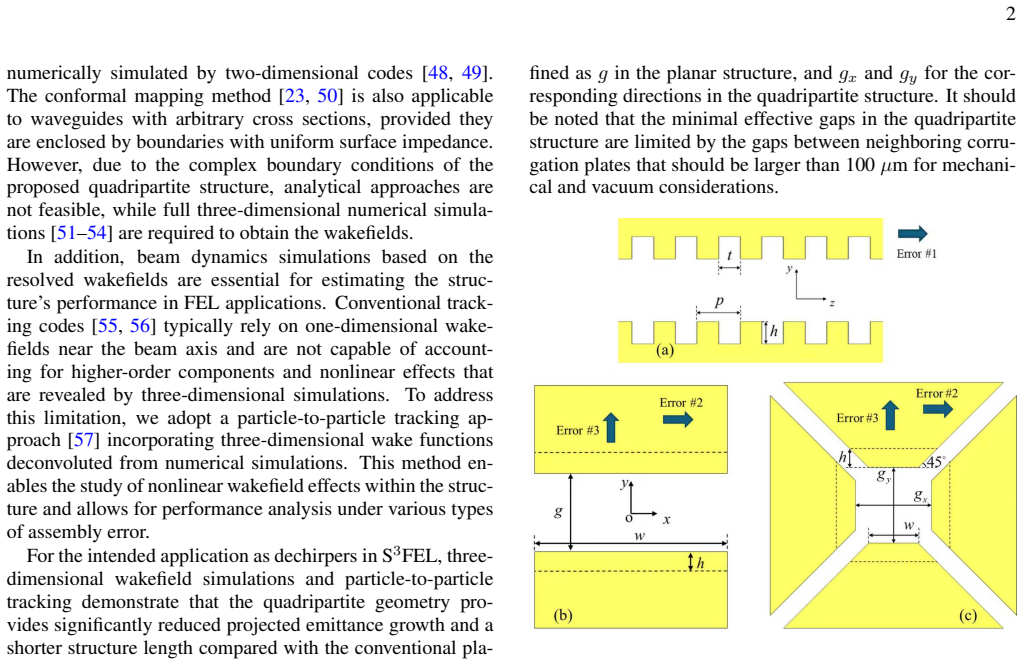
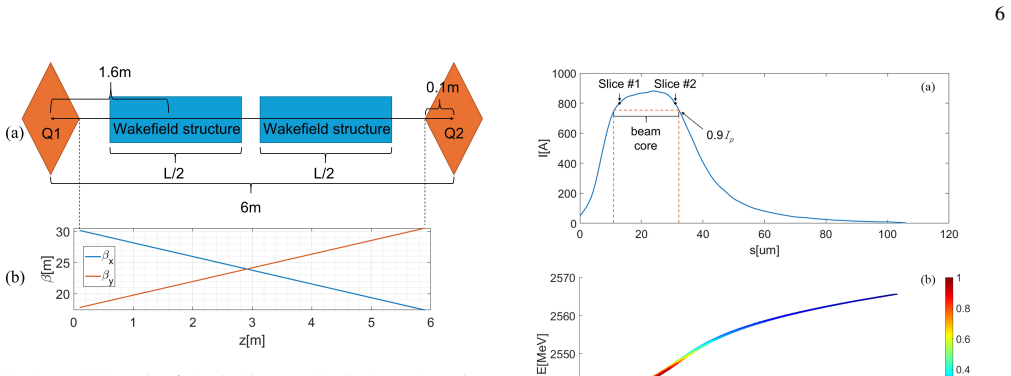
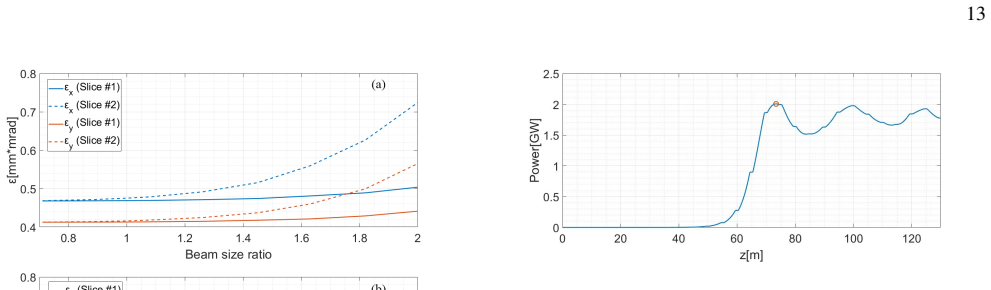
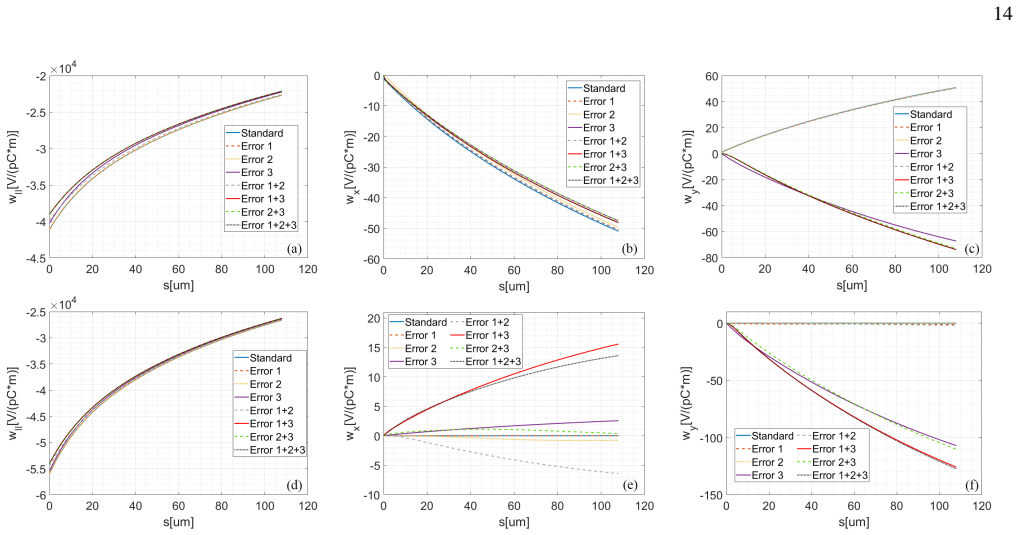
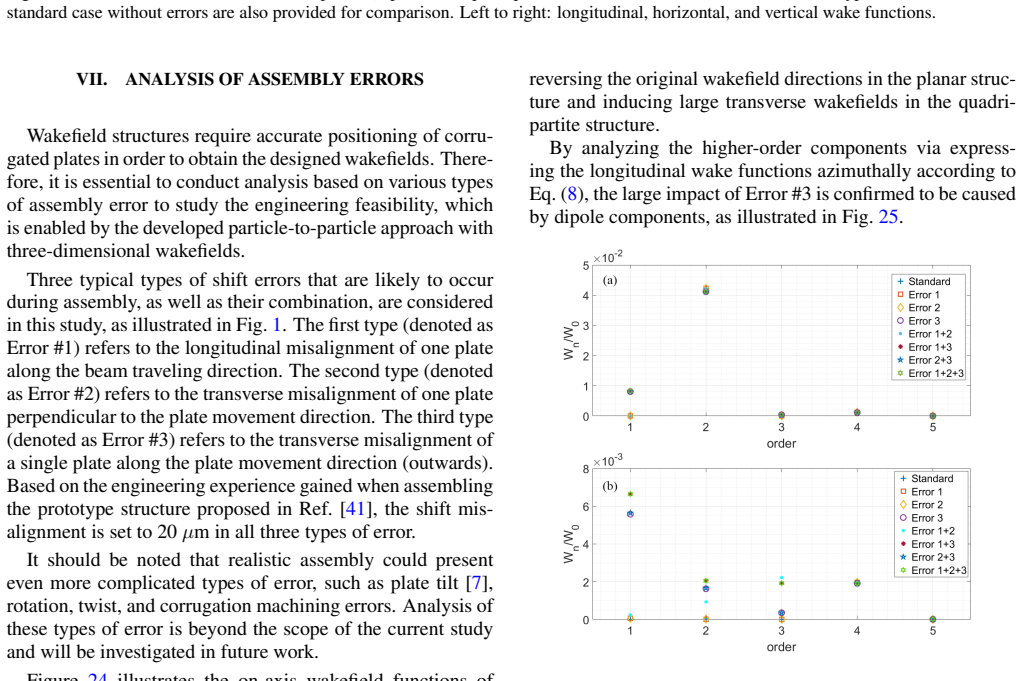
Wakefield structures are critical for beam manipulation in free-electron lasers (FELs), particularly when serving as dechirpers, where beam-induced longitudinal wakefields compensate the energy chirp introduced during beam magnetic compression. However, conventional planar structures also generate time-dependent quadrupole wakefields due to their asymmetric geometry, which can cause beam mismatch and projected emittance growth. To address this limitation, we propose a quadripartite wakefield structure comprising four identical corrugated plates, able to fully suppress quadrupole wakefields while preserving strong longitudinal wakefields. To accurately evaluate its performance, we calculate wake potentials based on the Panofsky-Wenzel theorem using three-dimensional simulation software and extract the corresponding wake functions by deconvolution. We further adopt a particle-to-particle (P2P) tracking method incorporating these wake functions, which is capable of accounting for higher-order components and nonlinear effects that are typically neglected in standard tracking codes. Simulation results confirm that the quadripartite geometry offers significantly reduced projected emittance growth and a 25% shorter structure length compared with the planar design. The tracking method also reveals that the nonlinearities of three-dimensional wakefields induce noticeable slice emittance growth for large transverse beam sizes, which may in turn affect lasing performance. In addition, the tracking method enables analysis of various types of assembly error and indicates that misalignment along the direction of plate motion may severely degrade the emittance via dipole wakefields. Such misalignment can be mitigated through beam-based alignment and precise plate adjustment using high-resolution servo motors.
Editorial analysis
A structured set of objections, weighed in public.
Axiom & Free-Parameter Ledger
Reference graph
Works this paper leans on
-
[1]
B. O’Shea, G. Andonian, S. Barber et al., Observation of ac- celeration and deceleration in gigaelectron-volt-per-metre gra- dient dielectric wakefield accelerators, Nat. Commun. , vol. 7, 12763, 2016. doi: 10.1038/ncomms12763
-
[2]
C. Jing, S. Antipov, M. Conde et al. , Electron acceleration through two successive electron beam driven wakefield accel- eration stages, Nucl. Instrum. Methods Phys. Res. A , vol. 898, p.72-76, 2018. doi: 10.1016/j.nima.2018.05.007
-
[3]
J. Shao, C. Jing, E. Wisniewski et al., Development and high- power testing of an X-band dielectric-loaded power extrac- tor, Phys. Rev. Accel. Beams , vol. 23, 011301, 2020. doi: 10.1103/PhysRevAccelBeams.23.011301
-
[4]
C. Feng and H. Deng, Review of fully coherent free- electron lasers, Nucl. Sci. Tech. , vol. 29, 160, 2018. doi: 10.1007/s41365-018-0490-1
-
[5]
K. Bane and G. Stupakov, Corrugated pipe as a beam dechirper, Nucl. Instrum. Methods Phys. Res. A , vol. 690, 106-110, 2012. doi: 10.1016/j.nima.2012.07.001
-
[6]
P. Emma, M. Venturini, K. Bane et al., Experimental demon- stration of energy-chirp control in relativistic electron bunches using a corrugated pipe, Phys. Rev. Lett. , vol. 112, 034801,
-
[7]
doi: 10.1103/PhysRevLett.112.034801 19 Fig. 33. Simulation results of the planar structure with g =1.4 mm and the original beam size. Left to right: longitudinal, horizontal, and vertical wake functions
-
[8]
Z. Zhang, K. Bane, Y . Ding et al., Electron beam energy chirp control with a rectangular corrugated structure at the Linac Coherent Light Source, Phys. Rev. ST Accel. Beams , vol. 18, 010702, 2015. doi: 10.1103/PhysRevSTAB.18.010702
-
[9]
Y . Gong, M. Zhang, W. Fan et al. , Beam performance of the SHINE dechirper, Nucl. Sci. Tech., vol. 32, p.1-10, 2021. doi: 10.1007/s41365-021-00860-8
-
[10]
Craievich, Passive longitudinal phase space linearizer, Phys
P. Craievich, Passive longitudinal phase space linearizer, Phys. Rev. ST Accel. Beams , vol. 13, 034401, 2010. doi: 10.1103/PhysRevSTAB.13.034401
-
[13]
Z. Wang, C. Feng, D. Huang et al. , Nonlinear energy chirp 20 Fig. 34. Simulation results of the quadripartite structure with gx = gy =1.4 mm and the original beam size. Left to right: longitudinal, horizontal, and vertical wake functions. compensation with corrugated structures, Nucl. Sci. Tech., vol. 29, issue 175, 1-7, 2018. doi: 10.1007/s41365-018-0512-z
-
[14]
Y . Ding, K. Bane, P. Emmaet al., Beam shaping with a passive linearizer at the LCLS-II for high-current operation, LCLS-II Technical note, LCLSII-TN-18-02, 2018
2018
-
[15]
F. Mayet, R. Assmann and F. Lemery, Longitudinal phase space synthesis with tailored 3D-printable dielectric-lined waveguides, Phys. Rev. Accel. Beams , vol. 23, 121302, 2020. doi: 10.1103/PhysRevAccelBeams.23.121302
-
[16]
A. Lutman, T. Maxwell, J. MacArthur et al., Fresh-slice multi- colour X-ray free-electron lasers, Nat. Photonics, vol. 10, 745- 750, 2016. doi: 10.1038/nphoton.2016.201
-
[18]
I. Zagorodnov, G. Feng and T. Limberg, Corrugated structure insertion for extending the SASE bandwidth up to 3% at the European XFEL, Nucl. Instrum. Methods Phys. Res., Sect. A , vol. 837, p.69-79, 2016. doi: 10.1016/j.nima.2016.09.001 21 Fig. 35. Simulation results of the planar structure with g =1.4 mm and the enlarged beam size. Left to right: longitud...
-
[19]
W. Qin, Y . Ding, A. Lutman et al. , Matching-based fresh- slice method for generating two-color x-ray free-electron lasers, Phys. Rev. Accel. Beams , vol. 20, 090701, 2017. doi: 10.1103/PhysRevAccelBeams.20.090701
-
[22]
Bettoni, P
S. Bettoni, P. Craievich, A. Dax et al. , Experimental demon- stration of two-color x-ray free-electron-laser pulses via wake- field excitation, Phys. Rev. Accel. Beams , vol. 24, 082801,
-
[23]
doi: 10.1103/PhysRevAccelBeams.24.082801
-
[24]
J. Duris, J. MacArthur, J. Glownia et al. , Controllable x- ray pulse trains from enhanced self-amplified spontaneous emission, Phys. Rev. Lett. , vol. 126, 104802, 2021. doi: 10.1103/PhysRevLett.126.104802
-
[26]
S. Bettoni, P. Craievich, A. Lutman et al. , Temporal profile measurements of relativistic electron bunch based on wakefield generation, Phys. Rev. Accel. Beams , vol. 19, 021304, 2016. doi: 10.1103/PhysRevAccelBeams.19.021304
-
[27]
J. Seok, M. Chung, H. Kang et al. , Use of a corrugated beam pipe as a passive deflector for bunch length measure- ments, Phys. Rev. Accel. Beams , vol. 21, 022801, 2018. doi: 10.1103/PhysRevAccelBeams.21.022801
-
[28]
P. Dijkstal, A. Malyzhenkov, P. Craievich et al. , Self- synchronized and cost-effective time-resolved measurements at x-ray free-electron lasers with femtosecond resolution,Phys. Rev. Res. , vol. 4, 013017, 2022. doi: 10.1103/PhysRevRe- search.4.013017
-
[29]
P. Dijkstal, W. Qin and S. Tomin, Longitudinal phase space diagnostics with a nonmovable corrugated passive wakefield streaker, Phys. Rev. Accel. Beams , vol. 27, 050702, 2024. doi: 10.1103/PhysRevAccelBeams.27.050702
-
[30]
Stupakov, Using pipe with corrugated walls for a subtera- hertz free electron laser, Phys
G. Stupakov, Using pipe with corrugated walls for a subtera- hertz free electron laser, Phys. Rev. ST Accel. Beams , vol. 18, 030709, 2015. doi: 10.1103/PhysRevSTAB.18.030709
-
[31]
K. Floettmann, F. Lemery, M. Dohlus et al. , Superradiant Cherenkov–wakefield radiation as THz source for FEL fa- cilities, J. Synchrotron Radiat. , vol. 28, p.18-27, 2021. doi: 10.1107/S1600577520014058
-
[33]
S. Liu, F. Li, Y . Du et al., Experimental Demonstration of an Emittance-Preserving Beam Energy Dechirper Using a Hollow Channel Plasma, Phys. Rev. Lett., vol. 133, 175001, 2024. doi: 10.1103/PhysRevLett.133.175001
-
[34]
X. Wang, L. Zeng, J. Shao et al., Physical Design for Shenzhen Superconducting Soft X-ray Free-Electron Laser (S 3FEL), in Proceedings of the 14th International Particle Accelerator Conference, TUPL043, 2023
2023
-
[35]
H. Sun, X. Wang, L. Zeng et al. , Synthesis of microbunch- ing rotation for generating isolated attosecond soft x-ray free- electron laser pulses, Phys. Rev. Res., vol. 6, 043242, 2024. doi: 10.1103/PhysRevResearch.6.043242
-
[36]
Huang, L
Q. Huang, L. Wei, J. Shao et al., Design of an S-band parallel- coupled polarizable transverse deflecting cavity for multi- dimensional phase space diagnostics in photoinjectors, in Pro- ceedings of the 13th International Beam Instrumentation Con- ference, WEP34, 2024
2024
-
[37]
J. Zhu, H. Ding, H. Li et al., Prototype design of a digital Low- Level RF system for S3FEL S-band Transverse Deflecting Cav- ities, J. Instrum., vol. 20, T01012, 2025. doi: 10.1088/1748- 0221/20/01/T01012
-
[38]
L. Hu, X. Wang, L. Yang et al., Conceptual design of S 3FEL cryogenic system, IOP Conf. Ser .: Mater . Sci. Eng., vol. 1240, 012092, 2022. doi: 10.1088/1757-899X/1240/1/012092
-
[39]
Zhang, X
B. Zhang, X. Li, Q. Liu et al. , High repetition-rate photoin- jector laser system for S 3FEL, Front. Phys., vol. 11, 1181862,
-
[40]
doi: 10.3389/fphy.2023.1181862
-
[41]
Z. Xu, W. Zhang, C. Yang et al., Shape optimization design of the offset mirror in FEL-1 beamline at S 3FEL, Sci. Rep., vol. 13, 9653, 2023. doi: 10.1038/s41598-023-36645-9
-
[42]
M. Wu, Q. Li, M. Wang et al. , Study on the UV FEL single-shot damage threshold of an Au thin film, J. Synchrotron Radiat. , vol. 31, p.1010-1018, 2024. doi: 10.1107/S1600577524005332
-
[43]
Ganter, S
R. Ganter, S. Bettoni, H. Braun et al. , Overview of the soft X-ray line ATHOS at SwissFEL, in Proceedings of the 38th International Free Electron Laser Conference, MOP038, 2017
2017
-
[44]
Y . Ji, C. Lei, J. Shaoet al., Design of a quadripartite wakefield structure for free electron laser applications, in Proceedings of the 32nd Linear Accelerator Conference , MOPB026, 2024
2024
-
[46]
L. Xiao, W. Gai and X. Sun, Field analysis of a dielectric- loaded rectangular waveguide accelerating structure,Phys. Rev. E, vol. 65, 016505, 2001. doi: 10.1103/PhysRevE.65.016505
-
[47]
K. Bane and G. Stupakov, Impedance of a rectangular beam tube with small corrugations, Phys. Rev. ST Accel. Beams , vol. 6, 024401, 2003. doi: 10.1103/PhysRevSTAB.6.024401
-
[48]
K. Bane and G. Stupakov, Using surface impedance for calcu- lating wakefields in flat geometry,Phys. Rev. ST Accel. Beams, vol. 18, 034401, 2015. doi: 10.1103/PhysRevSTAB.18.034401
-
[49]
K. Bane and G. Stupakov, Dechirper wakefields for short bunches, Nucl. Instrum. Methods Phys. Res., Sect. A , vol. 820, p.156-163, 2016. doi: 10.1016/j.nima.2016.02.055
-
[50]
K. Bane, G. Stupakov and I. Zagorodnov, Analytical formu- las for short bunch wakes in a flat dechirper, Phys. Rev. Accel. Beams, vol. 19, 084401, 2016. doi: 10.1103/PhysRevAccel- Beams.19.084401
-
[51]
I. Zagorodnov, K. Bane, and G. Stupakov, Calculation of wake- fields in 2D rectangular structures,Phys. Rev. ST Accel. Beams, vol. 18, 104401, 2015. doi: 10.1103/PhysRevSTAB.18.104401
-
[52]
Novokhatski, Wakefield potentials of corrugated structures, Phys
A. Novokhatski, Wakefield potentials of corrugated structures, Phys. Rev. ST Accel. Beams , vol. 18, 104402, 2015. doi: 10.1103/PhysRevSTAB.18.104402
-
[53]
S. Baturin and A. Kanareykin, New method of calculating the wakefields of a point charge in a waveguide of arbitrary cross section, Phys. Rev. Accel. Beams , vol. 19, 051001, 2016. doi: 10.1103/PhysRevAccelBeams.19.051001
-
[54]
W. Bruns, GdfidL: a finite difference program for arbitrar- ily small perturbations in rectangular geometries, IEEE Trans. Magn., vol. 32, p.1453-1456, 1996. doi: 10.1109/20.497522
-
[55]
Ng and K
C. Ng and K. Bane, Wakefield computations for a corrugated pipe as a beam dechirper for FEL applications, in Proceedings of the 2013 North American Particle Accelerator Conference , p.877-879, 2013
2013
-
[56]
I. Zagorodnov, Computation of electromagnetic fields gener- ated by relativistic beams in complicated structures, in Pro- ceedings of the 2016 North American Particle Accelerator Conference, p.642-646, 2016
2016
-
[57]
19, 64289 Darmstadt, Germany
CST Studio, CST, Bad Nauheimer Str. 19, 64289 Darmstadt, Germany
-
[58]
Borland, ELEGANT: A flexible SDDS-compliant code for accelerator simulation, Argonne National Laboratory Ad- 23 vanced Photon Source Report, No
M. Borland, ELEGANT: A flexible SDDS-compliant code for accelerator simulation, Argonne National Laboratory Ad- 23 vanced Photon Source Report, No. LS-287, 2020
2020
-
[59]
Floettmann, ASTRA-A Space Charge Tracking Algorithm
K. Floettmann, ASTRA-A Space Charge Tracking Algorithm
-
[60]
D. Wang, W. Gai, C. Tang et al. , Research on the Terahertz wakefield radiation based on the electron bunch train,Thesis of Tsinghua University, 2016
2016
-
[61]
W. Panofsky and W. Wenzel, Some considerations concern- ing the transverse deflection of charged particles in radio- frequency fields, Rev. Sci. Instrum. , vol. 27, 967-967, 1956. doi: 10.1063/1.1715427
-
[62]
S. Bettoni, M. Pedrozzi and S. Reiche, Low emittance injector design for free electron lasers,Phys. Rev. ST Accel. Beams, vol. 18, 123403, 2015. doi: 10.1103/PhysRevSTAB.18.123403
-
[64]
Kondratenko and E.L
A.M. Kondratenko and E.L. Saldin, Generation of coherent ra- diation by a relativistic electron beam in an undulator, Part. Accel., vol. 10, p.207-216, 1980
1980
-
[65]
R. Bonifacio, C. Pellegrini and L.M. Narducci, Collective instabilities and high-gain regime in a free electron laser, Opt. Comm. , vol. 50, p.373-378, 1984. doi: 10.1016/0030- 4018(84)90105-6
-
[66]
URLhttps://www.sciencedirect.com/science/article/ pii/S016890029900114X
S. Reiche, GENESIS 1.3: A fully 3D time-dependent FEL sim- ulation code, Nucl. Instrum. Methods Phys. Res., Sect. A , vol. 429, p.243-248, 1999. doi: 10.1016/S0168-9002(99)00114-X
-
[67]
H. Yi, X. Wang, L. Zeng et al., Stability enhancement of a self- amplified spontaneous emission free-electron laser with bunch- ing containment, Phys. Rev. Accel. Beams , vol. 28, 050703,
-
[68]
doi: 10.1103/xbkr-n5h7
-
[69]
R. Kersevan and J. Pons, Introduction to MOLFLOW+: New graphical processing unit-based Monte Carlo code for sim- ulating molecular flows and for calculating angular coeffi- cients in the compute unified device architecture environment, J. V ac. Sci. Technol. A , vol. 27, p.1017–1023, 2009. doi: 10.1116/1.3153280
-
[70]
F. Fu, R. Wang, P. Zhu et al. , Demonstration of nonlinear- energy-spread compensation in relativistic electron bunches with corrugated structures, Phys. Rev. Lett., vol. 114, 114801,
-
[71]
doi: 10.1103/PhysRevLett.114.114801
-
[72]
C. Lu, F. Fu, T. Jiang et al. , Time-resolved measurement of quadrupole wakefields in corrugated structures, Phys. Rev. Ac- cel. Beams, vol. 19, 020706, 2016. doi: 10.1103/PhysRevAc- celBeams.19.020706
-
[73]
Z. Dong, H. Chen, C. Song et al., Longitudinal phase space ma- nipulation with planar corrugated wakefield structures, Nucl. Instrum. Methods Phys. Res., Sect. A , vol. 987, 164819, 2021. doi: 10.1016/j.nima.2020.164819
-
[74]
S. Antipov, M. Babzien, C. Jing et al. , Subpicosecond bunch train production for a tunable mJ level THz source, Phys. Rev. Lett. , vol. 111, 134802, 2013. doi: 10.1103/Phys- RevLett.111.134802
-
[75]
S. Antipov, S. Baturin, C. Jing et al. , Experimental demon- stration of energy-chirp compensation by a tunable dielectric- based structure, Phys. Rev. Lett., vol. 112, 114801, 2014. doi: 10.1103/PhysRevLett.112.114801
-
[76]
Y . Nie, R. Assmann, U. Dorda et al., Potential applications of the dielectric wakefield accelerators in the SINBAD facility at DESY ,Nucl. Instrum. Methods Phys. Res., Sect. A , vol. 829, p.183-186, 2016. doi: 10.1016/j.nima.2016.01.038
-
[77]
T. Pacey, Y . Saveliev, G. Xia et al. , Simulation studies for dielectric wakefield programme at CLARA facility, Nucl. In- strum. Methods Phys. Res., Sect. A , vol. 909, p.261-265, 2018. doi: 10.1016/j.nima.2017.12.038
-
[78]
G. Ha, K. Kim, J. Power et al., Bunch shaping in electron lin- ear accelerators, Rev. Mod. Phys., vol. 94, 025006, 2022. doi: 10.1103/RevModPhys.94.025006
-
[79]
J. Sun, X. Li, J. Yang et al. , An experimental application of machine learning algorithms to optimize the FEL lasing via beam trajectory tuning at Dalian Coherent Light Source, Nucl. Instrum. Methods Phys. Res. A , vol. 1063, 169320, 2024. doi: 10.1016/j.nima.2024.169320
-
[80]
X. Li, Y . Yu, Q. Li et al., Wavelength switching and scanning of the high-gain harmonic generation free-electron laser at the Dalian Coherent Light Source, Phys. Rev. Accel. Beams , vol. 28, 100701, 2025. doi: 10.1103/2wmp-cb2b
-
[81]
K. Bane, G. Stupakov and E. Gjonaj, Joule heating in a flat dechirper, Phys. Rev. Accel. Beams, vol. 20, 054403, 2017. doi: 10.1103/PhysRevAccelBeams.20.054403
-
[82]
J. Guo, W. Decking, M. Guetg et al., Beam loss study for the implementation of corrugated structure at the European XFEL, Nucl. Instrum. Methods Phys. Res., Sect. A , vol. 1034, 166780,
-
[83]
doi: 10.1016/j.nima.2022.166780
-
[84]
Zagorodnov, Electromagnetic code ECHO User’s Manual
I. Zagorodnov, Electromagnetic code ECHO User’s Manual
discussion (0)
Sign in with ORCID, Apple, or X to comment. Anyone can read and Pith papers without signing in.