Recognition: unknown
Formation of Suprathermal Electron Populations in the Expanding, Turbulent Solar Wind
Pith reviewed 2026-05-09 16:35 UTC · model grok-4.3
The pith
Solar wind simulations reveal how expansion and turbulence generate suprathermal electron tails.
A machine-rendered reading of the paper's core claim, the machinery that carries it, and where it could break.
Core claim
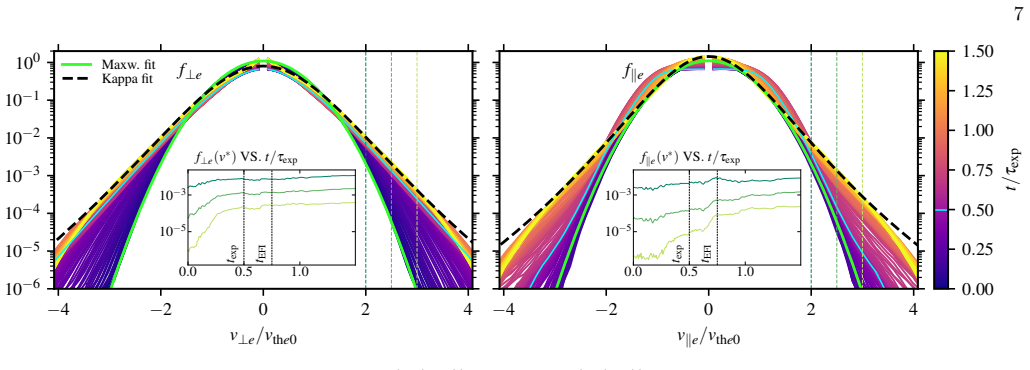
In the first fully kinetic particle-in-cell simulation of an expanding turbulent plasma under heliospheric conditions, expansion-driven weakening of the magnetic field adiabatically cools the plasma perpendicularly to the mean field while leaving the parallel temperature largely unchanged, driving the system toward the firehose-instability threshold; concurrently, strongly anisotropic turbulence leads to perpendicular heating and the development of nonthermal features, after which suprathermal electron populations preferentially develop in the parallel direction, forming pronounced power-law tails even under weakly compressive, highly Alfvénic conditions, and persist despite anisotropy being
What carries the argument
The coupled kinetic evolution of expansion-induced adiabatic perpendicular cooling, turbulence-driven perpendicular heating, and firehose-instability regulation that channels energy into parallel suprathermal electron tails.
Load-bearing premise
The specific expansion rate, turbulence amplitude, and initial conditions chosen in the simulation accurately capture real solar-wind behavior without important missing physics such as additional wave modes or boundary effects.
What would settle it
Comparison of the simulated parallel and perpendicular electron velocity distributions against in-situ data from spacecraft traversing regions of measured solar-wind expansion and Alfvénic turbulence levels, checking whether parallel power-law tails appear at the predicted amplitudes.
Figures


read the original abstract
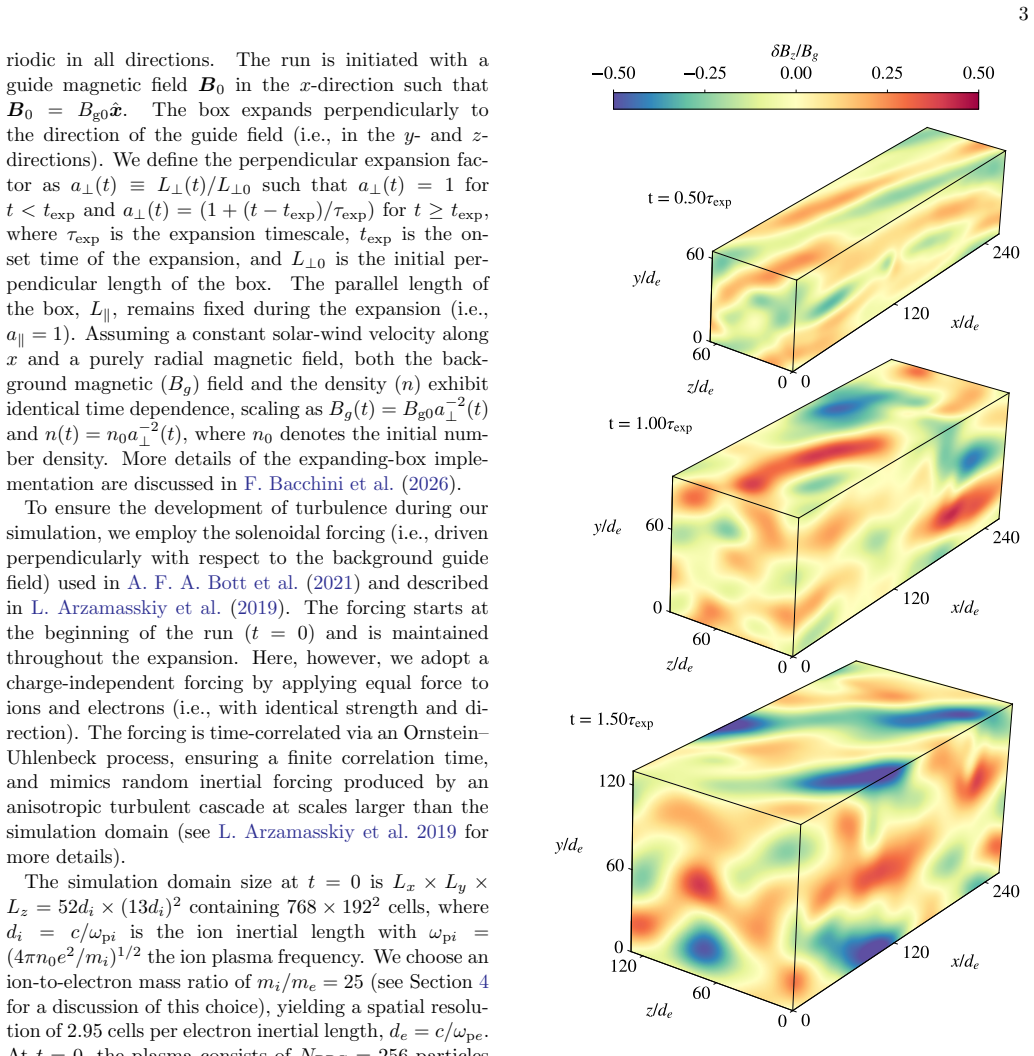
Nonthermal features are ubiquitously observed in electron velocity distribution functions in the solar wind, yet their origin in the collisionless, turbulent, expanding solar-wind plasma remains unclear. We investigate how solar-wind expansion and Alfv\'enic turbulence jointly generate and regulate these features using the first fully kinetic particle-in-cell simulation of an expanding turbulent plasma under heliospheric conditions. In our setup, expansion-driven weakening of the magnetic field adiabatically cools the plasma perpendicularly to the mean field while leaving the parallel temperature largely unchanged, driving the system toward the firehose-instability threshold. Concurrently, strongly anisotropic turbulence leads to perpendicular heating and the development of nonthermal features. Subsequently, we find that suprathermal electron populations preferentially develop in the parallel direction, forming pronounced power-law tails even under weakly compressive, highly Alfv\'enic conditions, and persist despite anisotropy regulation by the firehose instability. The preferentially parallel energization suggests the involvement of parallel electric fields or resonant wave--particle interactions, rather than simple velocity-space redistribution. These results provide the first direct evidence of the emergence of nonthermal-electron features in a unified kinetic framework linking expansion, turbulence, and instabilities in the solar wind.
Editorial analysis
A structured set of objections, weighed in public.
Referee Report
Summary. The paper reports results from the first fully kinetic particle-in-cell simulation of an expanding, Alfvénic turbulent plasma under heliospheric conditions. It claims that expansion-driven perpendicular cooling combined with anisotropic turbulence drives the plasma toward the firehose threshold while generating suprathermal electron populations that form pronounced parallel power-law tails; these tails persist even after firehose regulation of anisotropy, implying involvement of parallel electric fields or resonant interactions rather than simple redistribution. The work positions this as direct evidence for a unified kinetic mechanism linking expansion, turbulence, and instabilities in the solar wind.
Significance. If the simulation results prove robust across parameter space, the work would be significant for solar-wind physics: it provides a self-consistent kinetic demonstration that nonthermal electron features can emerge from the interplay of expansion cooling, Alfvénic turbulence, and firehose regulation without invoking separate mechanisms. This addresses an open question about the origin of observed suprathermal electrons. The use of a single unified PIC framework is a strength, though the absence of quantitative measures (e.g., exact spectral indices, error bars) and sensitivity tests in the presented description reduces immediate applicability to observations.
major comments (2)
- [Abstract] Abstract: The central claim that parallel power-law tails arise from the joint action of expansion, turbulence, and firehose regulation is load-bearing for the 'unified framework' attribution, yet the description is limited to a single run under unspecified 'heliospheric conditions' with no mention of control simulations at varied expansion rates or turbulence amplitudes. If the tails weaken or vanish under modest changes to these parameters, the generality of the mechanism is not established.
- [Abstract] Abstract: The manuscript asserts 'first direct evidence' and 'pronounced power-law tails' but supplies no quantitative details such as measured spectral indices, their uncertainties, or comparison to observed solar-wind statistics. Without these, it is difficult to assess whether the simulated tails match heliospheric data or are an artifact of the chosen initial beta, anisotropy, or resolution.
minor comments (1)
- [Abstract] The abstract would benefit from a brief statement of the simulation domain size, particle number, and time-stepping scheme to allow readers to gauge numerical convergence.
Simulated Author's Rebuttal
We thank the referee for their detailed and insightful report. Their comments have helped us clarify the scope and quantitative aspects of our simulation results. We address each major comment below.
read point-by-point responses
-
Referee: [Abstract] Abstract: The central claim that parallel power-law tails arise from the joint action of expansion, turbulence, and firehose regulation is load-bearing for the 'unified framework' attribution, yet the description is limited to a single run under unspecified 'heliospheric conditions' with no mention of control simulations at varied expansion rates or turbulence amplitudes. If the tails weaken or vanish under modest changes to these parameters, the generality of the mechanism is not established.
Authors: We recognize the importance of establishing the robustness of the observed power-law tails across parameter space. Our study focuses on a single, computationally demanding simulation chosen to represent typical heliospheric conditions (as detailed in Section 2 of the manuscript). Performing additional control simulations would require substantial additional resources and is beyond the scope of the current work. However, we have revised the abstract to remove the implication of broad generality and instead highlight the results for the simulated conditions. We have also added a paragraph in the discussion section addressing how the mechanism might depend on expansion rate and turbulence amplitude, drawing on supporting evidence from reduced models and linear analysis. revision: partial
-
Referee: [Abstract] Abstract: The manuscript asserts 'first direct evidence' and 'pronounced power-law tails' but supplies no quantitative details such as measured spectral indices, their uncertainties, or comparison to observed solar-wind statistics. Without these, it is difficult to assess whether the simulated tails match heliospheric data or are an artifact of the chosen initial beta, anisotropy, or resolution.
Authors: We agree that including quantitative details strengthens the manuscript. In the revised version, we have added measurements of the spectral indices of the parallel suprathermal tails, along with estimates of their uncertainties from the fitting procedure. We have also added a comparison to typical observed spectral indices in the solar wind from spacecraft data. These additions are now in the results section and referenced in the abstract. The 'first direct evidence' phrasing has been revised to 'provides direct evidence' to accurately reflect the scope of our single simulation study. revision: yes
- The lack of additional control simulations to demonstrate robustness across parameter variations, which we cannot perform due to computational limitations.
Circularity Check
No circularity: results emerge from explicit numerical dynamics
full rationale
The paper reports outcomes of a single fully kinetic PIC simulation with specified expansion rate, turbulence amplitude, and initial conditions. Nonthermal parallel tails and firehose regulation are observed consequences of the time-stepped Vlasov-Maxwell evolution under those inputs; no equation is rearranged to equal its own fitted parameter, no prediction is statistically forced by a prior fit, and no uniqueness theorem or ansatz is imported via self-citation to close the argument. The framework is self-contained as a forward simulation whose outputs are not definitionally identical to the chosen setup.
Axiom & Free-Parameter Ledger
free parameters (2)
- expansion rate
- turbulence amplitude
axioms (2)
- domain assumption The solar wind plasma is collisionless on the scales of interest
- domain assumption The turbulence is highly Alfvénic and weakly compressive
Reference graph
Works this paper leans on
-
[1]
A kinetic exospheric model of the solar wind with a nonmonotonic potential energy for the protons , volume =. JGR , author =. 2003 , pages =. doi:10.1029/2002JA009487 , language =
-
[2]
A&A , author =
A kinetic model of the solar wind with. A&A , author =. 1997 , note =
1997
-
[3]
A. ApJ , author =. 2004 , pages =. doi:10.1086/382866 , language =
-
[4]
A kinetic model of solar wind acceleration driven by ambipolar electric potential and velocity-space diffusion , volume =. A&A , author =. 2025 , pages =. doi:10.1051/0004-6361/202554250 , abstract =
-
[5]
Adaptive. ApJL , author =. 2021 , pages =. doi:10.3847/2041-8213/ac37c2 , abstract =
-
[6]
Hybrid-kinetic. ApJ , author =. 2019 , pages =. doi:10.3847/1538-4357/ab20cc , abstract =
-
[7]
On the. ApJ , author =. 2021 , pages =. doi:10.3847/1538-4357/ac1067 , abstract =
-
[8]
A. ApJ , author =. 2019 , pages =. doi:10.3847/1538-4357/aaf1be , abstract =
-
[9]
ApJ , author =. 2015 , pages =. doi:10.1088/0004-637X/800/2/88 , number =
-
[10]
Proton fire hose instabilities in the expanding solar wind , volume =. JPlPh , author =. 2017 , pages =. doi:10.1017/S0022377817000071 , abstract =
-
[11]
Electron-. FrASS , author =. 2022 , pages =. doi:10.3389/fspas.2022.951628 , abstract =
-
[12]
ApJ , author =. 2013 , pages =. doi:10.1088/0004-637X/770/2/147 , number =
-
[13]
Fully. ApJ , author =. 2022 , pages =. doi:10.3847/1538-4357/ac8a94 , abstract =
-
[14]
Alpha. ApJ , author =. 2026 , pages =. doi:10.3847/1538-4357/ae27a3 , abstract =
-
[15]
Bacchini, Fabio and Gorbunov, Evgeny A. and Péters de Bonhome, Maximilien and Els, Paul and Argyropoulos, Konstantinos-Xanthos and Ly, Minh Nhat and Grošelj, Daniel , year =. Particle-in-. doi:10.48550/ARXIV.2602.15939 , abstract =
-
[16]
Resonant electron firehose instability:. PhPl , author =. 2003 , pages =. doi:10.1063/1.1590982 , abstract =
-
[17]
Precision electron measurements in the solar wind at 1 au from. A&A , author =. 2023 , pages =. doi:10.1051/0004-6361/202141816 , abstract =
-
[18]
Particle-in-cell. ApJL , author =. 2019 , pages =. doi:10.3847/2041-8213/ab0c95 , abstract =
-
[19]
A model of turbulence in magnetized plasmas:. JGRA , author =. 2008 , pages =. doi:10.1029/2007JA012665 , abstract =
-
[20]
Local. PhRvL , author =. 2012 , pages =. doi:10.1103/PhysRevLett.108.045001 , language =
-
[21]
Nature Communications , author =
Evidence for electron. Nature Communications , author =. 2019 , pages =. doi:10.1038/s41467-019-08435-3 , abstract =
-
[22]
Kinetic. LRSP , author =. 2006 , file =. doi:10.12942/lrsp-2006-1 , language =
-
[23]
Characteristics of solar wind suprathermal halo electrons , volume =. A&A , author =. 2020 , pages =. doi:10.1051/0004-6361/202038830 , abstract =
-
[24]
Coronal. ApJ , author =. 2020 , pages =. doi:10.3847/1538-4357/ab7b7a , abstract =
-
[25]
Electrons in the. ApJS , author =. 2020 , pages =. doi:10.3847/1538-4365/ab4cec , abstract =
-
[26]
Radial. ApJ , author =. 2022 , pages =. doi:10.3847/1538-4357/ac6605 , abstract =
-
[27]
Radial. ApJ , author =. 2024 , pages =. doi:10.3847/1538-4357/ad7d05 , abstract =
-
[28]
Kappa distributions: theory and applications in plasmas , isbn =
Livadiotis, George , year =. Kappa distributions: theory and applications in plasmas , isbn =
-
[29]
Kappa. SoPh , author =. 2010 , pages =. doi:10.1007/s11207-010-9640-2 , language =
-
[30]
Self-induced. ApJ , author =. 2019 , pages =. doi:10.3847/1538-4357/ab4c30 , abstract =
-
[31]
Collisionless. ApJL , author =. 2020 , pages =. doi:10.3847/2041-8213/aba591 , abstract =
-
[32]
The. ApJ , author =. 2024 , pages =. doi:10.3847/1538-4357/ad1329 , abstract =
-
[33]
The. RSPSA , author =. 1956 , pages =. doi:10.1098/rspa.1956.0116 , abstract =
-
[34]
Kinetic models of the solar wind , volume =. JGR , author =. 1971 , pages =. doi:10.1029/JA076i031p07479 , language =
-
[35]
The. ApJ , author =. 2022 , pages =. doi:10.3847/1538-4357/ac85b8 , abstract =
-
[36]
Electron kappa distribution and quasi‐thermal noise , volume =. JGRA , author =. 2014 , pages =. doi:10.1002/2014JA020353 , abstract =
-
[37]
Particle. PhRvL , author =. 2018 , pages =. doi:10.1103/PhysRevLett.121.255101 , language =
-
[38]
Turbulence versus. ApJ , author =. 2019 , pages =. doi:10.3847/1538-4357/ab3e01 , abstract =
-
[39]
Intermittency in. E&SS , author =. 2019 , pages =. doi:10.1029/2018EA000535 , abstract =
-
[40]
Dependence of kinetic plasma waves on ion-to-electron mass ratio and light-to-. MNRAS , author =. 2020 , pages =. doi:10.1093/mnras/staa977 , abstract =
-
[41]
Electron parameter correlations in high-speed streams and heat flux instabilities , volume =. JGR , author =. 1976 , pages =. doi:10.1029/JA081i013p02377 , language =
-
[42]
Regulation of the solar wind electron heat flux from 1 to 5. JGRA , author =. 1994 , pages =. doi:10.1029/94JA02068 , abstract =
-
[43]
Journal of Geophysical Research , author =
Solar wind electrons , volume =. JGR , author =. 1975 , pages =. doi:10.1029/JA080i031p04181 , language =
-
[44]
Firehose instabilities triggered by the solar wind suprathermal electrons , volume =. MNRAS , author =. 2019 , pages =. doi:10.1093/mnras/sty3377 , language =
-
[45]
Quantifying the. ApJ , author =. 2023 , pages =. doi:10.3847/1538-4357/acd769 , abstract =
-
[46]
Mirror. ApJ , author =. 2017 , pages =. doi:10.3847/1538-4357/aa67e0 , abstract =
-
[47]
Oblique proton fire hose instability in the expanding solar wind:. JGRA , author =. 2008 , pages =. doi:10.1029/2008JA013416 , abstract =
-
[48]
Parallel proton fire hose instability in the expanding solar wind:. JGRA , author =. 2006 , pages =. doi:10.1029/2006JA011667 , abstract =
-
[49]
Evolution of the solar wind proton temperature anisotropy from 0.3 to 2.5. GeoRL , author =. 2007 , pages =. doi:10.1029/2007GL030920 , abstract =
discussion (0)
Sign in with ORCID, Apple, or X to comment. Anyone can read and Pith papers without signing in.