Recognition: unknown
Scalar-Electromagnetic Couplings as Source of Deformed Black Hole: From Shadows to Thermodynamic Topology
Pith reviewed 2026-05-09 16:30 UTC · model grok-4.3
The pith
Non-minimal coupling between a scalar field and nonlinear electrodynamics provides the matter source for a deformed black hole spacetime.
A machine-rendered reading of the paper's core claim, the machinery that carries it, and where it could break.
Core claim
The central claim is that the deformed black hole metric arises from a fundamental action with non-minimal scalar-NED coupling. The inverse construction identifies the supporting matter as a magnetically charged NED field, reducing the parameter space to a single magnetic charge and producing the Lagrangian family L(F) = F^{n+1}/(n+1). Analyses show a critical charge separating black hole and horizonless solutions, shadow radii bounded by EHT observations, thermodynamic satisfaction of the first law and Smarr relation with a Hawking-Page transition but no van der Waals behavior, and topological charges Q_tot = -1 for the photon sphere and W = 0 for thermodynamics, placing the solution in the
What carries the argument
The non-minimal scalar-electromagnetic coupling together with the inverse construction formalism that recovers the electromagnetic Lagrangian from the given effective metric.
If this is right
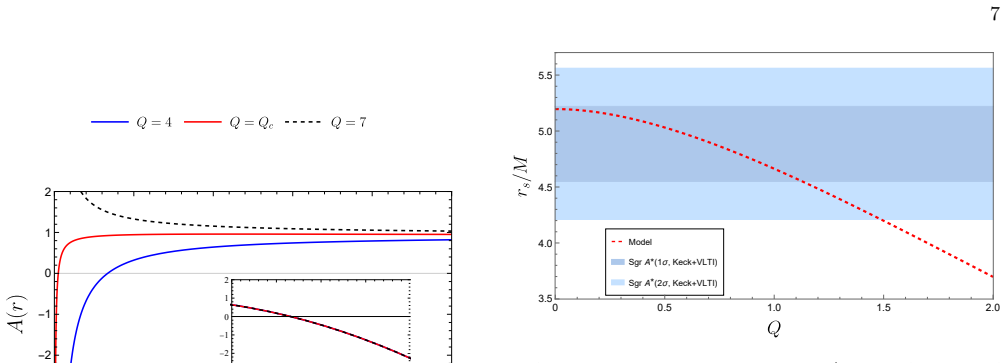
- A critical value of the magnetic charge separates black hole solutions from horizonless configurations.
- Event Horizon Telescope data on Sagittarius A* impose bounds on the allowed range of the magnetic charge through the computed shadow radius.
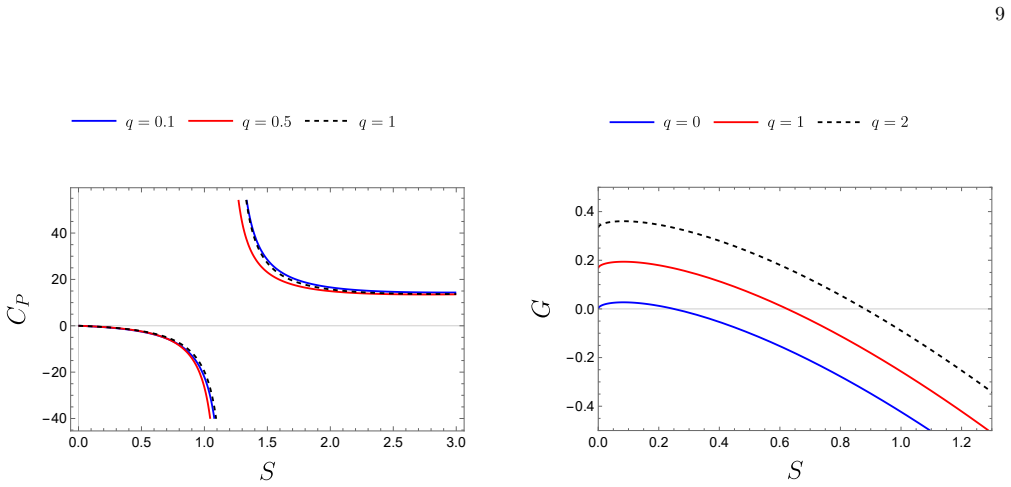
- The thermodynamics obeys the first law and Smarr relation, exhibits a Hawking-Page phase transition, and displays a single stability change without van der Waals critical points.
- The photon sphere carries total topological charge -1 while the thermodynamic vector field has winding number 0, classifying the solution with the Reissner-Nordström black hole.
Where Pith is reading between the lines
- The non-minimal coupling framework may be applied to other effective metrics to derive their underlying fundamental sources.
- The topological equivalence to the Reissner-Nordström black hole suggests comparable stability properties under strong-field perturbations.
- Extending the shadow analysis to additional black hole candidates could further restrict the magnetic charge parameter.
Load-bearing premise
The inverse construction formalism applied to the non-minimal scalar-NED coupling exactly reproduces the original effective metric without additional inconsistencies or hidden assumptions in the Lagrangian form.
What would settle it
An observed shadow radius for Sagittarius A* lying outside the range permitted by the magnetic charge bounds, or detection of van der Waals-type critical behavior in the thermodynamics, would falsify the reconstruction.
Figures





read the original abstract
We reconstruct a static and spherically symmetric black hole geometry originally proposed as an effective metric by identifying a consistent matter source derived from a fundamental action. The space-time is supported by a magnetically charged nonlinear electrodynamics (NED) field non-minimally coupled to a scalar field. Dimensional consistency reduces the parameter space to a single magnetic charge, and the inverse construction formalism yields a one-parameter family of electromagnetic Lagrangians $\mathcal{L}(F)=F^{n+1}/(n+1)$, encompassing both linear and nonlinear electrodynamics. We analyze the horizon structure and determine the critical magnetic charge separating black hole and horizonless configurations. The photon sphere and the corresponding shadow radius are computed, and observational bounds from the Event Horizon Telescope for Sagittarius A* constrain the allowed range of the magnetic charge. In the extended phase space thermodynamics, the solution satisfies the first law and the Smarr relation, exhibits a Hawking-Page phase transition, and presents a single change in stability without van der Waals-type critical behavior. We also investigate the topological properties of both the photon sphere and the thermodynamic parameter space. The photon sphere carries a total topological charge $Q_{\text{tot}}=-1$, while the thermodynamic vector field yields a global winding number $W=0$, placing the solution in the same topological class as the one of the Reissner-Nordstr\"om black hole. We finally discuss the versatility of this non-minimal coupling framework in both providing theoretical support to previously introduced solution and also to connect them to observational settings within strong-field gravity.
Editorial analysis
A structured set of objections, weighed in public.
Referee Report
Summary. The manuscript reconstructs a static spherically symmetric black hole geometry, originally introduced as an effective metric, by identifying a consistent matter source from a magnetically charged nonlinear electrodynamics (NED) field non-minimally coupled to a scalar field. Dimensional consistency reduces the setup to a single magnetic charge parameter, and an inverse construction formalism is used to derive the one-parameter family of electromagnetic Lagrangians L(F) = F^{n+1}/(n+1). The analysis covers horizon structure and the critical charge separating black hole from horizonless solutions, computation of the photon sphere and shadow radius with EHT bounds on Sagittarius A*, extended phase space thermodynamics (first law, Smarr relation, Hawking-Page transition, stability change without van der Waals behavior), and topological invariants (photon sphere total charge Q_tot = -1, thermodynamic winding number W = 0, same class as Reissner-Nordström). The non-minimal coupling framework is presented as a versatile tool for grounding effective metrics in fundamental actions and linking to observations.
Significance. If the reconstruction is valid, this work provides a useful bridge between effective black hole metrics and underlying fundamental actions via non-minimal scalar-NED couplings, enabling direct observational constraints from shadows and adding to the study of thermodynamic topology and phase transitions. It shows how such models can recover standard thermodynamic relations and topological classifications akin to known solutions, potentially aiding in the interpretation of strong-field gravity data.
major comments (1)
- Reconstruction via inverse construction: The central claim that the inverse formalism applied to the non-minimally coupled scalar-NED system yields L(F) = F^{n+1}/(n+1) that exactly supports the given effective metric requires explicit verification. Standard inverse methods derive L(F) assuming minimal coupling; the non-minimal term contributes extra pieces to the stress-energy tensor and scalar equation that are not automatically satisfied. The manuscript should include a back-substitution check of the derived Lagrangian into the Einstein equations and scalar field equation to confirm consistency, particularly regarding any constraints on the scalar profile (see abstract and the section deriving the matter source).
minor comments (3)
- Abstract: The text states that dimensional consistency reduces the parameter space to a single magnetic charge while deriving a one-parameter family of Lagrangians parameterized by n. Clarify the precise relation between n and the magnetic charge to ensure the counting of free parameters is unambiguous.
- Thermodynamic section: The satisfaction of the first law and Smarr relation is asserted for the extended phase space; adding a short derivation outline or explicit reference to the relevant thermodynamic quantities and potentials would improve transparency.
- Topological analysis: The reported values Q_tot = -1 for the photon sphere and W = 0 for the thermodynamic vector field are interesting; briefly indicating the computational procedure or the vector field definition used would aid in assessing the topological classification.
Simulated Author's Rebuttal
We thank the referee for the careful reading of our manuscript and the constructive comment on the reconstruction procedure. We address the point raised below and have incorporated an explicit verification in the revised version.
read point-by-point responses
-
Referee: Reconstruction via inverse construction: The central claim that the inverse formalism applied to the non-minimally coupled scalar-NED system yields L(F) = F^{n+1}/(n+1) that exactly supports the given effective metric requires explicit verification. Standard inverse methods derive L(F) assuming minimal coupling; the non-minimal term contributes extra pieces to the stress-energy tensor and scalar equation that are not automatically satisfied. The manuscript should include a back-substitution check of the derived Lagrangian into the Einstein equations and scalar field equation to confirm consistency, particularly regarding any constraints on the scalar profile (see abstract and the section deriving the matter source).
Authors: We thank the referee for this important observation. The inverse construction was performed by solving the Einstein equations for the electromagnetic Lagrangian after incorporating the non-minimal coupling contribution to the stress-energy tensor, rather than applying the minimal-coupling formula directly. To make this explicit, the revised manuscript now contains a dedicated verification subsection. We substitute the derived family L(F) = F^{n+1}/(n+1) back into the full Einstein equations (including the non-minimal term) and the scalar field equation. The equations are satisfied identically when the scalar profile is the one used in the original derivation (a constant or radially dependent form consistent with spherical symmetry and dimensional reduction). No additional constraints on the scalar profile appear beyond those already stated. The extra stress-energy contributions from the non-minimal coupling are precisely canceled by the chosen coupling function and the form of L(F), confirming that the reconstructed geometry is supported by the fundamental action. revision: yes
Circularity Check
No significant circularity in the derivation chain
full rationale
The paper begins with a pre-existing effective metric and applies the inverse construction formalism to identify a supporting matter source (non-minimally coupled scalar-NED with derived L(F)=F^{n+1}/(n+1)). This reconstruction step produces the Lagrangian from the metric via an independent method rather than defining one in terms of the other or fitting parameters that are then relabeled as predictions. Subsequent analyses of horizons, shadows, thermodynamics, and topology follow from the constructed solution without reducing to self-citations or tautological inputs. The magnetic charge is bounded externally by EHT data, and no load-bearing self-citation chain or ansatz smuggling is required for the central claims. The derivation remains self-contained against external benchmarks.
Axiom & Free-Parameter Ledger
free parameters (1)
- magnetic charge
axioms (2)
- domain assumption Static and spherically symmetric spacetime ansatz
- ad hoc to paper Existence of consistent matter source via non-minimal scalar-NED coupling
invented entities (1)
-
Non-minimally coupled scalar-NED system
no independent evidence
Reference graph
Works this paper leans on
-
[1]
Einstein’s Miraculous Year: Five Papers That Changed the Face of Physics
J. Stachel and R. Penrose, “Einstein’s Miraculous Year: Five Papers That Changed the Face of Physics”, Prince- ton University Press, Nova Jersey 2005
2005
-
[2]
New General Relativistic Contribution to Mercury’s Perihelion Advance,
C. M. Will, “New General Relativistic Contribution to Mercury’s Perihelion Advance,” Phys. Rev. Lett.120 (2018) no.19, 191101 [arXiv:1802.05304 [gr-qc]]
-
[3]
The 1919 measurement of the deflection of light,
C. M. Will, “The 1919 measurement of the deflection of light,” Class. Quant. Grav.32(2015) no.12, 124001 [arXiv:1409.7812 [physics.hist-ph]]
-
[4]
First M87 Event Horizon Telescope Results. VI. The Shadow and Mass of the Central Black Hole
K. Akiyamaet al.[Event Horizon Telescope], “First M87 Event Horizon Telescope Results. VI. The Shadow and Mass of the Central Black Hole,” Astrophys. J. Lett.875 (2019) no.1, L6 [arXiv:1906.11243 [astro-ph.GA]]
work page Pith review arXiv 2019
-
[5]
K. Akiyamaet al.[Event Horizon Telescope], “First Sagittarius A* Event Horizon Telescope Results. I. The Shadow of the Supermassive Black Hole in the Center of the Milky Way,” Astrophys. J. Lett.930(2022) no.2, L12 [arXiv:2311.08680 [astro-ph.HE]]
work page internal anchor Pith review arXiv 2022
-
[6]
S. Vagnozzi,et al.“Horizon-scale tests of gravity theories and fundamental physics from the Event Horizon Tele- scope image of Sagittarius A,” Class. Quant. Grav.40 (2023) no.16, 165007 [arXiv:2205.07787 [gr-qc]]
-
[7]
The Large Scale Structure of Space-Time,
S. W. Hawking and G. F. R. Ellis, “The Large Scale Structure of Space-Time,” Cambridge University Press, 2023
2023
-
[8]
S. Ansoldi, “Spherical black holes with regular center: A Review of existing models including a recent realization with Gaussian sources,” [arXiv:0802.0330 [gr-qc]]
-
[9]
Geodesically complete black holes,
R. Carballo-Rubio, F. Di Filippo, S. Liberati and M. Visser, “Geodesically complete black holes,” Phys. Rev. D101(2020), 084047 [arXiv:1911.11200 [gr-qc]]
-
[10]
Regular Magnetic Black Holes and Monopoles from Nonlinear Electrodynamics
K. A. Bronnikov, “Regular magnetic black holes and monopoles from nonlinear electrodynamics,” Phys. Rev. D63(2001), 044005 [arXiv:gr-qc/0006014 [gr-qc]]
work page Pith review arXiv 2001
-
[11]
Regular black hole in general relativity coupled to nonlinear electrodynam- ics,
E. Ayon-Beato and A. Garcia, “Regular black hole in general relativity coupled to nonlinear electrodynam- ics,” Phys. Rev. Lett.80(1998), 5056-5059 [arXiv:gr- qc/9911046 [gr-qc]]
-
[12]
Construction of Regular Black Holes in General Relativity
Z. Y. Fan and X. Wang, “Construction of Regular Black Holes in General Relativity,” Phys. Rev. D94(2016) no.12, 124027 [arXiv:1610.02636 [gr-qc]]
work page Pith review arXiv 2016
-
[13]
Cosmology in scalar tensor gravity,
V. Faraoni, “Cosmology in scalar tensor gravity,” Funda- mental Theories of Physics (Springer Dordrecht, 2004)
2004
-
[14]
Asymptotically flat black holes with scalar hair: a review
C. A. R. Herdeiro and E. Radu, “Asymptotically flat black holes with scalar hair: a review,” Int. J. Mod. Phys. D24(2015) no.09, 1542014 [arXiv:1504.08209 [gr-qc]]
work page Pith review arXiv 2015
-
[15]
String Theory,
J. Polchinski, “String Theory,” Cambridge University Press, 1998
1998
-
[16]
Superstring Theory,
M. B. Green, J. H. Schwarz, and E. Witten, “Superstring Theory,” Cambridge University Press, 1987
1987
-
[17]
Nonperturbative strong field effects in tensor - scalar theories of gravi- tation,
T. Damour and G. Esposito-Farese, “Nonperturbative strong field effects in tensor - scalar theories of gravi- tation,” Phys. Rev. Lett.70(1993), 2220-2223
1993
-
[18]
D. D. Doneva, F. M. Ramazano˘ glu, H. O. Silva, T. P. Sotiriou and S. S. Yazadjiev, “Spontaneous scalar- ization,” Rev. Mod. Phys.96(2024) no.1, 015004 [arXiv:2211.01766 [gr-qc]]
-
[19]
Testing General Relativity with Present and Future Astrophysical Observations
E. Berti,et al.“Testing General Relativity with Present and Future Astrophysical Observations,” Class. Quant. Grav.32(2015), 243001 [arXiv:1501.07274 [gr-qc]]
work page internal anchor Pith review arXiv 2015
-
[20]
Regular Bardeen black holes within non-minimal scalar-linear electrodynamic cou- plings,
D. S. J. Cordeiro,et al.“Regular Bardeen black holes within non-minimal scalar-linear electrodynamic cou- plings,” [arXiv:2509.24052 [gr-qc]]
-
[21]
Black bounce solutions via nonminimal scalar-electrodynamic couplings,
D. S. J. Cordeiro,et al.“Black bounce solutions via nonminimal scalar-electrodynamic couplings,” JCAP01 (2026), 058 [arXiv:2509.24053 [gr-qc]]
-
[22]
Black holes and entropy,
J. D. Bekenstein, “Black holes and entropy,” Phys. Rev. D7(1973), 2333-2346
1973
-
[23]
Particle Creation by Black Holes,
S. W. Hawking, “Particle Creation by Black Holes,” Commun. Math. Phys.43(1975), 199-220 [erratum: Commun. Math. Phys.46(1976), 206]
1975
-
[24]
The Four laws of black hole mechanics,
J. M. Bardeen, B. Carter and S. W. Hawking, “The Four laws of black hole mechanics,” Commun. Math. Phys.31 (1973), 161-170
1973
-
[25]
Thermodynamics of Black Holes,
P. C. W. Davies, “Thermodynamics of Black Holes,” Proc. Roy. Soc. Lond. A353(1977), 499-521
1977
-
[26]
Enthalpy and the Mechanics of AdS Black Holes
D. Kastor, S. Ray and J. Traschen, “Enthalpy and the Mechanics of AdS Black Holes,” Class. Quant. Grav.26 (2009), 195011 [arXiv:0904.2765 [hep-th]]
work page Pith review arXiv 2009
-
[27]
Pressure and volume in the first law of black hole thermodynamics,
B. P. Dolan, “Pressure and volume in the first law of black hole thermodynamics,” Class. Quant. Grav.28 (2011), 235017 [arXiv:1106.6260 [gr-qc]]
-
[28]
P-V criticality of charged AdS black holes
D. Kubiznak and R. B. Mann, “P-V criticality of charged AdS black holes,” JHEP07(2012), 033 [arXiv:1205.0559 [hep-th]]
work page Pith review arXiv 2012
-
[29]
Thermodynamics of Black Holes in anti-De Sitter Space,
S. W. Hawking and D. N. Page, “Thermodynamics of Black Holes in anti-De Sitter Space,” Commun. Math. Phys.87(1983), 577
1983
-
[30]
Anti-de Sitter Space, Thermal Phase Transition, And Confinement In Gauge Theories
E. Witten, “Anti-de Sitter space, thermal phase transi- tion, and confinement in gauge theories,” Adv. Theor. Math. Phys.2(1998), 505-532 [arXiv:hep-th/9803131 [hep-th]]
work page Pith review arXiv 1998
-
[31]
Anti de Sitter space and holography,
E. Witten, “Anti de Sitter space and holography,” Adv. Theor. Math. Phys.2(1998), 253-291 [arXiv:hep- th/9802150 [hep-th]]
-
[32]
Light-Ring Stability for Ultracompact Objects,
P. V. P. Cunha, E. Berti and C. A. R. Herdeiro, “Light- Ring Stability for Ultracompact Objects,” Phys. Rev. Lett.119(2017) no.25, 251102 [arXiv:1708.04211 [gr- qc]]
-
[33]
Stationary black holes and light rings,
P. V. P. Cunha and C. A. R. Herdeiro, “Stationary black holes and light rings,” Phys. Rev. Lett.124(2020) no.18, 181101 [arXiv:2003.06445 [gr-qc]]
-
[34]
Traversable wormholes and light rings,
S. V. M. C. B. Xavier, C. A. R. Herdeiro and L. C. B. Crispino, “Traversable wormholes and light rings,” Phys. Rev. D109(2024) no.12, 124065 [arXiv:2404.02208 [gr-qc]]
-
[35]
Wei, Topological Charge and Black Hole Photon Spheres, Phys
S. W. Wei, “Topological Charge and Black Hole Pho- ton Spheres,” Phys. Rev. D102(2020) no.6, 064039 [arXiv:2006.02112 [gr-qc]]
-
[36]
Black Hole So- lutions as Topological Thermodynamic Defects,
S. W. Wei, Y. X. Liu and R. B. Mann, “Black Hole So- lutions as Topological Thermodynamic Defects,” Phys. Rev. Lett.129(2022) no.19, 191101 [arXiv:2208.01932 [gr-qc]]
-
[37]
Thermodynamics of deformed AdS-Schwarzschild black hole,
M. R. Khosravipoor and M. Farhoudi, “Thermodynamics of deformed AdS-Schwarzschild black hole,” Eur. Phys. J. C83(2023) no.11, 1045 [arXiv:2311.02456 [gr-qc]]
-
[38]
Higher-dimensional black holes with a conformally invariant Maxwell source,
M. Hassaine and C. Martinez, “Higher-dimensional black holes with a conformally invariant Maxwell source,” Phys. Rev. D75(2007), 027502 [arXiv:hep-th/0701058 [hep-th]]. 15
-
[39]
Source of black bounces in general relativity,
M. E. Rodrigues and M. V. d. S. Silva, “Source of black bounces in general relativity,” Phys. Rev. D107(2023) no.4, 044064 [arXiv:2302.10772 [gr-qc]]
-
[40]
G. Alencar,et al.“On black bounce space-times in non- linear electrodynamics,” Eur. Phys. J. C84(2024) no.7, 745 [arXiv:2403.12897 [gr-qc]]
-
[41]
V. Perlick and O. Y. Tsupko, “Calculating black hole shadows: Review of analytical studies,” Phys. Rept.947 (2022), 1-39 [arXiv:2105.07101 [gr-qc]]
-
[42]
C. M. Claudel, K. S. Virbhadra and G. F. R. Ellis, “The Geometry of photon surfaces,” J. Math. Phys.42(2001), 818-838 [arXiv:gr-qc/0005050 [gr-qc]]
-
[43]
Relativistic redshift of the star S0-2 orbit- ing the Galactic center supermassive black hole,
T. Do,et al.“Relativistic redshift of the star S0-2 orbit- ing the Galactic center supermassive black hole,” Science 365(2019) no.6454, 664-668 [arXiv:1907.10731 [astro- ph.GA]]
-
[44]
First Sagittarius A* Event Horizon Telescope Results. VI. Testing the Black Hole Metric,
K. Akiyamaet al.[Event Horizon Telescope], “First Sagittarius A* Event Horizon Telescope Results. VI. Testing the Black Hole Metric,” Astrophys. J. Lett.930 (2022) no.2, L17
2022
-
[45]
Geodesic stability, Lyapunov exponents and quasinormal modes,
V. Cardoso, A. S. Miranda, E. Berti, H. Witek and V. T. Zanchin, “Geodesic stability, Lyapunov expo- nents and quasinormal modes,” Phys. Rev. D79(2009), 064016 [arXiv:0812.1806 [hep-th]]
discussion (0)
Sign in with ORCID, Apple, or X to comment. Anyone can read and Pith papers without signing in.