Recognition: unknown
Radio Signature of Higher Atmospheric Meridional Flow and Implications for Magnetic Trees in the Sun
Pith reviewed 2026-05-09 16:14 UTC · model grok-4.3
The pith
17 GHz radio brightness features move poleward in lockstep with magnetic flux transport at 3000 km altitude.
A machine-rendered reading of the paper's core claim, the machinery that carries it, and where it could break.
Core claim
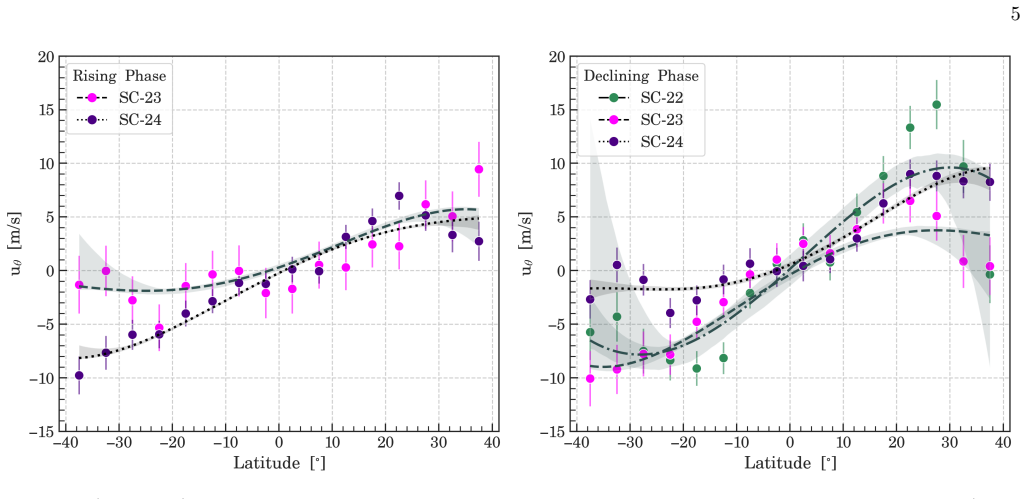
Using 27 years of full-disk radio imaging, a poleward flow signature is detected at heights of 3000 plus or minus 500 km. The latitudinal velocity profile of the 17 GHz brightness features mirrors the established photospheric meridional circulation and is modulated by solar-cycle parameters. Direct comparison with synoptic magnetograms shows that the radio features track the poleward transport of magnetic flux, implying the structures are anchored by magnetic fields that connect the upper chromosphere to deeper layers.
What carries the argument
The observed displacement of 17 GHz brightness features as a tracer whose motion directly follows poleward magnetic flux transport, thereby revealing deep magnetic anchoring.
Load-bearing premise
That the measured shifts of the radio brightness features represent a true large-scale meridional flow anchored to subsurface magnetic structures rather than local dynamics, projection effects, or tracking biases.
What would settle it
Tracking the same radio features over multiple years and finding no statistical correlation between their poleward speeds and the independently measured magnetic flux transport rates from magnetograms.
Figures



read the original abstract
The coupling between plasma flows and magnetic fields in the solar atmosphere governs the transport of angular momentum and the redistribution of magnetic flux, yet its manifestation in the magnetically dominated upper chromosphere remains uncertain. Using 27 years of 17 GHz full-disk solar radio imaging observations from the Nobeyama Radioheliograph, we report the first detection of a poleward flow signature at heights of $3000\pm500$ km, an altitude where plasma magnetohydrodynamics expects magnetic dominance ($\beta<1$). The derived latitudinal velocity profile ($5-15$ m/s) mirrors the established photospheric meridional circulation, displaying modulation with solar cycle parameters. Comparison with long-term synoptic magnetograms reveals that the motion of 17 GHz brightness features closely tracks poleward magnetic flux transport, implying a deep magnetic anchoring of these structures. This finding provides the first observational evidence that chromospheric flows at radio wavelengths reflect subsurface meridional dynamics, consistent with the "magnetic tree" hypothesis, which links high-altitude motion to deep-seated magnetic connectivity.
Editorial analysis
A structured set of objections, weighed in public.
Referee Report
Summary. The manuscript analyzes 27 years of 17 GHz full-disk imaging from the Nobeyama Radioheliograph to report a poleward flow signature at chromospheric heights of 3000±500 km (where β<1 is expected). Derived latitudinal velocities of 5-15 m/s are stated to mirror photospheric meridional circulation, modulate with solar cycle parameters, and closely track poleward magnetic flux transport seen in synoptic magnetograms, implying deep magnetic anchoring of the radio features and providing the first observational support for the magnetic tree hypothesis.
Significance. If the reported displacements are demonstrated to be physical advection of magnetically anchored structures rather than apparent motion, the result would supply novel evidence linking chromospheric radio features to subsurface meridional dynamics, with potential implications for flux transport and dynamo models. The 27-year baseline is a clear strength for cycle modulation studies. However, the current significance is limited by the absence of methodological validation.
major comments (2)
- [Abstract] Abstract: The central claim that 'the motion of 17 GHz brightness features closely tracks poleward magnetic flux transport' is load-bearing for the deep-anchoring conclusion, yet the text supplies no details on the feature-tracking algorithm (lifetime thresholds, cross-correlation window size, handling of feature birth/death, or latitude-dependent projection corrections). Without these, it cannot be determined whether the 5-15 m/s profile represents true meridional advection or selection biases tied to the underlying magnetic flux distribution.
- [Abstract] Abstract: No quantitative error analysis, data-selection criteria, or controls for artifacts (e.g., projection effects, cycle-phase changes in feature lifetimes, or local dynamics versus bulk flow) are reported for the velocity profile or its comparison to magnetograms. This omission prevents evaluation of whether the reported tracking is statistically robust or consistent with the stated height and β<1 regime.
minor comments (1)
- [Abstract] Abstract: The uncertainty on the formation height (3000±500 km) is stated without reference to the specific model, frequency-dependent opacity calculation, or observational constraint used to derive it.
Simulated Author's Rebuttal
We thank the referee for the careful and constructive review of our manuscript. We appreciate the recognition of the 27-year baseline as a strength and the potential implications for linking chromospheric radio features to subsurface dynamics. We address each major comment below and will revise the manuscript to improve methodological transparency and quantitative support.
read point-by-point responses
-
Referee: [Abstract] Abstract: The central claim that 'the motion of 17 GHz brightness features closely tracks poleward magnetic flux transport' is load-bearing for the deep-anchoring conclusion, yet the text supplies no details on the feature-tracking algorithm (lifetime thresholds, cross-correlation window size, handling of feature birth/death, or latitude-dependent projection corrections). Without these, it cannot be determined whether the 5-15 m/s profile represents true meridional advection or selection biases tied to the underlying magnetic flux distribution.
Authors: We agree that the abstract is too concise to convey these parameters. The main text outlines the tracking approach but does not provide the full algorithmic specifications. In the revised manuscript we will add an expanded Methods subsection that explicitly states the lifetime threshold (features required to persist across at least three consecutive daily maps), the cross-correlation window size, the criteria for rejecting birth/death events (continuity in both position and intensity), and the latitude-dependent projection corrections applied via heliographic coordinate transformation. We will also include a brief sensitivity test showing that the derived 5-15 m/s profile changes by less than 2 m/s when these thresholds are varied within plausible ranges, indicating that the result is not driven by selection biases linked to the underlying flux distribution. revision: yes
-
Referee: [Abstract] Abstract: No quantitative error analysis, data-selection criteria, or controls for artifacts (e.g., projection effects, cycle-phase changes in feature lifetimes, or local dynamics versus bulk flow) are reported for the velocity profile or its comparison to magnetograms. This omission prevents evaluation of whether the reported tracking is statistically robust or consistent with the stated height and β<1 regime.
Authors: We acknowledge that the current version lacks a dedicated error budget and artifact-control discussion. In the revision we will add quantitative uncertainties (standard deviation across independent tracking runs and across different solar-cycle phases) to the velocity profiles, together with explicit data-selection criteria (e.g., exclusion of maps with poor seeing or during major flare periods). We will also present controls that compare the latitudinal motion in quiet versus active regions and demonstrate that the poleward signal persists after subtracting local supergranular flows. These additions will allow readers to assess statistical robustness and consistency with the chromospheric height and β<1 regime. revision: yes
Circularity Check
No circularity: observational comparison of independent datasets
full rationale
The paper reports direct feature tracking in 27 years of Nobeyama 17 GHz radio images and compares the resulting latitudinal displacements to poleward magnetic flux transport measured in independent synoptic magnetograms. No equations, parameter fits, ansatzes, or self-citations are presented that would render the reported velocity profile or anchoring conclusion tautological with the input data or assumptions. The central claim rests on the empirical match between two separately observed quantities rather than any definitional or fitted equivalence.
Axiom & Free-Parameter Ledger
axioms (2)
- domain assumption 17 GHz emission originates at approximately 3000 km height in the chromosphere
- domain assumption Displacement of radio brightness features directly traces plasma flow rather than wave or projection effects
invented entities (1)
-
magnetic tree
no independent evidence
Reference graph
Works this paper leans on
-
[1]
Badalyan, O. G., & Obridko, V. N. 2018, Astronomy Letters 2018 44:11, 44, 727, doi: 10.1134/S1063773718110014
-
[2]
Brun, A. S., & Browning, M. K. 2017, Living Reviews in Solar Physics, 14, 4, doi: 10.1007/s41116-017-0007-8
-
[3]
R., Sch¨ ussler, M., & Dikpati, M
Choudhuri, A. R., Sch¨ ussler, M., & Dikpati, M. 1995, Astronomy & Astrophysics, 303, L29
1995
-
[4]
2015, SILSO Sunspot Number V2.0, https://doi.org/10.24414/qnza-ac80, doi: 10.24414/qnza-ac80
Clette, F., & Lef` evre, L. 2015, SILSO Sunspot Number V2.0, https://doi.org/10.24414/qnza-ac80, doi: 10.24414/qnza-ac80
-
[5]
1999, Astrophysical Journal, 518, 508, doi: 10.1086/307269
Dikpati, M., & Charbonneau, P. 1999, Astrophysical Journal, 518, 508, doi: 10.1086/307269
-
[6]
2019, SoPh, 294, 30, doi: 10.1007/s11207-019-1418-6
Fujiki, K., Shibasaki, K., Yashiro, S., et al. 2019, SoPh, 294, 30, doi: 10.1007/s11207-019-1418-6
-
[7]
Gary, G. A. 2001, SoPh, 203, 71, doi: 10.1023/A:1012722021820
-
[8]
Gopalswamy, N., M¨ akel¨ a, P., Yashiro, S., & Akiyama, S. 2018, Journal of Atmospheric and Solar-Terrestrial Physics, 176, 26, doi: 10.1016/j.jastp.2018.04.005
-
[9]
J., & Shibasaki, K
Gopalswamy, N., Thompson, B. J., & Shibasaki, K. 1998, in Astronomical Society of the Pacific Conference Series, Vol. 140, Synoptic Solar Physics, ed. K. S
1998
-
[10]
2016, ApJL, 823, L15, doi: 10.3847/2041-8205/823/1/L15
Gopalswamy, N., Yashiro, S., & Akiyama, S. 2016, ApJL, 823, L15, doi: 10.3847/2041-8205/823/1/L15
-
[11]
2012, ApJL, 750, L42, doi: 10.1088/2041-8205/750/2/L42 8
Gopalswamy, N., Yashiro, S., M¨ akel¨ a, P., et al. 2012, ApJL, 750, L42, doi: 10.1088/2041-8205/750/2/L42 8
-
[12]
Hathaway, D. H., & Rightmire, L. 2010, Science, 327, 1350, doi: 10.1126/science.1181990
-
[13]
Imada, S., Matoba, K., Fujiyama, M., & Iijima, H. 2020,
2020
-
[14]
Earth, Planets and Space, 72, 1, doi: 10.1186/S40623-020-01314-Y
-
[15]
K., & Gosain, S
Janardhan, P., Bisoi, S. K., & Gosain, S. 2010, Solar Physics, 267, 267
2010
-
[16]
Jiang, J., Zhang, Z., & Petrovay, K. 2023, Journal of Atmospheric and Solar-Terrestrial Physics, 243, 106018, doi: 10.1016/j.jastp.2023.106018
-
[17]
Lamb, D. A. 2017, ApJ, 836, 10, doi: 10.3847/1538-4357/836/1/10
-
[18]
2019, Monthly Notices of the Royal Astronomical Society, 489, 714
Lekshmi, B., Nandy, D., & Antia, H. 2019, Monthly Notices of the Royal Astronomical Society, 489, 714
2019
-
[19]
C., Harvey, J., Slaughter, C., & Trumbo, D
Livingston, W. C., Harvey, J., Slaughter, C., & Trumbo, D. 1976, Appl. Opt., 15, 40, doi: 10.1364/AO.15.000040
-
[20]
Martens, P. C. 2021, ApJ, 917, 100, doi: 10.3847/1538-4357/ac0a80
-
[21]
2003, Experiments in Fluids, 35, 408, doi: 10.1007/s00348-003-0673-2
Meunier, P., & Leweke, T. 2003, Experiments in Fluids, 35, 408, doi: 10.1007/s00348-003-0673-2
-
[22]
Miesch, M. S., & Hindman, B. W. 2011, Astrophysical Journal, 743, 79, doi: 10.1088/0004-637X/743/1/79
-
[23]
Mishra, D. K., Routh, S., Jha, B. K., et al. 2024, The Astrophysical Journal, 961, 40, doi: 10.3847/1538-4357/ad1188
-
[24]
1994, IEEE Proceedings, 82, 705
Nakajima, H., Nishio, M., Enome, S., et al. 1994, IEEE Proceedings, 82, 705
1994
-
[25]
Olemskoy, S. V., & Kitchatinov, L. L. 2005, Astronomy Letters, 31, 706, doi: 10.1134/1.2075313
-
[26]
2017, A&A, 607, A120, doi: 10.1051/0004-6361/201730568
Passos, D., Miesch, M., Guerrero, G., & Charbonneau, P. 2017, A&A, 607, A120, doi: 10.1051/0004-6361/201730568
-
[27]
Petit, P. e. a. 2018, Monthly Notices of the Royal Astronomical Society, 478, 4390, doi: 10.1093/mnras/sty1313
-
[28]
Rightmire-Upton, L., Hathaway, D. H., & Kosak, K. 2012, ApJL, 761, L14, doi: 10.1088/2041-8205/761/1/L14
-
[29]
Riha, L., Fischer, J., Smid, R., & Docekal, A. 2007, in 2007 IEEE Instrumentation & Measurement Technology Conference IMTC 2007, 1–5, doi: 10.1109/IMTC.2007.379183
-
[30]
Routh, S., Jha, B. K., Mishra, D. K., et al. 2024, ApJ, 975, 158, doi: 10.3847/1538-4357/ad7ba2
-
[31]
2025, A&A, 700, L3, doi: 10.1051/0004-6361/202555364
Routh, S., Kumari, A., Pant, V., et al. 2025, A&A, 700, L3, doi: 10.1051/0004-6361/202555364
-
[32]
Scherrer, P. H., Bogart, R. S., Bush, R. I., et al. 1995, SoPh, 162, 129, doi: 10.1007/BF00733429
-
[33]
Scherrer, P. H., Schou, J., Bush, R. I., et al. 2012, SoPh, 275, 207, doi: 10.1007/s11207-011-9834-2
-
[34]
2003, A&A, 401, 1143, doi: 10.1051/0004-6361:20030071
Shibasaki, K. 2003, A&A, 401, 1143, doi: 10.1051/0004-6361:20030071
-
[35]
Thompson, W. T. 2006, A&A, 449, 791, doi: 10.1051/0004-6361:20054262
-
[36]
Weber, E. J. 1969, SoPh, 9, 150, doi: 10.1007/BF00145735
-
[37]
2023, SSRv, 219, 31, doi: 10.1007/s11214-023-00978-8
Wang, Y.-M. 2023, SSRv, 219, 31, doi: 10.1007/s11214-023-00978-8
-
[38]
1992, A&A, 265, 115
Zahn, J.-P. 1992, A&A, 265, 115
1992
-
[39]
1988, Astrophysics of the sun
Zirin, H. 1988, Astrophysics of the sun
1988
discussion (0)
Sign in with ORCID, Apple, or X to comment. Anyone can read and Pith papers without signing in.