Recognition: 3 theorem links
· Lean TheoremA Comprehensive Study of Morphology and Kinematics in Extended Nebulae Around UV Luminous Quasars at zapprox1
Pith reviewed 2026-05-08 19:31 UTC · model grok-4.3
The pith
Giant nebulae around quasars at z≈1 arise through multiple pathways, with the largest irregular ones often tied to galaxy interactions.
A machine-rendered reading of the paper's core claim, the machinery that carries it, and where it could break.
Core claim
Giant quasar nebulae are not a uniform class of objects, but instead arise through multiple pathways shaped by host-galaxy gas, galaxy interactions, group environments, and quasar activity, with the most striking cases associated with galaxy interactions.
What carries the argument
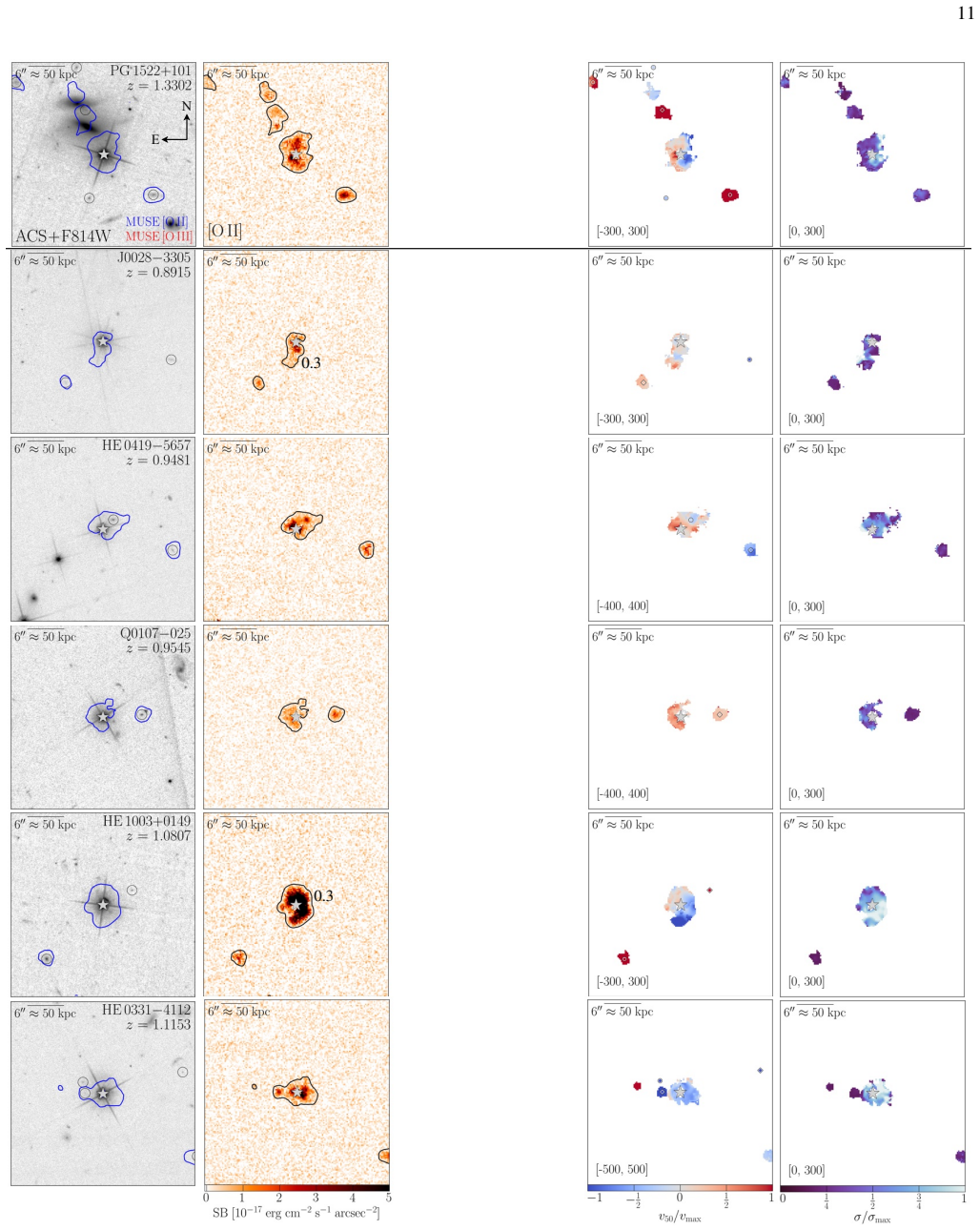
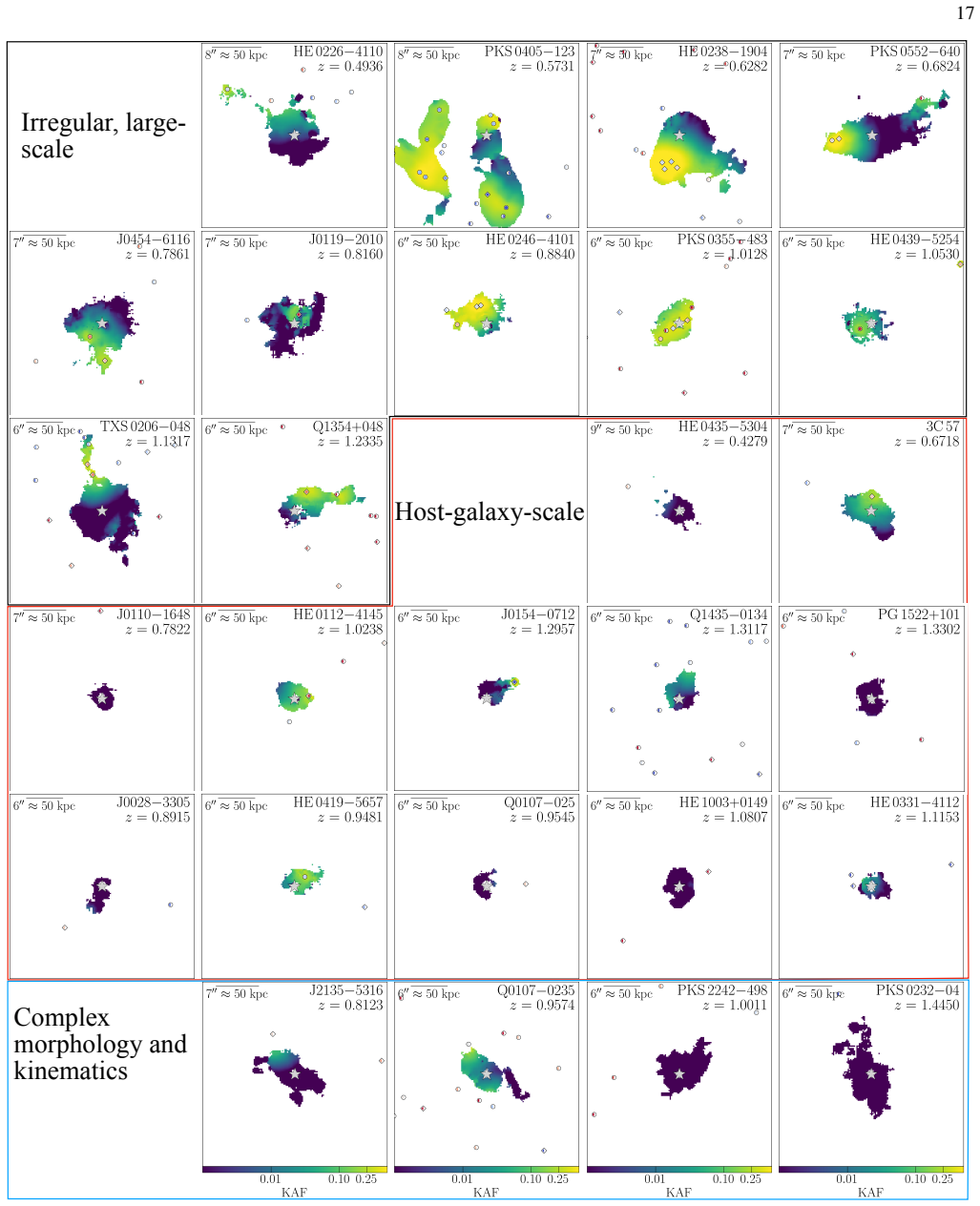
Morpho-kinematic classifications (irregular large-scale >50 kpc systems, compact host-galaxy-scale nebulae, complex morphologies) plus a quantitative spatial-kinematic association metric between nebulae and group galaxies.
If this is right
- Eleven irregular large-scale systems are likely linked to galaxy interactions.
- Ten nebulae exhibit statistically significant association with quasar-host group galaxies, predominantly the irregular large-scale ones.
- Radio jets appear in six systems with no strong correlation to nebular morphology or extent.
- [O II] nebulae are more asymmetric than Lyα nebulae at z>2 yet resemble local H I distributions around elliptical galaxies.
- Blueshifted-redshifted velocity patterns occur in about 30 percent of systems, while disturbed kinematics indicate feedback may also shape the gas.
Where Pith is reading between the lines
- Models of circumgalactic gas must incorporate multiple formation channels rather than assuming one dominant process for all extended nebulae.
- The observed continuity with local elliptical galaxy H I suggests large-scale gas structures persist across cosmic time.
- Disturbed kinematics may imply quasar feedback influences gas on tens-of-kpc scales and could affect star formation in neighboring galaxies.
- Future integral-field surveys at varying redshifts could test whether the fraction of interaction-linked nebulae evolves with cosmic epoch or quasar power.
Load-bearing premise
The morpho-kinematic classifications reliably trace distinct physical origins such as galaxy interactions without major contamination from projection effects, incomplete sampling, or alternative excitation mechanisms.
What would settle it
Detection of many large irregular nebulae around isolated quasars lacking interacting group galaxies, or absence of any statistical spatial-kinematic association in the sample.
Figures





read the original abstract
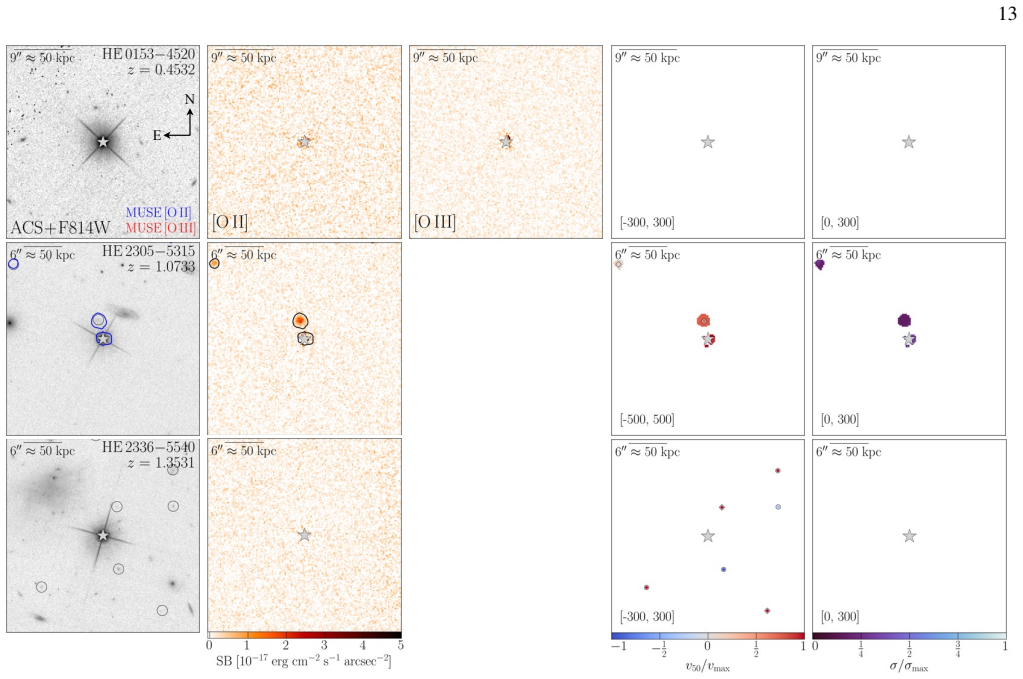
Gas flows between galaxies and the circumgalactic medium (CGM) play a central role in galaxy evolution and can become observable as giant nebulae when illuminated by the quasars. We present an ensemble study of nebulae around 30 UV-luminous quasars at $z\approx0.4{-}1.4$ from the CUBS and MUSEQuBES surveys, 27 of which are detected in extended [O II] and/or [O III] emission. Based on a joint analysis of nebular morphology and surrounding galaxy environments, we introduce three morpho-kinematic classifications. We identify eleven irregular, large-scale (>50 kpc) systems, many of which are likely interaction-related; twelve compact host-galaxy-scale nebula, likely tracing CGM/ISM gas; and four systems with complex morphologies of uncertain origin. We introduce a quantitative measure of the spatial and kinematic association between nebulae and quasar-host group galaxies, finding a statistically significant association for ten nebulae, most of which are irregular, large-scale nebulae, consistent with qualitative analysis. Radio jets are detected in six systems, with no strong correlation found between radio activity and nebular emission. The [O II] nebulae are more asymmetric than their Lyalpha counterparts at $z>2$, but bear more similarity to H I gas observed in 21 cm around local elliptical galaxies. Blueshifted-redshifted patterns, likely tracing gas rotation, are observed in roughly 30% of the systems, though disturbed kinematics suggest that feedback may also be important. These results show that giant quasar nebulae are not a uniform class of objects, but instead arise through multiple pathways shaped by host-galaxy gas, galaxy interactions, group environments, and quasar activity, with the most striking cases associated with galaxy interactions.
Editorial analysis
A structured set of objections, weighed in public.
Referee Report
Summary. The paper presents an ensemble study of nebulae around 30 UV-luminous quasars at z≈0.4-1.4 from the CUBS and MUSEQuBES surveys, detecting extended emission in 27. Through joint morphology, kinematics, and environment analysis, they classify the nebulae into three categories: 11 irregular large-scale (>50 kpc) systems often linked to galaxy interactions, 12 compact systems tracing CGM/ISM, and 4 complex of uncertain origin. A quantitative spatial-kinematic association measure shows significant association for 10 nebulae, mostly irregular ones. No strong radio jet correlation is found. [O II] nebulae are more asymmetric than high-z Lyα but similar to local HI. About 30% show blueshifted-redshifted patterns suggestive of rotation, with disturbed kinematics indicating feedback. The key result is that these nebulae are diverse, arising via multiple pathways with interactions prominent in the largest cases.
Significance. This study is significant for showing that giant quasar nebulae are not a monolithic class but result from varied processes including interactions and host gas. The ensemble approach with quantitative metrics strengthens the case for multiple origins, impacting models of CGM and galaxy evolution at cosmic noon. Credit for the joint analysis and the introduction of a quantitative association measure.
major comments (3)
- [Quantitative Association Measure] The reported statistically significant association for ten nebulae (mostly irregular large-scale) is central to the claim of interaction-driven origins, but no control tests (e.g., randomized positions or mock data) are described to confirm it is not an artifact of the flux-limited sample or projection effects at z≈1. This needs to be addressed to support the inference.
- [Morpho-kinematic Classifications] The mapping of the 11 irregular systems to interaction-related origins and 12 compact to host CGM/ISM assumes the classifications trace distinct physical pathways without major contamination; however, the limited MUSE resolution and lack of completeness quantification for the galaxy sample make this vulnerable.
- [Kinematics Analysis] The observation of blueshifted-redshifted patterns in roughly 30% of systems is used to suggest rotation, but without details on how projection of unrelated structures is ruled out, this could affect the disturbed kinematics interpretation and overall diversity conclusion.
minor comments (3)
- [Abstract] The redshift range is given as z≈0.4-1.4 but the title says z≈1; clarify if the sample is centered at z≈1 or the full range.
- [Results] Provide the exact number and fraction for the blueshifted-redshifted patterns rather than 'roughly 30%' for precision.
- [Figures] Ensure figures illustrating the three classifications include scale bars and clear labels for associated galaxies.
Simulated Author's Rebuttal
We thank the referee for their thorough review and positive evaluation of our work. We appreciate the constructive feedback and have prepared point-by-point responses to the major comments. We will revise the manuscript to incorporate the suggested improvements where possible.
read point-by-point responses
-
Referee: [Quantitative Association Measure] The reported statistically significant association for ten nebulae (mostly irregular large-scale) is central to the claim of interaction-driven origins, but no control tests (e.g., randomized positions or mock data) are described to confirm it is not an artifact of the flux-limited sample or projection effects at z≈1. This needs to be addressed to support the inference.
Authors: We agree that additional control tests would provide stronger support for the statistical significance of the association measure. Although our measure incorporates both spatial proximity and kinematic coherence to mitigate projection effects, we did not include explicit randomization tests in the submitted manuscript. In the revised version, we will add a dedicated subsection describing Monte Carlo simulations where galaxy positions are randomized within the field of view and mock velocity fields are generated to assess the false positive rate of our association metric. This will help confirm that the observed associations, particularly for the irregular nebulae, are not artifacts of the sample selection or projection. revision: yes
-
Referee: [Morpho-kinematic Classifications] The mapping of the 11 irregular systems to interaction-related origins and 12 compact to host CGM/ISM assumes the classifications trace distinct physical pathways without major contamination; however, the limited MUSE resolution and lack of completeness quantification for the galaxy sample make this vulnerable.
Authors: The referee correctly points out the challenges in classifying the nebulae given the spatial resolution of MUSE at z≈1 and the potential incompleteness of the galaxy catalogs. Our classifications are primarily morphological, supplemented by kinematic information and environmental context, and we have been careful to label four systems as 'complex of uncertain origin'. We will revise the manuscript to include a more quantitative assessment of galaxy detection completeness based on the survey depths and to discuss possible contamination between categories. However, the overall conclusion of diversity in origins remains robust as it is supported by the range of observed properties across the sample. revision: partial
-
Referee: [Kinematics Analysis] The observation of blueshifted-redshifted patterns in roughly 30% of systems is used to suggest rotation, but without details on how projection of unrelated structures is ruled out, this could affect the disturbed kinematics interpretation and overall diversity conclusion.
Authors: We acknowledge that projection effects could mimic blueshifted-redshifted patterns in some cases. The patterns were identified in the velocity fields and position-velocity diagrams extracted along the major axes of the nebulae. To address this, we will expand the kinematics section to detail the selection criteria (e.g., coherent velocity gradients spanning >20 kpc) and include a discussion of alternative interpretations such as outflows or superpositions. While higher-resolution data would be ideal to fully rule out projections, the combination with morphological irregularity in many cases supports our interpretation of rotation in a subset of systems. revision: yes
Circularity Check
No circularity: purely observational classifications and association measures extracted directly from data
full rationale
This is a purely observational study with no equations, derivations, fitted parameters, or model predictions. Morpho-kinematic classifications and the quantitative spatial-kinematic association measure are defined and applied directly to the imaging and spectroscopic observations of the 30 quasars. No load-bearing step reduces to a self-citation, self-definition, or input by construction; the claims about multiple pathways follow from the empirical patterns in the data rather than from any tautological reduction.
Axiom & Free-Parameter Ledger
axioms (1)
- domain assumption Extended [O II] and [O III] emission traces ionized gas in the CGM or ISM illuminated by the quasar
Lean theorems connected to this paper
-
Cost.FunctionalEquation (J(x)=½(x+x⁻¹)−1)washburn_uniqueness_aczel unclear?
unclearRelation between the paper passage and the cited Recognition theorem.
We model the PDF of each galaxy and each nebular spaxel as independent three-dimensional Gaussian distributions ... BC = ∫ √(p(x)q(x)) dx ... KAF(x_i,y_i) = Σ BC_{k,i}
-
Foundation.AlexanderDuality / DimensionForcing (D=3)alexander_duality_circle_linking unclear?
unclearRelation between the paper passage and the cited Recognition theorem.
we introduce three morpho-kinematic classifications ... eleven irregular, large-scale (>50 kpc) systems ... twelve compact host-galaxy-scale nebulae ... four systems with complex morphologies
What do these tags mean?
- matches
- The paper's claim is directly supported by a theorem in the formal canon.
- supports
- The theorem supports part of the paper's argument, but the paper may add assumptions or extra steps.
- extends
- The paper goes beyond the formal theorem; the theorem is a base layer rather than the whole result.
- uses
- The paper appears to rely on the theorem as machinery.
- contradicts
- The paper's claim conflicts with a theorem or certificate in the canon.
- unclear
- Pith found a possible connection, but the passage is too broad, indirect, or ambiguous to say the theorem truly supports the claim.
Reference graph
Works this paper leans on
-
[1]
Galaxy morphology to I=25 mag in the Hubble Deep Field
Abraham, R. G., Tanvir, N. R., Santiago, B. X., et al. 1996, MNRAS, 279, L47, doi: 10.1093/mnras/279.3.L47
-
[2]
2023, ApJ, 947, 16, doi: 10.3847/1538-4357/acb13f
Amiri, M., Bandura, K., Chen, T., et al. 2023, ApJ, 947, 16, doi: 10.3847/1538-4357/acb13f
-
[3]
Antonucci, R. 1993, ARA&A, 31, 473, doi: 10.1146/annurev.aa.31.090193.002353 Arrigoni Battaia, F., Hennawi, J. F., Prochaska, J. X., et al. 2019a, MNRAS, 482, 3162, doi: 10.1093/mnras/sty2827 Arrigoni Battaia, F., Obreja, A., Prochaska, J. X., et al. 2019b, A&A, 631, A18, doi: 10.1051/0004-6361/201936211 Astropy Collaboration, Price-Whelan, A. M., Lim, P....
-
[4]
2010, in Society of Photo-Optical Instrumentation Engineers (SPIE) Conference
Bacon, R., Accardo, M., Adjali, L., et al. 2010, in Society of Photo-Optical Instrumentation Engineers (SPIE) Conference
2010
-
[5]
Series, Vol. 7735, Ground-based and Airborne Instrumentation for Astronomy III, ed. I. S. McLean, S. K. Ramsay, & H. Takami, 773508, doi: 10.1117/12.856027
-
[6]
2018, A&A, 619, A83, doi: 10.1051/0004-6361/201833515
Balmaverde, B., Capetti, A., Marconi, A., et al. 2018, A&A, 619, A83, doi: 10.1051/0004-6361/201833515
-
[7]
Balmaverde, B., Capetti, A., Baldi, R. D., et al. 2022, A&A, 662, A23, doi: 10.1051/0004-6361/202142823
-
[8]
Communications Physics , keywords =
Barone, T. M., Kacprzak, G. G., Nightingale, J. W., et al. 2024, Communications Physics, 7, 286, doi: 10.1038/s42005-024-01778-4
-
[9]
Beckett, A., Morris, S. L., Fumagalli, M., et al. 2023, MNRAS, 521, 1113, doi: 10.1093/mnras/stad596
-
[10]
2025, ApJ, 992, 155, doi: 10.3847/1538-4357/ae0291
Beckett, A., Rafelski, M., Scarlata, C., et al. 2025, ApJ, 992, 155, doi: 10.3847/1538-4357/ae0291
-
[11]
Bellomi, E., ZuHone, J. A., Truong, N., et al. 2025, arXiv e-prints, arXiv:2512.12754, doi: 10.48550/arXiv.2512.12754
-
[12]
1946, Sankhy¯a: The Indian Journal of Statistics, 7, 401
Bhattacharyya, A. 1946, Sankhy¯a: The Indian Journal of Statistics, 7, 401
1946
-
[13]
Bolton, A. S., Schlegel, D. J., Aubourg, É., et al. 2012, AJ, 144, 144, doi: 10.1088/0004-6256/144/5/144
-
[14]
Borisova, E., Cantalupo, S., Lilly, S. J., et al. 2016, ApJ, 831, 39, doi: 10.3847/0004-637X/831/1/39
-
[15]
Boroson, T. A., & Oke, J. B. 1984, ApJ, 281, 535, doi: 10.1086/162126
-
[16]
2023, astropy/photutils: 1.8.0 , 1.8.0 Zenodo, 10.5281/zenodo.7946442
Bradley, L. 2023,, 1.8.0 Zenodo, doi: 10.5281/zenodo.7946442
-
[17]
2016,, Astrophysics Source Code Library, record ascl:1609.011 http://ascl.net/1609.011
Bradley, L., Sipocz, B., Robitaille, T., et al. 2016,, Astrophysics Source Code Library, record ascl:1609.011 http://ascl.net/1609.011
2016
-
[18]
Cai, Z., Cantalupo, S., Prochaska, J. X., et al. 2019, ApJS, 245, 23, doi: 10.3847/1538-4365/ab4796 Cantalupo,S.,Arrigoni-Battaia,F.,Prochaska,J.X.,Hennawi,J.F., & Madau, P. 2014, Nature, 506, 63, doi: 10.1038/nature12898
-
[19]
Cantalupo, S., Pezzulli, G., Lilly, S. J., et al. 2019, MNRAS, 483, 5188, doi: 10.1093/mnras/sty3481
-
[20]
Cappellari, M., Emsellem, E., Krajnović, D., et al. 2011, MNRAS, 413, 813, doi: 10.1111/j.1365-2966.2010.18174.x
-
[21]
2013, MNRAS, 432, 1709, doi: 10.1093/mnras/stt562
Cappellari, M., Scott, N., Alatalo, K., et al. 2013, MNRAS, 432, 1709, doi: 10.1093/mnras/stt562
-
[22]
Chen, H.-W., Boettcher, E., Johnson, S. D., et al. 2019, ApJL, 878, L33, doi: 10.3847/2041-8213/ab25ec
-
[23]
doi:10.1093/MNRAS/stt2288 , number =
Chen, H.-W., Gauthier, J.-R., Sharon, K., et al. 2014, MNRAS, 438, 1435, doi: 10.1093/mnras/stt2288
-
[24]
Chen, H.-W., & Zahedy, F. S. 2026, in Encyclopedia of
2026
-
[25]
4, 370–400, doi: 10.1016/B978-0-443-21439-4.00059-6
Astrophysics, Volume 4, Vol. 4, 370–400, doi: 10.1016/B978-0-443-21439-4.00059-6
-
[26]
Chen, H.-W., Zahedy, F. S., Boettcher, E., et al. 2020, MNRAS, 497, 498, doi: 10.1093/mnras/staa1773
-
[27]
Chen, M. C., Chen, H.-W., Rauch, M., et al. 2023, MNRAS, 518, 2354, doi: 10.1093/mnras/stac3193
-
[28]
C., Chen, H.-W., Rauch, M., et al
Chen, M. C., Chen, H.-W., Rauch, M., et al. 2024, ApJ, 962, 98, doi: 10.3847/1538-4357/ad1406
-
[29]
C., Chen, H.-W., Rauch, M., et al
Chen, M. C., Chen, H.-W., Rauch, M., et al. 2025, ApJL, 978, L18, doi: 10.3847/2041-8213/ad9bac
-
[30]
2025, ApJS, 279, 19, doi: 10.3847/1538-4365/add897
Chen, Z., Cunnington, S., Pourtsidou, A., et al. 2025, ApJS, 279, 19, doi: 10.3847/1538-4365/add897
-
[31]
Chiappini, C., Matteucci, F., & Gratton, R. 1997, ApJ, 477, 765, doi: 10.1086/303726
-
[32]
Chowdhury, A., Kanekar, N., & Chengalur, J. N. 2022, ApJ, 937, 103, doi: 10.3847/1538-4357/ac7d52
-
[33]
J., et al., 2000, @doi [ ] 10.1086/308300 , 529, 886
Conselice, C. J., Bershady, M. A., & Jangren, A. 2000, ApJ, 529, 886, doi: 10.1086/308300 de Blok, W. J. G., Walter, F., Brinks, E., et al. 2008, AJ, 136, 2648, doi: 10.1088/0004-6256/136/6/2648 denBrok,J.S.,Cantalupo,S.,Mackenzie,R.,etal.2020,MNRAS, 495, 1874, doi: 10.1093/mnras/staa1269 26
-
[34]
2025, ApJL, 993, L18, doi: 10.3847/2041-8213/ae0d8b
DePalma, D., Gupta, N., Chen, H.-W., et al. 2025, ApJL, 993, L18, doi: 10.3847/2041-8213/ae0d8b
-
[35]
Dey, A., Schlegel, D. J., Lang, D., et al. 2019, AJ, 157, 168, doi: 10.3847/1538-3881/ab089d
-
[36]
Dutta, R., Acebron, A., Fumagalli, M., et al. 2024, MNRAS, 528, 1895, doi: 10.1093/mnras/stae048
-
[37]
2023, MNRAS, 522, 535, doi: 10.1093/mnras/stad1002
Dutta, R., Fossati, M., Fumagalli, M., et al. 2023, MNRAS, 522, 535, doi: 10.1093/mnras/stad1002
-
[38]
2024, MNRAS, 528, 3745, doi: 10.1093/mnras/stae206
Dutta, S., Muzahid, S., Schaye, J., et al. 2024, MNRAS, 528, 3745, doi: 10.1093/mnras/stae206
-
[39]
Ebeling, H., Stephenson, L. N., & Edge, A. C. 2014, ApJL, 781, L40, doi: 10.1088/2041-8205/781/2/L40
-
[40]
2024, A&A, 683, A205, doi: 10.1051/0004-6361/202348038
Epinat, B., Contini, T., Mercier, W., et al. 2024, A&A, 683, A205, doi: 10.1051/0004-6361/202348038
-
[41]
Fabian, A. C. 2012, ARA&A, 50, 455, doi: 10.1146/annurev-astro-081811-125521
work page Pith review doi:10.1146/annurev-astro-081811-125521 2012
-
[42]
Fanaroff, B. L., & Riley, J. M. 1974, MNRAS, 167, 31P, doi: 10.1093/mnras/167.1.31P
-
[43]
Fossati, M., Fumagalli, M., Lofthouse, E. K., et al. 2021, MNRAS, 503, 3044, doi: 10.1093/mnras/stab660
-
[44]
2009, ApJ, 696, 1693, doi: 10.1088/0004-637X/696/2/1693 Gaia Collaboration, Vallenari, A., Brown, A
Fu, H., & Stockton, A. 2009, ApJ, 696, 1693, doi: 10.1088/0004-637X/696/2/1693 Gaia Collaboration, Vallenari, A., Brown, A. G. A., et al. 2023, A&A, 674, A1, doi: 10.1051/0004-6361/202243940
-
[45]
2012, The DrizzlePac Handbook González Lobos, J., Arrigoni Battaia, F., Obreja, A., et al
Gonzaga, S., Hack, W., Fruchter, A., & Mack, J. 2012, The DrizzlePac Handbook González Lobos, J., Arrigoni Battaia, F., Obreja, A., et al. 2025, arXiv e-prints, arXiv:2507.16898, doi: 10.48550/arXiv.2507.16898
-
[46]
Guo, Y., Bacon, R., Bouché, N. F., et al. 2023, Nature, 624, 53, doi: 10.1038/s41586-023-06718-w
-
[47]
Guo, Y., Bacon, R., Wisotzki, L., et al. 2024, A&A, 688, A37, doi: 10.1051/0004-6361/202347658
-
[48]
Helton, J. M., Johnson, S. D., Greene, J. E., & Chen, H.-W. 2021, MNRAS, 505, 5497, doi: 10.1093/mnras/stab1647
-
[49]
Herwig, E., Arrigoni Battaia, F., González Lobos, J., et al. 2024, A&A, 691, A210, doi: 10.1051/0004-6361/202450959
-
[50]
Hester, J. A. 2006, ApJ, 647, 910, doi: 10.1086/505614
-
[51]
L., Mack, J., Avila, R
Hoffman, S. L., Mack, J., Avila, R. J., et al. 2021, in The DrizzlePac Handbook, 2
2021
-
[52]
Hogg, D. W., Baldry, I. K., Blanton, M. R., & Eisenstein, D. J. 2002, arXiv e-prints, astro, doi: 10.48550/arXiv.astro-ph/0210394
work page internal anchor Pith review doi:10.48550/arxiv.astro-ph/0210394 2002
-
[53]
2011, MNRAS, 418, 467, doi: 10.1111/j.1365-2966.2011.19497.x
Holwerda, B. W., Pirzkal, N., de Blok, W. J. G., et al. 2011, MNRAS, 416, 2401, doi: 10.1111/j.1365-2966.2011.18938.x
-
[54]
Johnson, S. D., Chen, H.-W., Straka, L. A., et al. 2018, ApJL, 869, L1, doi: 10.3847/2041-8213/aaf1cf
-
[55]
Johnson, S. D., Schaye, J., Walth, G. L., et al. 2022, ApJL, 940, L40, doi: 10.3847/2041-8213/aca28e
-
[56]
Johnson, S. D., Liu, Z. W., Li, J. I. H., et al. 2024, ApJ, 966, 218, doi: 10.3847/1538-4357/ad3911
-
[57]
King, A., & Pounds, K. 2015, ARA&A, 53, 115, doi: 10.1146/annurev-astro-082214-122316
-
[58]
Kolb, J., Madec, P.-Y., Arsenault, R., et al. 2016, doi: 10.1117/12.2232788
-
[59]
Kravtsov, A. V., Vikhlinin, A. A., & Meshcheryakov, A. V. 2018, Astronomy Letters, 44, 8, doi: 10.1134/S1063773717120015
-
[60]
2024, A&A, 691, A255, doi: 10.1051/0004-6361/202451009
Kusakabe, H., Mauerhofer, V., Verhamme, A., et al. 2024, A&A, 691, A255, doi: 10.1051/0004-6361/202451009
-
[61]
Lacy, M., Baum, S. A., Chandler, C. J., et al. 2020, PASP, 132, 035001, doi: 10.1088/1538-3873/ab63eb
-
[62]
Leclercq, F., Verhamme, A., Epinat, B., et al. 2022, A&A, 663, A11, doi: 10.1051/0004-6361/202142179
-
[63]
Li, J. I. H., Johnson, S. D., Boettcher, E., et al. 2024, ApJ, 965, 143, doi: 10.3847/1538-4357/ad2fad
-
[64]
Liddle, A. R. 2007, MNRAS, 377, L74, doi: 10.1111/j.1745-3933.2007.00306.x Liu,Z.,Johnson,S.D.,Li,J.I.H.,etal.2024,MNRAS,527,5429, doi: 10.1093/mnras/stad3364
-
[65]
Liu, Z. W., Johnson, S. D., Li, J. I. H., et al. 2025, ApJ, 984, 140, doi: 10.3847/1538-4357/adc1bf
-
[66]
K., Fumagalli, M., Fossati, M., et al
Lofthouse, E. K., Fumagalli, M., Fossati, M., et al. 2020, MNRAS, 491, 2057, doi: 10.1093/mnras/stz3066
-
[67]
Lopez, S., Tejos, N., Ledoux, C., et al. 2018, Nature, 554, 493, doi: 10.1038/nature25436
-
[68]
2021, MNRAS, 502, 494, doi: 10.1093/mnras/staa3277
Mackenzie, R., Pezzulli, G., Cantalupo, S., et al. 2021, MNRAS, 502, 494, doi: 10.1093/mnras/staa3277
-
[69]
Y., Arsenault, R., Kuntschner, H., et al
Madec, P. Y., Arsenault, R., Kuntschner, H., et al. 2018, in Society of Photo-Optical Instrumentation Engineers (SPIE) Conference Series,Vol.10703,AdaptiveOpticsSystemsVI,ed.L.M.Close, L. Schreiber, & D. Schmidt, 1070302, doi: 10.1117/12.2312428
-
[70]
Marasco, A., Crain, R. A., Schaye, J., et al. 2016, MNRAS, 461, 2630, doi: 10.1093/mnras/stw1498
-
[71]
McConnell, D., Hale, C. L., Lenc, E., et al. 2020, PASA, 37, e048, doi: 10.1017/pasa.2020.41
-
[72]
McNamara, B. R., & Nulsen, P. E. J. 2007, ARA&A, 45, 117, doi: 10.1146/annurev.astro.45.051806.110625
-
[73]
Mintz, A., Greene, J. E., Kado-Fong, E., et al. 2024, ApJ, 974, 273, doi: 10.3847/1538-4357/ad6861
-
[74]
Muzahid, S., Schaye, J., Marino, R. A., et al. 2020, MNRAS, 496, 1013, doi: 10.1093/mnras/staa1347 National Academies of Sciences. 2021, Pathways to Discovery in Astronomy and Astrophysics for the 2020s, doi: 10.17226/26141 Oke,J.B.,&Gunn,J.E.1983,ApJ,266,713,doi:10.1086/160817 O’Sullivan, D. B., Martin, C., Matuszewski, M., et al. 2020, ApJ, 894, 3, doi:...
-
[75]
M., et al., 2016, @doi [ ] 10.1093/mnras/stv2878 , 456, 3032
Pawlik, M. M., Wild, V., Walcher, C. J., et al. 2016, MNRAS, 456, 3032, doi: 10.1093/mnras/stv2878 27
-
[76]
J., Rafelski, M., Cooke, J., et al
Prichard, L. J., Rafelski, M., Cooke, J., et al. 2022, ApJ, 924, 14, doi: 10.3847/1538-4357/ac3004
-
[77]
Putman, M. E., Peek, J. E. G., & Joung, M. R. 2012, ARA&A, 50, 491, doi: 10.1146/annurev-astro-081811-125612
-
[78]
Reid, R. I., Kronberg, P. P., & Perley, R. A. 1999, ApJS, 124, 285, doi: 10.1086/313259
-
[79]
2012,, Astrophysics Source Code Library http://ascl.net/1208.017
Robitaille, T., & Bressert, E. 2012,, Astrophysics Source Code Library http://ascl.net/1208.017
2012
-
[80]
Rodriguez-Gomez, V., Snyder, G. F., Lotz, J. M., et al. 2019, MNRAS, 483, 4140, doi: 10.1093/mnras/sty3345
discussion (0)
Sign in with ORCID, Apple, or X to comment. Anyone can read and Pith papers without signing in.