Recognition: 2 theorem links
· Lean TheoremThroughput Analysis and On-Board Buffer Sizing for Hybrid RF and Optical LEO Satellites
Pith reviewed 2026-05-08 19:12 UTC · model grok-4.3
The pith
In hybrid RF and optical LEO satellite networks, selecting suitable transmission scheduling priorities maximizes throughput while minimizing buffer size and packet loss, outperforming increases in transmission power.
A machine-rendered reading of the paper's core claim, the machinery that carries it, and where it could break.
Core claim
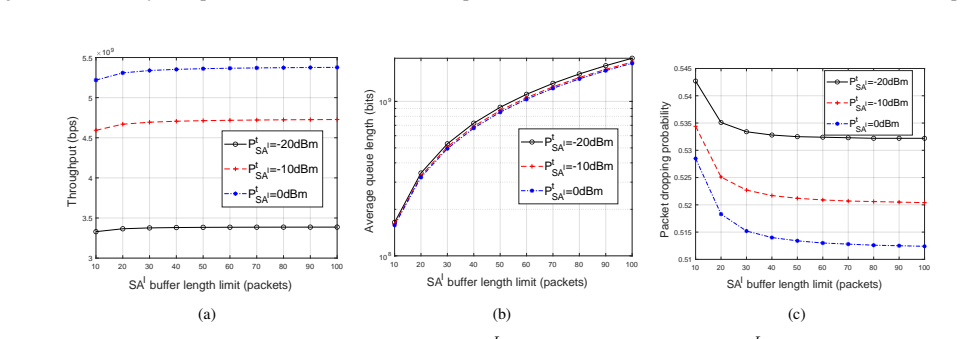
The paper models hybrid RF/FSO LEO satellite networks with finite buffer capacity, interference-aware transmission scheduling, and weather-dependent laser link outage probabilities. Numerical results indicate that laser communications bring significant performance gains. Instead of increasing the transmission power of the satellite to maximize the throughput, selecting a suitable transmission scheduling priority achieves a maximum throughput while minimizing the buffer requirement and lowering packet loss probability under realistic operational conditions and constraints.
What carries the argument
Finite-buffer model with interference-aware scheduling and weather-dependent optical outage probabilities for hybrid RF/FSO LEO links.
If this is right
- Laser links yield substantial throughput improvements over RF-only operation in hybrid setups.
- Scheduling priority selection achieves higher throughput than increasing transmit power while using less buffer space.
- Packet loss probability drops when scheduling accounts for optical outages and interference.
- Buffer requirements stay manageable under energy and weight constraints when priorities are chosen appropriately.
Where Pith is reading between the lines
- Constellation designers could reduce satellite mass by relying on priority-based scheduling instead of larger buffers or higher-power amplifiers.
- Real-time incorporation of local weather forecasts into the scheduling policy would likely extend the performance gains beyond the static outage models used here.
- Ground-segment handoff strategies might further lower buffer pressure by routing traffic to clear optical paths sooner.
Load-bearing premise
The modeled weather-dependent laser outage probabilities and interference patterns accurately represent real LEO orbital dynamics and atmospheric conditions, and the finite-buffer scheduling policy can be implemented onboard under strict energy and weight limits.
What would settle it
Direct comparison of modeled throughput, buffer occupancy, and packet loss against measurements collected from a real hybrid RF/optical LEO satellite constellation during documented weather events.
Figures


read the original abstract
Low Earth Orbit (LEO) satellite networks are increasingly adopting laser (Free Space Optics, FSO) links to provide high-capacity communications. Although laser inter-satellite links offer high throughput and low latency, RF up- and downlinks remain necessary to maintain connectivity during optical outages caused by adverse atmospheric conditions. In such hybrid link scenarios, satellite buffer design remains a key challenge, since up- and downlink traffic must be buffered and forwarded among satellite nodes. The hybrid RF/FSO scenario requires careful transmission scheduling, especially at envisioned optical transmission rates of 100Gb/s and beyond, making buffer sizing critical under strict onboard energy and weight constraints. Thus, this paper analyzes throughput performance and buffer sizing in hybrid RF/laser satellite networks with finite buffer capacity, interference-aware scheduling, and weather-dependent laser link outage probabilities. Numerical results indicate that laser communications bring significant performance gains. Instead of increasing the transmission power of the satellite to maximize the throughput, we can select a suitable transmission scheduling priority to achieve a maximum throughput, while minimizing the buffer requirement, and lowering packet loss probability under realistic operational conditions and constraints.
Editorial analysis
A structured set of objections, weighed in public.
Referee Report
Summary. The paper analyzes throughput performance and on-board buffer sizing for hybrid RF/FSO LEO satellite networks. It models finite-buffer queues with interference-aware scheduling and weather-dependent laser outage probabilities, then presents numerical results claiming that laser links yield significant gains and that a suitable scheduling priority can maximize throughput, minimize buffer size, and reduce packet loss without increasing transmit power under realistic conditions.
Significance. If the outage and interference models prove representative, the work offers actionable guidance for resource-constrained LEO system design by showing that scheduling can substitute for power scaling, thereby easing onboard energy and mass budgets while maintaining high-rate optical links during clear-sky periods.
major comments (1)
- [Numerical Results and Model Assumptions] The headline claim that scheduling priority outperforms power scaling rests on numerical evaluation of weather-dependent outage probabilities and interference patterns; however, the manuscript supplies neither a derivation of these statistics from orbital mechanics nor validation against flight or atmospheric data, so the reported gains may be artifacts of the chosen parameter regime rather than robust operational results.
minor comments (1)
- [Abstract] The abstract refers to 'realistic operational conditions and constraints' without stating the specific buffer sizes, transmission rates (e.g., 100 Gb/s), or range of weather/outage parameters used in the simulations.
Simulated Author's Rebuttal
We thank the referee for the constructive feedback on our manuscript. We address the major comment below, clarifying our modeling approach and committing to revisions that strengthen the grounding of the numerical results.
read point-by-point responses
-
Referee: The headline claim that scheduling priority outperforms power scaling rests on numerical evaluation of weather-dependent outage probabilities and interference patterns; however, the manuscript supplies neither a derivation of these statistics from orbital mechanics nor validation against flight or atmospheric data, so the reported gains may be artifacts of the chosen parameter regime rather than robust operational results.
Authors: We appreciate this observation on model transparency. The weather-dependent outage probabilities follow standard atmospheric attenuation and turbulence models commonly used in FSO satellite literature (e.g., based on visibility statistics, cloud cover, and scintillation indices for LEO altitudes). Interference patterns are computed from relative satellite geometries and distances using basic orbital mechanics for typical LEO inclinations and altitudes. We agree the manuscript would be improved by making these foundations explicit. In revision we will add a dedicated subsection on model derivation, including references to the underlying orbital and atmospheric sources, and we will include a sensitivity analysis varying outage probabilities and interference levels to confirm that priority scheduling continues to outperform power scaling across realistic parameter ranges. This addresses the potential for artifacts while preserving the paper's analytical focus; full empirical validation against proprietary flight data lies outside the scope of this theoretical study. revision: yes
Circularity Check
No significant circularity in throughput and buffer analysis
full rationale
The paper models a hybrid RF/FSO LEO satellite queueing system with finite buffers, interference-aware scheduling, and weather-dependent outage probabilities, then evaluates throughput, buffer size, and loss via numerical simulation. The headline claims (scheduling priority yields max throughput/min buffer/lower loss without power increase) are outputs of this forward model evaluation rather than inputs redefined as predictions. No equations reduce to self-definition, no fitted parameters are relabeled as predictions, and no load-bearing self-citations or imported uniqueness theorems appear in the abstract or described derivation. The analysis is self-contained against its stated model assumptions and is therefore not circular.
Axiom & Free-Parameter Ledger
Reference graph
Works this paper leans on
-
[1]
Challenges and opportunities in free space optical satellite communication,
M. Cardakli, “Challenges and opportunities in free space optical satellite communication,”Journal of Lightwave Technology, vol. 44, no. 3, pp. 903–912, 2026
2026
-
[2]
Co-channel interference reduction by optimizing field of view angle of angular diversity receiver in vlc systems,
M. E. Hosney, H. A. I. Selmy, and K. M. F. Elsayed, “Co-channel interference reduction by optimizing field of view angle of angular diversity receiver in vlc systems,” in2020 22nd International Conference on Transparent Optical Networks (ICTON), 2020, pp. 1–4
2020
-
[3]
A weather-dependent hybrid rf/fso satellite communication for im- proved power efficiency,
O. B. Yahia, E. Erdogan, G. K. Kurt, I. Altunbas, and H. Yanikomeroglu, “A weather-dependent hybrid rf/fso satellite communication for im- proved power efficiency,”IEEE Wireless Communications Letters, vol. 11, no. 3, pp. 573–577, 2022
2022
-
[4]
Network characteristics of leo satellite constellations: A starlink-based measure- ment from end users,
S. Ma, Y . C. Chou, H. Zhao, L. Chen, X. Ma, and J. Liu, “Network characteristics of leo satellite constellations: A starlink-based measure- ment from end users,” inIEEE INFOCOM 2023 - IEEE Conference on Computer Communications, 2023, pp. 1–10
2023
-
[5]
Towards reliable space-ground integrated networks: From system-level design to implementation,
H. He, Y . Hou, J. Yang, X. Jiang, S. Chen, and L. Hanzo, “Towards reliable space-ground integrated networks: From system-level design to implementation,”IEEE Network, vol. 37, no. 5, pp. 154–161, 2023
2023
-
[6]
A buffer-limited maximum throughput routing algorithm for satellite network,
B. Lin, H. Li, and Y . Long, “A buffer-limited maximum throughput routing algorithm for satellite network,” in2015 22nd International Conference on Telecommunications (ICT), 2015, pp. 378–383
2015
-
[7]
Practical throughput analysis for two-hop wireless network coding,
K. Chi, Y .-h. Zhu, X. Jiang, and X. Tian, “Practical throughput analysis for two-hop wireless network coding,”Computer Networks, vol. 60, pp. 101–114, 2014. [Online]. Available: https://www.sciencedirect.com/ science/article/pii/S1389128613004283
2014
-
[8]
Achievable throughput and on-board buffer sizing in ris-uav relay-assisted satellite-aerial- ground integrated networks (sagins),
C. V . Phung, A. C. Drummond, and A. Jukan, “Achievable throughput and on-board buffer sizing in ris-uav relay-assisted satellite-aerial- ground integrated networks (sagins),”IEEE Transactions on Aerospace and Electronic Systems, vol. 61, no. 6, pp. 16 666–16 691, 2025
2025
-
[9]
Throughput maximization of mixed fso/rf uav-aided mobile relaying with a buffer,
J.-H. Lee, K.-H. Park, Y .-C. Ko, and M.-S. Alouini, “Throughput maximization of mixed fso/rf uav-aided mobile relaying with a buffer,” IEEE Transactions on Wireless Communications, vol. 20, no. 1, pp. 683– 694, 2021
2021
-
[10]
Design and analysis of sliding window arq protocols with rate adaptation for burst transmission over fso turbulence channels,
H. D. Le, V . V . Mai, C. T. Nguyen, and A. T. Pham, “Design and analysis of sliding window arq protocols with rate adaptation for burst transmission over fso turbulence channels,”Journal of Optical Communications and Networking, vol. 11, no. 5, pp. 151–163, 2019
2019
-
[11]
Reliable low-latency routing for vleo satellite optical network: A multiagent reinforcement learning approach,
Z. Niu, H. Yang, Q. Yao, B. Wu, S. Yin, S. Shen, B. Wei, J. Zhang, and A. V . Vasilakos, “Reliable low-latency routing for vleo satellite optical network: A multiagent reinforcement learning approach,”IEEE Internet of Things Journal, vol. 12, no. 3, pp. 2309–2321, 2025
2025
-
[12]
Parallel fso-rf transmissions for high-throughput remote access with satellite commu- nications,
R. Samy, H.-C. Yang, T. Rakia, and M.-S. Alouini, “Parallel fso-rf transmissions for high-throughput remote access with satellite commu- nications,”IEEE Transactions on Aerospace and Electronic Systems, vol. 59, no. 6, pp. 9417–9426, 2023
2023
discussion (0)
Sign in with ORCID, Apple, or X to comment. Anyone can read and Pith papers without signing in.