Recognition: 2 theorem links
· Lean TheoremEquivariantly Slice Knots in Symmetric 4-Manifolds
Pith reviewed 2026-05-08 19:04 UTC · model grok-4.3
The pith
S²×S² with an involution makes the figure-eight knot equivariantly slice for one strong inversion but not the other.
A machine-rendered reading of the paper's core claim, the machinery that carries it, and where it could break.
Core claim
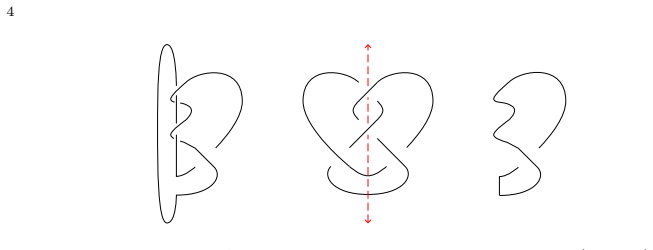
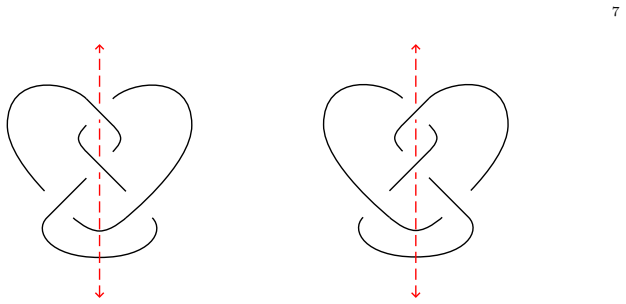
S²×S² admits an involution such that the figure-eight knot is equivariantly slice with respect to one of its two strong inversions but not the other, demonstrating that the equivariant four-genus of a knot in a symmetric four-manifold can differ both from its ordinary four-genus and from the equivariant four-genus it possesses in S⁴.
What carries the argument
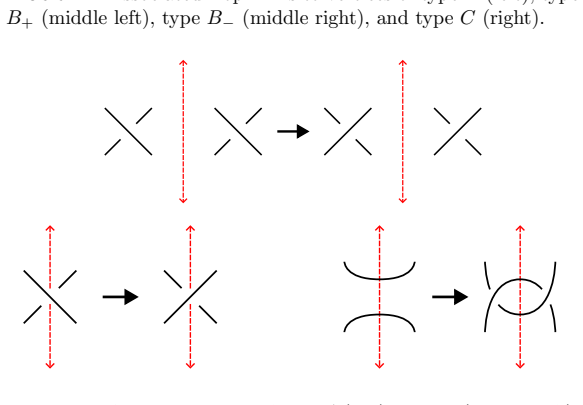
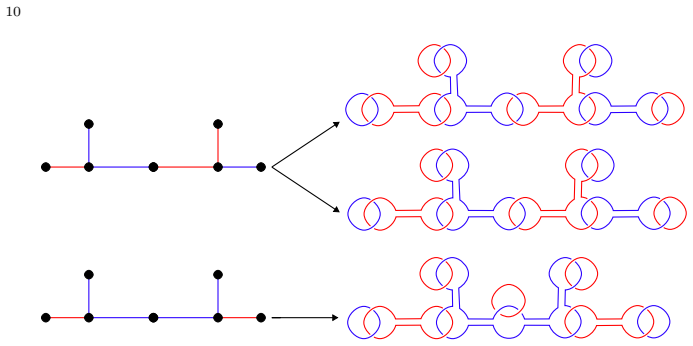
Equivariant version of the tubing construction, which builds slice disks for strongly invertible knots while preserving the involution on both the four-manifold and the knot.
If this is right
- The equivariant four-genus can be strictly smaller than the ordinary four-genus for some knots in symmetric four-manifolds.
- The equivariant four-genus in a symmetric four-manifold can differ from the value computed inside S⁴.
- A single knot can admit different equivariant slice properties under different choices of its strong inversion once placed in a symmetric four-manifold.
- The same techniques produce equivariantly slice examples in other four-manifolds equipped with involutions.
Where Pith is reading between the lines
- Similar dependence on the choice of involution may appear in other four-manifolds such as connected sums or other quotients.
- Equivariant versions of concordance invariants could be used to distinguish the two cases for the figure-eight knot.
- The construction might extend to produce families of knots whose equivariant slice status varies with the symmetry.
Load-bearing premise
The equivariant tubing construction can be carried out in these symmetric four-manifolds without new obstructions arising from the combined symmetry of the manifold and the knot.
What would settle it
An explicit equivariant invariant, such as a non-vanishing equivariant signature or a non-trivial equivariant Floer obstruction, computed for the figure-eight knot under the second strong inversion inside the symmetric S²×S² would show that the disk does not exist.
Figures


read the original abstract
We study the equivariant 4-genus of strongly invertible knots in the $S^3$ boundary of 4-manifolds with involution. We provide techniques for constructing slice disks for knots in various symmetric 4-manifolds via an equivariant version of Marengon and Mihajlovi\`c's tubing construction. Using these techniques, we show that this equivariant 4-genus can differ from the standard 4-genus function of the 4-manifold as well as the equivariant 4-genus of $S^4$. As an example, we show that $S^2\times S^2$ admits an involution such that the figure $8$ knot is equivariantly slice with respect to one of its two strong inversions but not the other.
Editorial analysis
A structured set of objections, weighed in public.
Referee Report
Summary. The paper develops an equivariant version of the Marengon-Mihajlović tubing construction to produce slice disks for strongly invertible knots in 4-manifolds equipped with involutions. It shows that the resulting equivariant 4-genus can differ both from the ordinary 4-genus of the ambient manifold and from the equivariant 4-genus in S^4. The central example is that S²×S² admits an involution under which the figure-eight knot is equivariantly slice with respect to one of its two strong inversions but not the other, with the distinction detected by an equivariant signature obstruction.
Significance. The explicit distinction between the two strong inversions on the same manifold supplies a concrete, computable witness that symmetry can affect sliceness in a manner invisible to the ordinary 4-genus. The equivariant tubing technique appears to be a reusable tool that extends prior non-equivariant constructions while preserving the necessary symmetry, which could be applied to other symmetric 4-manifolds and knots.
major comments (2)
- [§3] §3: the claim that the equivariant tubing disks remain disjoint from the fixed set and produce an equivariant slice disk requires an explicit verification that the chosen arcs and disks are invariant under the involution; without a diagram or coordinate description of the symmetry-preserving choices, it is difficult to confirm that no new intersection obstructions are introduced.
- [§4] §4, figure-8 example: the computation of the equivariant signature for the two inversions is asserted to vanish in one case and not the other, but the intersection form of the resulting 4-manifold after tubing is not displayed; a short table or matrix showing the form in each case would make the obstruction calculation fully checkable.
minor comments (2)
- The abstract states that the equivariant 4-genus 'can differ from the standard 4-genus function of the 4-manifold'; this phrasing is slightly imprecise and should be clarified to 'the ordinary 4-genus of the knot in that manifold'.
- [§2] Notation for the two strong inversions on the figure-eight knot should be introduced once in §2 and used consistently thereafter rather than redefined in §4.
Simulated Author's Rebuttal
We thank the referee for their careful reading of the manuscript and for the constructive comments. We address each major comment below and will incorporate clarifications in the revised version to improve readability and verifiability of the constructions and computations.
read point-by-point responses
-
Referee: §3: the claim that the equivariant tubing disks remain disjoint from the fixed set and produce an equivariant slice disk requires an explicit verification that the chosen arcs and disks are invariant under the involution; without a diagram or coordinate description of the symmetry-preserving choices, it is difficult to confirm that no new intersection obstructions are introduced.
Authors: We agree that additional explicit verification would strengthen the presentation. In the revised manuscript we will add a coordinate description of the involution on the 4-manifold together with a diagram of the chosen arcs and the resulting tubing disks, explicitly showing their invariance and confirming that they remain disjoint from the fixed set. This will make the absence of new intersection obstructions immediate from the construction. revision: yes
-
Referee: §4, figure-8 example: the computation of the equivariant signature for the two inversions is asserted to vanish in one case and not the other, but the intersection form of the resulting 4-manifold after tubing is not displayed; a short table or matrix showing the form in each case would make the obstruction calculation fully checkable.
Authors: We thank the referee for this suggestion. In the revision we will include a short table displaying the intersection forms of the 4-manifolds obtained after the equivariant tubing construction for each of the two strong inversions of the figure-eight knot. The table will allow direct verification of the equivariant signature values in both cases. revision: yes
Circularity Check
No significant circularity detected
full rationale
The paper establishes its main claim via explicit equivariant tubing constructions (extending Marengon-Mihajlović) applied to the figure-8 knot in S²×S², with the distinction between the two strong inversions witnessed by direct computation of the equivariant signature invariant. No derivation step reduces to a self-definition, fitted parameter renamed as prediction, or load-bearing self-citation chain; the constructions and obstructions are independent and externally verifiable in the 4-manifold topology setting.
Axiom & Free-Parameter Ledger
axioms (2)
- domain assumption Properties of involutions on 4-manifolds and strong inversions on knots
- ad hoc to paper The tubing construction extends equivariantly to the symmetric case
Reference graph
Works this paper leans on
-
[1]
Journal of the European Mathematical Society , volume=
Chern--Simons functional, singular instantons, and the four-dimensional clasp number , author=. Journal of the European Mathematical Society , volume=
-
[2]
On slice knots in the complex projective plane , author=. Rev. Mat. Univ. Complut. Madrid , volume=
-
[3]
arXiv preprint arXiv:2412.09797 , year=
Equivariant unknotting numbers of strongly invertible knots , author=. arXiv preprint arXiv:2412.09797 , year=
-
[4]
arXiv preprint arXiv:2210.10089 , year=
Unknotting number 21 knots are slice in K3 , author=. arXiv preprint arXiv:2210.10089 , year=
-
[5]
Journal of Knot Theory and Its Ramifications , volume=
Genera and degrees of torus knots in CP2 , author=. Journal of Knot Theory and Its Ramifications , volume=. 2009 , publisher=
2009
-
[6]
Proceedings of the American Mathematical Society, Series B , volume=
A note on surfaces in ℂℙ ^2 and ℂℙ ^2 \# ℂℙ ^2 , author=. Proceedings of the American Mathematical Society, Series B , volume=
-
[7]
Inventiones mathematicae , volume=
Dehn's lemma for certain 4-manifolds , author=. Inventiones mathematicae , volume=. 1969 , publisher=
1969
-
[8]
Journal of Topology , volume=
Equivariant 4-genera of strongly invertible and periodic knots , author=. Journal of Topology , volume=. 2022 , publisher=
2022
-
[9]
Journal of Topology , volume=
Equivariant knots and knot Floer homology , author=. Journal of Topology , volume=. 2023 , publisher=
2023
-
[10]
Algebraic and Topological Theories
On strongly invertible knots , author=. Algebraic and Topological Theories. Papers from the Symposium Dedicated to the Memory of Dr. Takehiko Miyata (Kinosaki, 1984), Kinokuniya Company Ltd., Tokyo , pages=
1984
-
[11]
Proceedings of the American Mathematical Society , volume=
On equivariant slice knots , author=. Proceedings of the American Mathematical Society , volume=
-
[12]
Journal of the London Mathematical Society , year=
Strongly invertible knots, equivariant slice genera, and an equivariant algebraic concordance group , author=. Journal of the London Mathematical Society , year=
-
[13]
arXiv preprint arXiv:2303.08794 , year=
A new invariant of equivariant concordance and results on 2-bridge knots , author=. arXiv preprint arXiv:2303.08794 , year=
discussion (0)
Sign in with ORCID, Apple, or X to comment. Anyone can read and Pith papers without signing in.