Recognition: 3 theorem links
· Lean TheoremGalaxy luminosity functions from far-UV to submillimetre at z=0 in the COLIBRE simulations
Pith reviewed 2026-05-08 19:10 UTC · model grok-4.3
The pith
COLIBRE simulations with direct dust modeling reproduce observed galaxy luminosity functions from far-UV to submillimetre at z=0.
A machine-rendered reading of the paper's core claim, the machinery that carries it, and where it could break.
Core claim
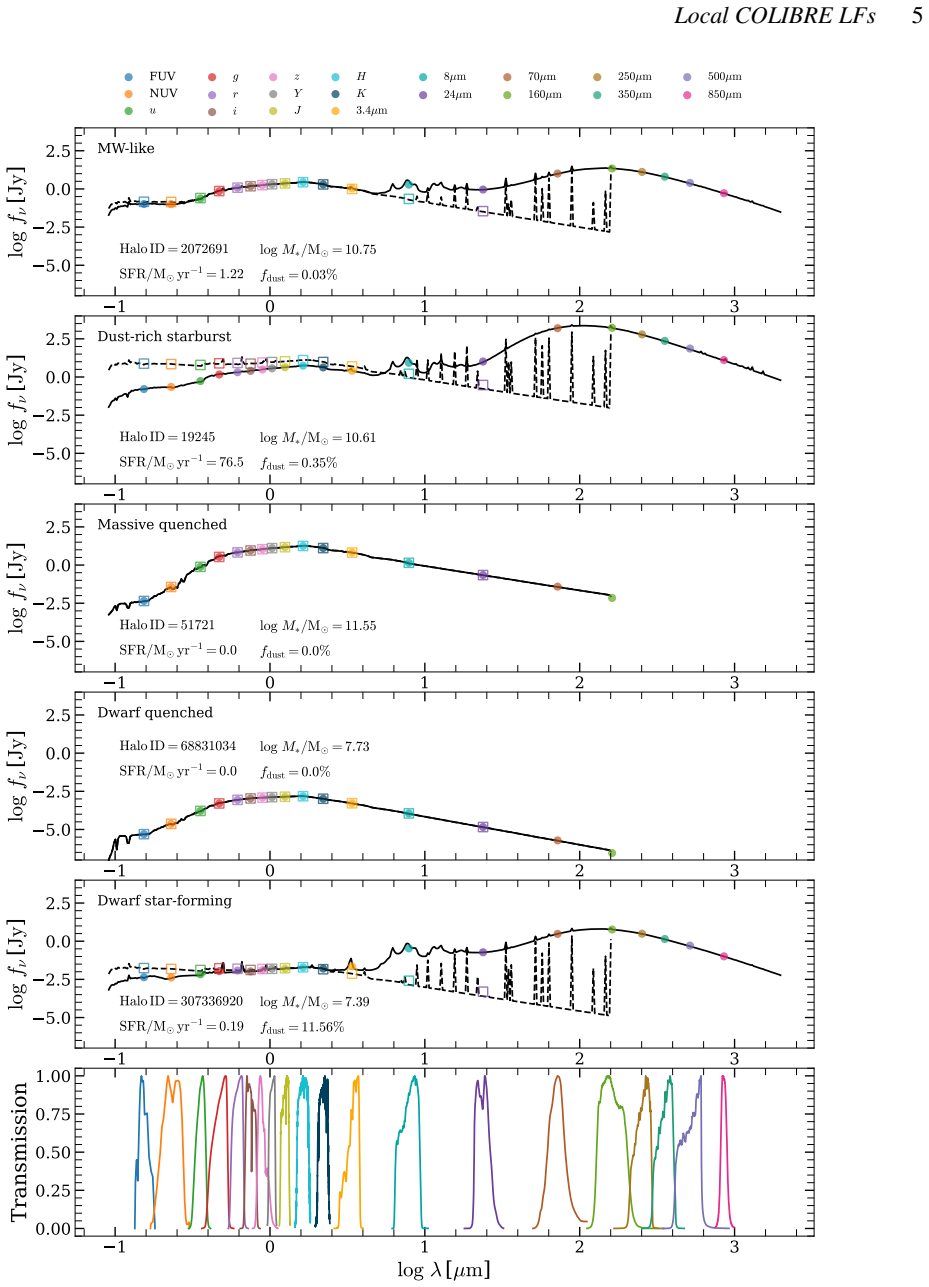
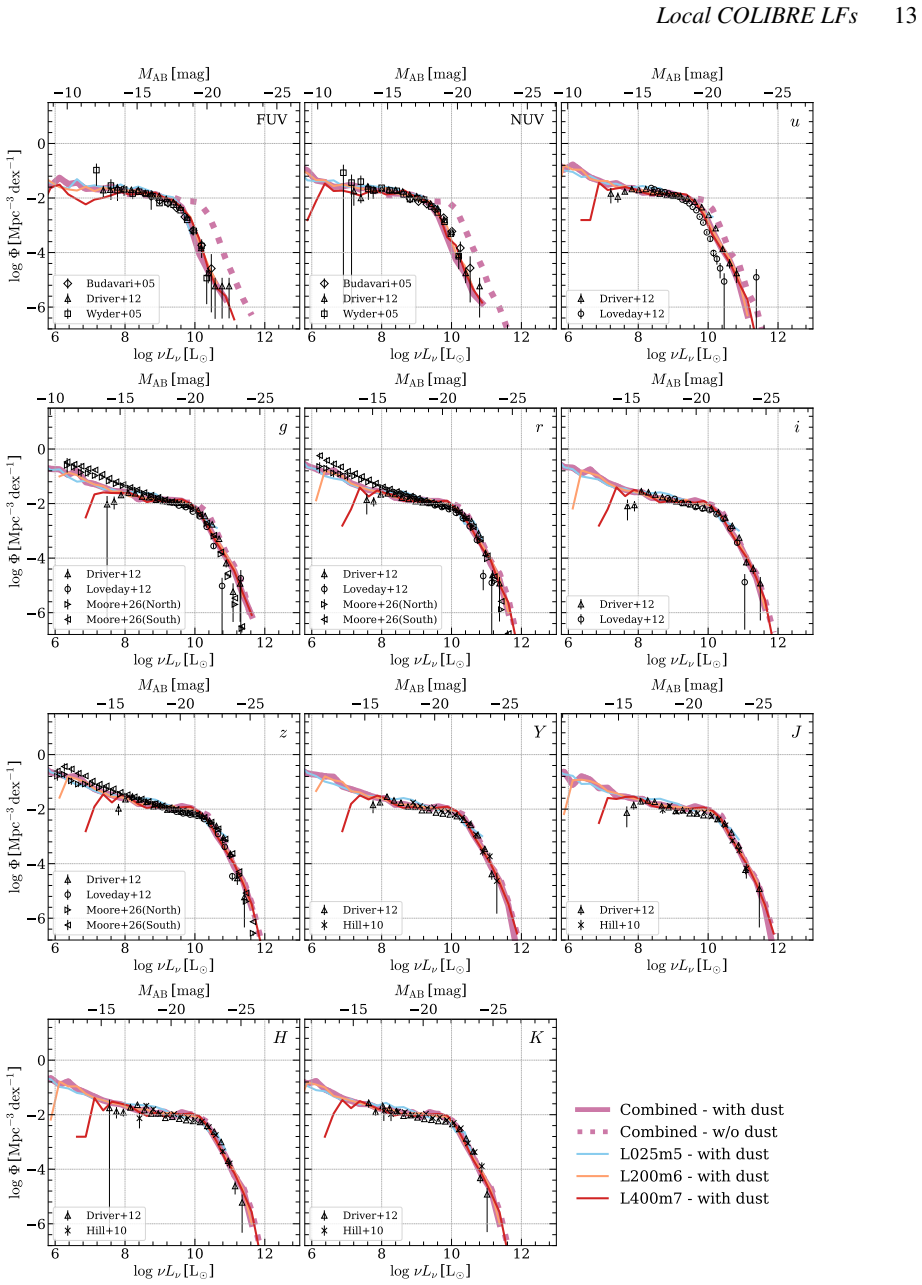
The COLIBRE-SKIRT luminosity functions match the data remarkably well from the far-ultraviolet to the near-infrared at 3.4 micrometres and also in the far-infrared and submillimetre range from 70 to 850 micrometres. The total infrared luminosity function, integrated over 8 to 1000 micrometres, matches observations at the faint end. This agreement across most wavelengths indicates that COLIBRE successfully predicts the properties of stellar populations at the present day and the amount and distribution of interstellar dust.
What carries the argument
The COLIBRE cosmological hydrodynamical simulations post-processed with the SKIRT radiative transfer code, using the distribution and properties of dust grains predicted directly by the simulations with no additional calibration.
If this is right
- The simulations capture the properties of stellar populations at z=0 with sufficient accuracy to match observed luminosity functions.
- The amount and distribution of interstellar dust in the simulations are realistic enough to reproduce attenuation and emission across most wavelengths.
- Very good numerical convergence is achieved over most luminosity ranges even when mass resolution varies by a factor of about 100.
- The mid-infrared luminosity functions underpredict the brightest galaxies, with the discrepancy growing toward longer wavelengths within that range.
- The total infrared luminosity function matches data at faint luminosities but underpredicts the very brightest objects.
Where Pith is reading between the lines
- The wide-wavelength success suggests the same framework could be applied at higher redshifts to test how dust and stellar properties evolve.
- The mid-infrared shortfall for luminous galaxies may indicate missing contributions from active galactic nuclei or different dust heating mechanisms not included in the current post-processing.
- Because the dust is taken directly from the hydrodynamics, future work could vary simulation parameters to see which changes improve the mid-infrared match while preserving agreement elsewhere.
Load-bearing premise
The dust grain properties and their spatial distribution as predicted by the COLIBRE simulations are accurate enough for the SKIRT calculations to produce realistic attenuation and emission without any further adjustment.
What would settle it
New observations that show a clear mismatch in the number of galaxies at luminosities where COLIBRE-SKIRT currently agrees, for example in the far-ultraviolet band or at 850 micrometres, would falsify the claim of successful prediction.
Figures




read the original abstract
We present predictions from the recent COLIBRE cosmological hydrodynamical simulations of galaxy formation for the present-day galaxy luminosity functions (LFs) at wavelengths ranging from the far-ultraviolet (FUV) to the submillimetre. The simulations are post-processed with the radiative transfer code SKIRT, accounting for dust attenuation and emission using the distribution and properties of dust grains predicted directly by COLIBRE. Results from simulations varying in mass resolution by a factor of $\sim 10^2$ ($\sim 10^5 - 10^7\,\mathrm{M_{\odot}}$) show very good convergence over most luminosity ranges. The COLIBRE-SKIRT LFs match the data remarkably well from the FUV to the near-infrared ($3.4\,\mathrm{\mu m}$) and also in the far-infrared and submillimetre wavelength range ($70-850\,\mathrm{\mu m}$). In the mid-infrared (MIR; $8-24\,\mathrm{\mu m}$), COLIBRE-SKIRT matches the data well at low luminosities but significantly underpredicts the luminosities of MIR-bright galaxies, with the discrepancy increasing towards longer wavelengths. The total infrared LF, obtained by integrating the spectral energy distributions over $8-1000\,\mathrm{\mu m}$, also matches observations well at the faint end but underpredicts the number of very bright galaxies. The unprecedented agreement at all other wavelengths indicates that COLIBRE, coupled with this calibration-free SKIRT post-processing framework, successfully predicts the properties of stellar populations at the present day and the amount and distribution of interstellar dust.
Editorial analysis
A structured set of objections, weighed in public.
Referee Report
Summary. The manuscript presents predictions of present-day galaxy luminosity functions (LFs) from the COLIBRE cosmological hydrodynamical simulations, post-processed with the SKIRT radiative transfer code using dust properties and distributions predicted directly by the simulation. It reports good numerical convergence across a factor of ~100 in mass resolution and finds that the COLIBRE-SKIRT LFs match observational data well from the far-UV to near-IR (3.4 μm) and in the far-IR to submillimetre (70-850 μm), while underpredicting bright galaxies in the mid-IR (8-24 μm) and at the bright end of the total IR LF. The authors conclude that this broad agreement demonstrates that COLIBRE successfully predicts the properties of stellar populations and interstellar dust at z=0.
Significance. If the COLIBRE subgrid parameters were fixed independently of the z=0 luminosity data used for validation, the result would be significant: it would provide evidence that a single hydrodynamical model plus calibration-free radiative transfer can reproduce galaxy LFs across most of the electromagnetic spectrum. The demonstrated convergence over two orders of magnitude in resolution and the quantitative matches in the majority of bands strengthen the case for the physical fidelity of the star-formation, feedback, and dust modules.
major comments (2)
- [Abstract] Abstract (final sentence) and §2 (simulation description): the central interpretive claim that the wavelength-by-wavelength agreement shows COLIBRE 'successfully predicts' stellar populations and dust relies on the assumption that COLIBRE subgrid parameters were not tuned against z=0 observables (e.g., the stellar mass function or proxies for the LFs shown here). The manuscript provides no explicit statement of the COLIBRE calibration targets, leaving the independence of the test unclear.
- [§4] §4 (results on MIR and total IR): the underprediction of MIR-bright galaxies and the bright end of the total IR LF is acknowledged, but the manuscript does not quantify how this discrepancy affects the overall conclusion of 'unprecedented agreement' or test whether it arises from dust grain properties, AGN contributions, or other model limitations.
minor comments (2)
- [§3] Figure captions and §3 (convergence tests): add explicit quantitative measures (e.g., fractional differences in LF amplitude between resolution levels) rather than qualitative statements of 'very good convergence'.
- [References] References: ensure all observational LF datasets cited in the text (e.g., for 3.4 μm and 850 μm) are listed with full bibliographic details.
Simulated Author's Rebuttal
We thank the referee for the constructive report and positive assessment of the work's significance. We address each major comment below and have made revisions to the manuscript where appropriate.
read point-by-point responses
-
Referee: [Abstract] Abstract (final sentence) and §2 (simulation description): the central interpretive claim that the wavelength-by-wavelength agreement shows COLIBRE 'successfully predicts' stellar populations and dust relies on the assumption that COLIBRE subgrid parameters were not tuned against z=0 observables (e.g., the stellar mass function or proxies for the LFs shown here). The manuscript provides no explicit statement of the COLIBRE calibration targets, leaving the independence of the test unclear.
Authors: We agree that an explicit statement of the calibration targets is required to support the interpretive claim. In the revised manuscript we have expanded §2 with a dedicated paragraph on the COLIBRE subgrid calibration procedure. The parameters were calibrated primarily against the z=0 stellar mass function, the galaxy size-mass relation, and a small number of higher-redshift constraints; the wavelength-dependent luminosity functions presented here were not used as calibration targets. The SKIRT post-processing remains calibration-free because dust masses, grain sizes and spatial distributions are taken directly from the simulation output. We have also revised the final sentence of the abstract to read 'The broad agreement across most wavelengths indicates that COLIBRE, coupled with this calibration-free SKIRT post-processing framework, provides a good description of the properties of stellar populations and interstellar dust at z=0.' revision: yes
-
Referee: [§4] §4 (results on MIR and total IR): the underprediction of MIR-bright galaxies and the bright end of the total IR LF is acknowledged, but the manuscript does not quantify how this discrepancy affects the overall conclusion of 'unprecedented agreement' or test whether it arises from dust grain properties, AGN contributions, or other model limitations.
Authors: The referee is correct that the MIR discrepancy merits more quantitative discussion. In the revised §4 we now report the magnitude of the offset (approximately 0.4–0.6 dex underprediction in number density at L_{24μm} > 10^{10.5} L_⊙) and note that the integrated 8–1000 μm LF is affected at a lower level because the MIR contributes only a modest fraction of the total energy. We discuss two plausible origins: (i) insufficient hot-dust emission from AGN, which are not explicitly modelled in the current COLIBRE runs, and (ii) the adopted dust grain size distribution, which may under-produce mid-IR emission from very small grains. We have replaced the phrase 'unprecedented agreement at all other wavelengths' with 'broad agreement from the FUV to the submillimetre, with a clear exception at the bright end of the mid-IR' in both the abstract and conclusions. Additional tests that vary dust properties or include AGN heating are beyond the scope of the present study and will be addressed in future work. revision: yes
Circularity Check
No significant circularity; derivation is self-contained validation
full rationale
The paper frames its results as predictions from COLIBRE hydrodynamical simulations post-processed via a calibration-free SKIRT radiative transfer step that uses dust properties directly output by the simulation. The abstract states that the LFs 'match the data remarkably well' and concludes this 'indicates that COLIBRE... successfully predicts' stellar populations and dust. No equations, self-citations, or steps are quoted in which a parameter is fitted to the target LFs (or closely related z=0 observables) and then relabeled as a prediction, nor is any output defined in terms of itself by construction. The chain from simulation run to post-processed LFs to observational comparison stands as an independent test rather than a tautology.
Axiom & Free-Parameter Ledger
free parameters (1)
- COLIBRE subgrid physics parameters
axioms (2)
- standard math Standard Lambda-CDM cosmological model
- domain assumption Dust properties output by COLIBRE are directly usable for realistic radiative transfer
Lean theorems connected to this paper
-
IndisputableMonolith/Foundation/AlphaDerivationExplicit.lean (and the broader constants chain)alphaProvenanceCert (RS constants are parameter-free, in contrast to COLIBRE's tuned subgrid parameters) unclear?
unclearRelation between the paper passage and the cited Recognition theorem.
The colibre model is calibrated by adjusting up to four subgrid parameters ... that control the strengths of stellar and AGN feedback in order to reproduce simple observed galaxy scaling relations at z=0: the galaxy stellar mass function (GSMF) and the galaxy size-stellar mass relation (SSMR).
What do these tags mean?
- matches
- The paper's claim is directly supported by a theorem in the formal canon.
- supports
- The theorem supports part of the paper's argument, but the paper may add assumptions or extra steps.
- extends
- The paper goes beyond the formal theorem; the theorem is a base layer rather than the whole result.
- uses
- The paper appears to rely on the theorem as machinery.
- contradicts
- The paper's claim conflicts with a theorem or certificate in the canon.
- unclear
- Pith found a possible connection, but the passage is too broad, indirect, or ambiguous to say the theorem truly supports the claim.
Reference graph
Works this paper leans on
-
[1]
Abbott T. M. C., et al., 2022, @doi [ ] 10.1103/PhysRevD.105.023520 , https://ui.adsabs.harvard.edu/abs/2022PhRvD.105b3520A 105, 023520
-
[2]
Arnouts S., et al., 2005, @doi [ ] 10.1086/426733 , https://ui.adsabs.harvard.edu/abs/2005ApJ...619L..43A 619, L43
-
[3]
Babbedge T. S. R., et al., 2006, @doi [ ] 10.1111/j.1365-2966.2006.10547.x , https://ui.adsabs.harvard.edu/abs/2006MNRAS.370.1159B 370, 1159
-
[4]
Baes M., Verstappen J., De Looze I., Fritz J., Saftly W., Vidal P \'e rez E., Stalevski M., Valcke S., 2011, @doi [ ] 10.1088/0067-0049/196/2/22 , https://ui.adsabs.harvard.edu/abs/2011ApJS..196...22B 196, 22
-
[5]
Baes M., Tr c ka A., Camps P., Nersesian A., Trayford J., Theuns T., Dobbels W., 2019, @doi [ ] 10.1093/mnras/stz302 , https://ui.adsabs.harvard.edu/abs/2019MNRAS.484.4069B 484, 4069
-
[6]
Baes M., et al., 2020, @doi [ ] 10.1093/mnras/staa990 , https://ui.adsabs.harvard.edu/abs/2020MNRAS.494.2912B 494, 2912
-
[7]
Bell E. F., de Jong R. S., 2001, @doi [ ] 10.1086/319728 , https://ui.adsabs.harvard.edu/abs/2001ApJ...550..212B 550, 212
-
[8]
Ben \' tez-Llambay A., et al., 2026, @doi [ ] 10.1093/mnras/stag268 , https://ui.adsabs.harvard.edu/abs/2026MNRAS.546ag268B 546, stag268
-
[9]
Bernardi M., Meert A., Sheth R. K., Vikram V., Huertas-Company M., Mei S., Shankar F., 2013, @doi [ ] 10.1093/mnras/stt1607 , https://ui.adsabs.harvard.edu/abs/2013MNRAS.436..697B 436, 697
-
[10]
2009, MNRAS, 396, 1383, doi:10.1111/j.1365-2966.2009.14843.x
Booth C. M., Schaye J., 2009, @doi [ ] 10.1111/j.1365-2966.2009.15043.x , https://ui.adsabs.harvard.edu/abs/2009MNRAS.398...53B 398, 53
-
[11]
Borrow J., Borrisov A., 2020, @doi [Journal of Open Source Software] 10.21105/joss.02430 , 5, 2430
-
[12]
Borrow J., Kelly A. J., 2021, @doi [arXiv e-prints] 10.48550/arXiv.2106.05281 , https://ui.adsabs.harvard.edu/abs/2021arXiv210605281B p. arXiv:2106.05281
-
[13]
doi:10.1093/mnras/stab3166 , archiveprefix =
Borrow J., Schaller M., Bower R. G., Schaye J., 2022, @doi [ ] 10.1093/mnras/stab3166 , https://ui.adsabs.harvard.edu/abs/2022MNRAS.511.2367B 511, 2367
-
[14]
Bruzual G., Charlot S., 2003, @doi [ ] 10.1046/j.1365-8711.2003.06897.x , https://ui.adsabs.harvard.edu/abs/2003MNRAS.344.1000B 344, 1000
-
[15]
Budav \'a ri T., et al., 2005, @doi [ ] 10.1086/423319 , https://ui.adsabs.harvard.edu/abs/2005ApJ...619L..31B 619, L31
-
[16]
Star Formation Rate Indicators
Calzetti D., 2013, in Falc \'o n-Barroso J., Knapen J. H., eds, , Secular Evolution of Galaxies. p. 419, @doi 10.48550/arXiv.1208.2997
-
[17]
Calzetti D., et al., 2007, @doi [ ] 10.1086/520082 , https://ui.adsabs.harvard.edu/abs/2007ApJ...666..870C 666, 870
-
[18]
Camps P., Baes M., 2015, @doi [Astronomy and Computing] 10.1016/j.ascom.2014.10.004 , https://ui.adsabs.harvard.edu/abs/2015A&C.....9...20C 9, 20
-
[19]
Camps P., Baes M., 2020, @doi [Astronomy and Computing] 10.1016/j.ascom.2020.100381 , https://ui.adsabs.harvard.edu/abs/2020A&C....3100381C 31, 100381
-
[20]
Camps P., Trayford J. W., Baes M., Theuns T., Schaller M., Schaye J., 2016, @doi [ ] 10.1093/mnras/stw1735 , https://ui.adsabs.harvard.edu/abs/2016MNRAS.462.1057C 462, 1057
-
[21]
Camps P., et al., 2018, @doi [ ] 10.3847/1538-4365/aaa24c , https://ui.adsabs.harvard.edu/abs/2018ApJS..234...20C 234, 20
-
[22]
Dusty Star-Forming Galaxies at High Redshift
Casey C. M., Narayanan D., Cooray A., 2014, @doi [ ] 10.1016/j.physrep.2014.02.009 , https://ui.adsabs.harvard.edu/abs/2014PhR...541...45C 541, 45
work page Pith review doi:10.1016/j.physrep.2014.02.009 2014
-
[23]
Chabrier G., 2003, @doi [ ] 10.1086/376392 , https://ui.adsabs.harvard.edu/abs/2003PASP..115..763C 115, 763
-
[24]
Chaikin E., Schaye J., Schaller M., Ben \' tez-Llambay A., Nobels F. S. J., Ploeckinger S., 2023, @doi [ ] 10.1093/mnras/stad1626 , https://ui.adsabs.harvard.edu/abs/2023MNRAS.523.3709C 523, 3709
-
[25]
Chaikin E., et al., 2026, @doi [ ] 10.1093/mnras/stag300 , https://ui.adsabs.harvard.edu/abs/2026MNRAS.548ag300C 548, stag300
-
[26]
Cheng H., Greengard L., Rokhlin V., 1999, @doi [Journal of Computational Physics] 10.1006/jcph.1999.6355 , https://ui.adsabs.harvard.edu/abs/1999JCoPh.155..468C 155, 468
-
[27]
2000, MNRAS, 314, 498, doi: 10.1046/j.1365-8711.2000.03357.x
Cole S., Lacey C. G., Baugh C. M., Frenk C. S., 2000, @doi [ ] 10.1046/j.1365-8711.2000.03879.x , https://ui.adsabs.harvard.edu/abs/2000MNRAS.319..168C 319, 168
-
[28]
Conroy C., Gunn J. E., 2010, @doi [ ] 10.1088/0004-637X/712/2/833 , https://ui.adsabs.harvard.edu/abs/2010ApJ...712..833C 712, 833
-
[29]
Conroy C., Gunn J. E., White M., 2009, @doi [ ] 10.1088/0004-637X/699/1/486 , https://ui.adsabs.harvard.edu/abs/2009ApJ...699..486C 699, 486
work page internal anchor Pith review doi:10.1088/0004-637x/699/1/486 2009
-
[30]
Correa C. A., et al., 2026, @doi [ ] 10.1093/mnras/stag645 , https://ui.adsabs.harvard.edu/abs/2026MNRAS.tmp..607C
-
[31]
Crain R. A., et al., 2015, @doi [ ] 10.1093/mnras/stv725 , https://ui.adsabs.harvard.edu/abs/2015MNRAS.450.1937C 450, 1937
-
[32]
Dai X., et al., 2009, @doi [ ] 10.1088/0004-637X/697/1/506 , https://ui.adsabs.harvard.edu/abs/2009ApJ...697..506D 697, 506
-
[33]
Dalla Vecchia C., Schaye J., 2012, @doi [ ] 10.1111/j.1365-2966.2012.21704.x , https://ui.adsabs.harvard.edu/abs/2012MNRAS.426..140D 426, 140
-
[34]
Simba: Cosmological Simulations with Black Hole Growth and Feedback
Dav \'e R., Angl \'e s-Alc \'a zar D., Narayanan D., Li Q., Rafieferantsoa M. H., Appleby S., 2019, @doi [ ] 10.1093/mnras/stz937 , https://ui.adsabs.harvard.edu/abs/2019MNRAS.486.2827D 486, 2827
-
[35]
Davies J. I., et al., 2017, @doi [ ] 10.1088/1538-3873/129/974/044102 , https://ui.adsabs.harvard.edu/abs/2017PASP..129d4102D 129, 044102
-
[36]
Davis M., Efstathiou G., Frenk C. S., White S. D. M., 1985, @doi [ ] 10.1086/163168 , https://ui.adsabs.harvard.edu/abs/1985ApJ...292..371D 292, 371
-
[37]
Annual Review of Astronomy &Astrophysics, vol
Draine B. T., 2003, @doi [ ] 10.1146/annurev.astro.41.011802.094840 , https://ui.adsabs.harvard.edu/abs/2003ARA&A..41..241D 41, 241
-
[38]
Draine B. T., Li A., 2007, @doi [ ] 10.1086/511055 , https://ui.adsabs.harvard.edu/abs/2007ApJ...657..810D 657, 810
-
[39]
Draine B. T., et al., 2007, @doi [ ] 10.1086/518306 , https://ui.adsabs.harvard.edu/abs/2007ApJ...663..866D 663, 866
-
[40]
Driver S. P., et al., 2012, @doi [ ] 10.1111/j.1365-2966.2012.22036.x , https://ui.adsabs.harvard.edu/abs/2012MNRAS.427.3244D 427, 3244
-
[41]
Driver S. P., et al., 2022, @doi [ ] 10.1093/mnras/stac472 , https://ui.adsabs.harvard.edu/abs/2022MNRAS.513..439D 513, 439
-
[42]
Dubois Y., Peirani S., Pichon C., Devriendt J., Gavazzi R., Welker C., Volonteri M., 2016, @doi [ ] 10.1093/mnras/stw2265 , https://ui.adsabs.harvard.edu/abs/2016MNRAS.463.3948D 463, 3948
-
[43]
2000, MNRAS, 314, 498, doi: 10.1046/j.1365-8711.2000.03357.x
Dunne L., Eales S., Edmunds M., Ivison R., Alexander P., Clements D. L., 2000, @doi [ ] 10.1046/j.1365-8711.2000.03386.x , https://ui.adsabs.harvard.edu/abs/2000MNRAS.315..115D 315, 115
-
[44]
Dunne L., et al., 2011, @doi [ ] 10.1111/j.1365-2966.2011.19363.x , https://ui.adsabs.harvard.edu/abs/2011MNRAS.417.1510D 417, 1510
-
[45]
Eldridge J. J., Stanway E. R., Xiao L., McClelland L. A. S., Taylor G., Ng M., Greis S. M. L., Bray J. C., 2017, @doi [ ] 10.1017/pasa.2017.51 , https://ui.adsabs.harvard.edu/abs/2017PASA...34...58E 34, e058
-
[46]
J., Helly J., McGibbon R., Schaye J., Schaller M., Han J., Kugel R., Bah \'e Y
Forouhar Moreno V. J., Helly J., McGibbon R., Schaye J., Schaller M., Han J., Kugel R., Bah \'e Y. M., 2025, @doi [ ] 10.1093/mnras/staf1478 , https://ui.adsabs.harvard.edu/abs/2025MNRAS.543.1339F 543, 1339
-
[47]
Galliano F., Galametz M., Jones A. P., 2018, @doi [ ] 10.1146/annurev-astro-081817-051900 , https://ui.adsabs.harvard.edu/abs/2018ARA&A..56..673G 56, 673
-
[48]
Gebek A., Tr c ka A., Baes M., Martorano M., Pillepich A., Kapoor A. U., Nersesian A., van der Wel A., 2024, @doi [ ] 10.1093/mnras/stae1377 , https://ui.adsabs.harvard.edu/abs/2024MNRAS.531.3839G 531, 3839
-
[49]
Graham A. W., Sahu N., 2023, @doi [ ] 10.1093/mnras/stac2019 , https://ui.adsabs.harvard.edu/abs/2023MNRAS.518.2177G 518, 2177
-
[50]
Granato G. L., Lacey C. G., Silva L., Bressan A., Baugh C. M., Cole S., Frenk C. S., 2000, @doi [ ] 10.1086/317032 , https://ui.adsabs.harvard.edu/abs/2000ApJ...542..710G 542, 710
-
[51]
Gruppioni C., et al., 2013, @doi [ ] 10.1093/mnras/stt308 , https://ui.adsabs.harvard.edu/abs/2013MNRAS.432...23G 432, 23
-
[52]
E., 2020, Astrophysics Source Code Library, pp ascl--2008
Hahn O., Michaux M., Rampf C., Uhlemann C., Angulo R. E., 2020, Astrophysics Source Code Library, pp ascl--2008
2020
-
[53]
Han J., Cole S., Frenk C. S., Benitez-Llambay A., Helly J., 2018, @doi [ ] 10.1093/mnras/stx2792 , https://ui.adsabs.harvard.edu/abs/2018MNRAS.474..604H 474, 604
-
[54]
A., Cortese L., Obreschkow D., Catinella B., Cook R
Hardwick J. A., Cortese L., Obreschkow D., Catinella B., Cook R. H. W., 2022, @doi [ ] 10.1093/mnras/stab3261 , https://ui.adsabs.harvard.edu/abs/2022MNRAS.509.3751H 509, 3751
-
[55]
The FABLE simulations: A feedback model for galaxies, groups and clusters
Henden N. A., Puchwein E., Shen S., Sijacki D., 2018, @doi [ ] 10.1093/mnras/sty1780 , https://ui.adsabs.harvard.edu/abs/2018MNRAS.479.5385H 479, 5385
-
[56]
H., 1983, , https://ui.adsabs.harvard.edu/abs/1983QJRAS..24..267H 24, 267
Hildebrand R. H., 1983, , https://ui.adsabs.harvard.edu/abs/1983QJRAS..24..267H 24, 267
1983
-
[57]
Hill D. T., Driver S. P., Cameron E., Cross N., Liske J., Robotham A., 2010, @doi [ ] 10.1111/j.1365-2966.2010.16374.x , https://ui.adsabs.harvard.edu/abs/2010MNRAS.404.1215H 404, 1215
-
[58]
Hu s ko F., et al., 2026, @doi [ ] 10.1093/mnras/stag324 , https://ui.adsabs.harvard.edu/abs/2026MNRAS.547ag324H 547, stag324
-
[59]
P., K¨ ohler, M., Ysard, N., Bocchio, M., & Verstraete, L
Jones A. P., K \"o hler M., Ysard N., Bocchio M., Verstraete L., 2017, @doi [ ] 10.1051/0004-6361/201630225 , https://ui.adsabs.harvard.edu/abs/2017A&A...602A..46J 602, A46
-
[60]
Jonsson P., 2006, @doi [ ] 10.1111/j.1365-2966.2006.10884.x , https://ui.adsabs.harvard.edu/abs/2006MNRAS.372....2J 372, 2
-
[61]
U., Baes, M., van der Wel, A., et al
Kapoor A. U., et al., 2023, @doi [ ] 10.1093/mnras/stad2977 , https://ui.adsabs.harvard.edu/abs/2023MNRAS.526.3871K 526, 3871
-
[62]
Star-formation rate indicators using Auriga zoom simulations
Kapoor A. U., et al., 2024, @doi [ ] 10.1051/0004-6361/202451207 , https://ui.adsabs.harvard.edu/abs/2024A&A...692A..79K 692, A79
-
[63]
Kaviraj S., et al., 2017, @doi [ ] 10.1093/mnras/stx126 , https://ui.adsabs.harvard.edu/abs/2017MNRAS.467.4739K 467, 4739
-
[64]
Kennicutt R. C., Evans N. J., 2012, @doi [ ] 10.1146/annurev-astro-081811-125610 , https://ui.adsabs.harvard.edu/abs/2012ARA&A..50..531K 50, 531
work page internal anchor Pith review doi:10.1146/annurev-astro-081811-125610 2012
-
[65]
Kugel R., et al., 2023, @doi [ ] 10.1093/mnras/stad2540 , https://ui.adsabs.harvard.edu/abs/2023MNRAS.526.6103K 526, 6103
-
[66]
Lagos C. d. P., Tobar R. J., Robotham A. S. G., Obreschkow D., Mitchell P. D., Power C., Elahi P. J., 2018, @doi [ ] 10.1093/mnras/sty2440 , https://ui.adsabs.harvard.edu/abs/2018MNRAS.481.3573L 481, 3573
-
[67]
Lagos C. d. P., et al., 2019, @doi [ ] 10.1093/mnras/stz2427 , https://ui.adsabs.harvard.edu/abs/2019MNRAS.489.4196L 489, 4196
-
[68]
Lagos C. d. P., et al., 2025, @doi [arXiv e-prints] 10.48550/arXiv.2512.11309 , https://ui.adsabs.harvard.edu/abs/2025arXiv251211309L p. arXiv:2512.11309
-
[69]
Le Floc'h E., et al., 2005, @doi [ ] 10.1086/432789 , https://ui.adsabs.harvard.edu/abs/2005ApJ...632..169L 632, 169
-
[70]
Lo Faro B., Buat V., Roehlly Y., Alvarez-Marquez J., Burgarella D., Silva L., Efstathiou A., 2017, @doi [ ] 10.1093/mnras/stx1901 , https://ui.adsabs.harvard.edu/abs/2017MNRAS.472.1372L 472, 1372
-
[71]
Loveday J., et al., 2012, @doi [ ] 10.1111/j.1365-2966.2011.20111.x , https://ui.adsabs.harvard.edu/abs/2012MNRAS.420.1239L 420, 1239
-
[72]
Ludlow A. D., Schaye J., Schaller M., Richings J., 2019, @doi [ ] 10.1093/mnrasl/slz110 , https://ui.adsabs.harvard.edu/abs/2019MNRAS.488L.123L 488, L123
-
[73]
Ludlow A. D., Fall S. M., Wilkinson M. J., Schaye J., Obreschkow D., 2023, @doi [ ] 10.1093/mnras/stad2615 , https://ui.adsabs.harvard.edu/abs/2023MNRAS.525.5614L 525, 5614
-
[74]
Ludlow A. D., et al., 2026, arXiv e-prints, https://ui.adsabs.harvard.edu/abs/2026arXiv260326200L p. arXiv:2603.26200
-
[75]
arXiv e-prints , arXiv:1510.07674arXiv:1510.07674
Mamajek E. E., et al., 2015, @doi [arXiv e-prints] 10.48550/arXiv.1510.07674 , https://ui.adsabs.harvard.edu/abs/2015arXiv151007674M p. arXiv:1510.07674
-
[76]
Marchetti L., et al., 2016, @doi [ ] 10.1093/mnras/stv2717 , https://ui.adsabs.harvard.edu/abs/2016MNRAS.456.1999M 456, 1999
-
[77]
Marleau F. R., Fadda D., Appleton P. N., Noriega-Crespo A., Im M., Clancy D., 2007, @doi [ ] 10.1086/518114 , https://ui.adsabs.harvard.edu/abs/2007ApJ...663..218M 663, 218
-
[78]
McGibbon R., Helly J., Schaye J., Schaller M., Vandenbroucke B., 2025, @doi [The Journal of Open Source Software] 10.21105/joss.08252 , https://ui.adsabs.harvard.edu/abs/2025JOSS...10.8252M 10, 8252
-
[79]
Michaux M., Hahn O., Rampf C., Angulo R. E., 2021, @doi [ ] 10.1093/mnras/staa3149 , https://ui.adsabs.harvard.edu/abs/2021MNRAS.500..663M 500, 663
-
[80]
Mitchell P. D., Lacey C. G., Baugh C. M., Cole S., 2013, @doi [ ] 10.1093/mnras/stt1280 , https://ui.adsabs.harvard.edu/abs/2013MNRAS.435...87M 435, 87
discussion (0)
Sign in with ORCID, Apple, or X to comment. Anyone can read and Pith papers without signing in.