Recognition: 3 theorem links
Probing the kinematics of FU Orionis objects through high-resolution near-infrared spectroscopy
Pith reviewed 2026-05-08 19:24 UTC · model grok-4.3
The pith
High-resolution near-infrared spectra reveal double-peaked Keplerian profiles in five FU Orionis objects.
A machine-rendered reading of the paper's core claim, the machinery that carries it, and where it could break.
Core claim
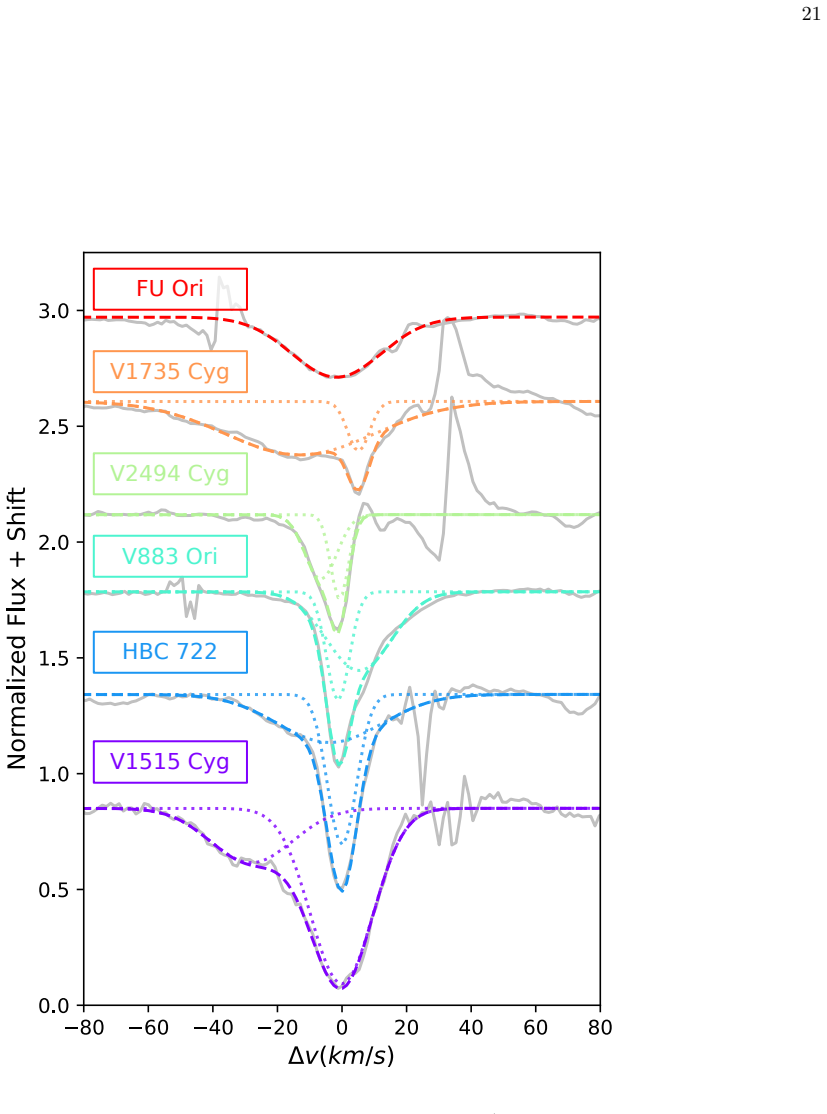
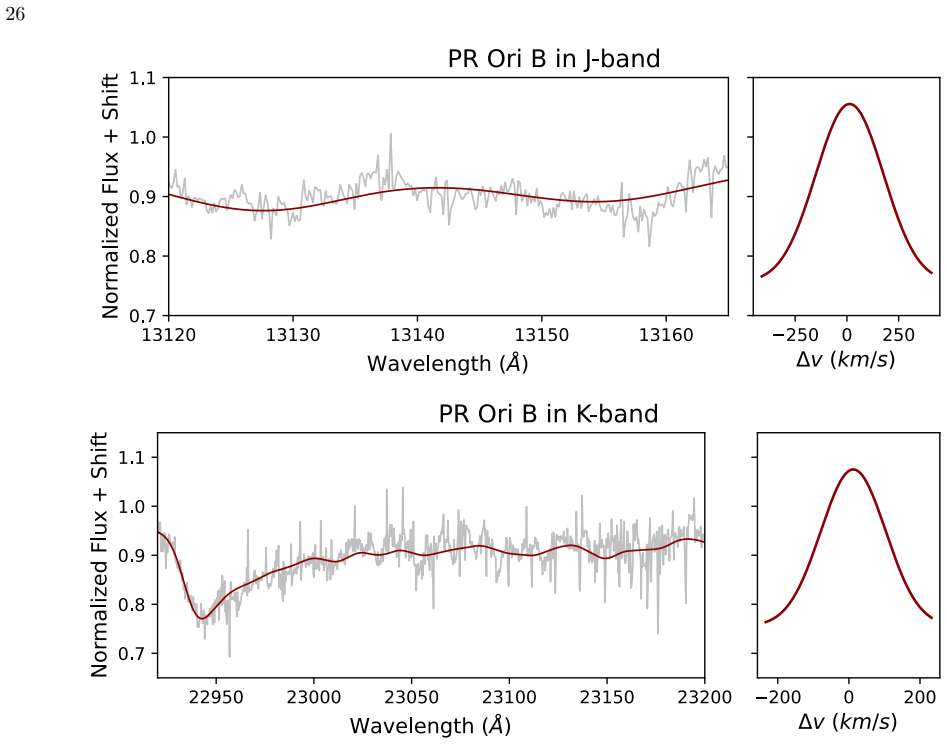
By convolving model cool atmosphere spectra with linear combinations of Gaussians and fitting to iSHELL high-resolution spectra, five of the fifteen targets are shown to have double-peaked line profiles in K-band that can be fitted by a Keplerian line profile. Line profiles in J-band for eight targets correlate with those in K-band, though the linewidth does not show a clear decrease with increasing wavelength. The CO lines observed in M-band are morphologically different from K-band lines, indicating they originate from a different region or mechanism. Double-peaked profiles prove difficult to detect due to blending with molecular features and possible absorption from disk winds or infaling
What carries the argument
Convolution of cool atmosphere model spectra with a linear combination of Gaussians to model and extract the kinematic line profiles from the observed spectra.
Where Pith is reading between the lines
- Time-series application of the same modeling could test whether the detected velocity fields change as the outbursts evolve.
- The technique may separate disk kinematics from wind contributions in other classes of accreting young stars.
- Comparison with resolved millimeter maps of the same objects could confirm whether the NIR lines trace the same radial zones.
Load-bearing premise
Deviations from double-peaked Keplerian profiles are primarily due to blending with molecular features, disk winds, or infalling material, and the Gaussian convolution accurately represents the underlying kinematics without other major unmodeled effects.
What would settle it
Obtaining spectra at higher resolution or in additional bands for the same targets that cannot be reproduced by any Keplerian disk model would challenge the claimed kinematics.
Figures








read the original abstract
FU Orionis (FUor) objects are thought to be described by a steady-state Keplerian disk. However, the characteristic double-peaked Keplerian line profile is not readily seen in most near-infrared spectra of FUors. In this paper, we measure the near-infrared line profiles of 15 FUors and FUor-like objects by convolving model cool atmosphere spectra with a linear combination of Gaussians. The models are fit to high-resolution spectra obtained with iSHELL on the NASA Infrared Telescope Facility (IRTF). Five of the targets are found to have double-peaked line profiles in K-band, which can also be fitted by a Keplerian line profile. For eight targets that were also observed in J-band, we find that the line profiles are well-correlated to what is observed in K-band, but the linewidth does not clearly appear to decrease with wavelength. We find that a double-peaked line profile can be difficult to see for several reasons, which include blending with extraneous molecular features and potential absorption from a disk wind or infalling material. The CO lines in M-band are morphologically different from their counterparts in K-band, so they are probably of a different origin.
Editorial analysis
A structured set of objections, weighed in public.
Referee Report
Summary. The paper presents high-resolution near-infrared spectroscopy of 15 FU Orionis and FUor-like objects obtained with iSHELL on the IRTF. Line profiles are extracted by convolving cool-atmosphere model spectra with linear combinations of Gaussians. Five targets exhibit double-peaked K-band profiles that are also fitted by Keplerian models; for the eight targets with J-band data the profiles correlate with K-band but show no clear wavelength-dependent narrowing of linewidth; M-band CO lines are morphologically distinct from K-band counterparts and are attributed to a different origin. The authors discuss blending, disk winds, and infall as reasons why double-peaked Keplerian signatures are often absent.
Significance. If the Gaussian-convolution extraction method is shown to recover true kinematics, the results would supply direct observational support for steady-state Keplerian disks in a subset of FUors and would explain the frequent non-detection of classic double-peaked profiles. The work is grounded in real telescope data and standard model atmospheres, but its impact is limited by the absence of forward-modeling validation and quantitative fit statistics.
major comments (3)
- [§3] §3 (line-profile extraction): the convolution of cool-atmosphere templates with an unconstrained linear combination of Gaussians is not validated on synthetic spectra that include a known Keplerian velocity field, inclination, inner/outer radii, and realistic molecular blending. Without such forward-modeling tests it is impossible to determine whether the recovered double-peaked shapes reliably indicate Keplerian rotation or simply absorb non-Keplerian contributions (winds, turbulence, infall) into the Gaussian basis.
- [§4.1] §4.1 (K-band results): the statement that five targets yield double-peaked profiles “that can also be fitted by a Keplerian line profile” is presented without reported error bars on the extracted profiles, quantitative goodness-of-fit metrics (χ², residuals), or comparison to alternative kinematic models. This omission makes it difficult to assess the robustness of the Keplerian interpretation.
- [§4.2] §4.2 (J- vs. K-band comparison): the reported lack of linewidth decrease between J and K bands is noted but not quantified (e.g., no measured FWHM values or radial-temperature model predictions). This observation appears inconsistent with the radial temperature structure expected for a Keplerian disk, yet no statistical test or alternative kinematic explanation is provided.
minor comments (2)
- Figure captions and text should explicitly state the number of Gaussian components used, their allowed width range, and any regularization applied during the fit.
- The M-band CO analysis would benefit from a direct overlay or quantitative cross-correlation metric between K- and M-band profiles to support the claim of different origins.
Simulated Author's Rebuttal
We thank the referee for their detailed and constructive review of our manuscript. Their comments highlight important areas for clarification and strengthening, particularly regarding methodological validation and quantitative analysis. We address each major comment below and outline the revisions we will make.
read point-by-point responses
-
Referee: [§3] §3 (line-profile extraction): the convolution of cool-atmosphere templates with an unconstrained linear combination of Gaussians is not validated on synthetic spectra that include a known Keplerian velocity field, inclination, inner/outer radii, and realistic molecular blending. Without such forward-modeling tests it is impossible to determine whether the recovered double-peaked shapes reliably indicate Keplerian rotation or simply absorb non-Keplerian contributions (winds, turbulence, infall) into the Gaussian basis.
Authors: We agree that dedicated forward-modeling tests on synthetic spectra with injected Keplerian fields would provide the strongest validation. Our extraction method follows standard practices in high-resolution NIR spectroscopy for recovering line profiles from blended features, allowing the data to determine the shape without presupposing kinematics. The resulting double-peaked profiles in five targets are then compared to Keplerian models. We will add a dedicated paragraph in §3 discussing the method's assumptions, potential absorption of non-Keplerian effects into the Gaussian basis, and the limitations of the approach. If time permits, we will perform limited synthetic tests; otherwise, we will explicitly note the absence of full forward modeling as a caveat. revision: partial
-
Referee: [§4.1] §4.1 (K-band results): the statement that five targets yield double-peaked profiles “that can also be fitted by a Keplerian line profile” is presented without reported error bars on the extracted profiles, quantitative goodness-of-fit metrics (χ², residuals), or comparison to alternative kinematic models. This omission makes it difficult to assess the robustness of the Keplerian interpretation.
Authors: We will revise §4.1 to include error bars on all extracted profiles, estimated from the spectral noise and covariance in the Gaussian convolution fit. We will report χ² values, degrees of freedom, and residual statistics for the Keplerian model fits to the five targets. We will also add direct comparisons to alternative models (single Gaussian and simple wind/infall profiles) with their respective χ² values to quantify the improvement provided by the Keplerian interpretation. revision: yes
-
Referee: [§4.2] §4.2 (J- vs. K-band comparison): the reported lack of linewidth decrease between J and K bands is noted but not quantified (e.g., no measured FWHM values or radial-temperature model predictions). This observation appears inconsistent with the radial temperature structure expected for a Keplerian disk, yet no statistical test or alternative kinematic explanation is provided.
Authors: We will add measured FWHM values for the J- and K-band profiles of the eight overlapping targets in a new table in §4.2, along with their uncertainties. We will compute expected linewidth trends using a simple radial temperature model for a Keplerian disk (assuming line formation radii based on excitation temperatures). The observed lack of clear narrowing will be discussed in the context of possible line formation at similar radii, blending, or contributions from disk winds. We will include a statistical measure of the J-K correlation and explicitly consider alternative kinematic explanations such as wind-dominated broadening. revision: yes
Circularity Check
No circularity: purely observational extraction and comparison
full rationale
The paper measures line profiles directly from IRTF/iSHELL spectra by convolving standard cool-atmosphere models with linear combinations of Gaussians, then compares the resulting shapes to Keplerian profiles and notes morphological differences across bands. No derivation step reduces a reported result to its own fitted parameters by construction, no self-citation chain supports a uniqueness claim, and the central findings (double-peaked profiles in five targets, lack of clear wavelength-dependent narrowing) are empirical outcomes from external data rather than tautological re-expressions of the analysis choices. The method is flexible but the paper does not claim the extracted profiles are predictions forced by the fitting procedure itself.
Axiom & Free-Parameter Ledger
free parameters (1)
- Gaussian combination coefficients and widths
axioms (1)
- domain assumption FU Orionis objects are described by a steady-state Keplerian disk
Reference graph
Works this paper leans on
-
[1]
Annual Review of Astronomy and Astrophysics , volume=
The FU orionis phenomenon , author=. Annual Review of Astronomy and Astrophysics , volume=. 1996 , publisher=
1996
-
[2]
Astrophysical Journal, Part 1 (ISSN 0004-637X), vol
On the nature of FU Orionis objects , author=. Astrophysical Journal, Part 1 (ISSN 0004-637X), vol. 299, Dec. 1, 1985, p. 462-478. Research supported by the Smithsonian Institution. , volume=
1985
-
[6]
Publications of the Astronomical Society of the Pacific , volume=
iSHELL: a 1--5 micron R= 80,000 Immersion Grating Spectrograph for the NASA Infrared Telescope Facility , author=. Publications of the Astronomical Society of the Pacific , volume=. 2022 , publisher=
2022
-
[9]
VizieR Online Data Catalog: 2MASS All-Sky Catalog of Point Sources (Cutri+ 2003)
2003
-
[11]
Molecular Line Emission from Circumstellar Disks. , keywords =. doi:10.1086/172131 , adsurl =
-
[12]
Publications of the Astronomical Society of the Pacific , volume=
emcee: the MCMC hammer , author=. Publications of the Astronomical Society of the Pacific , volume=. 2013 , publisher=
2013
-
[14]
VizieR Online Data Catalog: AllWISE Data Release (Cutri+ 2013)
2013
-
[15]
Astronomy & Astrophysics , volume=
Probing the rotation curve of the outer accretion disk in FU Orionis objects with long-wavelength spectroscopy , author=. Astronomy & Astrophysics , volume=. 2003 , publisher=
2003
-
[17]
Advances in Methods and Practices in Psychological Science , volume=
A conceptual introduction to Bayesian model averaging , author=. Advances in Methods and Practices in Psychological Science , volume=. 2020 , publisher=
2020
-
[19]
The Astrophysical Journal , volume=
Measuring the magnetic field of young stars using iSHELL observations: BP Tau and V347 Aur , author=. The Astrophysical Journal , volume=. 2019 , publisher=
2019
-
[20]
Astronomy and Astrophysics , author =
Photometric and spectroscopic variability of the FUor star V582 Aurigae. , keywords =. doi:10.1051/0004-6361/201321732 , archivePrefix =. 1306.6647 , primaryClass =
-
[23]
Clyde, David Draper and EI George, and a rejoinder by the authors , author=
Bayesian model averaging: a tutorial (with comments by M. Clyde, David Draper and EI George, and a rejoinder by the authors , author=. Statistical science , volume=. 1999 , publisher=
1999
-
[24]
Near infrared hydrogen lines as diagnostic of accretion and winds in T Tauri stars. , keywords =. doi:10.1051/0004-6361:20000018 , adsurl =
-
[25]
Astronomy & Astrophysics , volume=
Rotational velocities of nearby young stars , author=. Astronomy & Astrophysics , volume=. 2010 , publisher=
2010
-
[31]
Estimating Distance from Parallaxes. IV. Distances to 1.33 Billion Stars in Gaia Data Release 2. , keywords =. doi:10.3847/1538-3881/aacb21 , archivePrefix =. 1804.10121 , primaryClass =
-
[34]
Ultraviolet Spectroscopy of Pre--Main-Sequence Accretion Disks. , keywords =. doi:10.1086/167860 , adsurl =
-
[37]
Astronomy & astrophysics , volume=
The gaia mission , author=. Astronomy & astrophysics , volume=. 2016 , publisher=
2016
-
[40]
and Haberland, Matt and Reddy, Tyler and Cournapeau, David and Burovski, Evgeni and Peterson, Pearu and Weckesser, Warren and Bright, Jonathan and
Virtanen, Pauli and Gommers, Ralf and Oliphant, Travis E. and Haberland, Matt and Reddy, Tyler and Cournapeau, David and Burovski, Evgeni and Peterson, Pearu and Weckesser, Warren and Bright, Jonathan and. Nature Methods , year =
-
[45]
Structure and Evolution of Close Binary Systems , year = 1976, editor =
Common Envelope Binaries. Structure and Evolution of Close Binary Systems , year = 1976, editor =
1976
-
[47]
Zenodo , year=
csalyk/spectools\_ir: First release , author=. Zenodo , year=
-
[52]
The Astrophysical Journal , volume=
Trigonometric parallaxes of high mass star forming regions: the structure and kinematics of the Milky Way , author=. The Astrophysical Journal , volume=. 2014 , publisher=
2014
-
[53]
The Astronomical Journal , volume=
Evolution of the Fu Orionis Object BBW 76 , author=. The Astronomical Journal , volume=
-
[54]
International Astronomical Union Colloquium , volume=
A Wide Latitiude CO Survey of Molecular Clouds in the Northern Milky Way , author=. International Astronomical Union Colloquium , volume=. 1984 , organization=
1984
-
[55]
The Gould’s Belt Distances Survey (GOBELINS). II. Distances and structure toward the Orion molecular clouds , author=. The Astrophysical Journal , volume=. 2017 , publisher=
2017
-
[56]
Monthly Notices of the Royal Astronomical Society , volume=
The star formation environment of the FU Ori type star V582 Aur , author=. Monthly Notices of the Royal Astronomical Society , volume=. 2017 , publisher=
2017
-
[57]
The Astronomer's Telegram , keywords =
The FUor outburst of PR Ori B. The Astronomer's Telegram , keywords =
-
[58]
Astrophysical Journal, Part 2-Letters (ISSN 0004-637X), vol
The inner-disk and stellar properties of the young stellar object WL 16 , author=. Astrophysical Journal, Part 2-Letters (ISSN 0004-637X), vol. 411, no. 1, p. L37-L40. , volume=
-
[59]
Astronomy & Astrophysics , volume=
The disk of FU Orionis viewed with MATISSE/VLTI-First interferometric observations in L and M bands , author=. Astronomy & Astrophysics , volume=. 2022 , publisher=
2022
-
[61]
Using Accretion and Stellar Rotation to Reveal the Star--Disk Connection in T Tauri Stars , author=
The ODYSSEUS Survey. Using Accretion and Stellar Rotation to Reveal the Star--Disk Connection in T Tauri Stars , author=. The Astrophysical Journal , volume=. 2025 , publisher=
2025
-
[62]
The Astrophysical Journal , volume=
High-resolution spectroscopy of FU Orionis stars , author=. The Astrophysical Journal , volume=
-
[63]
Allard , F., Homeier , D., Freytag , B., Schaffenberger , W., & Rajpurohit , A. S. 2013, Memorie della Societa Astronomica Italiana Supplementi, 24, 128, 10.48550/arXiv.1302.6559
-
[64]
S., Tokunaga, A
Carr, J. S., Tokunaga, A. T., Najita, J., Shu, F. H., & Glassgold, A. E. 1993, Astrophysical Journal, Part 2-Letters (ISSN 0004-637X), vol. 411, no. 1, p. L37-L40., 411, L37
1993
-
[65]
Carvalho , A., Hillenbrand , L., & Seebeck , J. 2023, , 958, 140, 10.3847/1538-4357/acff59
-
[66]
Carvalho , A., Hillenbrand , L., Seebeck , J., & Covey , K. 2024, , 971, 44, 10.3847/1538-4357/ad5286
-
[67]
Carvalho , A. S., Hillenbrand , L. A., & K \'o sp \'a l , \'A . 2025, , 993, 38, 10.3847/1538-4357/ae0646
-
[68]
A., Casassus, S., Tobin, J., et al
Cieza , L. A., Casassus , S., Tobin , J., et al. 2016, , 535, 258, 10.1038/nature18612
-
[69]
Connelley , M. S., & Reipurth , B. 2018, , 861, 145, 10.3847/1538-4357/aaba7b
-
[70]
Cushing , M. C., Vacca , W. D., & Rayner , J. T. 2004, , 116, 362, 10.1086/382907
-
[71]
M., Skrutskie , M
Cutri , R. M., Skrutskie , M. F., van Dyk , S., et al. 2003, VizieR Online Data Catalog: 2MASS All-Sky Catalog of Point Sources (Cutri+ 2003) , VizieR On-line Data Catalog: II/246. Originally published in: 2003yCat.2246....0C
2003
-
[72]
M., Wright , E
Cutri , R. M., Wright , E. L., Conrow , T., et al. 2021, VizieR Online Data Catalog: AllWISE Data Release (Cutri+ 2013) , VizieR On-line Data Catalog: II/328. Originally published in: IPAC/Caltech (2013)
2021
-
[73]
1984, in International Astronomical Union Colloquium, Vol
Dame, T., & Thaddeus, P. 1984, in International Astronomical Union Colloquium, Vol. 81, Cambridge University Press, 235--238
1984
-
[74]
S., Reipurth, B., & Boogert, A
Flores, C., Connelley, M. S., Reipurth, B., & Boogert, A. 2019, The Astrophysical Journal, 882, 75
2019
-
[75]
Flores , C., Connelley , M. S., Reipurth , B., Boogert , A., & Doppmann , G. 2024, , 972, 149, 10.3847/1538-4357/ad58b1
-
[76]
S., Reipurth, B., & Duchˆ ene, G
Flores , C., Connelley , M. S., Reipurth , B., & Duch \^e ne , G. 2022, , 925, 21, 10.3847/1538-4357/ac37bd
-
[77]
Foreman-Mackey, D. 2016, The Journal of Open Source Software, 1, 24, 10.21105/joss.00024
-
[78]
W., Lang, D., & Goodman, J
Foreman-Mackey, D., Hogg, D. W., Lang, D., & Goodman, J. 2013, Publications of the Astronomical Society of the Pacific, 125, 306
2013
-
[79]
Gordon , I. E., Rothman , L. S., Hargreaves , R. J., et al. 2026, , 353, 109807, 10.1016/j.jqsrt.2026.109807
-
[80]
P., Aspin , C., & Reipurth , B
Greene , T. P., Aspin , C., & Reipurth , B. 2008, , 135, 1421, 10.1088/0004-6256/135/4/1421
-
[81]
2004, , 609, 906, 10.1086/421317
Hartmann , L., Hinkle , K., & Calvet , N. 2004, , 609, 906, 10.1086/421317
-
[82]
1985, Astrophysical Journal, Part 1 (ISSN 0004-637X), vol
Hartmann, L., & Kenyon, S. 1985, Astrophysical Journal, Part 1 (ISSN 0004-637X), vol. 299, Dec. 1, 1985, p. 462-478. Research supported by the Smithsonian Institution., 299, 462
1985
-
[83]
Hartmann, L., & Kenyon, S. J. 1996, Annual Review of Astronomy and Astrophysics, 34, 207
1996
-
[84]
2003, The Astrophysical Journal, 595, 384
Herbig, G., Petrov, P., & Duemmler, R. 2003, The Astrophysical Journal, 595, 384
2003
-
[85]
Herbig , G. H. 1966, Vistas in Astronomy, 8, 109, 10.1016/0083-6656(66)90025-0
- [86]
-
[87]
Herbig , G. H., Petrov , P. P., & Duemmler , R. 2003, , 595, 384, 10.1086/377194
-
[88]
Herczeg , G. J., & Reipurth , B. 2025, , 994, L43, 10.3847/2041-8213/ae1caf
-
[89]
F., van den Bergh, D., & Wagenmakers, E.-J
Hinne, M., Gronau, Q. F., van den Bergh, D., & Wagenmakers, E.-J. 2020, Advances in Methods and Practices in Psychological Science, 3, 200
2020
-
[90]
A., Madigan, D., Raftery, A
Hoeting, J. A., Madigan, D., Raftery, A. E., & Volinsky, C. T. 1999, Statistical science, 14, 382
1999
-
[91]
Kenyon , S. J., Hartmann , L., & Hewett , R. 1988, , 325, 231, 10.1086/165999
-
[92]
Kopatskaya, E. N., Kolotilov, E. A., & Arkharov, A. A. 2013, Monthly Notices of the Royal Astronomical Society, 434, 38, 10.1093/mnras/stt963
-
[93]
2017, The Astrophysical Journal, 834, 142
Kounkel, M., Hartmann, L., Loinard, L., et al. 2017, The Astrophysical Journal, 834, 142
2017
-
[94]
Kuhn , M. A., & Hillenbrand , L. A. 2019, , 883, 117, 10.3847/1538-4357/ab3a3f
-
[95]
2017, Monthly Notices of the Royal Astronomical Society, 468, 2325
Kun, M., Szegedi-Elek, E., & Reipurth, B. 2017, Monthly Notices of the Royal Astronomical Society, 468, 2325
2017
-
[96]
2003, Astronomy & Astrophysics, 408, 1015
Lodato, G., & Bertin, G. 2003, Astronomy & Astrophysics, 408, 1015
2003
-
[97]
2022, Astronomy & Astrophysics, 663, A86
Lykou, F., \'A brah \'a m, P., Chen, L., et al. 2022, Astronomy & Astrophysics, 663, A86
2022
-
[98]
2005, , 437, 627, 10.1051/0004-6361:20042556
Malbet , F., Lachaume , R., Berger , J.-P., et al. 2005, , 437, 627, 10.1051/0004-6361:20042556
-
[99]
The VizieR database of astronomical catalogues , publisher =
Ochsenbein, F. 1996, The VizieR database of astronomical catalogues, CDS, Centre de Données astronomiques de Strasbourg, 10.26093/CDS/VIZIER
-
[100]
Astronomy and Astrophysics Supplement Series , author =
Ochsenbein , F., Bauer , P., & Marcout , J. 2000, , 143, 23, 10.1051/aas:2000169
-
[101]
1976, in IAU Symposium, Vol
Paczynski , B. 1976, in IAU Symposium, Vol. 73, Structure and Evolution of Close Binary Systems, ed. P. Eggleton , S. Mitton , & J. Whelan , 75
1976
-
[102]
Park , S., Lee , J.-E., Pyo , T.-S., et al. 2020, , 900, 36, 10.3847/1538-4357/aba532
-
[103]
C., Herczeg , G., Lee , J.-E., et al
Pena , C. C., Herczeg , G., Lee , J.-E., et al. 2024, The Astronomer's Telegram, 16776, 1
2024
-
[104]
P \'e rez , S., Hales , A., Liu , H. B., et al. 2020, , 889, 59, 10.3847/1538-4357/ab5c1b
-
[105]
Petrov , P. P., & Herbig , G. H. 2008, , 136, 676, 10.1088/0004-6256/136/2/676
-
[106]
V., Espaillat, C
Pittman, C. V., Espaillat, C. C., Zhu, Z., et al. 2025, The Astrophysical Journal, 993, 181
2025
-
[107]
2022, Publications of the Astronomical Society of the Pacific, 134, 015002
Rayner, J., Tokunaga, A., Jaffe, D., et al. 2022, Publications of the Astronomical Society of the Pacific, 134, 015002
2022
-
[108]
J., Menten, K
Reid, M. J., Menten, K. M., Brunthaler, A., et al. 2014, The Astrophysical Journal, 783, 130
2014
-
[109]
J., Smette, A., & Bouchet, P
Reipurth, B., Hartmann, L., Kenyon, S. J., Smette, A., & Bouchet, P. 2002, The Astronomical Journal, 124, 2194
2002
-
[110]
Reipurth , B., Herbig , G. H., Bally , J., et al. 2018, , 156, 25, 10.3847/1538-3881/aac020
-
[111]
2022, Zenodo
Salyk, C. 2022, Zenodo
2022
-
[112]
Szab \'o , Z. M., K \'o sp \'a l , \'A ., \'A brah \'a m , P., et al. 2021, , 917, 80, 10.3847/1538-4357/ac04b3
discussion (0)
Sign in with ORCID, Apple, or X to comment. Anyone can read and Pith papers without signing in.