Recognition: 3 theorem links
· Lean TheoremLattice Realization of Twist Defects in a mathbb{Z}₂times mathbb{Z}₂ Topological Order
Pith reviewed 2026-05-08 18:57 UTC · model grok-4.3
The pith
Twist defects in a lattice Z2×Z2 topological order are characterized by quantum dimensions and non-Abelian fusion rules from double loop operators.
A machine-rendered reading of the paper's core claim, the machinery that carries it, and where it could break.
Core claim
In a setup of two stacked Wen plaquette models forming a Z2×Z2 topological order, dislocations in the Hamiltonian localize twist defects that act as sources of anyon permutations. The defects are characterized by their quantum dimensions, and double loop operators encircling them determine the non-Abelian fusion rules between defects carrying different anyon permutations.
What carries the argument
Dislocations introduced into the stacked Wen plaquette Hamiltonian that localize twist defects, with branch cuts serving as sources of anyon permutations and double loop operators extracting the fusion rules.
Load-bearing premise
The introduced dislocations modify the Hamiltonian in a way that localizes the twist defects and induces interlayer interactions without destroying the parent topological order or creating unwanted gapless modes.
What would settle it
A direct computation or simulation showing that the fusion rules extracted from double loop operators around the defects fail to match the non-Abelian statistics predicted by their anyon permutations would falsify the central characterization.
Figures




read the original abstract
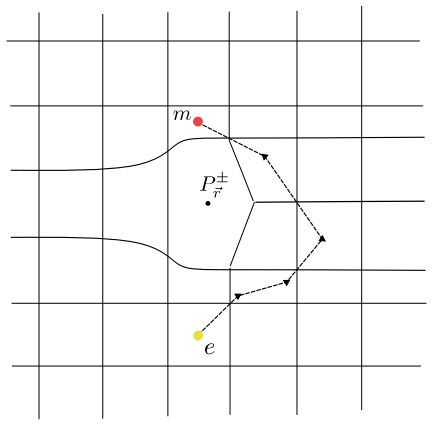
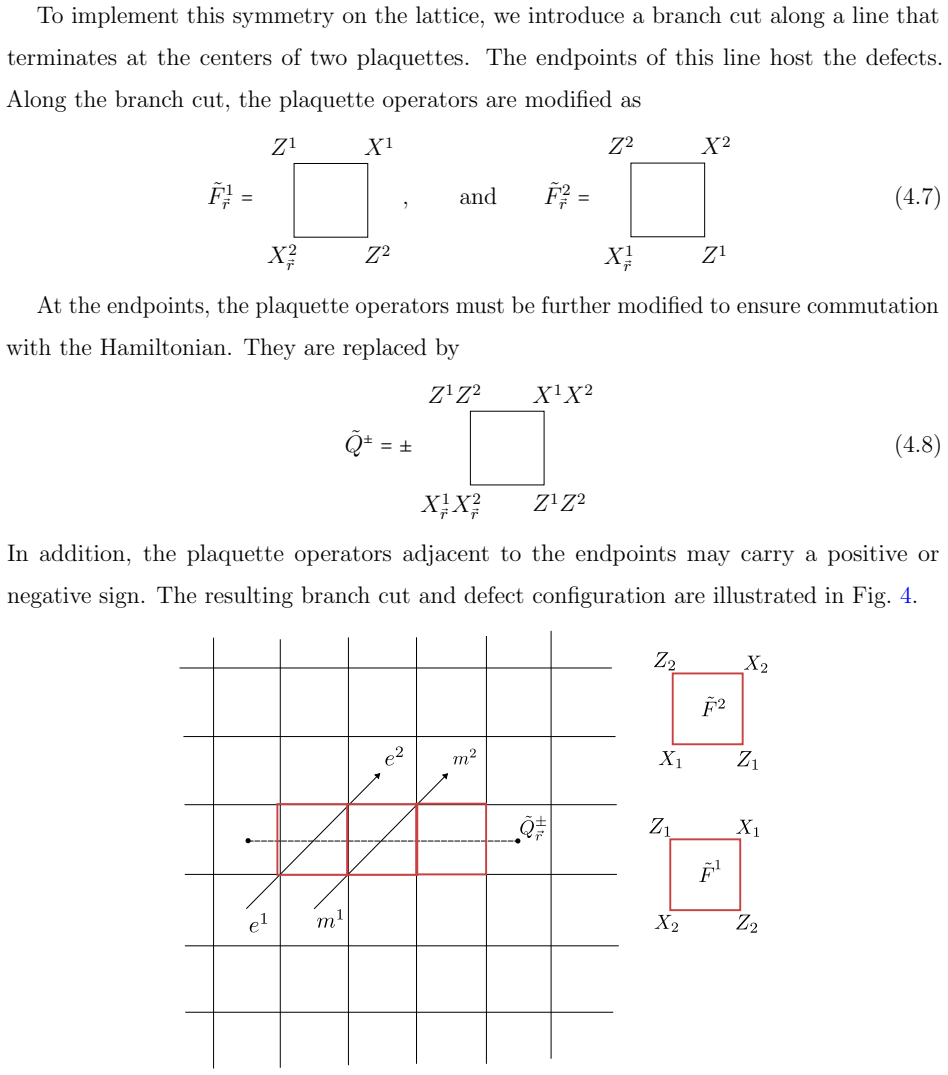
In this work, we explore a microscopic realization of three types of anyonic symmetries in a $\mathbb{Z}_2\times\mathbb{Z}_2$ topological order, corresponding to a double toric code. These symmetries act as nontrivial permutations on the anyon labels of the parent state. We consider a setup consisting of two decoupled Wen plaquette models stacked on top of each other and introduce dislocations that modify the Hamiltonian, giving rise to localized twist defects, eventually inducing interactions between the layers. In this context, branch cuts act as sources of anyon permutations when they cross it. We characterize the defects by calculating their quantum dimensions, and we also consider double loop operators around them that allow us to determine the non-Abelian fusion rules between the defects, including when they carry different anyon permutations.
Editorial analysis
A structured set of objections, weighed in public.
Referee Report
Summary. The manuscript constructs a lattice model for twist defects in a Z2×Z2 topological order by stacking two decoupled Wen plaquette models and introducing dislocations that modify the Hamiltonian to localize defects and induce interlayer couplings. It computes the quantum dimensions of three types of defects corresponding to anyonic symmetries and employs double-loop operators encircling the defects to extract non-Abelian fusion rules, including cases where defects carry distinct anyon permutations.
Significance. If the derivations are complete and the topological order is preserved, the work supplies a microscopic realization of anyonic symmetries and twist defects, together with explicit fusion data obtained from loop operators. This is useful for connecting abstract TQFT descriptions of defects to lattice Hamiltonians and could inform numerical or experimental studies of defect braiding in bilayer topological phases.
major comments (2)
- [Model construction and Hamiltonian modification] The central claim that double-loop operators determine the fusion rules rests on the dislocations localizing the defects while keeping the parent Z2×Z2 order gapped. The abstract states that the Hamiltonian is modified to give rise to localized twist defects, but no explicit gap calculation, spectrum analysis, or proof that unwanted gapless modes are absent is provided in the sections describing the model construction. This assumption is load-bearing for the validity of the quantum-dimension and fusion-rule results.
- [Double-loop operators and fusion rules] The definition and explicit operator expressions for the double-loop operators around the twist defects are not given in sufficient detail to allow independent verification that they commute with the modified Hamiltonian away from the defects and correctly capture the anyon-permutation action. Without these, it is unclear whether the extracted fusion rules follow directly from the lattice operators or involve additional assumptions.
minor comments (2)
- Notation for the three types of defects and their associated anyon permutations should be introduced with a clear table or diagram early in the text to aid readability.
- The manuscript would benefit from a brief comparison of the obtained quantum dimensions and fusion rules with known results from the continuum TQFT description of twist defects in Z2×Z2 order.
Simulated Author's Rebuttal
We thank the referee for their careful reading of our manuscript and for the constructive comments. We appreciate the positive assessment of the significance of the work and address the two major points below. We will revise the manuscript to improve clarity and completeness on these aspects.
read point-by-point responses
-
Referee: [Model construction and Hamiltonian modification] The central claim that double-loop operators determine the fusion rules rests on the dislocations localizing the defects while keeping the parent Z2×Z2 order gapped. The abstract states that the Hamiltonian is modified to give rise to localized twist defects, but no explicit gap calculation, spectrum analysis, or proof that unwanted gapless modes are absent is provided in the sections describing the model construction. This assumption is load-bearing for the validity of the quantum-dimension and fusion-rule results.
Authors: We agree that an explicit verification of the gapped bulk would strengthen the presentation. The construction begins from two decoupled, gapped Wen plaquette models; the dislocations are implemented by local modifications to a finite number of plaquette terms that induce interlayer couplings only along the branch cuts. Because these modifications are strictly local and preserve the stabilizer structure away from the defects, the parent Z2×Z2 topological order remains gapped in the bulk. In the revised manuscript we will add a dedicated paragraph (and, if space permits, a short appendix) that makes this locality argument explicit, together with a small-system exact-diagonalization check confirming the absence of additional gapless modes. This directly addresses the load-bearing assumption for the subsequent quantum-dimension and fusion calculations. revision: partial
-
Referee: [Double-loop operators and fusion rules] The definition and explicit operator expressions for the double-loop operators around the twist defects are not given in sufficient detail to allow independent verification that they commute with the modified Hamiltonian away from the defects and correctly capture the anyon-permutation action. Without these, it is unclear whether the extracted fusion rules follow directly from the lattice operators or involve additional assumptions.
Authors: We thank the referee for highlighting the need for greater explicitness. The double-loop operators are constructed as products of the modified plaquette stabilizers that encircle both defects while respecting the branch-cut permutation; they are designed to commute with all Hamiltonian terms outside the defect cores by construction. In the revised version we will supply the full Pauli-string expressions for these operators on the lattice, demonstrate their commutation with the modified Hamiltonian away from the defects, and show how their eigenvalues directly encode the anyon-permutation action. This will make the derivation of the non-Abelian fusion rules fully traceable from the lattice operators without additional assumptions. revision: yes
Circularity Check
No significant circularity; derivation is self-contained construction plus operator algebra.
full rationale
The paper begins with two decoupled, standard Wen plaquette models (known Z2 topological orders), introduces explicit dislocations to modify the Hamiltonian and localize twist defects, then computes quantum dimensions and extracts fusion rules from the algebra of explicitly defined double loop operators around those defects. These steps are direct calculations within the constructed lattice model; the fusion rules and dimensions are outputs of the operator commutation relations and ground-state degeneracy counting, not inputs or fitted quantities. No self-citation is invoked as a load-bearing uniqueness theorem, no ansatz is smuggled, and no parameter is fitted to a subset of data then relabeled as a prediction. The central claims therefore do not reduce to the inputs by definition.
Axiom & Free-Parameter Ledger
axioms (2)
- domain assumption The Wen plaquette model on a square lattice realizes Z2 topological order with four anyon types.
- ad hoc to paper Dislocations can be added to the Hamiltonian while preserving the topological gap and localizing twist defects.
Lean theorems connected to this paper
-
Foundation/AlexanderDuality.lean (D=3 forcing)alexander_duality_circle_linking unclearWe consider a setup consisting of two decoupled Wen plaquette models stacked on top of each other and introduce dislocations that modify the Hamiltonian, giving rise to localized twist defects
-
Cost.FunctionalEquation (J-cost uniqueness)washburn_uniqueness_aczel unclearσ_i × σ_i = 1 + ψ_1 + ψ_2 + ψ_1 ψ_2 ... defects have quantum dimension d=2
Reference graph
Works this paper leans on
-
[1]
Topological quantum memory
Eric Dennis, Alexei Kitaev, Andrew Landahl, and John Preskill. Topological quantum memory. Journal of Mathematical Physics, 43(9):4452–4505, 2002
2002
-
[2]
Quantum computing and the entanglement frontier, 2012
John Preskill. Quantum computing and the entanglement frontier, 2012. 21
2012
-
[3]
Quantum Computation with Topological Codes: from qubit to topological fault-tolerance
Keisuke Fujii. Quantum Computation with Topological Codes: from qubit to topological fault-tolerance. 4 2015
2015
-
[4]
Zoo of quantum-topological phases of matter.Reviews of Modern Physics, 89(4), December 2017
Xiao-Gang Wen. Zoo of quantum-topological phases of matter.Reviews of Modern Physics, 89(4), December 2017
2017
-
[5]
X. G. Wen. Vacuum degeneracy of chiral spin states in compactified space.Phys. Rev. B, 40:7387–7390, Oct 1989
1989
-
[6]
A. Yu. Kitaev. Fault tolerant quantum computation by anyons.Annals Phys., 303:2–30, 2003
2003
-
[7]
Mayukh Nilay Khan, Jeffrey C. Y. Teo, and Taylor L. Hughes. Anyonic symmetries and topological defects in abelian topological phases: An application to the ade classification. Physical Review B, 90(23), December 2014
2014
-
[8]
Symmetry Frac- tionalization, Defects, and Gauging of Topological Phases.Phys
Maissam Barkeshli, Parsa Bonderson, Meng Cheng, and Zhenghan Wang. Symmetry Frac- tionalization, Defects, and Gauging of Topological Phases.Phys. Rev. B, 100(11):115147, 2019
2019
-
[9]
Mayukh Nilay Khan, Jeffrey C. Y. Teo, Taylor L. Hughes, and Smitha Vishveshwara. Fermion Parity Flips and Majorana Bound States at twist defects in Superconducting Fractional Topological Phases.Phys. Rev. B, 95(20):205112, 2017
2017
-
[10]
Jeffrey C. Y. Teo, Taylor L. Hughes, and Eduardo Fradkin. Theory of Twist Liquids: Gauging an Anyonic Symmetry.Annals Phys., 360:349–445, 2015
2015
-
[11]
Globally symmetric topological phase: from anyonic symmetry to twist defect
Jeffrey C Y Teo. Globally symmetric topological phase: from anyonic symmetry to twist defect. Journal of Physics: Condensed Matter, 28(14):143001, March 2016
2016
-
[12]
Twist defects and projective non- Abelian braiding statistics.Phys
Maissam Barkeshli, Chao-Ming Jian, and Xiao-Liang Qi. Twist defects and projective non- Abelian braiding statistics.Phys. Rev. B, 87(4):045130, 2013
2013
-
[13]
Topological nematic states and non-abelian lattice dislocations.Physical Review X, 2(3), August 2012
Maissam Barkeshli and Xiao-Liang Qi. Topological nematic states and non-abelian lattice dislocations.Physical Review X, 2(3), August 2012
2012
-
[14]
Filippo Iulianelli, Sung Kim, Joshua Sussan, and Aaron D. Lauda. Universal quantum computation using Ising anyons from a non-semisimple topological quantum field theory. Nature Commun., 16(1):6408, 2025
2025
-
[15]
Simon, Ady Stern, Michael Freedman, and Sankar Das Sarma
Chetan Nayak, Steven H. Simon, Ady Stern, Michael Freedman, and Sankar Das Sarma. Non-abelian anyons and topological quantum computation.Reviews of Modern Physics, 80(3):1083–1159, 2008
2008
-
[16]
Introduction to topological quantum computation with 22 non-Abelian anyons.Quantum Sci
Bernard Field and Tapio Simula. Introduction to topological quantum computation with 22 non-Abelian anyons.Quantum Sci. Technol., 3(4):045004, 2018
2018
-
[17]
Projective non-Abelian statistics of dislocation defects in aZ N rotor model.Phys
Yi-Zhuang You and Xiao-Gang Wen. Projective non-Abelian statistics of dislocation defects in aZ N rotor model.Phys. Rev. B, 86(16):161107, 2012
2012
-
[18]
Synthetic non-Abelian statistics by Abelian anyon condensation.Phys
Yi-Zhuang You, Chao-Ming Jian, and Xiao-Gang Wen. Synthetic non-Abelian statistics by Abelian anyon condensation.Phys. Rev. B, 87(4):045106, 2013
2013
-
[19]
H. Bombin. Topological Order with a Twist: Ising Anyons from an Abelian Model.Phys. Rev. Lett., 105:030403, 2010
2010
-
[20]
Brown, Stephen D
Benjamin J. Brown, Stephen D. Bartlett, Andrew C. Doherty, and Sean D. Barrett. Topological Entanglement Entropy with a Twist.Phys. Rev. Lett., 111(22):220402, 2013
2013
-
[21]
Models for gapped boundaries and domain walls.Communica- tions in Mathematical Physics, 313(2):351–373, 2012
Alexei Kitaev and Liang Kong. Models for gapped boundaries and domain walls.Communica- tions in Mathematical Physics, 313(2):351–373, 2012
2012
-
[22]
Bowen Yan, Penghua Chen, and Shawn X. Cui. Generalized kitaev spin liquid model and emergent twist defect, 2024
2024
-
[23]
Anyons in an exactly solved model and beyond.Annals Phys., 321(1):2–111, 2006
Alexei Kitaev. Anyons in an exactly solved model and beyond.Annals Phys., 321(1):2–111, 2006
2006
-
[24]
Topological phases and quantum computation
Alexei Kitaev and Chris Laumann. Topological phases and quantum computation. 4 2009
2009
-
[25]
Unpaired Majorana modes in the gapped phase of Kitaev’s honeycomb model.Phys
Olga Petrova, Paula Mellado, and Oleg Tchernyshyov. Unpaired Majorana modes in the gapped phase of Kitaev’s honeycomb model.Phys. Rev. B, 88(14):140405, 2013
2013
-
[26]
Fractional topological superconductor with fractionalized majorana fermions
Abolhassan Vaezi. Fractional topological superconductor with fractionalized majorana fermions. Physical Review B, 87(3), January 2013
2013
-
[27]
Clarke, Jason Alicea, and Kirill Shtengel
David J. Clarke, Jason Alicea, and Kirill Shtengel. Exotic non-abelian anyons from conventional fractional quantum hall states.Nature Communications, 4(1), January 2013
2013
-
[28]
Signatures of parafermion zero modes in fractional quantum Hall–superconductor heterostructures.Phys
Junyi Cao, Angela Kou, and Eduardo Fradkin. Signatures of parafermion zero modes in fractional quantum Hall–superconductor heterostructures.Phys. Rev. B, 109(16):L161106, 2024
2024
-
[29]
Superconducting proximity effect on the edge of fractional topological insulators
Meng Cheng. Superconducting proximity effect on the edge of fractional topological insulators. Physical Review B, 86(19), November 2012
2012
-
[30]
Katzir, Ady Stern, Erez Berg, and Netanel H
Barak A. Katzir, Ady Stern, Erez Berg, and Netanel H. Lindner. Superconducting fractional quantum Hall edges via repulsive interactions. 11 2020
2020
-
[31]
Lindner, Erez Berg, Gil Refael, and Ady Stern
Netanel H. Lindner, Erez Berg, Gil Refael, and Ady Stern. Fractionalizing majorana fermions: Non-abelian statistics on the edges of abelian quantum hall states.Physical Review X, 2(4), 23 October 2012
2012
-
[32]
Yoshitome and Pedro R
Gustavo M. Yoshitome and Pedro R. S. Gomes. Non-Abelian Zero Modes in Fractional Quantum Hall-Superconductor Heterostructure. 11 2025
2025
-
[33]
Jeffrey C. Y. Teo, Abhishek Roy, and Xiao Chen. Braiding statistics and congruent invariance of twist defects in bosonic bilayer fractional quantum hall states.Physical Review B, 90(15), October 2014
2014
-
[34]
Julian May-Mann and Taylor L. Hughes. Twisted kitaev bilayers and the moir´ e ising model. Physical Review B, 101(24), 2020
2020
-
[35]
Electric-magnetic duality of lattice systems with topological order.Nucl
Oliver Buerschaper, Matthias Christandl, Liang Kong, and Miguel Aguado. Electric-magnetic duality of lattice systems with topological order.Nucl. Phys. B, 876:619–636, 2013
2013
-
[36]
Self-duality and bound states of the toric code model in a transverse field.Phys
Julien Vidal, Ronny Thomale, Kai Phillip Schmidt, and Sebastien Dusuel. Self-duality and bound states of the toric code model in a transverse field.Phys. Rev. B, 80:081104, 2009
2009
-
[37]
Topological holography: Towards a unification of Landau and beyond-Landau physics.SciPost Phys
Heidar Moradi, Seyed Faroogh Moosavian, and Apoorv Tiwari. Topological holography: Towards a unification of Landau and beyond-Landau physics.SciPost Phys. Core, 6:066, 2023. 24
2023
discussion (0)
Sign in with ORCID, Apple, or X to comment. Anyone can read and Pith papers without signing in.