Recognition: 4 theorem links
· Lean TheoremToward the Internet of Space Things: Performance Analysis of LEO Satellite Relay Networks using mmWave and sub-THz links
Pith reviewed 2026-05-08 18:48 UTC · model grok-4.3
The pith
Networks of ten LEO satellites using mmWave and sub-THz inter-satellite links can deliver continuous 24/7 connectivity to space vehicles with orders-of-magnitude higher capacity than ground stations.
A machine-rendered reading of the paper's core claim, the machinery that carries it, and where it could break.
Core claim
The analysis demonstrates that LEO satellite relay networks with mmWave and sub-THz links overcome the contact-time limits of ground stations, delivering improvements of up to several orders of magnitude in throughput and availability. A joint framework accounts for time-varying orbits and link properties to derive contact probability, channel capacity, and energy efficiency. It identifies a fundamental bound on download capacity and shows that continuous 24/7 connectivity is achievable with only ten LEO relay satellites.
What carries the argument
A joint mathematical framework that combines time-variant orbital dynamics with mmWave and sub-THz link characteristics to derive performance metrics including contact probability, channel capacity, and energy efficiency.
If this is right
- A high-throughput and high-availability relay backbone becomes available for space vehicles.
- Energy efficiency improves for continuous space connectivity operations.
- The design scales to support growing numbers of space users including data centers and CubeSats.
- A quantifiable upper limit on download capacity is established for these systems.
Where Pith is reading between the lines
- Reliance on extensive ground infrastructure for space-to-space links could decrease over time.
- Multi-hop extensions in larger constellations might further increase coverage and capacity.
- Spectrum regulations for sub-THz bands in space would need clarification for widespread use.
- Prototype tests in actual orbits could identify sensitivities to unmodeled factors like orbital drag.
Load-bearing premise
The mathematical model fully captures orbital movements and signal propagation without missing real-world effects such as atmospheric interference or hardware limits.
What would settle it
Real orbital measurements or simulations that show contact probabilities or capacities substantially below the model's predictions would disprove the claimed performance levels.
Figures



read the original abstract
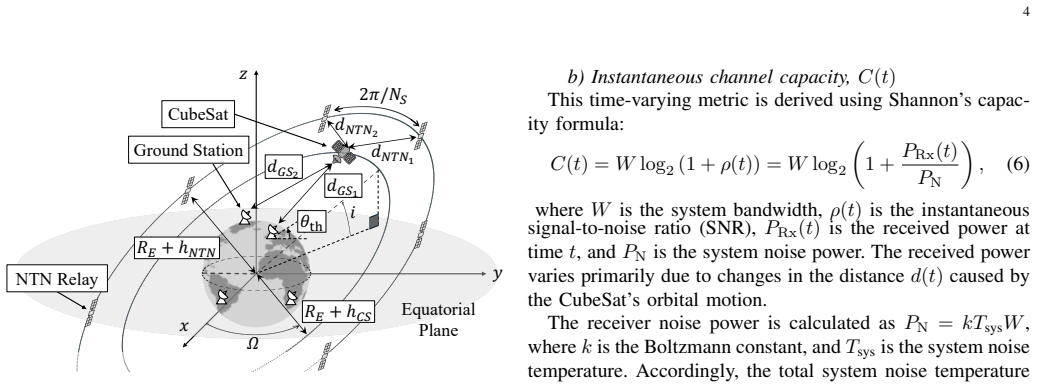
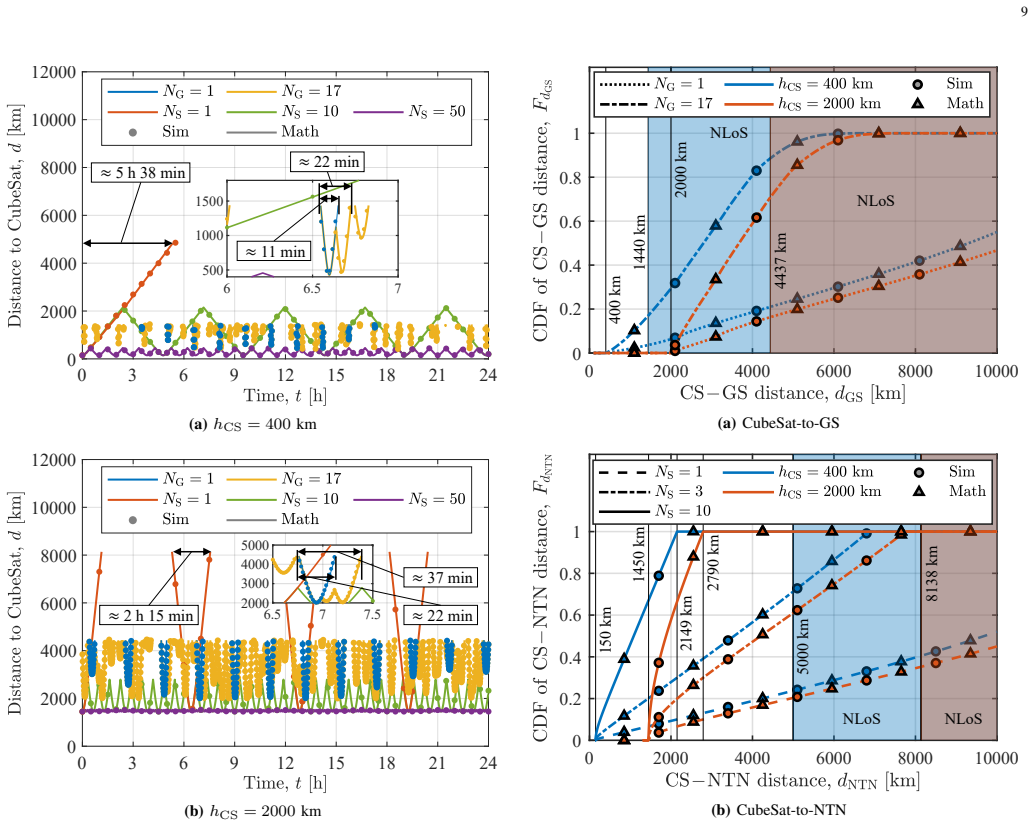
As the commercial space economy expands, existing ground-based infrastructure faces severe bottlenecks in supporting the data-intensive continuous connectivity needs of next-generation "space users," including CubeSats, space data centers, and more. Even when utilizing existing Ku-band ground relay networks, the contact time with a CubeSat at low-Earth orbit (LEO) is often still limited to minutes per day only. This paper analyzes an alternative system design that leverages emerging high-rate millimeter-wave (mmWave) and sub-terahertz (sub-THz) inter-satellite links to build a high-throughput and high-availability satellite-based relay backbone for space vehicles. To evaluate this concept, we develop a comprehensive mathematical framework that jointly incorporates complex time-variant orbital dynamics and mmWave/sub-THz link characteristics. We then derive the key performance indicators, including contact probability, channel capacity, and energy efficiency. The numerical results, cross-verified by computer simulations, demonstrate that such systems can provide improvements of up to several orders of magnitude compared to existing networks of ground stations. Notably, we identify a fundamental bound on download capacity and show that continuous 24/7 connectivity becomes achievable with only ten LEO relay satellites. These findings establish mmWave and sub-THz satellite relay networks as a promising, scalable, and energy-efficient solution, thus unlocking improved connectivity with various space vehicles of tomorrow.
Editorial analysis
A structured set of objections, weighed in public.
Referee Report
Summary. The manuscript presents a mathematical framework that integrates time-variant orbital dynamics with mmWave and sub-THz propagation models for LEO satellite relay networks aimed at supporting space users. Key performance indicators including contact probability, channel capacity, and energy efficiency are derived. Through numerical evaluation and simulations, the authors conclude that continuous 24/7 connectivity can be achieved using only ten LEO relay satellites, yielding improvements of several orders of magnitude over traditional ground station networks, and identify a fundamental bound on download capacity.
Significance. Should the idealized assumptions hold in practice, this work would be significant for the development of space-based communication infrastructures. It provides quantitative evidence for the feasibility of high-frequency inter-satellite links in creating a relay backbone that overcomes the limitations of ground-based systems for continuous, high-rate data transfer to LEO assets. The low satellite count for full coverage and the energy efficiency analysis could influence the design of future commercial space networks.
major comments (2)
- [§§3-4] §§3-4 (joint orbital-dynamics and link framework): the contact-probability and capacity derivations assume deterministic LOS geometry with perfect antenna pointing at all times. Sub-THz beams have half-power beamwidths of only a few milliradians while LEO relative velocities produce angular rates of several degrees per second; without stochastic terms for residual pointing error, attitude jitter, or finite beam-tracking bandwidth, the reported 24/7 coverage with ten relays and the orders-of-magnitude gain become sensitive to an unvalidated modeling choice that directly multiplies outage probability.
- [Numerical results] Numerical results (capacity bound and ten-satellite threshold): the fundamental download-capacity bound and the claim of continuous connectivity rest on the idealized propagation and geometry model. No sensitivity analysis to beam-alignment overhead or ephemeris uncertainty is provided, so it is unclear whether the central performance claims survive realistic impairments.
minor comments (2)
- [Abstract] The abstract states that results are 'cross-verified by computer simulations' yet the main text should explicitly list the simulation parameters, Monte-Carlo settings, and quantitative validation metrics (e.g., maximum relative error between analysis and simulation) to allow independent reproduction.
- Notation for orbital elements and link parameters (e.g., E_p, beamwidth definitions) should be introduced with a dedicated table or early subsection to improve readability for readers outside the immediate sub-field.
Simulated Author's Rebuttal
We thank the referee for the insightful and constructive comments on our manuscript. The points raised regarding idealized assumptions and the need for sensitivity analysis are well taken. We provide point-by-point responses below and will revise the manuscript to incorporate additional discussion and analysis where appropriate.
read point-by-point responses
-
Referee: [§§3-4] §§3-4 (joint orbital-dynamics and link framework): the contact-probability and capacity derivations assume deterministic LOS geometry with perfect antenna pointing at all times. Sub-THz beams have half-power beamwidths of only a few milliradians while LEO relative velocities produce angular rates of several degrees per second; without stochastic terms for residual pointing error, attitude jitter, or finite beam-tracking bandwidth, the reported 24/7 coverage with ten relays and the orders-of-magnitude gain become sensitive to an unvalidated modeling choice that directly multiplies outage probability.
Authors: We agree that the derivations in Sections 3 and 4 rely on deterministic LOS geometry and perfect antenna pointing to establish fundamental performance bounds. This modeling choice isolates the impact of orbital dynamics and propagation characteristics under ideal alignment. However, we acknowledge that narrow sub-THz beams and high LEO angular rates make the results sensitive to unmodeled impairments such as pointing errors and jitter. In the revised version, we will add a dedicated subsection in Section 4 discussing these effects and include a sensitivity analysis that incorporates stochastic pointing error terms, showing the degradation in contact probability and capacity under realistic beam-tracking limitations. revision: yes
-
Referee: [Numerical results] Numerical results (capacity bound and ten-satellite threshold): the fundamental download-capacity bound and the claim of continuous connectivity rest on the idealized propagation and geometry model. No sensitivity analysis to beam-alignment overhead or ephemeris uncertainty is provided, so it is unclear whether the central performance claims survive realistic impairments.
Authors: The referee correctly identifies that the numerical results, including the capacity bound and the ten-satellite threshold for 24/7 connectivity, are derived under idealized conditions without explicit sensitivity analysis. Our current evaluation provides upper-bound performance to highlight the potential of mmWave/sub-THz relays. To address this, we will extend the numerical results section with Monte Carlo simulations that incorporate beam-alignment overhead, residual pointing errors, and ephemeris uncertainty. This will demonstrate the robustness of the key claims and quantify performance degradation under realistic impairments. revision: yes
Circularity Check
Derivation chain is self-contained from orbital mechanics and propagation models
full rationale
The paper constructs a joint mathematical framework from time-variant orbital dynamics and standard mmWave/sub-THz link models to derive contact probability, channel capacity, and energy efficiency. These KPIs are computed directly from the model equations rather than being fitted or redefined in terms of the target outcomes. No self-citations or ansatzes are invoked to justify the core results, and the fundamental bound and ten-satellite threshold emerge from the numerical evaluation of the derived expressions. The analysis remains independent of the specific performance figures it reports.
Axiom & Free-Parameter Ledger
axioms (1)
- domain assumption Orbital mechanics and mmWave/sub-THz propagation models remain valid for LEO inter-satellite links.
Reference graph
Works this paper leans on
-
[1]
Non-Terrestrial Networks for Space Vehicles Beyond 6G: Applications, Architecture, and Capacity Limits,
S. Aliagaet al., “Non-Terrestrial Networks for Space Vehicles Beyond 6G: Applications, Architecture, and Capacity Limits,” in2024 Asilomar Conf on Signals, Systems, and Computers, Oct. 2024, p. 850–857
2024
-
[2]
Evolution of the Intelsat system from Intelsat IV to Intelsat V,
G. Quaglione, “Evolution of the Intelsat system from Intelsat IV to Intelsat V,”J. of Spacecraft and Rockets, vol. 17, no. 2, pp. 67–74, Mar. 1980
1980
-
[3]
An Updated Comparison of Four Low Earth Orbit Satellite Constellation Systems to Provide Global Broadband,
N. Pachleret al., “An Updated Comparison of Four Low Earth Orbit Satellite Constellation Systems to Provide Global Broadband,” in2021 IEEE ICC Workshops, Jun. 2021, pp. 1–7
2021
-
[4]
Satellite Communications in the New Space Era: A Survey and Future Challenges,
O. Kodheliet al., “Satellite Communications in the New Space Era: A Survey and Future Challenges,”IEEE Communications Surveys & Tutorials, vol. 23, no. 1, pp. 70–109, Oct. 2021
2021
-
[5]
The Open Challenge of Integrating Satellites into (Beyond-) 5G Cellular Networks,
R. De Gaudenziet al., “The Open Challenge of Integrating Satellites into (Beyond-) 5G Cellular Networks,”IEEE Network, vol. 36, no. 2, p. 168–174, Mar. 2022
2022
-
[6]
Terahertz wireless communications in space,
M. Civas and O. B. Akan, “Terahertz wireless communications in space,” ITU J. on Future and Evolving Technologies, vol. 2, no. 7, pp. 31–38, Oct. 2021
2021
-
[7]
Joint Terahertz Communication and Atmospheric Sensing in Low Earth Orbit Satellite Networks: Physical Layer Design,
S. Aliagaet al., “Joint Terahertz Communication and Atmospheric Sensing in Low Earth Orbit Satellite Networks: Physical Layer Design,” inProc. of the IEEE WoWMoM Workshops, Jun. 2022, pp. 457–463
2022
-
[8]
Temporary Laser Inter-Satellite Links in Free-Space Optical Satellite Networks,
A. U. Chaudhry and H. Yanikomeroglu, “Temporary Laser Inter-Satellite Links in Free-Space Optical Satellite Networks,”IEEE Open Journal of the Communications Society, vol. 3, pp. 1413–1427, Aug. 2022
2022
-
[9]
Evolution of non-terrestrial networks from 5g to 6g: A survey,
M. M. Azariet al., “Evolution of non-terrestrial networks from 5g to 6g: A survey,”IEEE Communications Surveys & Tutorials, vol. 24, no. 4, pp. 2633–2672, Fourthquarter 2022
2022
-
[10]
The internet of space things/cubesats,
I. F. Akyildiz and A. Kak, “The internet of space things/cubesats,”IEEE Network, vol. 33, no. 5, pp. 212–218, 2019
2019
-
[11]
ESA’s Annual Space Environment Report,
ESA Space Debris Office, “ESA’s Annual Space Environment Report,” European Space Agency (ESA), Darmstadt, Germany, Report GEN- DB-LOG-00288-OPS-SD, Mar. 2025, accessed: 2026-04-04. [Online]. Available: https://sdup.esoc.esa.int/discosweb/statistics/
2025
-
[12]
Big Earth Data: From Data to Information,
D. Tiede, “Big Earth Data: From Data to Information,”Journal for Geographic Information Science, vol. V olume 6,, pp. 184–193, Jun. 2018
2018
-
[13]
Recommendations emerging from an analysis of NASA’s deep space communications capacity,
D. S. Abrahamet al., “Recommendations emerging from an analysis of NASA’s deep space communications capacity,”Space Operations: Inspiring Humankind’s Future, pp. 475–511, May 2019
2019
-
[14]
2020, no
3GPP,Study on New Radio (NR) to support non-terrestrial networks, Oct. 2020, no. TR 38.811
2020
-
[15]
Next-generation NASA Earth-orbiting relay satellites: Fusing optical and microwave communications,
D. J. Israel and H. Shaw, “Next-generation NASA Earth-orbiting relay satellites: Fusing optical and microwave communications,” in2018 IEEE Aero. Conf. Proc., Mar. 2018, pp. 1–7
2018
-
[16]
Development and prospect of Chinese lunar relay commu- nication satellite,
L. Zhang, “Development and prospect of Chinese lunar relay commu- nication satellite,”Space: Science & Technology, Apr. 2021
2021
-
[17]
MarCO: Interplanetary Mission Development on a CubeSat Scale,
J. Schoolcraftet al., “MarCO: Interplanetary Mission Development on a CubeSat Scale,” inSpace Operations: Contributions from the Global Community, C. Cruzenet al., Eds. Cham: Springer, 2017, pp. 221–231
2017
-
[18]
A structured Solar System satellite relay constel- lation network topology design for Earth-Mars deep space communica- tions,
P. Wan and Y . Zhan, “A structured Solar System satellite relay constel- lation network topology design for Earth-Mars deep space communica- tions,”Int. J. of Satellite Comms. and Networking, vol. 37, no. 3, pp. 292–313, Nov. 2019
2019
-
[19]
Two-leg deep-space relay architectures: Perfor- mance, challenges, and perspectives,
D. Modeniniet al., “Two-leg deep-space relay architectures: Perfor- mance, challenges, and perspectives,”IEEE Trans. on Aerospace and Electronic Systems, vol. 58, no. 5, pp. 3840–3858, May 2022
2022
-
[20]
Deep space relay architecture for communications and navigation,
K.-M. Cheunget al., “Deep space relay architecture for communications and navigation,” in2023 IEEE Aero. Conf. Proc., Mar. 2023, pp. 1–19
2023
-
[21]
Delay/disruption-tolerant networking-based the integrated deep-space relay network: State-of-the-art,
D. I. Elewailyet al., “Delay/disruption-tolerant networking-based the integrated deep-space relay network: State-of-the-art,”Ad Hoc Networks, vol. 152, p. 103307, 2024
2024
-
[22]
Earth Orbiting Support Systems for commercial low Earth orbit data relay: Assessing architectures through tradespace exploration,
G. Palermoet al., “Earth Orbiting Support Systems for commercial low Earth orbit data relay: Assessing architectures through tradespace exploration,”Acta Astronautica, vol. 111, p. 48–60, Jun. 2015
2015
-
[23]
THz Technology for Space Communications,
I. Mehdiet al., “THz Technology for Space Communications,” in2018 Asia-Pacific Microwave Conf. (APMC), Nov. 2018, p. 76–78
2018
-
[24]
Performance Analysis of a Dual Terahertz/Ka Band Communication System for Satellite Mega-Constellations,
A. J. Alqaraghuliet al., “Performance Analysis of a Dual Terahertz/Ka Band Communication System for Satellite Mega-Constellations,” in Proc. of the IEEE WoWMoM Workshops, Jun. 2021, p. 316–322
2021
-
[25]
Channel Modeling and Analysis of Inter- Small-Satellite Links in Terahertz Band Space Networks,
S. Nie and I. F. Akyildiz, “Channel Modeling and Analysis of Inter- Small-Satellite Links in Terahertz Band Space Networks,”IEEE Trans. on Communications, vol. 69, no. 12, p. 8585–8599, Dec. 2021
2021
-
[26]
Channel modeling and performance analysis of airplane-satellite terahertz band communications,
J. Kokkoniemiet al., “Channel modeling and performance analysis of airplane-satellite terahertz band communications,”IEEE Trans. on Vehicular Technology, vol. 70, no. 3, pp. 2047–2061, Feb. 2021
2047
-
[27]
Coverage and Rate Analysis of LEO Satellite-to- Airplane Communication Networks in Terahertz Band,
X. Wanget al., “Coverage and Rate Analysis of LEO Satellite-to- Airplane Communication Networks in Terahertz Band,”IEEE Trans. on Wireless Communications, vol. 22, no. 12, p. 9076–9090, Dec. 2023
2023
-
[28]
Terahertz aerospace communications: enabling technolo- gies and future directions,
W. Gaoet al., “Terahertz aerospace communications: enabling technolo- gies and future directions,”Science China Information Sciences, vol. 68, no. 12, p. 220302, Nov. 2025
2025
-
[29]
Terahertz (THz) wireless systems for space appli- cations,
S. U. Hwuet al., “Terahertz (THz) wireless systems for space appli- cations,” in2013 IEEE Sensors Applications Symposium Proceedings, Feb. 2013, p. 171–175
2013
-
[30]
Satellite Constellations,
J. G. Walker, “Satellite Constellations,”Journal of the British Interplan- etary Society, vol. 37, no. 12, pp. 559–572, 1984
1984
-
[31]
Attenuation by atmospheric gases and related effects,
“Attenuation by atmospheric gases and related effects,”International Telecommunication Union, vol. P.676-12, 2019
2019
-
[32]
Reference standard atmospheres,
“Reference standard atmospheres,”International Telecommunication Union, vol. P.835-6, 2017
2017
-
[33]
Leaf Line,
Leaf Space, “Leaf Line,” https://satsearch.co/products/leafspace-leafline, Accessed: Feb. 2026
2026
-
[34]
The Evolution of Applications, Hardware Design, and Channel Modeling for Terahertz (THz) Band Communications and Sensing: Ready for 6G?
J. M. Jornetet al., “The Evolution of Applications, Hardware Design, and Channel Modeling for Terahertz (THz) Band Communications and Sensing: Ready for 6G?”Proceedings of the IEEE, vol. 113, no. 9, pp. 920–951, Sept. 2025
2025
-
[35]
Maralet al.,Satellite communications systems: Systems, techniques and technology
G. Maralet al.,Satellite communications systems: Systems, techniques and technology. Wiley, 2009
2009
-
[36]
A New Generation of Room-Temperature Frequency- Multiplied Sources With up to 10× Higher Output Power in the 160- GHz–1.6-THz Range,
J. V . Sileset al., “A New Generation of Room-Temperature Frequency- Multiplied Sources With up to 10× Higher Output Power in the 160- GHz–1.6-THz Range,”IEEE Trans. on Terahertz Science and Technol- ogy, vol. 8, no. 6, p. 596–604, Oct. 2018
2018
-
[37]
Catalyzing satellite communication: A 20W Ku-Band RF front-end power amplifier design and deployment,
J. Chenet al., “Catalyzing satellite communication: A 20W Ku-Band RF front-end power amplifier design and deployment,”PLoS ONE, vol. 19, no. 4, p. e0300616, Apr. 2024
2024
-
[38]
A versatile experimental testbed for ultrabroadband communication networks above 100 GHz,
P. Senet al., “A versatile experimental testbed for ultrabroadband communication networks above 100 GHz,”Computer Networks, vol. 193, p. 108092, Jul. 2021
2021
-
[39]
A Power-Combined 240 GHz Frequency-Multiplier Source for Cloud Radar Applications,
K. B. Cooperet al., “A Power-Combined 240 GHz Frequency-Multiplier Source for Cloud Radar Applications,”IEEE Journal of Microwaves, vol. 5, no. 6, p. 1253–1259, Nov. 2025
2025
discussion (0)
Sign in with ORCID, Apple, or X to comment. Anyone can read and Pith papers without signing in.