Recognition: 3 theorem links
· Lean TheoremRealizing Saddle-Node Bifurcations from Finite Data
Pith reviewed 2026-05-08 18:44 UTC · model grok-4.3
The pith
Given finite data whose isolating block has the right Conley index, the unknown vector field in dimension six or higher deforms to a canonical model with exactly one structurally stable saddle-node bifurcation, leaving the field unchanged 0
A machine-rendered reading of the paper's core claim, the machinery that carries it, and where it could break.
Core claim
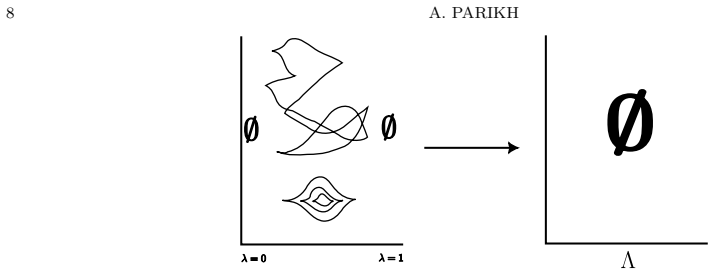
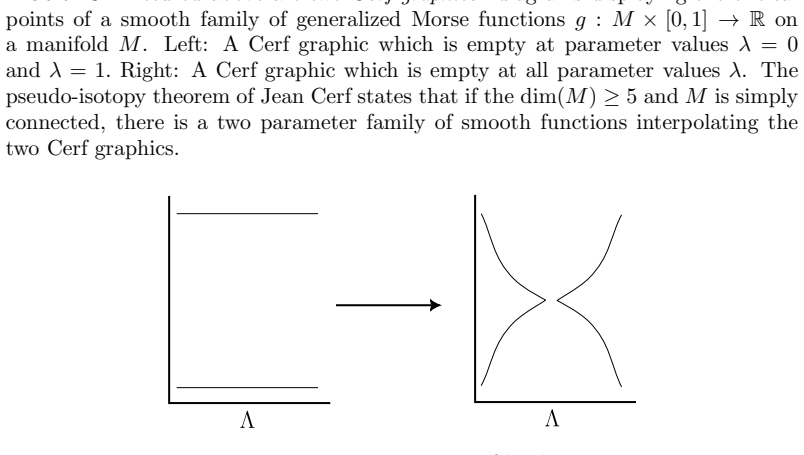
If the data allows construction of an isolating block over a parameter space whose homological Conley index is consistent with a saddle-node bifurcation, then for phase spaces of dimension greater than or equal to 6 the original vector field can be smoothly deformed into a canonical model exhibiting exactly one structurally stable saddle-node bifurcation, with the vector field left unaltered outside the isolating block.
What carries the argument
An isolating block over a parameter space equipped with a homological Conley index matching a saddle-node bifurcation, which serves as the region inside which the deformation to the canonical model is performed.
Load-bearing premise
The finite data must permit construction of an isolating block over the parameter space whose homological Conley index is consistent with a saddle-node bifurcation.
What would settle it
A concrete finite dataset in six or higher dimensions that admits an isolating block with saddle-node Conley index but for which every smooth deformation to the canonical model necessarily alters the vector field at some point outside that block.
Figures


read the original abstract
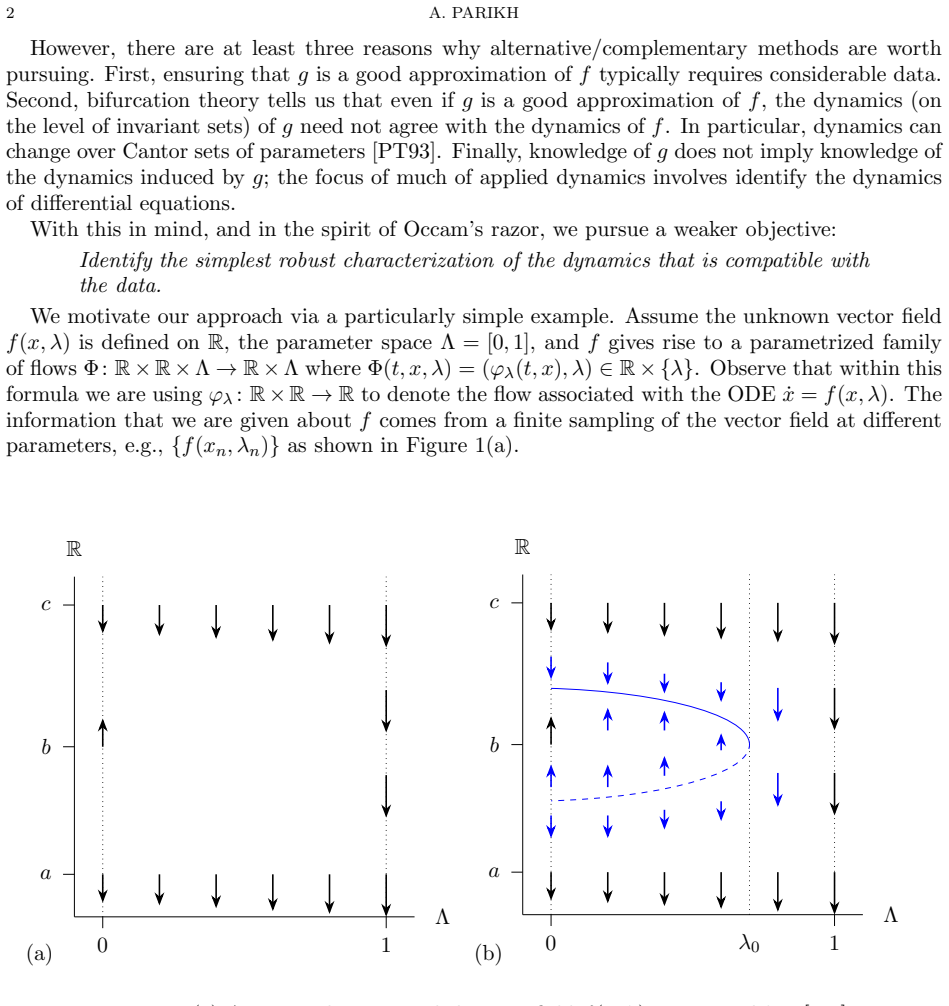
Given a finite set of data generated by an unknown ordinary differential equation it is impossible to exactly determine the associated vector field, and hence, bifurcation theory tells us that it is impossible, in general, to correctly characterize the underlying dynamics. In this paper, we bypass the effort of obtaining an analytic approximation of the vector field, and we adopt an approach based on Occam's razor: identify the simplest robust characterization of the dynamics that is compatible with the given data. Our fundamental assumption is that the data allows for the construction of an isolating block over a parameter space whose homological Conley index is consistent with a saddle-node bifurcation. Our main result establishes that, for phase spaces of dimension greater than or equal to 6, the original vector field can be smoothly deformed into a canonical model exhibiting exactly one structurally stable saddle-node bifurcation. Crucially, this deformation leaves the vector field unaltered outside the isolating block, ensuring strict compatibility with the observed data.
Editorial analysis
A structured set of objections, weighed in public.
Referee Report
Summary. The manuscript claims that, given finite data from an unknown ODE permitting construction of an isolating block over a parameter interval whose homological Conley index is consistent with a saddle-node bifurcation, then for phase-space dimension at least 6 the original vector field admits a smooth deformation supported inside the block that realizes a canonical model with exactly one structurally stable saddle-node bifurcation while leaving the vector field unchanged outside the block.
Significance. If the result holds, it supplies a conditional existence theorem that realizes a specific, structurally stable bifurcation from data without requiring a global analytic approximation of the vector field. The approach rests on standard Conley index theory together with embedding and general-position arguments from differential topology that become available in dimension >=6; the locality of the deformation automatically guarantees compatibility with the observed finite data. This offers a minimal, topologically justified model consistent with the data and may be useful for data-driven detection of bifurcations in high-dimensional systems.
major comments (1)
- [Main Theorem] Main Theorem (presumably §3 or §4): the statement is conditional on the data permitting an isolating block whose homological Conley index matches that of a saddle-node; the manuscript must make explicit how the finite data set is used to certify the existence and index of this block, because the deformation result is vacuous without a concrete construction or verification procedure for the block from the given data points.
minor comments (2)
- [Preliminaries] Notation for the homological Conley index should be defined once at the beginning and used consistently; the current presentation mixes H_* and CH_* without a single reference definition.
- [Canonical Model] The canonical model for the saddle-node should be written explicitly (vector field on R^n x I) rather than left as a verbal description, so that the reader can verify the index calculation directly.
Simulated Author's Rebuttal
We thank the referee for their thorough reading, positive evaluation of the work's significance, and constructive feedback. We address the single major comment below and will incorporate the suggested clarification in the revised manuscript.
read point-by-point responses
-
Referee: [Main Theorem] Main Theorem (presumably §3 or §4): the statement is conditional on the data permitting an isolating block whose homological Conley index matches that of a saddle-node; the manuscript must make explicit how the finite data set is used to certify the existence and index of this block, because the deformation result is vacuous without a concrete construction or verification procedure for the block from the given data points.
Authors: We agree that the applicability of the main result would be strengthened by an explicit description of how the finite data set is used to construct and certify an isolating block with the required homological Conley index. Although the theorem is stated under the standing assumption that such a block exists and can be verified from the data (as is standard in Conley-index-based approaches to data-driven dynamics), the current manuscript does not provide a self-contained outline of this verification step. In the revision we will add a dedicated subsection (placed before the statement of the main theorem) that recalls the standard algorithmic procedure: (i) using the sampled trajectories to define a candidate isolating neighborhood via a grid or triangulation, (ii) confirming the isolating property by checking that the vector field points inward on the boundary (or via a discrete approximation thereof), and (iii) computing the homological Conley index via the induced chain complex or persistent homology on the data. This addition will make the hypotheses of the theorem directly checkable from the given finite data without changing the statement or proof of the deformation result itself. revision: yes
Circularity Check
No significant circularity in derivation chain
full rationale
The paper advances a conditional existence theorem: given finite data permitting an isolating block (over a parameter interval) whose homological Conley index matches that of a saddle-node, and for phase-space dimension at least 6, there exists a smooth deformation supported inside the block realizing a canonical structurally stable saddle-node while leaving the vector field unchanged outside the block. This is an independent mathematical statement resting on standard Conley index theory, bifurcation results, and differential topology (embedding and general-position techniques). No parameter fitting, self-definitional constructions, or load-bearing self-citations appear; the deformation is local and the assumption is stated explicitly, so the result does not reduce to its inputs by construction.
Axiom & Free-Parameter Ledger
axioms (2)
- domain assumption Finite data permits construction of an isolating block whose homological Conley index is consistent with a saddle-node bifurcation.
- standard math In phase space dimension >=6, vector fields can be deformed inside an isolating block to a canonical saddle-node model while remaining unchanged outside.
Lean theorems connected to this paper
-
Foundation/AlexanderDuality.leanalexander_duality_circle_linking unclearOur main result establishes that, for phase spaces of dimension greater than or equal to 6, the original vector field can be smoothly deformed into a canonical model exhibiting exactly one structurally stable saddle-node bifurcation.
-
Cost/FunctionalEquation.leanwashburn_uniqueness_aczel unclearg(x,λ) = g(x0,λ0) + z^3 ± (λ − λ0) z + Q(y), Q a non-degenerate quadratic form on R^{n−1} (Whitney coordinates for the cubic singularity).
-
Foundation/LogicAsFunctionalEquation.lean(philosophical echo only — no formal contact) echoesIdentify the simplest robust characterization of the dynamics that is compatible with the data (Occam's razor philosophy).
Reference graph
Works this paper leans on
-
[1]
Chicone, Carmen , TITLE =. [2024] 2024 , PAGES =. doi:10.1007/978-3-031-51652-8 , URL =
-
[2]
Salamon, Dietmar , TITLE =. Trans. Amer. Math. Soc. , FJOURNAL =. 1985 , NUMBER =. doi:10.2307/1999893 , URL =
-
[3]
1978 , PAGES =
Conley, Charles , TITLE =. 1978 , PAGES =
1978
-
[4]
Conley, C. and Easton, R. , TITLE =. Trans. Amer. Math. Soc. , FJOURNAL =. 1971 , PAGES =. doi:10.2307/1995770 , URL =
-
[5]
Foreman, Matthew and Rudolph, Daniel J. and Weiss, Benjamin , TITLE =. Ann. of Math. (2) , FJOURNAL =. 2011 , NUMBER =. doi:10.4007/annals.2011.173.3.7 , URL =
-
[6]
Abhimanyu Das, Weihao Kong, Rajat Sen, and Yichen Zhou
Brunton, Steven L. and Proctor, Joshua L. and Kutz, J. Nathan , Title =. PROCEEDINGS OF THE NATIONAL ACADEMY OF SCIENCES OF THE UNITED STATES OF AMERICA , Year =. doi:10.1073/pnas.1517384113 , ISSN =
-
[7]
1993 , PAGES =
Palis, Jacob and Takens, Floris , TITLE =. 1993 , PAGES =
1993
-
[8]
1973 , PAGES =
Hatcher, Allen and Wagoner, John , TITLE =. 1973 , PAGES =
1973
-
[9]
and Salamon, Dietmar , TITLE =
Robbin, Joel W. and Salamon, Dietmar , TITLE =. Ergodic Theory Dynam. Systems , FJOURNAL =. 1988 , PAGES =. doi:10.1017/S0143385700009494 , URL =
-
[10]
Laudenbach, Fran cois , TITLE =. Ann. Fac. Sci. Toulouse Math. (6) , FJOURNAL =. 2014 , NUMBER =. doi:10.5802/afst.1404 , URL =
-
[11]
Reineck, James F. , TITLE =. Duke Math. J. , FJOURNAL =. 1992 , NUMBER =. doi:10.1215/S0012-7094-92-06807-4 , URL =
-
[12]
Reineck, James F. , TITLE =. Duke Math. J. , FJOURNAL =. 1991 , NUMBER =. doi:10.1215/S0012-7094-91-06413-6 , URL =
-
[13]
Cerf, Jean , TITLE =. Inst. Hautes \'Etudes Sci. Publ. Math. , FJOURNAL =. 1970 , PAGES =
1970
-
[14]
Laudenbach, Fran cois , TITLE =. C. R. Math. Acad. Sci. Paris , FJOURNAL =. 2013 , NUMBER =. doi:10.1016/j.crma.2013.06.009 , URL =
-
[15]
Connected Cerf Theory , author=
-
[16]
Symposium internacional de topolog\'ia algebraica
Whitney, Hassler , TITLE =. Symposium internacional de topolog\'ia algebraica. 1958 , MRCLASS =
1958
discussion (0)
Sign in with ORCID, Apple, or X to comment. Anyone can read and Pith papers without signing in.