Recognition: 2 theorem links
· Lean TheoremOn the Practical Impact of Local Linear Instabilities in Entropy-Stable Schemes
Pith reviewed 2026-05-08 18:49 UTC · model grok-4.3
The pith
Local linear instabilities in entropy-stable schemes generate only small, controllable numerical errors that do not limit their use.
A machine-rendered reading of the paper's core claim, the machinery that carries it, and where it could break.
Core claim
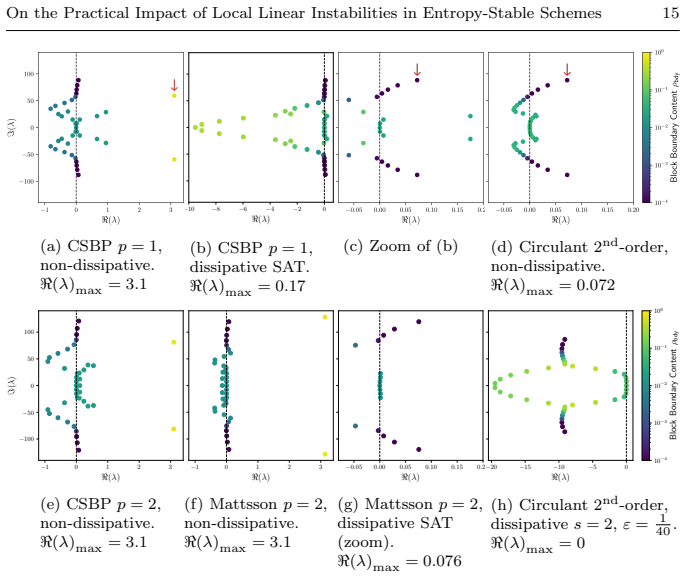
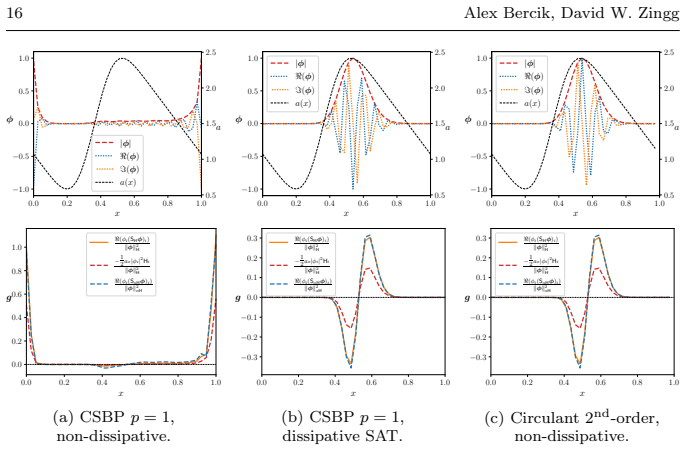
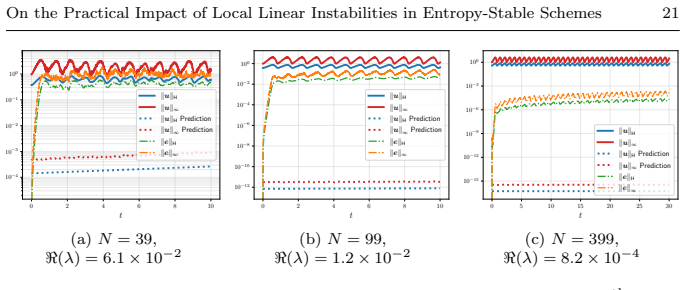
Local linear instabilities produce unphysical modal growth in linearized split-form discretizations of variable-coefficient advection, yet this growth satisfies physically interpretable bounds, stays typically small, and is dominated by highly oscillatory and boundary-localized modes that small dissipation controls. Floquet analysis shows that unstable spectra of frozen Jacobians need not produce unstable perturbation growth in the full nonlinear two-point-flux discretizations typical of entropy-stable schemes. Sharp bounds derived for the geometric flux predict negligible growth, with analogous numerical behavior for the logarithmic flux; robustness issues in density-wave problems are thus,
What carries the argument
The re-interpretation of local linear instability as a bounded source of numerical error, combined with modified-equation analysis, Floquet analysis, and explicit perturbation growth bounds for geometric and logarithmic fluxes.
If this is right
- High-order entropy-stable schemes can be used for nonlinear conservation laws without special treatment for local linear instabilities.
- Minimal artificial dissipation suffices to suppress any residual modal growth from linearizations.
- Development effort should focus on improving logarithmic-mean approximations near vacuum rather than on linear stability fixes.
- Frozen-coefficient Jacobian spectra alone do not determine the stability of time-dependent nonlinear schemes.
Where Pith is reading between the lines
- Designers of entropy-stable codes can adopt higher polynomial degrees with greater confidence that linear modal issues will not dominate error budgets.
- The same modal-growth analysis may extend to other split-form or summation-by-parts schemes outside entropy-stable families.
- Practical implementations could standardize small, fixed dissipation levels calibrated to the observed bound for linear advection.
Load-bearing premise
Perturbation growth stays dominated by oscillatory and boundary-localized modes that small dissipation can suppress and does not transfer into the nonlinear two-point-flux discretizations used in practice.
What would settle it
A numerical test in which a high-order entropy-stable discretization of the Euler equations exhibits sustained, large-amplitude unphysical growth that persists even after modest added dissipation and is independent of near-vacuum effects would falsify the claim.
Figures





read the original abstract
Local linear instability refers to the linearized discrete operator exhibiting perturbation growth exceeding that of the corresponding continuous linearized problem. In the context of nonlinear entropy-stable discretizations, we argue that local linear instabilities should be interpreted as a source of numerical error whose practical impact is often negligible compared with other discretization errors. For split-form discretizations of the variable-coefficient linear advection equation, such as those resulting from linearizations of entropy-stable discretizations of the Burgers equation, perturbations can indeed exhibit unphysical modal growth. However, we demonstrate that this growth satisfies physically interpretable bounds and is typically small. Furthermore, through modified-equation analysis and numerical experiments, we show that the growth is dominated by highly oscillatory and boundary-localized unphysical modes, and can therefore be readily controlled by small amounts of numerical dissipation. More generally, this modal perturbation growth does not extend directly to nonlinear two-point-flux discretizations of the type used in entropy-stable discretizations of the Euler equations. Floquet analysis demonstrates that unstable spectra of frozen-baseflow Jacobians need not lead to unstable perturbation growth. Using the geometric flux for the variable-coefficient linear advection equation, we derive a sharp perturbation growth bound predicting negligible growth, then show analogous behaviour for the logarithmic flux numerically. Finally, we argue that robustness issues observed for entropy-stable schemes in density-wave problems are better attributed to poor near-vacuum behaviour of the logarithmic mean than to local linear instabilities. Overall, our results suggest that local linear instabilities do not pose a practical obstacle to the use of high-order entropy-stable schemes.
Editorial analysis
A structured set of objections, weighed in public.
Referee Report
Summary. The manuscript examines local linear instabilities in entropy-stable schemes, defined as linearized discrete operators showing perturbation growth exceeding the continuous case. For split-form discretizations of the variable-coefficient linear advection equation (arising from Burgers linearizations), it employs modified-equation analysis, Floquet analysis, and numerical experiments to establish that growth is bounded, typically small, and dominated by highly oscillatory, boundary-localized unphysical modes controllable by small numerical dissipation. It further argues via Floquet analysis that such growth does not extend directly to nonlinear two-point-flux discretizations used in entropy-stable Euler schemes, derives a sharp growth bound for the geometric flux, shows analogous numerical behavior for the logarithmic flux, and attributes observed robustness issues in density-wave problems to the logarithmic mean rather than instabilities. The central conclusion is that local linear instabilities do not pose a practical obstacle to high-order entropy-stable schemes.
Significance. If substantiated, the work would provide reassurance for practitioners using high-order entropy-stable schemes by quantifying that local instabilities contribute negligibly compared to other discretization errors and can be managed with existing dissipation. Strengths include the derivation of a sharp, physically interpretable perturbation growth bound for the geometric flux (providing independent grounding) and the Floquet analysis showing that unstable frozen-Jacobian spectra need not imply growth, both of which support a falsifiable assessment of practical impact.
major comments (2)
- [Floquet analysis and nonlinear extension discussion] The claim that modal growth does not extend directly to nonlinear two-point-flux discretizations of the Euler equations rests on Floquet analysis for frozen Jacobians and specific checks for the geometric and logarithmic fluxes in linear advection; no general theorem is provided for arbitrary entropy-conservative two-point fluxes, and no direct perturbation-growth measurements are reported for a nonlinear Euler discretization. This is load-bearing for the practical-impact conclusion.
- [Modified-equation analysis and numerical experiments] The assumption that growth is dominated by highly oscillatory and boundary-localized modes (readily controlled by small dissipation) is supported in the linear advection setting but lacks direct verification that the same control holds once the discretization becomes a genuine nonlinear two-point entropy-conservative flux for systems.
minor comments (2)
- [Introduction] Notation for the geometric and logarithmic fluxes could be introduced earlier with explicit definitions to aid readers unfamiliar with the specific two-point flux forms.
- [Abstract] The abstract mentions 'small amounts of numerical dissipation' without quantifying the amounts used in the experiments; adding a brief statement on the dissipation coefficients would improve clarity.
Simulated Author's Rebuttal
We thank the referee for the thorough review and constructive suggestions. We address each major comment below with clarifications on the scope of our analysis and indicate revisions to strengthen the presentation of results and limitations.
read point-by-point responses
-
Referee: [Floquet analysis and nonlinear extension discussion] The claim that modal growth does not extend directly to nonlinear two-point-flux discretizations of the Euler equations rests on Floquet analysis for frozen Jacobians and specific checks for the geometric and logarithmic fluxes in linear advection; no general theorem is provided for arbitrary entropy-conservative two-point fluxes, and no direct perturbation-growth measurements are reported for a nonlinear Euler discretization. This is load-bearing for the practical-impact conclusion.
Authors: We acknowledge that our conclusions for nonlinear two-point fluxes rely on Floquet analysis of frozen Jacobians (showing that unstable spectra need not produce net growth under time-varying base flows) together with explicit bounds and numerics for the geometric and logarithmic fluxes in the variable-coefficient linear advection equation. These fluxes are the ones actually employed in standard entropy-stable Euler discretizations, so the specific checks are directly relevant. A general theorem covering every conceivable entropy-conservative two-point flux lies outside the manuscript's scope and is not required to support the practical-impact claim for schemes in current use. We will revise the discussion section to state this scope limitation explicitly, add a brief remark on the absence of a general theorem as an open question, and clarify that the linear-advection results serve as a representative model for the local linearization behavior encountered in nonlinear Euler schemes. No direct nonlinear Euler perturbation-growth measurements are added, as the existing evidence already indicates negligible practical effect. revision: partial
-
Referee: [Modified-equation analysis and numerical experiments] The assumption that growth is dominated by highly oscillatory and boundary-localized modes (readily controlled by small dissipation) is supported in the linear advection setting but lacks direct verification that the same control holds once the discretization becomes a genuine nonlinear two-point entropy-conservative flux for systems.
Authors: The modified-equation analysis isolates the leading-order dispersive and dissipative terms responsible for the oscillatory, boundary-localized character of the unstable modes; this structural feature of the split-form operator is independent of linearity. Nevertheless, we agree that explicit confirmation in a nonlinear setting would strengthen the argument. We will therefore add a short subsection containing numerical experiments on a nonlinear two-point entropy-conservative discretization (e.g., Burgers equation with the geometric flux) that demonstrate the same mode localization and the effectiveness of small added dissipation in suppressing growth. These new results will be placed alongside the existing linear-advection evidence. revision: yes
Circularity Check
No circularity; derivations are independent from discretization equations and analysis
full rationale
The paper derives the sharp perturbation growth bound directly from the discretization equations of the geometric flux for variable-coefficient linear advection, yielding a physically interpretable result without fitting or self-definition. Floquet analysis on frozen Jacobians is a separate mathematical demonstration that unstable spectra need not produce growth. Numerical checks for the logarithmic flux and attribution of robustness issues to logarithmic-mean behavior are supported by explicit experiments and modified-equation analysis rather than reduction to prior inputs. No load-bearing step equates a prediction to its own fitted parameter or self-citation chain; the central claim rests on these independent elements and remains self-contained against external benchmarks.
Axiom & Free-Parameter Ledger
axioms (2)
- domain assumption Linearization of the nonlinear entropy-stable discretization leads to split-form discretizations for variable-coefficient linear advection.
- standard math Perturbation growth can be analyzed via modified-equation analysis and Floquet analysis on frozen baseflows.
Lean theorems connected to this paper
-
IndisputableMonolith.Cost.FunctionalEquationwashburn_uniqueness_aczel unclearF⋆(ui,uj) = {{au}}_geom := √(a_i u_i a_j u_j) ... the logarithmic flux can be expressed as a convex (albeit nonlinear) combination of the arithmetic and geometric fluxes.
-
IndisputableMonolith.Foundation.RealityFromDistinction (Tick / LogicNat time-as-orbit)reality_from_one_distinction unclearFloquet analysis is used to demonstrate that unstable spectra of frozen-baseflow Jacobians do not necessarily lead to unstable perturbation growth.
Reference graph
Works this paper leans on
-
[1]
Journal of Scientific Computing 85(2), 43 (2020)
Abgrall, R., Nordstr¨ om, J.,¨Offner, P., Tokareva, S.: Analysis of the SBP-SAT stabiliza- tion for finite element methods part I: Linear problems. Journal of Scientific Computing 85(2), 43 (2020). DOI 10.1007/s10915-020-01349-z
-
[2]
Communications on Applied Mathematics and Computation5, 573–595 (2023)
Abgrall, R., Nordstr¨ om, J.,¨Offner, P., Tokareva, S.: Analysis of the SBP-SAT stabiliza- tion for finite element methods part II: Entropy stability. Communications on Applied Mathematics and Computation5, 573–595 (2023). DOI 10.1007/s42967-020-00086-2
-
[3]
Antonelli, P., Dolce, M., Marcati, P.: Linear stability analysis of the homogeneous cou- ette flow in a 2d isentropic compressible fluid. Annals of PDE7(24) (2021). DOI 10.1007/s40818-021-00112-3
-
[4]
Journal of Fluid Mechanics322, 215–241 (1996)
Barkley, D., Henderson, R.D.: Three-dimensional Floquet stability analysis of the wake of a circular cylinder. Journal of Fluid Mechanics322, 215–241 (1996). DOI 10.1017/ S0022112096002777
1996
-
[5]
SIAM Journal on Scientific Computing14(4), 971–1006 (1993)
Beam, R.M., Warming, R.F.: The asymptotic spectra of banded Toeplitz and quasi- Toeplitz matrices. SIAM Journal on Scientific Computing14(4), 971–1006 (1993). DOI 10.1137/0914059
-
[6]
Journal of Scientific Computing107(1), 28 (2026)
Bercik, A., Craig Penner, D.A., Zingg, D.W.: Stable volume dissipation for high-order finite-difference and spectral-element methods with the summation-by-parts property. Journal of Scientific Computing107(1), 28 (2026). DOI 10.1007/s10915-026-03213-y
-
[7]
Journal of Computational Physics431, 110148 (2021)
Biswas, B., Kumar, H., Yadav, A.: Entropy stable discontinuous Galerkin methods for ten-moment gaussian closure equations. Journal of Computational Physics431, 110148 (2021). DOI 10.1016/j.jcp.2021.110148
-
[8]
Blanes, S., Casas, F., Oteo, J., Ros, J.: The Magnus expansion and some of its applica- tions. Physics Reports470(5), 151–238 (2009). DOI 10.1016/j.physrep.2008.11.001
-
[9]
part i: Theory and numerical verification
Bohm, M.W., Winters, A.R., Gassner, G.J., Derigs, D., Hindenlang, F.J., Saur, J.: An entropy stable nodal discontinuous Galerkin method for the resistive mhd equations. part i: Theory and numerical verification. Journal of Computational Physics422, 108076 (2020). DOI 10.1016/j.jcp.2019.108076
-
[10]
SIAM Journal on Scientific Computing36(5), B835–B867 (2014)
Carpenter, M.H., Fisher, T.C., Nielsen, E.J., Frankel, S.H.: Entropy stable spectral collocation schemes for the Navier–Stokes equations: Discontinuous interfaces. SIAM Journal on Scientific Computing36(5), B835–B867 (2014). DOI 10.1137/130932193
-
[11]
Journal of Computational Physics148(2), 341–365 (1999)
Carpenter, M.H., Nordstr¨ om, J., Gottlieb, D.: A stable and conservative interface treat- ment of arbitrary spatial accuracy. Journal of Computational Physics148(2), 341–365 (1999). DOI 10.1006/jcph.1998.6114
-
[13]
Chan, J., Ranocha, H., Rueda-Ram´ ırez, A.M., Gassner, G., Warburton, T.: On the entropy projection and the robustness of high order entropy stable discontinuous Galerkin schemes for under-resolved flows. Frontiers in Physics10(2022). DOI 10.3389/fphy.2022.898028
-
[14]
Communications in Computational Physics14(5), 1252–1286 (2013)
Chandrashekar, P.: Kinetic energy preserving and entropy stable finite volume schemes for compressible Euler and Navier–Stokes equations. Communications in Computational Physics14(5), 1252–1286 (2013). DOI 10.4208/cicp.170712.010313a On the Practical Impact of Local Linear Instabilities in Entropy-Stable Schemes 55
-
[15]
Chandrashekar, P.: Finite volume discretization of heat equation and compressible Navier-Stokes equations with weak Dirichlet boundary condition on triangular grids. International Journal of Advances in Engineering Sciences and Applied Mathematics 8(3), 174–193 (2016). DOI 10.1007/s12572-015-0160-z
-
[16]
Journal of Computational Physics345, 427–461 (2017)
Chen, T., Shu, C.W.: Entropy stable high order discontinuous Galerkin methods with suitable quadrature rules for hyperbolic conservation laws. Journal of Computational Physics345, 427–461 (2017). DOI 10.1016/j.jcp.2017.05.025
-
[17]
CSIAM Transactions on Applied Mathematics1(1), 1–52 (2020)
Chen, T., Shu, C.W.: Review of entropy stable discontinuous Galerkin methods for systems of conservation laws on unstructured simplex meshes. CSIAM Transactions on Applied Mathematics1(1), 1–52 (2020). DOI 10.4208/csiam-am.2020-0003
-
[18]
Chicone, C.: Ordinary Differential Equations with Applications,Texts in Applied Math- ematics, vol. 34, 2 edn. Springer, New York, NY (2006). DOI 10.1007/0-387-35794-7
-
[19]
Journal of Computational Physics356, 410–438 (2018)
Crean, J., Hicken, J.E., Del Rey Fern´ andez, D.C., Zingg, D.W., Carpenter, M.H.: Entropy-stable summation-by-parts discretization of the Euler equations on general curved elements. Journal of Computational Physics356, 410–438 (2018). DOI 10.1016/j.jcp.2017.12.015
-
[20]
Dafermos, C.M.: Hyperbolic Conservation Laws in Continuum Physics,Grundlehren der mathematischen Wissenschaften, vol. 325, 3 edn. Springer-Verlag Berlin Heidelberg, Berlin, Heidelberg (2010). DOI 10.1007/978-3-642-04048-1
-
[21]
Journal of Computational Physics492, 112439 (2023)
De Michele, C., Coppola, G.: Asymptotically entropy-conservative and kinetic-energy preserving numerical fluxes for compressible Euler equations. Journal of Computational Physics492, 112439 (2023). DOI 10.1016/j.jcp.2023.112439
-
[22]
Journal of Computational Physics518, 113338 (2024)
De Michele, C., Coppola, G.: Novel pressure-equilibrium and kinetic-energy preserving fluxes for compressible flows based on the harmonic mean. Journal of Computational Physics518, 113338 (2024). DOI 10.1016/j.jcp.2024.113338
-
[23]
SN Partial Differential Equa- tions and Applications1(2), 9 (2020)
Del Rey Fern´ andez, D.C., Carpenter, M.H., Dalcin, L., Zampini, S., Parsani, M.: En- tropy stable h/p-nonconforming discretization with the summation-by-parts property for the compressible Euler and Navier–Stokes equations. SN Partial Differential Equa- tions and Applications1(2), 9 (2020). DOI 10.1007/s42985-020-00009-z
-
[24]
Del Rey Fern´ andez, D.C., Hicken, J.E., Zingg, D.W.: Review of summation-by-parts operators with simultaneous approximation terms for the numerical solution of par- tial differential equations. Computers & Fluids95, 171–196 (2014). DOI 10.1016/j. compfluid.2014.02.016
work page doi:10.1016/j 2014
-
[25]
Dyson, F.J.: The radiation theories of Tomonaga, Schwinger, and Feynman. Phys. Rev. 75, 486–502 (1949). DOI 10.1103/PhysRev.75.486
-
[26]
Dyson, F.J.: Divergence of perturbation theory in quantum electrodynamics. Phys. Rev. 85, 631–632 (1952). DOI 10.1103/PhysRev.85.631
-
[27]
Graduate Texts in Mathematics
Engel, K.J., Nagel, R.: One-Parameter Semigroups for Linear Evolution Equations, 1 edn. Graduate Texts in Mathematics. Springer, New York, NY (2000). DOI 10.1007/ b97696
2000
-
[28]
Fairgrieve, T.F., Jepson, A.D.: O. k. floquet multipliers. SIAM Journal on Numerical Analysis28(5), 1446–1462 (1991). DOI 10.1137/0728075
-
[29]
Bulletin de la Classe des sciences44, 818–829 (1958)
Fer, F.: R´ esolution de l’´ equation matricielle du/dt=pupar produit infini d’exponentielles matricielles. Bulletin de la Classe des sciences44, 818–829 (1958). DOI 10.3406/barb.1958.68918
-
[30]
Journal of Computational Physics252, 518–557 (2013)
Fisher, T.C., Carpenter, M.H.: High-order entropy stable finite difference schemes for nonlinear conservation laws: Finite domains. Journal of Computational Physics252, 518–557 (2013). DOI 10.1016/j.jcp.2013.06.014
-
[31]
Journal of Computational Physics234, 353–375 (2013)
Fisher, T.C., Carpenter, M.H., Nordstr¨ om, J., Yamaleev, N.K., Swanson, C.: Discretely conservative finite-difference formulations for nonlinear conservation laws in split form: Theory and boundary conditions. Journal of Computational Physics234, 353–375 (2013). DOI 10.1016/j.jcp.2012.09.026
-
[32]
International Journal for Numerical Methods in Engineering11(7), 1117–1136 (1977)
Friedmann, P., Hammond, C.E., Woo, T.H.: Efficient numerical treatment of periodic systems with application to stability problems. International Journal for Numerical Methods in Engineering11(7), 1117–1136 (1977). DOI 10.1002/nme.1620110708
-
[33]
SIAM Journal on Scientific Computing35(3), A1233–A1253 (2013)
Gassner, G.J.: A skew-symmetric discontinuous Galerkin spectral element discretiza- tion and its relation to sbp-sat finite difference methods. SIAM Journal on Scientific Computing35(3), A1233–A1253 (2013). DOI 10.1137/120890144 56 Alex Bercik, David W. Zingg
-
[34]
Journal of Scientific Com- puting90, 79 (2022)
Gassner, G.J., Sv¨ ard, M., Hindenlang, F.J.: Stability issues of entropy-stable and/or split-form high-order schemes: Analysis of linear stability. Journal of Scientific Com- puting90, 79 (2022). DOI 10.1007/s10915-021-01720-8
-
[35]
Gassner, G.J., Winters, A.R.: A novel robust strategy for discontinuous Galerkin meth- ods in computational fluid mechanics: Why? When? What? Where? Frontiers in Physics 8, 500690 (2021). DOI 10.3389/fphy.2020.500690
-
[36]
Gassner, G.J., Winters, A.R., Kopriva, D.A.: Split form nodal discontinuous Galerkin schemes with summation-by-parts property for the compressible Euler equations. Jour- nal of Computational Physics327, 39–66 (2016). DOI 10.1016/j.jcp.2016.09.013
-
[37]
Ap- plied Mathematics and Computation272, 291–308 (2016)
Gassner, G.J., Winters, A.R., Kopriva, D.A.: A well balanced and entropy conservative discontinuous Galerkin spectral element method for the shallow water equations. Ap- plied Mathematics and Computation272, 291–308 (2016). DOI 10.1016/j.amc.2015.07. 014
-
[38]
Journal of Scientific Computing98(1), 30 (2024)
Glaubitz, J., Nordstr¨ om, J.,¨Offner, P.: Energy-stable global radial basis function meth- ods on summation-by-parts form. Journal of Scientific Computing98(1), 30 (2024). DOI 10.1007/s10915-023-02427-8
-
[39]
Foundations of Computational Mathematics16(3), 751–777 (2016)
Hairer, E., Iserles, A.: Numerical stability in the presence of variable coefficients. Foundations of Computational Mathematics16(3), 751–777 (2016). DOI 10.1007/ s10208-015-9263-y
2016
-
[40]
1993, Solving Orginary Differential Equations I (Springer), doi: 10.1007/978-3-540-78862-1
Hairer, E., Wanner, G., Nørsett, S.P.: Solving Ordinary Differential Equations I: Nonstiff Problems, 2nd edn. Springer Series in Computational Mathematics. Springer-Verlag Berlin Heidelberg (1993). DOI 10.1007/978-3-540-78862-1
-
[41]
Journal of Computational Physics532, 113940 (2025)
Hicken, J., Yan, G., Kaur, S.: Constructing stable, high-order finite-difference operators on point clouds over complex geometries. Journal of Computational Physics532, 113940 (2025). DOI 10.1016/j.jcp.2025.113940
-
[42]
Journal of Scientific Computing82(2), 50 (2020)
Hicken, J.E.: Entropy-stable, high-order summation-by-parts discretizations without in- terface penalties. Journal of Scientific Computing82(2), 50 (2020). DOI 10.1007/ s10915-020-01154-8
2020
-
[43]
Springer Nature
Hicken, J.E., Del Rey Fern´ andez, D.C., Zingg, D.W.: Summation-by-Parts Methods for the Numerical Solution of Partial Differential Equations: Theory and Practice. Springer Nature. In preparation
-
[44]
SIAM Journal on Scientific Computing38(4), A1935–A1958 (2016)
Hicken, J.E., Del Rey Fern´ andez, D.C., Zingg, D.W.: Multidimensional summation-by- parts operators: General theory and application to simplex elements. SIAM Journal on Scientific Computing38(4), A1935–A1958 (2016). DOI 10.1137/15M1038360
-
[45]
BIT Numerical Mathe- matics34(1), 88–98 (1994)
Higham, D.J.: Runge–Kutta stability on a Floquet problem. BIT Numerical Mathe- matics34(1), 88–98 (1994). DOI 10.1007/BF01935018
-
[46]
International Journal for Numerical Methods in Engineering55(5), 503–518 (2002)
Insperger, T., St´ ep´ an, G.: Semi-discretization method for delayed systems. International Journal for Numerical Methods in Engineering55(5), 503–518 (2002). DOI 10.1002/ nme.505
2002
-
[47]
Iserles, A., Munthe-Kaas, H.Z., Nørsett, S.P., Zanna, A.: Lie-group methods. Acta Numerica9, 215–365 (2000). DOI 10.1017/S0962492900002154
-
[48]
Journal of Computational Physics228(15), 5410–5436 (2009)
Ismail, F., Roe, P.L.: Affordable, entropy-consistent Euler flux functions II: Entropy production at shocks. Journal of Computational Physics228(15), 5410–5436 (2009). DOI 10.1016/j.jcp.2009.04.021
-
[49]
SIAM Review50(3), 570–584 (2008)
Josi´ c, K., Rosenbaum, R.: Unstable solutions of nonautonomous linear differential equa- tions. SIAM Review50(3), 570–584 (2008). DOI 10.1137/060677057
-
[50]
Journal of Computational Physics227(3), 1676–1700 (2008)
Kennedy, C.A., Gruber, A.: Reduced aliasing formulations of the convective terms within the Navier–Stokes equations for a compressible fluid. Journal of Computational Physics227(3), 1676–1700 (2008). DOI 10.1016/j.jcp.2007.09.020
-
[51]
SIAM Journal on Scientific Computing36(4), A2076–A2099 (2014)
Kopriva, D.A., Gassner, G.J.: An energy stable discontinuous Galerkin spectral element discretization for variable coefficient advection problems. SIAM Journal on Scientific Computing36(4), A2076–A2099 (2014). DOI 10.1137/130928650
-
[52]
Kreiss, H.O., Lorenz, J.: Initial-Boundary Value Problems and the Navier-Stokes Equa- tions. Academic Press, Boston (1989). DOI 10.1137/1.9780898719130
-
[53]
Kreiss, H.O., Scherer, G.: Finite element and finite difference methods for hyperbolic partial differential equations. In: C. de Boor (ed.) Mathematical Aspects of Finite Elements in Partial Differential Equations, pp. 195–212. Academic Press (1974). DOI 10.1016/B978-0-12-208350-1.50012-1 On the Practical Impact of Local Linear Instabilities in Entropy-St...
-
[54]
Kinetic energy and entropy preserving schemes for compressible flows by split convective forms
Kuya, Y., Totani, K., Kawai, S.: Kinetic energy and entropy preserving schemes for compressible flows by split convective forms. Journal of Computational Physics375, 823–853 (2018). DOI 10.1016/j.jcp.2018.08.058
-
[55]
Communications on Pure and Applied Mathematics9(2), 267–293 (1956)
Lax, P.D., Richtmyer, R.D.: Survey of the stability of linear finite difference equations. Communications on Pure and Applied Mathematics9(2), 267–293 (1956). DOI 10. 1002/cpa.3160090206
1956
-
[56]
SIAM Journal on Numerical Analysis40(5), 1968–1992 (2002)
LeFloch, P.G., Mercier, J.M., Rohde, C.: Fully discrete, entropy conservative schemes of arbitrary order. SIAM Journal on Numerical Analysis40(5), 1968–1992 (2002). DOI 10.1137/S003614290240069X
-
[57]
Journal of Computational Physics 354, 163–178 (2018)
Liu, Y., Shu, C.W., Zhang, M.: Entropy stable high order discontinuous Galerkin meth- ods for ideal compressible mhd on structured meshes. Journal of Computational Physics 354, 163–178 (2018). DOI 10.1016/j.jcp.2017.10.043
-
[58]
International Journal of Bifurcation and Chaos11(09), 2389–2410 (2001)
Lust, K.: Improved numerical floquet multipliers. International Journal of Bifurcation and Chaos11(09), 2389–2410 (2001). DOI 10.1142/S0218127401003486
-
[59]
Communications on Pure and Applied Mathematics7(4), 649–673 (1954)
Magnus, W.: On the exponential solution of differential equations for a linear operator. Communications on Pure and Applied Mathematics7(4), 649–673 (1954). DOI 10. 1002/cpa.3160070404
1954
-
[60]
Journal of Scientific Computing75(3), 1262–1281 (2018)
Manzanero, J., Rubio, G., Ferrer, E., Valero, E., Kopriva, D.A.: Insights on aliasing driven instabilities for advection equations with application to Gauss–Lobatto discon- tinuous Galerkin methods. Journal of Scientific Computing75(3), 1262–1281 (2018). DOI 10.1007/s10915-017-0585-6
-
[61]
Journal of Computational Physics264, 91–111 (2014)
Mattsson, K., Almquist, M., Carpenter, M.H.: Optimal diagonal-norm SBP operators. Journal of Computational Physics264, 91–111 (2014). DOI 10.1016/j.jcp.2013.12.041
-
[62]
NASA Technical Memorandum NASA-TM-101086, NASA Ames Research Center, Moffett Field, CA (1989)
Merriam, M.L.: An entropy-based approach to nonlinear stability. NASA Technical Memorandum NASA-TM-101086, NASA Ames Research Center, Moffett Field, CA (1989). Accession Number: 90N17376
1989
-
[63]
Montoya, T., Zingg, D.W.: A unifying algebraic framework for discontinuous Galerkin and flux reconstruction methods based on the summation-by-parts property. Journal of Scientific Computing92(3), 87 (2022). DOI 10.1007/s10915-022-01935-3
-
[64]
Mathematics Magazine68(4), 305 (1995)
Nelsen, R.B.: Proof without words: The arithmetic–logarithmic–geometric mean in- equality. Mathematics Magazine68(4), 305 (1995)
1995
-
[65]
Applied Numerical Mathematics38(3), 237–255 (2001)
Nordstr¨ om, J., Bj¨ orck, M.: Finite volume approximations and strict stability for hy- perbolic problems. Applied Numerical Mathematics38(3), 237–255 (2001). DOI 10.1016/S0168-9274(01)00027-7
-
[66]
Applied Numerical Math- ematics45(4), 453–473 (2003)
Nordstr¨ om, J., Forsberg, K., Adamsson, C., Eliasson, P.: Finite volume methods, un- structured meshes and strict stability for hyperbolic problems. Applied Numerical Math- ematics45(4), 453–473 (2003). DOI 10.1016/S0168-9274(02)00239-8
-
[67]
Ntoukas, G., Manzanero, J., Rubio, G., Valero, E., Ferrer, E.: An entropy-stable p- adaptive nodal discontinuous Galerkin for the coupled Navier–Stokes/Cahn–Hilliard system. Journal of Computational Physics458, 111093 (2022). DOI 10.1016/j.jcp. 2022.111093
-
[68]
Journal of the American Helicopter Society16(2), 25–33 (1971)
Peters, D.A., Hohenemser, K.H.: Application of the Floquet transition matrix to prob- lems of lifting rotor stability. Journal of the American Helicopter Society16(2), 25–33 (1971). DOI 10.4050/JAHS.16.25
-
[69]
Journal of Differential Equa- tions369, 215–228 (2023)
Pu, X., Wu, X., Yang, L.: Linear stability analysis of the Couette flow for the two dimensional non-isentropic compressible Euler equations. Journal of Differential Equa- tions369, 215–228 (2023). DOI 10.1016/j.jde.2023.06.006
-
[70]
Journal of Scientific Computing76, 216–242 (2018)
Ranocha, H.: Comparison of some entropy conservative numerical fluxes for the Eu- ler equations. Journal of Scientific Computing76, 216–242 (2018). DOI 10.1007/ s10915-017-0618-1
2018
-
[71]
Jour- nal of Computational Physics362, 20–48 (2018)
Ranocha, H.: Generalised summation-by-parts operators and variable coefficients. Jour- nal of Computational Physics362, 20–48 (2018). DOI 10.1016/j.jcp.2018.02.021
-
[72]
Communica- tions on Applied Mathematics and Computation4, 880–903 (2022)
Ranocha, H., Gassner, G.J.: Preventing pressure oscillations does not fix local lin- ear stability issues of entropy-based split-form high-order schemes. Communica- tions on Applied Mathematics and Computation4, 880–903 (2022). DOI 10.1007/ s42967-021-00148-z
2022
-
[73]
Journal of Computational Physics311, 299–328 (2016)
Ranocha, H., ¨Offner, P., Sonar, T.: Summation-by-parts operators for correction pro- cedure via reconstruction. Journal of Computational Physics311, 299–328 (2016). DOI 10.1016/j.jcp.2016.02.009 58 Alex Bercik, David W. Zingg
-
[74]
Journal of Computational Physics382, 1–26 (2019)
Renac, F.: Entropy stable dgsem for nonlinear hyperbolic systems in nonconservative form with application to two-phase flows. Journal of Computational Physics382, 1–26 (2019). DOI 10.1016/j.jcp.2018.12.035
-
[75]
Journal of Computational Physics427, 110060 (2021)
Shima, N., Kuya, Y., Tamaki, Y., Kawai, S.: Preventing spurious pressure oscillations in split convective form discretization for compressible flows. Journal of Computational Physics427, 110060 (2021). DOI 10.1016/j.jcp.2020.110060
-
[76]
arXiv preprint arXiv:2104.14941 (2021)
Singh, V., Chandrashekar, P.: On a linear stability issue of split form schemes for com- pressible flows. arXiv preprint arXiv:2104.14941 (2021). DOI 10.48550/arXiv.2104. 14941
-
[77]
Journal of Computational Physics110(1), 47–67 (1994)
Strand, B.: Summation by parts for finite difference approximations for d/dx. Journal of Computational Physics110(1), 47–67 (1994). DOI 10.1006/jcph.1994.1005
-
[78]
Strang, G.: Accurate partial difference methods: II. non-linear problems. Numerische Mathematik6(1), 37–46 (1964). DOI 10.1007/BF01386051
-
[79]
Journal of Computational Physics288, 19–51 (2015)
Sv¨ ard, M.: Weak solutions and convergent numerical schemes of modified compressible Navier-Stokes equations. Journal of Computational Physics288, 19–51 (2015). DOI 10.1016/j.jcp.2015.02.013
-
[80]
Acta Numerica12, 451–512 (2003)
Tadmor, E.: Entropy stability theory for difference approximations of nonlinear conser- vation laws and related time-dependent problems. Acta Numerica12, 451–512 (2003). DOI 10.1017/S0962492902000156
-
[81]
Temple, B., Young, R.: Time-periodic solutions of the compressible Euler equations and the nonlinear theory of sound (2024). DOI 10.48550/arXiv.2406.00200
discussion (0)
Sign in with ORCID, Apple, or X to comment. Anyone can read and Pith papers without signing in.