Recognition: 4 theorem links
· Lean TheoremSpinning charged test particle dynamics around a Schwarzschild black hole embedded in a homogeneous magnetic field
Pith reviewed 2026-05-08 18:53 UTC · model grok-4.3
The pith
Spinning charged test particles around a Schwarzschild black hole in a uniform magnetic field have integrable equatorial motion but exhibit chaos off the equator.
A machine-rendered reading of the paper's core claim, the machinery that carries it, and where it could break.
Core claim
In the equatorial plane, with the spin vector orthogonal to the orbital plane, analytical expressions are obtained for the conserved energy and angular momentum as well as the radial and orbital frequencies in terms of the spin and magnetic parameters. An effective potential is constructed to identify allowed regions of motion. The equatorial system remains integrable due to the spacetime symmetries and the alignment of the magnetic field. For off-equatorial configurations the dynamics constitute a non-integrable system that is analyzed using four-dimensional Poincaré surfaces of sections and recurrence analysis, which reveal chaotic behavior for particular choices of parameters and initial
What carries the argument
The Mathisson-Papapetrou-Dixon equations augmented by the Lorentz force for a charged spinning test particle, reduced analytically via conserved quantities in the equatorial plane and examined numerically through four-dimensional Poincaré sections and recurrence quantification off the equator.
If this is right
- Equatorial orbits permit explicit formulas for radial and orbital frequencies that depend on both the spin parameter and the magnetic field strength.
- The effective potential directly determines the radial turning points and allowed regions of equatorial motion.
- Off-equatorial motion can be reduced only to three degrees of freedom and must be studied with four-dimensional phase-space tools.
- Comparison with the spinning neutral and non-spinning charged limits isolates the separate contributions of spin-curvature coupling and electromagnetic interaction.
Where Pith is reading between the lines
- The appearance of chaos implies that particle trajectories in magnetized regions near black holes can become highly sensitive to small changes in initial conditions or parameters.
- Extending the model to include the back-reaction of the magnetic field on the spacetime geometry might shrink or enlarge the chaotic domains.
- Similar phase-space methods could be applied to spinning charged particles around Kerr black holes where frame-dragging introduces an additional non-integrable channel.
Load-bearing premise
The magnetic field is a uniform test field that does not distort the Schwarzschild geometry and the particle is a test particle whose motion does not affect the background fields.
What would settle it
Numerical integration of the equations of motion for off-equatorial initial conditions with non-zero spin and magnetic parameters that produces only quasi-periodic orbits with zero maximal Lyapunov exponents and bounded recurrence plots would falsify the reported chaotic behavior.
Figures




read the original abstract
We study the dynamics of spinning charged test particles orbiting a Schwarzschild black hole immersed in a test uniform magnetic field. This setup provides a simple but physically relevant framework for modeling particle motion in magnetized astrophysical environments near compact objects, where both spin-curvature coupling and electromagnetic interactions can play a significant role. The particle trajectories are obtained numerically in both equatorial and off-equatorial configurations, allowing us to examine the influence of spin-curvature and Lorentz forces on the motion. In the equatorial plane, assuming the particle's spin vector is orthogonal to the orbital plane, we derive analytical expressions for the conserved energy and angular momentum, as well as for the radial and orbital frequencies as functions of spin parameter and magnetic parameter. We also construct the corresponding effective potential to determine the allowed regions of particle motion. The equatorial dynamics remain integrable due to the existence of conserved quantities associated with the spacetime symmetries and the alignment of the magnetic field. In contrast, the off-equatorial motion constitutes a non-integrable dynamical system. While limiting subcases of the system, i.e., the spinning neutral and non-spinning charged cases, can be analyzed using two-dimensional Poincar\'{e} surface of sections (PSs), the combined system can be reduced only up to three degrees of freedom. Hence, to investigate the resulting complexity, we analyze the phase space using four-dimensional PS along with recurrence analysis, revealing the presence of chaotic behavior for particular choices of parameters and initial conditions. Finally, we compare the dynamics of spinning charged test particles with the limiting cases, thereby distinguishing the respective contributions of spin-curvature and electromagnetic interactions.
Editorial analysis
A structured set of objections, weighed in public.
Referee Report
Summary. The paper examines the dynamics of spinning charged test particles around a Schwarzschild black hole in a uniform test magnetic field. In the equatorial plane with spin orthogonal to the plane, it derives analytical expressions for conserved energy and angular momentum, radial and orbital frequencies, and the effective potential as functions of the spin and magnetic parameters. The equatorial motion is shown to be integrable. For off-equatorial motion, which reduces to a 3DOF non-integrable system, the authors employ 4D Poincaré sections and recurrence analysis on numerical trajectories to identify chaotic behavior for selected parameters and initial conditions, while comparing to the spinning-neutral and non-spinning-charged limits.
Significance. If the numerical evidence for chaos holds under quantitative scrutiny, the work offers a concrete framework for distinguishing spin-curvature versus electromagnetic contributions to particle motion in magnetized compact-object environments. The equatorial analytical results follow standard conserved-quantity methods and provide explicit parameter dependence that could be useful for further studies.
major comments (1)
- [off-equatorial motion] Off-equatorial dynamics section: the identification of chaotic behavior rests on visual inspection of 4D Poincaré sections and recurrence plots for a 3DOF system. In such systems, these qualitative tools alone cannot reliably distinguish true chaos from long-lived regular or sticky orbits; quantitative measures such as Lyapunov exponents or recurrence quantification analysis are needed to support the central claim.
minor comments (2)
- [numerical results] Numerical methods: the abstract and text provide no explicit integration scheme, step-size control, or convergence tests for the trajectories used in the Poincaré sections and recurrence analysis.
- [equatorial plane] The abstract states that the equatorial dynamics remain integrable due to spacetime symmetries and magnetic-field alignment, but does not explicitly list the full set of conserved quantities beyond energy and angular momentum.
Simulated Author's Rebuttal
We thank the referee for the careful review and constructive feedback on our manuscript. We address the major comment on the off-equatorial dynamics below and have revised the manuscript to strengthen the evidence for chaotic behavior.
read point-by-point responses
-
Referee: Off-equatorial dynamics section: the identification of chaotic behavior rests on visual inspection of 4D Poincaré sections and recurrence plots for a 3DOF system. In such systems, these qualitative tools alone cannot reliably distinguish true chaos from long-lived regular or sticky orbits; quantitative measures such as Lyapunov exponents or recurrence quantification analysis are needed to support the central claim.
Authors: We agree that, for a 3DOF non-integrable system, visual inspection of 4D Poincaré sections and recurrence plots provides only qualitative indications and should be supplemented by quantitative diagnostics to distinguish true chaos from sticky or long-lived regular orbits. In the revised manuscript we have added calculations of the largest Lyapunov exponents for the representative off-equatorial trajectories previously shown. These exponents are positive (and converge to non-zero values) precisely for the parameter sets and initial conditions we had identified as chaotic, while remaining near zero for the regular cases. We have also included a short description of the numerical method employed to compute the exponents and a brief comparison with the limiting spinning-neutral and non-spinning-charged cases. revision: yes
Circularity Check
No circularity: derivations follow directly from standard MPD + Lorentz equations on fixed background
full rationale
The equatorial analytical expressions for energy, angular momentum, frequencies and effective potential are obtained from the Killing symmetries of Schwarzschild spacetime together with the Mathisson-Papapetrou-Dixon equations plus the Lorentz force term for a uniform test magnetic field; these are direct consequences of the equations of motion and do not involve fitting, self-definition, or renaming of inputs. The off-equatorial analysis reduces the system to three degrees of freedom via the two Killing constants and then applies standard 4D Poincaré sections plus recurrence plots to exhibit non-integrability; this numerical procedure is independent of any prior fitted result or self-citation chain. No load-bearing self-citation, ansatz smuggling, or uniqueness theorem imported from the authors' own work appears in the derivation chain. The setup remains self-contained against external benchmarks.
Axiom & Free-Parameter Ledger
free parameters (2)
- spin parameter
- magnetic parameter
axioms (3)
- domain assumption Spacetime is exactly the Schwarzschild metric.
- domain assumption Magnetic field is uniform and does not back-react on the metric.
- domain assumption Particle obeys Mathisson-Papapetrou-Dixon equations plus Lorentz force.
Lean theorems connected to this paper
-
Foundation/AlphaDerivationExplicit.lean (RS uses parameter-free φ-ladder; paper uses two free parameters S, B)alphaProvenanceCert unclear?
unclearRelation between the paper passage and the cited Recognition theorem.
We introduce for convenience the dimensionless quantities ... E, L, S, and magnetic parameter B ... The radius of ISCO decreases with the increase of the magnetic field B or spin S.
-
Foundation/AlexanderDuality.lean (D=3 forced by circle linking)alexander_duality_circle_linking echoes?
echoesECHOES: this paper passage has the same mathematical shape or conceptual pattern as the Recognition theorem, but is not a direct formal dependency.
Schwarzschild BH ... line element ds² = −f(r)dt² + f⁻¹(r)dr² + r²(dθ² + sin²θ dϕ²)
What do these tags mean?
- matches
- The paper's claim is directly supported by a theorem in the formal canon.
- supports
- The theorem supports part of the paper's argument, but the paper may add assumptions or extra steps.
- extends
- The paper goes beyond the formal theorem; the theorem is a base layer rather than the whole result.
- uses
- The paper appears to rely on the theorem as machinery.
- contradicts
- The paper's claim conflicts with a theorem or certificate in the canon.
- unclear
- Pith found a possible connection, but the passage is too broad, indirect, or ambiguous to say the theorem truly supports the claim.
Reference graph
Works this paper leans on
-
[1]
Classification of forces and motion As we have seen up to this point, on the basis of the sign of the magnetic field parameterBor spinS, the spin- ning charged body motion can be distinguished into dif- ferent situations, presented in Tab. I. The spin-curvature force is analogous to the electromagnetic Lorentz force, with spin replacing the electric charg...
-
[2]
1 + L ˆr− Bˆr 2# +E
Analytical expressions for circular orbits up toO(S 2) Having closed-form analytical expressions at hand has several advantages, such as enabling faster calculations and providing deeper insight into the dynamics. Follow- ing this line of thought, in this section, we provide an- alytical expressions forLandEup toO(S 2) as shown below. The time and radial ...
-
[3]
In partic- ular, having at hand Eq
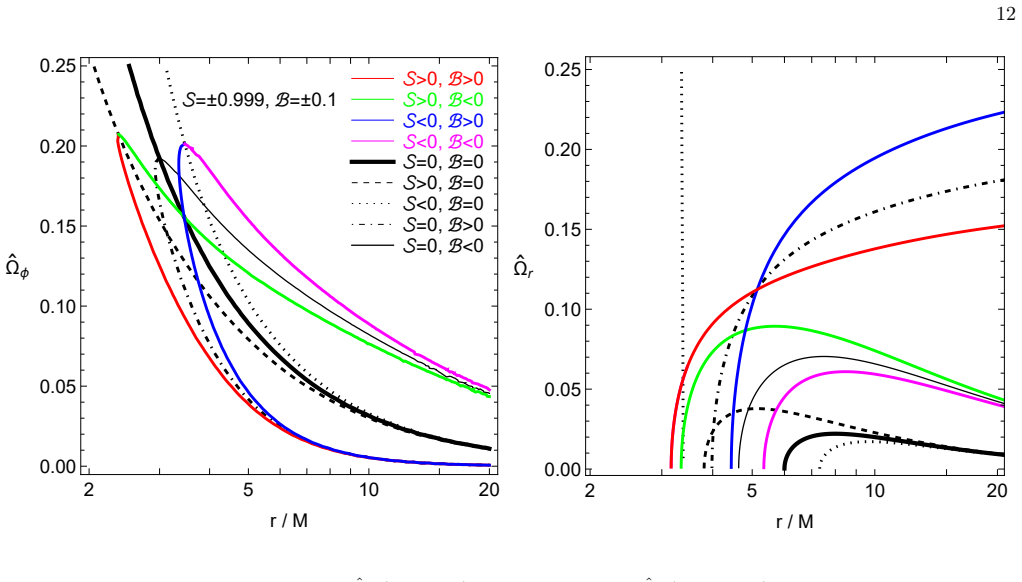
Radial epicyclic frequency As we mentioned earlier in the text, if a test body is slightly displaced from the equilibrium position situated at a minimum of the effective potentialV eff(ˆr,S,B) at r0 andθ 0 =π/2, corresponding to a stable circular or- bit, then the particle will start to oscillate around the minimum realizing the epicyclic motion, which ca...
-
[4]
In this case, the system of MPDS Eqs
Azimuthal frequency For circular equatorial orbits, the radial and vertical components of the four-velocity vanish (ur =u θ = 0). In this case, the system of MPDS Eqs. (2) and (3) results in trivial identities, except for the components Dp r/dτ 13 and DS tϕ/dτ. These components satisfy the following relation dpr dτ = dStϕ dτ = 0.(81) After further calcula...
-
[5]
A PS exploits the symplectic struc- ture of a Hamiltonian system and allows us to study its flow on a 2D hypersurface of the phase space
Poincar´ e sections The PS is one of the most powerful and widely used techniques for visualizing the qualitative behaviour of dynamical systems in Hamiltonian systems that are re- ducible to two Dof. A PS exploits the symplectic struc- ture of a Hamiltonian system and allows us to study its flow on a 2D hypersurface of the phase space. In a two DoF Hamil...
-
[6]
For a generic phase space of dimensiond, let us denote thei-th phase space vector in a time series⃗ xi, wherei= 1,
Recurrence analysis Recurrence analysis is a method to study the proper- ties of a dynamical system by observing its recurrences, i.e., the temporal correlation of its states. For a generic phase space of dimensiond, let us denote thei-th phase space vector in a time series⃗ xi, wherei= 1, . . . , l, andl is the total number of sampled points in the traje...
-
[7]
Non-spinning charged case In the non-spinning charged case (S= 0,B ̸= 0), the PS is 2D as discussed in Sec. IV B 1. It can thus be interpreted unambiguously and cross-referenced with the RPs and quantifiers. The corresponding PSs and RPs are shown in Fig. 9, and the respective RQA values are listed in Tab. II. The first three and final four are regular or...
-
[8]
Therein, we expect a regular trajectory to display a closed curve with epicyclic oscillations superposed due to the coupling between the radial and spin DoF
Spinning charged case In the case of spinning charged particles (S ̸= 0,B ̸= 0), we first study the 2D projections of the PSs. Therein, we expect a regular trajectory to display a closed curve with epicyclic oscillations superposed due to the coupling between the radial and spin DoF. A chaotic orbit, on the other hand, is expected to manifest again as a s...
-
[9]
Order and chaos in dynamical astronomy
George Contopoulos. Order and chaos in dynamical astronomy. Springer Berlin, Heidelberg, 2002
2002
-
[10]
Katsanikas, P
M. Katsanikas, P. A. Patsis, and G. Contopoulos. The Structure and Evolution of Confined Tori Near a Hamiltonian Hopf Bifurcation. International Journal of Bifurcation and Chaos, 21(8):2321, January 2011
2011
-
[11]
H. T. Moges, M. Katsanikas, P. A. Patsis, M. Hillebrand, and Ch. Skokos. The Evolution of the Phase Space Struc- ture Along Pitchfork and Period-Doubling Bifurcations in a 3D-Galactic Bar Potential. International Journal of Bifurcation and Chaos, 34(6):2430013–360, January 2024
2024
-
[12]
Carmen Romano, Marco Thiel, and Jrgen Kurths
Norbert Marwan, M. Carmen Romano, Marco Thiel, and Jrgen Kurths. Recurrence plots for the analysis of com- plex systems. Physics Reports, 438(5):237–329, 2007
2007
-
[13]
Ch. Skokos. The Lyapunov Characteristic Exponents and Their Computation. In J. Souchay and R. Dvorak, ed- itors, Lecture Notes in Physics, Berlin Springer Verlag, volume 790, pages 63–135. Springer, Berlin, Heidelberg, 2010
2010
-
[14]
Global Structure of the Kerr Family of Gravitational Fields
Brandon Carter. Global Structure of the Kerr Family of Gravitational Fields. Physical Review, 174(5):1559–1571, October 1968
1968
-
[15]
Semer´ ak and P
O. Semer´ ak and P. Sukov´ a. Free motion around black holes with discs or rings: between integrability and chaos - I. Monthly Notices of the Royal Astronomical Society, 404(2):545–574, May 2010
2010
-
[16]
Sukov´ a and O
P. Sukov´ a and O. Semer´ ak. Free mo- tion around black holes with discs or rings: between integrability and chaos - III. Monthly Notices of the Royal Astronomical Society, 436(2):978–996, December 2013
2013
-
[17]
Adjusting chaotic indica- tors to curved spacetimes
Georgios Lukes-Gerakopoulos. Adjusting chaotic indica- tors to curved spacetimes. Phys. Rev. D, 89(4):043002, February 2014
2014
-
[18]
Chaotic or- bits for spinning particles in Schwarzschild spacetime
Georgios Lukes-Gerakopoulos. Comment on “Chaotic or- bits for spinning particles in Schwarzschild spacetime”. Phys. Rev. D, 94(10):108501, November 2016
2016
-
[20]
Nonlinear Effects in EMRI Dynamics and Their Imprints on Gravitational Waves
Georgios Lukes-Gerakopoulos and Vojtˇ ech Witzany. Nonlinear Effects in EMRI Dynamics and Their Imprints on Gravitational Waves. In Cosimo Bambi, Stavros Katsanevas, and Konstantinos D. Kokkotas, editors, Handbook of Gravitational Wave Astronomy, page 42. Springer, Singapore, 2021
2021
-
[21]
Neue mechanik materieller systemes
Myron Mathisson. Neue mechanik materieller systemes. Acta Phys. Polon., 6:163–200, 1937
1937
-
[22]
Papapetrou
A. Papapetrou. Equations of Motion in General Relativ- ity. Proceedings of the Physical Society A, 64(1):57–75, January 1951
1951
-
[23]
W. G. Dixon. A covariant multipole formalism for extended test bodies in general relativity. Il Nuovo Cimento, 34(2):317–339, October 1964
1964
-
[24]
Filipe O
L. Filipe O. Costa and Jos´ e Nat´ ario. Center of Mass, Spin Supplementary Conditions, and the Momentum of Spin- ning Particles. In Dirk Puetzfeld, Claus L¨ ammerzahl, and Bernard Schutz, editors, Equations of Motion in Relativistic Gravity, pages 215–258. Springer, Cham, 2015
2015
-
[25]
Vigeland, and Scott A
Uchupol Ruangsri, Sarah J. Vigeland, and Scott A. Hughes. Gyroscopes orbiting black holes: A frequency- domain approach to precession and spin-curvature cou- pling for spinning bodies on generic Kerr orbits. Phys. Rev. D, 94(4):044008, August 2016
2016
-
[26]
Drummond and Scott A
Lisa V. Drummond and Scott A. Hughes. Precisely com- puting bound orbits of spinning bodies around black holes. II. Generic orbits. Phys. Rev. D, 105(12):124041, June 2022
2022
-
[27]
Chaos in Schwarzschild spacetime: The motion of a spinning par- ticle
Shingo Suzuki and Kei-Ichi Maeda. Chaos in Schwarzschild spacetime: The motion of a spinning par- ticle. Phys. Rev. D, 55(8):4848–4859, April 1997
1997
-
[28]
K. P. Tod, F. de Felice, and M. Calvani. Spinning test particles in the field of a black hole. Nuovo Cimento B Serie, 34:365–379, August 1976
1976
-
[29]
Semer´ ak
O. Semer´ ak. Spinning test particles in a Kerr field - I. Monthly Notices of the Royal Astronomical Society, 308(3):863–875, September 1999
1999
-
[30]
Kyrian and O
K. Kyrian and O. Semer´ ak. Spin- ning test particles in a Kerr field - II. Monthly Notices of the Royal Astronomical Society, 382(4):1922–1932, December 2007
1922
-
[31]
Obukhov, Dirk Puetzfeld, and Isabell Schaffer
Eva Hackmann, Claus L¨ ammerzahl, Yuri N. Obukhov, Dirk Puetzfeld, and Isabell Schaffer. Motion of spin- ning test bodies in Kerr spacetime. Phys. Rev. D, 90(6):064035, September 2014
2014
-
[32]
Investigating spinning test particles: Spin supplementary conditions and the Hamiltonian for- malism
Georgios Lukes-Gerakopoulos, Jonathan Seyrich, and Daniela Kunst. Investigating spinning test particles: Spin supplementary conditions and the Hamiltonian for- malism. Phys. Rev. D, 90(10):104019, November 2014
2014
-
[33]
Patsis, and Jonathan Seyrich
Georgios Lukes-Gerakopoulos, Matthaios Katsanikas, Panos A. Patsis, and Jonathan Seyrich. Dynamics of a spinning particle in a linear in spin Hamiltonian ap- proximation. Phys. Rev. D, 94(2):024024, July 2016
2016
-
[34]
Filipe O
L. Filipe O. Costa, Georgios Lukes-Gerakopoulos, and Oldˇ rich Semer´ ak. Spinning particles in general rela- tivity: Momentum-velocity relation for the Mathisson- Pirani spin condition. Phys. Rev. D, 97(8):084023, April 2018
2018
-
[35]
Growth of resonances and chaos for a spinning test particle in the Schwarzschild background
Ondˇ rej Zelenka, Georgios Lukes-Gerakopoulos, Vojtˇ ech Witzany, and Ondˇ rej Kop´ aˇ cek. Growth of resonances and chaos for a spinning test particle in the Schwarzschild background. Phys. Rev. D, 101(2):024037, January 2020
2020
-
[36]
Apostolatos
Iason Timogiannis, Georgios Lukes-Gerakopoulos, and Theocharis A. Apostolatos. Spinning test body orbit- ing around a Schwarzschild black hole: Comparing spin supplementary conditions for circular equatorial orbits. Phys. Rev. D, 104(2):024042, July 2021
2021
-
[37]
Circular equatorial orbits of extended bodies with spin-induced quadrupole around a Kerr black hole: Comparing spin-supplementary conditions
Misbah Shahzadi, Georgios Lukes-Gerakopoulos, and Martin Koloˇ s. Circular equatorial orbits of extended bodies with spin-induced quadrupole around a Kerr black hole: Comparing spin-supplementary conditions. Phys. Rev. D, 112(6):064013, September 2025
2025
-
[38]
R. P. Eatough, H. Falcke, R. Karuppusamy, K. J. Lee, D. J. Champion, E. F. Keane, G. Desvignes, D. H. F. M. Schnitzeler, L. G. Spitler, M. Kramer, B. Klein, C. Bassa, G. C. Bower, A. Brunthaler, I. Cognard, A. T. Deller, P. B. Demorest, P. C. C. Freire, A. Kraus, A. G. Lyne, A. Noutsos, B. Stappers, and N. Wex. A strong magnetic 30 field around the superm...
2013
-
[39]
McKinney, Michael D
Roman Gold, Jonathan C. McKinney, Michael D. John- son, and Sheperd S. Doeleman. Probing the Mag- netic Field Structure in Sgr A* on Black Hole Horizon Scales with Polarized Radiative Transfer Simulations. The Astrophysical Journal, 837(2):180, March 2017
2017
-
[40]
First M87 Event Horizon Telescope Results
Event Horizon Telescope Collaboration. First M87 Event Horizon Telescope Results. VIII. Mag- netic Field Structure near The Event Horizon. Astrophysical Journal Letters, 910(1):L13, March 2021
2021
-
[41]
R. D. Blandford and R. L. Znajek. Electromag- netic extraction of energy from Kerr black holes. Monthly Notices of the Royal Astronomical Society, 179:433–456, May 1977
1977
-
[42]
Robert M. Wald. Black hole in a uniform magnetic field. Phys. Rev. D, 10(6):1680–1685, September 1974
1974
-
[43]
Koloˇ s, Z
M. Koloˇ s, Z. Stuchl´ ık, and A. Tursunov. Quasi- harmonic oscillatory motion of charged particles around a Schwarzschild black hole immersed in a uniform magnetic field. Classical and Quantum Gravity, 32(16):165009, August 2015
2015
-
[44]
Koloˇ s, A
M. Koloˇ s, A. Tursunov, and Z. Stuchl´ ık. Possible signa- ture of the magnetic fields related to quasi-periodic os- cillations observed in microquasars. European Physical Journal C, 77:860, December 2017
2017
-
[45]
Sharif and M
M. Sharif and M. Shahzadi. Particle dynamics near Kerr- MOG black hole. European Physical Journal C, 77:363, June 2017
2017
-
[46]
Radiative Penrose process: Energy gain by a single radi- ating charged particle in the ergosphere of rotating black hole
Martin Koloˇ s, Arman Tursunov, and Zdenˇ ek Stuchl´ ık. Radiative Penrose process: Energy gain by a single radi- ating charged particle in the ergosphere of rotating black hole. Phys. Rev. D, 103(2):024021, January 2021
2021
-
[47]
Charged particle dynamics in parabolic magnetosphere around Schwarzschild black hole
Martin Koloˇ s, Misbah Shahzadi, and Arman Tursunov. Charged particle dynamics in parabolic magnetosphere around Schwarzschild black hole. European Physical Journal C, 83(4):323, April 2023
2023
-
[48]
Spinning charged test particles in a Kerr-Newman background
Roberto Hojman and Sergio Hojman. Spinning charged test particles in a Kerr-Newman background. Phys. Rev. D, 15(10):2724–2730, May 1977
1977
-
[49]
Epicyclic oscillations in spinning particle motion around Kerr black hole applied in models fitting the quasi-periodic oscillations observed in microquasars and AGNs
Misbah Shahzadi, Martin Koloˇ s, Zdenˇ ek Stuchl´ ık, and Yousaf Habib. Epicyclic oscillations in spinning particle motion around Kerr black hole applied in models fitting the quasi-periodic oscillations observed in microquasars and AGNs. European Physical Journal C, 81(12):1067, December 2021
2021
-
[50]
A. R. Prasanna. General-relativistic analysis of charged- particle motion in electromagnetic fields surrounding black holes. Nuovo Cimento Rivista Serie, 11:1–53, Jan- uary 1980
1980
-
[51]
D. B. Papadopoulos. Gravitational Waves Interact- ing with a Spinning Charged Particle in the Presence of a Uniform Magnetic Field. General Relativity and Gravitation, 36(5):949–966, May 2004
2004
-
[52]
Charged Spinning Particles on Circular Orbits in the REISSNER-NORDSTR ¨OM Space-Time
Donato Bini, Andrea Geralico, and Fernando de Felice. Charged Spinning Particles on Circular Orbits in the REISSNER-NORDSTR ¨OM Space-Time. International Journal of Modern Physics D, 14(10):1793–1811, January 2005
2005
-
[53]
Filipe O
L. Filipe O. Costa, Jos´ e Nat´ ario, and Miguel Zilh˜ ao. Spacetime dynamics of spinning particles: Exact electro- magnetic analogies. Phys. Rev. D, 93(10):104006, May 2016
2016
-
[54]
Collisional Penrose process of charged spinning particles
Ming Zhang, Jie Jiang, Yan Liu, and Wen-Biao Liu. Collisional Penrose process of charged spinning particles. Phys. Rev. D, 98(4):044006, August 2018
2018
-
[55]
Innermost stable circular orbits of charged spinning test particles
Ming Zhang and Wen-Biao Liu. Innermost stable circular orbits of charged spinning test particles. Physics Letters B, 789:393–398, February 2019
2019
-
[56]
McKinney, Alexander Tchekhovskoy, and Roger D
Jonathan C. McKinney, Alexander Tchekhovskoy, and Roger D. Blandford. General relativistic magnetohydrodynamic simulations of magneti- cally choked accretion flows around black holes. Monthly Notices of the Royal Astronomical Society, 423(4):3083–3117, July 2012
2012
-
[57]
W. G. Dixon. Dynamics of Extended Bodies in Gen- eral Relativity. I. Momentum and Angular Momentum. Proceedings of the Royal Society of London Series A, 314(1519):499–527, January 1970
1970
-
[58]
W. G. Dixon. Dynamics of Extended Bodies in Gen- eral Relativity. III. Equations of Motion. Philosophical Transactions of the Royal Society of London Series A, 277(1264):59–119, August 1974
1974
-
[59]
Mod` ele de particule ` a spin dans le champ ´ electromagn´ etique et gravitationnel
Jean-Marie Souriau. Mod` ele de particule ` a spin dans le champ ´ electromagn´ etique et gravitationnel. InAnnales de l’IHP Physique th´ eorique, volume 20, pages 315–364, 1974
1974
-
[60]
Spin- ning test particles in general relativity: Nongeodesic mo- tion in the Reissner-Nordstr¨ om spacetime.Phys
Donato Bini, Gianluca Gemelli, and Remo Ruffini. Spin- ning test particles in general relativity: Nongeodesic mo- tion in the Reissner-Nordstr¨ om spacetime.Phys. Rev. D, 61(6):064013, March 2000
2000
-
[61]
A. R. Prasanna and K. S. Virbhadra. Spinning charged particle in an electromagnetic field on curved space-time. Physics Letters A, 138(6-7):242–246, July 1989
1989
-
[62]
Bargmann, Louis Michel, and V
V. Bargmann, Louis Michel, and V. L. Telegdi. Pre- cession of the Polarization of Particles Moving in a Ho- mogeneous Electromagnetic Field. Phys. Rev. Lett., 2(10):435–436, May 1959
1959
-
[63]
Cognola, L
G. Cognola, L. Vanzo, S. Zerbini, and R. Soldati. On the lagrangian formulation of a charged spinning particle in an external electromagnetic field. Physics Letters B, 104(1):67–69, August 1981
1981
-
[64]
Pomeranskii, Roman A
Andrei A. Pomeranskii, Roman A. Sen’kov, and Iosif B. Khriplovich. FROM THE CURRENT LITERATURE: Spinning relativistic particles in external fields. Physics Uspekhi, 43(10):1055–1066, October 2000
2000
-
[65]
H. P. K¨ unzle. Canonical Dynamics of Spinning Particles in Gravitational and Electromagnetic Fields. Journal of Mathematical Physics, 13(5):739–744, May 1972
1972
-
[66]
Gralla, Abraham I
Samuel E. Gralla, Abraham I. Harte, and Robert M. Wald. Bobbing and kicks in electromagnetism and grav- ity. Phys. Rev. D, 81(10):104012, May 2010
2010
-
[67]
Heydari-Fard, M
M. Heydari-Fard, M. Mohseni, and H. R. Sepangi. World- line deviations of charged spinning particles. Physics Letters B, 626(1-4):230–234, October 2005
2005
-
[68]
R. M. Wald. General relativity. The University of Chicago Press, Chicago, 1984
1984
-
[69]
Hamiltonians and canonical coordinates for spinning particles in curved space-time
Vojtˇ ech Witzany, Jan Steinhoff, and Georgios Lukes- Gerakopoulos. Hamiltonians and canonical coordinates for spinning particles in curved space-time. Classical and Quantum Gravity, 36(7):075003, April 2019
2019
-
[70]
Geometric numerical integration: structure-preserving algorithms for ordinary differential equations, volume 31
Ernst Hairer, Christian Lubich, and Gerhard Wanner. Geometric numerical integration: structure-preserving algorithms for ordinary differential equations, volume 31. Springer Science & Business Media, 2006
2006
-
[71]
Symmetric integrator for nonintegrable Hamiltonian rela- 31 tivistic systems
Jonathan Seyrich and Georgios Lukes-Gerakopoulos. Symmetric integrator for nonintegrable Hamiltonian rela- 31 tivistic systems. Phys. Rev. D, 86(12):124013, December 2012
2012
-
[72]
Structure-preserving numerical simulations of test particle dynamics around slowly rotating neutron stars within the Hartle-Thorne approach
Misbah Shahzadi, Martin Koloˇ s, Rabia Saleem, Yousaf Habib, and Adri´ an Eduarte-Rojas. Structure-preserving numerical simulations of test particle dynamics around slowly rotating neutron stars within the Hartle-Thorne approach. Phys. Rev. D, 108(10):103006, November 2023
2023
-
[73]
Innermost stable circular orbit of a spinning particle in Kerr spacetime
Shingo Suzuki and Kei-Ichi Maeda. Innermost stable circular orbit of a spinning particle in Kerr spacetime. Phys. Rev. D, 58(2):023005, July 1998
1998
-
[74]
Quasi-harmonic oscillatory motion of charged particles around a Schwarzschild black hole immersed in a uni- form magnetic field
Martin Koloˇ s, Zdenˇ ek Stuchl´ ık, and Arman Tursunov. Quasi-harmonic oscillatory motion of charged particles around a Schwarzschild black hole immersed in a uni- form magnetic field. Classical and Quantum Gravity, 32(16):165009, August 2015
2015
-
[75]
Aschenbach effect for spinning particles in Kerr space- time
Jafar Khodagholizadeh, Volker Perlick, and Ali Vahedi. Aschenbach effect for spinning particles in Kerr space- time. Phys. Rev. D, 102(2):024021, July 2020
2020
-
[76]
Proof of poincar’s geometric theorem
George David Birkhoff. Proof of poincar’s geometric theorem. Transactions of the American Mathematical Society, 14(1):14–22, 1913
1913
-
[77]
V. I. Arnol’d. Proof of a Theorem of A. N. KOL- MOGOROV on the Invariance of Quasi-Periodic Motions Under Small Perturbations of the Hamiltonian. Russian Mathematical Surveys, 18(5):9–36, October 1963
1963
-
[78]
De- termination of chaotic behaviour in time series gen- erated by charged particle motion around magnetized Schwarzschild black holes
Radim P´ anis, Martin Koloˇ s, and Zdenˇ ek Stuchl´ ık. De- termination of chaotic behaviour in time series gen- erated by charged particle motion around magnetized Schwarzschild black holes. European Physical Journal C, 79(6):479, June 2019
2019
-
[79]
P. A. Patsis and L. Zachilas. Using Color and Rota- tion for Visualizing Four-Dimensional Poincare Cross- Sections. International Journal of Bifurcation and Chaos, 6:1399–1424, December 1994
1994
-
[80]
Detecting strange attractors in turbulence
Floris Takens. Detecting strange attractors in turbulence. In David Rand and Lai-Sang Young, editors, Dynamical Systems and Turbulence, Warwick 1980, pages 366–381, Berlin, Heidelberg, 1981. Springer Berlin Heidelberg
1980
-
[81]
Chaotic and stochastic processes in the accretion flows of the black hole X-ray binaries revealed by recur- rence analysis
Petra Sukov´ a, Mikolaj Grzedzielski, and Agnieszka Ja- niuk. Chaotic and stochastic processes in the accretion flows of the black hole X-ray binaries revealed by recur- rence analysis. Astron. Astrophys., 586:A143, 2016
2016
discussion (0)
Sign in with ORCID, Apple, or X to comment. Anyone can read and Pith papers without signing in.