Recognition: unknown
Detecting Adversarial Data via Provable Adversarial Noise Amplification
Pith reviewed 2026-05-09 17:03 UTC · model grok-4.3
The pith
A formal theorem guarantees that adversarial noise amplifies across layers in deep networks under specific conditions, enabling reliable detection of adversarial inputs.
A machine-rendered reading of the paper's core claim, the machinery that carries it, and where it could break.
Core claim
We present a formal adversarial noise amplification theorem and specify sufficient conditions on the network architecture, attack type, and noise properties under which the amplification is mathematically guaranteed. Using these observations we introduce a custom spectral loss and architectural design that enhance the amplification effect, along with a lightweight inference-time detector that relies on the strengthened signal.
What carries the argument
The adversarial noise amplification theorem, which proves that perturbation magnitude increases layer by layer when the listed sufficient conditions hold.
Load-bearing premise
The network architecture, attack type, and noise properties must satisfy the theorem's sufficient conditions for amplification to be guaranteed.
What would settle it
A counterexample network and attack that meet the sufficient conditions yet show no increase in noise magnitude across layers would disprove the theorem.
Figures



read the original abstract
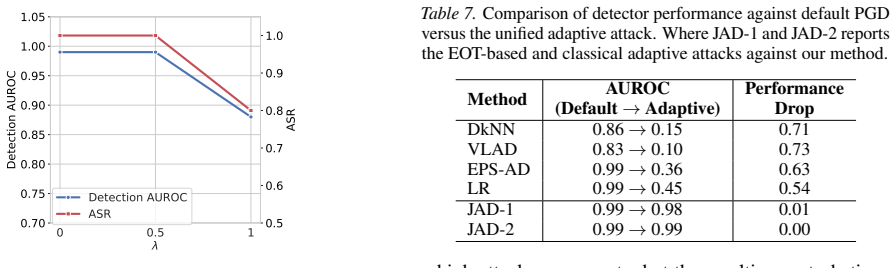
The nonuniform and growing impact of adversarial noise across the layers of deep neural networks has been used in the literature, without a formal mathematical justification, to detect adversarial inputs and improve robustness. In this work, we study this phenomenon in detail and present a formal adversarial noise amplification theorem. We specify a set of sufficient conditions under which the adversarial noise amplification is mathematically guaranteed. Based on theoretical observations, we propose a novel training methodology with a custom spectral loss function and a specific architectural design to enhance the amplification signal for detecting adversarial data. Finally, we introduce a new, lightweight detection mechanism that leverages the enhanced amplification signal and operates entirely at inference time. To validate our approach, we demonstrate the detector's efficacy against both state-of-the-art attacks and a purpose-built adaptive attack, confirming that enhanced amplification can serve as a robust and reliable signal for adversarial defense.
Editorial analysis
A structured set of objections, weighed in public.
Referee Report
Summary. The paper claims to derive a formal adversarial noise amplification theorem that guarantees amplification of adversarial perturbations across DNN layers under a set of sufficient conditions on architecture, attack model, and noise statistics. It then introduces a custom spectral loss and targeted architectural modifications to strengthen this amplification signal, enabling a lightweight inference-time detector. The detector is evaluated empirically on standard benchmarks against both SOTA attacks and a purpose-designed adaptive attack.
Significance. A rigorously verified theorem linking noise amplification to detection would be a notable contribution, moving beyond the heuristic layer-wise noise observations common in prior work. The inference-time design and inclusion of an adaptive attack are practical strengths. Credit is due for attempting a formal statement with external sufficient conditions rather than post-hoc fitting. However, the significance is limited by the unresolved question of whether the proposed spectral loss and architectural changes preserve the theorem's premises.
major comments (2)
- [Theorem 1 and §4 (training methodology)] Theorem 1 (and its proof in §3): the manuscript must demonstrate that the networks trained under the custom spectral loss and the described architectural modifications continue to satisfy every sufficient condition (e.g., spectral properties of layers, bounded noise statistics, attack model assumptions). Without an explicit verification or counter-example check, the mathematical guarantee does not transfer to the deployed detector, rendering the central claim unsupported.
- [§5] §5 (experiments): the reported detection rates against SOTA and adaptive attacks are not accompanied by any measurement or argument showing that the observed amplification matches the quantitative predictions of the theorem under the stated conditions. This leaves open whether performance stems from the provable mechanism or from incidental effects of the spectral loss.
minor comments (2)
- [Abstract and §1] The abstract and introduction should explicitly list the sufficient conditions rather than referring to them generically, so readers can immediately assess applicability.
- [§4] Notation for the spectral loss (Eq. (X)) should be defined before its first use and cross-referenced to the theorem's assumptions.
Simulated Author's Rebuttal
We thank the referee for the constructive feedback, which helps clarify how the theoretical guarantees connect to the trained detector and empirical results. We address each major comment below and will revise the manuscript accordingly to strengthen these links.
read point-by-point responses
-
Referee: [Theorem 1 and §4 (training methodology)] Theorem 1 (and its proof in §3): the manuscript must demonstrate that the networks trained under the custom spectral loss and the described architectural modifications continue to satisfy every sufficient condition (e.g., spectral properties of layers, bounded noise statistics, attack model assumptions). Without an explicit verification or counter-example check, the mathematical guarantee does not transfer to the deployed detector, rendering the central claim unsupported.
Authors: The sufficient conditions of Theorem 1 concern the final network architecture (e.g., layer spectral norms and activation properties that control noise propagation), the attack model (standard bounded perturbations), and noise statistics (bounded variance assumptions). Our architectural modifications were explicitly selected to satisfy these spectral requirements, and the attack model is unchanged from the theorem statement. The custom spectral loss regularizes singular values to enhance amplification but is constructed to preserve boundedness of the noise statistics, as it does not introduce unbounded growth or violate the layer-wise contraction/expansion factors used in the proof. Nevertheless, we agree that an explicit post-training verification is necessary to confirm the conditions hold for the deployed models. In the revised manuscript we will add a dedicated subsection in §4 that computes the relevant spectral norms, verifies bounded noise statistics on the trained networks, and confirms the attack-model assumptions remain satisfied, thereby ensuring the theorem's guarantee applies to the detector. revision: yes
-
Referee: [§5] §5 (experiments): the reported detection rates against SOTA and adaptive attacks are not accompanied by any measurement or argument showing that the observed amplification matches the quantitative predictions of the theorem under the stated conditions. This leaves open whether performance stems from the provable mechanism or from incidental effects of the spectral loss.
Authors: The theorem guarantees that adversarial noise is amplified across layers (specifically, the noise norm grows by a factor strictly greater than one under the stated conditions). Our experiments already demonstrate that adversarial inputs produce substantially larger layer-wise noise signals than clean inputs, which directly enables the reported detection performance. To make the quantitative link explicit, we will augment §5 with additional measurements: for each evaluated architecture we will report the observed amplification ratios (layer-wise noise norm ratios) and compare them against the theoretical lower bound obtained by instantiating the theorem with the network dimensions, activation parameters, and noise bounds used in the experiments. This comparison will show that the measured amplification is consistent with the provable mechanism and exceeds what would be expected from incidental effects of the spectral loss alone. revision: yes
Circularity Check
Formal theorem with independent sufficient conditions; no reduction to inputs by construction
full rationale
The paper states a new adversarial noise amplification theorem under a set of sufficient conditions on architecture, attack type, and noise properties. It then uses theoretical observations to motivate a custom spectral loss and architectural changes that aim to strengthen the amplification signal, followed by an inference-time detector. No equation or claim in the provided text shows a prediction that is definitionally equivalent to a fitted parameter from the same data, nor does the central result rest on a self-citation chain whose premises already encode the target conclusion. The theorem is presented as a mathematical guarantee with externally verifiable conditions, and empirical results are reported separately. The derivation chain therefore remains self-contained against external benchmarks.
Axiom & Free-Parameter Ledger
axioms (1)
- domain assumption Sufficient conditions exist under which adversarial noise amplification is mathematically guaranteed
Reference graph
Works this paper leans on
-
[1]
Synthesizing robust adversarial exam- ples
Anish Athalye, Logan Engstrom, Andrew Ilyas, and Kevin Kwok. Synthesizing robust adversarial exam- ples. InInternational conference on machine learning, pages 284–293. PMLR, 2018
2018
-
[2]
Brian R Bartoldson, James Diffenderfer, Konstanti- nos Parasyris, and Bhavya Kailkhura. Adversarial ro- bustness limits via scaling-law and human-alignment studies.arXiv preprint arXiv:2404.09349, 2024
-
[3]
Parseval net- works: Improving robustness to adversarial examples
Moustapha Cˆıss´e, Piotr Bojanowski, ´Edouard Grave, Yann Dauphin, and Nicolas Usunier. Parseval net- works: Improving robustness to adversarial examples. InProceedings of the 34th International Conference on Machine Learning (ICML), volume 70 ofPro- ceedings of Machine Learning Research, pages 854–
-
[4]
URL https://proceedings
PMLR, 2017. URL https://proceedings. mlr.press/v70/cisse17a.html
2017
-
[5]
Detecting adversarial samples using influence func- tions and nearest neighbors
Gilad Cohen, Guillermo Sapiro, and Raja Giryes. Detecting adversarial samples using influence func- tions and nearest neighbors. InProceedings of the 8 IEEE/CVF conference on computer vision and pattern recognition, pages 14453–14462, 2020
2020
-
[7]
Reliable evalu- ation of adversarial robustness with an ensemble of diverse parameter-free attacks
Francesco Croce and Matthias Hein. Reliable evalu- ation of adversarial robustness with an ensemble of diverse parameter-free attacks. InInternational confer- ence on machine learning, pages 2206–2216. PMLR, 2020
2020
-
[8]
Robustbench: a standardized adversarial robustness benchmark
Francesco Croce, Maksym Andriushchenko, Vikash Sehwag, Edoardo Debenedetti, Nicolas Flammarion, Mung Chiang, Prateek Mittal, and Matthias Hein. Robustbench: a standardized adversarial robustness benchmark.arXiv preprint arXiv:2010.09670, 2020
-
[9]
An Image is Worth 16x16 Words: Transformers for Image Recognition at Scale
Alexey Dosovitskiy. An image is worth 16x16 words: Transformers for image recognition at scale.arXiv preprint arXiv:2010.11929, 2020
work page internal anchor Pith review Pith/arXiv arXiv 2010
-
[10]
Gener- alizable adversarial training via spectral normalization
Farzan Farnia, Jesse M Zhang, and David Tse. Gener- alizable adversarial training via spectral normalization. arXiv preprint arXiv:1811.07457, 2018
-
[11]
Explaining and Harnessing Adversarial Examples
Ian J Goodfellow, Jonathon Shlens, and Christian Szegedy. Explaining and harnessing adversarial exam- ples.arXiv preprint arXiv:1412.6572, 2014
work page internal anchor Pith review arXiv 2014
-
[12]
Sven Gowal, Chongli Qin, Jonathan Uesato, Timothy Mann, and Pushmeet Kohli. Uncovering the limits of adversarial training against norm-bounded adversarial examples.arXiv preprint arXiv:2010.03593, 2020
-
[13]
Deep Residual Learning for Image Recognition
Kaiming He, Xiangyu Zhang, Shaoqing Ren, and Jian Sun. Deep residual learning for image recognition. arxiv e-prints.arXiv preprint arXiv:1512.03385, 10, 2015
work page internal anchor Pith review arXiv 2015
-
[14]
A singular value perspective on model robust- ness.arXiv preprint arXiv:2012.03516, 2020
Malhar Jere, Maghav Kumar, and Farinaz Koushan- far. A singular value perspective on model robust- ness.arXiv preprint arXiv:2012.03516, 2020. URL https://arxiv.org/abs/2012.03516
-
[15]
Im- proving training of deep neural networks via singular value bounding
Kui Jia, Dacheng Tao, and Shenghua Gao. Im- proving training of deep neural networks via singular value bounding. InProceedings of the IEEE/CVF Conference on Computer Vision and Pattern Recognition (CVPR), 2017. URL https: //openaccess.thecvf.com/content_ cvpr_2017/html/Jia_Improving_ Training_of_CVPR_2017_paper.html
2017
-
[16]
Improving training of deep neural networks via singular value bounding
Kui Jia, Dacheng Tao, Shenghua Gao, and Xiangmin Xu. Improving training of deep neural networks via singular value bounding. InProceedings of the IEEE Conference on Computer Vision and Pattern Recogni- tion, pages 4344–4352, 2017
2017
-
[17]
Learning multiple layers of features from tiny images
Alex Krizhevsky, Geoffrey Hinton, et al. Learning multiple layers of features from tiny images. 2009
2009
-
[18]
Adversarial examples in the physical world
Alexey Kurakin, Ian J Goodfellow, and Samy Bengio. Adversarial examples in the physical world. InArti- ficial intelligence safety and security, pages 99–112. Chapman and Hall/CRC, 2018
2018
-
[19]
Towards Deep Learning Models Resistant to Adversarial Attacks
Aleksander Madry, Aleksandar Makelov, Ludwig Schmidt, Dimitris Tsipras, and Adrian Vladu. To- wards deep learning models resistant to adversarial attacks.arXiv preprint arXiv:1706.06083, 2017
work page internal anchor Pith review arXiv 2017
-
[20]
Adversarial robustness of deep neural networks: A survey from a formal verification perspective.IEEE Transactions on Dependable and Secure Computing, 2022
Mark Huasong Meng, Guangdong Bai, Sin Gee Teo, Zhe Hou, Yan Xiao, Yun Lin, and Jin Song Dong. Adversarial robustness of deep neural networks: A survey from a formal verification perspective.IEEE Transactions on Dependable and Secure Computing, 2022
2022
-
[21]
Sequential architecture-agnostic black-box attack design and anal- ysis.Pattern Recognition, 147:110066, 2024
Furkan Mumcu and Yasin Yilmaz. Sequential architecture-agnostic black-box attack design and anal- ysis.Pattern Recognition, 147:110066, 2024
2024
-
[22]
Fast and lightweight vision-language model for adversarial traf- fic sign detection.Electronics, 13(11):2172, 2024
Furkan Mumcu and Yasin Yilmaz. Fast and lightweight vision-language model for adversarial traf- fic sign detection.Electronics, 13(11):2172, 2024
2024
-
[23]
Multimodal attack detection for action recognition models
Furkan Mumcu and Yasin Yilmaz. Multimodal attack detection for action recognition models. InProceed- ings of the IEEE/CVF Conference on Computer Vision and Pattern Recognition, pages 2967–2976, 2024
2024
-
[24]
Furkan Mumcu and Yasin Yilmaz. Universal and ef- ficient detection of adversarial data through nonuni- form impact on network layers.arXiv preprint arXiv:2506.20816, 2025
-
[25]
Furkan Mumcu and Yasin Yilmaz. Robustness of agen- tic ai systems via adversarially-aligned jacobian regu- larization.arXiv preprint arXiv:2603.04378, 2026
-
[26]
Adversarial machine learning attacks against video anomaly detection systems
Furkan Mumcu, Keval Doshi, and Yasin Yilmaz. Adversarial machine learning attacks against video anomaly detection systems. InProceedings of the IEEE/CVF Conference on Computer Vision and Pat- tern Recognition, pages 206–213, 2022
2022
-
[27]
Deep k-nearest neighbors: Towards confident, inter- pretable and robust deep learning
Nicolas Papernot and Patrick McDaniel. Deep k-nearest neighbors: Towards confident, inter- pretable and robust deep learning.arXiv preprint arXiv:1803.04765, 2018
-
[28]
Deflecting adver- sarial attacks with pixel deflection
Aaditya Prakash, Nick Moran, Solomon Garber, An- tonella DiLillo, and James Storer. Deflecting adver- sarial attacks with pixel deflection. InProceedings of the IEEE conference on computer vision and pattern 9 recognition, pages 8571–8580, 2018
2018
-
[29]
Berg, and Li Fei-Fei
Olga Russakovsky, Jia Deng, Hao Su, Jonathan Krause, Sanjeev Satheesh, Sean Ma, Zhiheng Huang, Andrej Karpathy, Aditya Khosla, Michael Bernstein, Alexander C. Berg, and Li Fei-Fei. ImageNet Large Scale Visual Recognition Challenge.International Journal of Computer Vision (IJCV), 115(3):211–252,
-
[30]
doi: 10.1007/s11263-015-0816-y
-
[31]
Denoised smoothing: A provable defense for pretrained classifiers.Advances in Neu- ral Information Processing Systems, 33:21945–21957, 2020
Hadi Salman, Mingjie Sun, Greg Yang, Ashish Kapoor, and J Zico Kolter. Denoised smoothing: A provable defense for pretrained classifiers.Advances in Neu- ral Information Processing Systems, 33:21945–21957, 2020
2020
-
[32]
Towards practical control of singular values of convolutional layers
Alexandra Senderovich, Ekaterina Bulatova, Anton Obukhov, and Maxim Rakhuba. Towards practical control of singular values of convolutional layers. In Advances in Neural Information Processing Systems (NeurIPS) 2022, 2022
2022
-
[33]
Towards practical control of singular values of convolutional layers.Ad- vances in Neural Information Processing Systems, 35: 10918–10930, 2022
Alexandra Senderovich, Ekaterina Bulatova, Anton Obukhov, and Maxim Rakhuba. Towards practical control of singular values of convolutional layers.Ad- vances in Neural Information Processing Systems, 35: 10918–10930, 2022
2022
-
[34]
Samuel Henrique Silva and Peyman Najafirad. Oppor- tunities and challenges in deep learning adversarial ro- bustness: A survey.arXiv preprint arXiv:2007.00753, 2020
-
[35]
Going deeper with convolutions
Christian Szegedy, Wei Liu, Yangqing Jia, Pierre Ser- manet, Scott Reed, Dragomir Anguelov, Dumitru Er- han, Vincent Vanhoucke, and Andrew Rabinovich. Going deeper with convolutions. InProceedings of the IEEE conference on computer vision and pattern recognition, pages 1–9, 2015
2015
-
[36]
Training data-efficient image transformers & distilla- tion through attention
Hugo Touvron, Matthieu Cord, Matthijs Douze, Fran- cisco Massa, Alexandre Sablayrolles, and Herv´e J´egou. Training data-efficient image transformers & distilla- tion through attention. InInternational conference on machine learning, pages 10347–10357. PMLR, 2021
2021
-
[37]
Lipschitz-margin training: Scalable certification of perturbation invariance for deep neural networks.Ad- vances in neural information processing systems, 31, 2018
Yusuke Tsuzuku, Issei Sato, and Masashi Sugiyama. Lipschitz-margin training: Scalable certification of perturbation invariance for deep neural networks.Ad- vances in neural information processing systems, 31, 2018
2018
-
[38]
Enhancing the trans- ferability of adversarial attacks through variance tun- ing
Xiaosen Wang and Kun He. Enhancing the trans- ferability of adversarial attacks through variance tun- ing. InProceedings of the IEEE/CVF conference on computer vision and pattern recognition, pages 1924– 1933, 2021
1924
-
[39]
Better diffusion models further improve adversarial training
Zekai Wang, Tianyu Pang, Chao Du, Min Lin, Wei- wei Liu, and Shuicheng Yan. Better diffusion models further improve adversarial training. InInternational conference on machine learning, pages 36246–36263. PMLR, 2023
2023
-
[40]
PyTorch Image Models
Ross Wightman. PyTorch Image Models. URL https://github.com/huggingface/ pytorch-image-models
-
[41]
Lrs: Enhancing adversarial transferability through lipschitz regularized surrogate
Tao Wu, Tie Luo, and Donald C Wunsch II. Lrs: Enhancing adversarial transferability through lipschitz regularized surrogate. InProceedings of the AAAI Conference on Artificial Intelligence, volume 38, pages 6135–6143, 2024
2024
-
[42]
Schoenholz, and Jeffrey Pennington
Lechao Xiao, Yasaman Bahri, Jascha Sohl-Dickstein, Samuel S. Schoenholz, and Jeffrey Pennington. Dy- namical isometry and a mean field theory of cnns: How to train 10,000-layer vanilla convolutional neural networks. Technical report, arXiv preprint, 2018. URL https://arxiv.org/abs/1806.05393
-
[43]
Feature squeez- ing: Detecting adversarial examples in deep neural networks
W Xu. Feature squeezing: Detecting adversarial exa mples in deep neural networks.arXiv preprint arXiv:1704.01155, 2017
-
[44]
Diffusion-based adversarial sample generation for improved stealthiness and controllability.Advances in Neural Information Processing Systems, 36:2894– 2921, 2023
Haotian Xue, Alexandre Araujo, Bin Hu, and Yongxin Chen. Diffusion-based adversarial sample generation for improved stealthiness and controllability.Advances in Neural Information Processing Systems, 36:2894– 2921, 2023
2023
-
[46]
Yijun Yang, Ruiyuan Gao, Yu Li, Qiuxia Lai, and Qiang Xu. What you see is not what the network in- fers: Detecting adversarial examples based on seman- tic contradiction.arXiv preprint arXiv:2201.09650, 2022
-
[47]
Norm-preservation: Why residual networks can become extremely deep?IEEE transac- tions on pattern analysis and machine intelligence, 43 (11):3980–3990, 2020
Alireza Zaeemzadeh, Nazanin Rahnavard, and Mubarak Shah. Norm-preservation: Why residual networks can become extremely deep?IEEE transac- tions on pattern analysis and machine intelligence, 43 (11):3980–3990, 2020
2020
-
[48]
Sergey Zagoruyko and Nikos Komodakis. Wide resid- ual networks.arXiv preprint arXiv:1605.07146, 2016
work page internal anchor Pith review arXiv 2016
-
[49]
Detect- ing adversarial data by probing multiple perturbations using expected perturbation score
Shuhai Zhang, Feng Liu, Jiahao Yang, Yifan Yang, Changsheng Li, Bo Han, and Mingkui Tan. Detect- ing adversarial data by probing multiple perturbations using expected perturbation score. InInternational conference on machine learning, pages 41429–41451. PMLR, 2023. 10 Method PGD BIM VNI VMI PGD-ℓ 2 AA Diff ResNet-50 0.99 0.99 0.99 0.99 0.99 0.99 0.99 ViT ...
2023
discussion (0)
Sign in with ORCID, Apple, or X to comment. Anyone can read and Pith papers without signing in.