Recognition: 3 theorem links
· Lean TheoremRisk-Budgeted Online Scheduling for Continuous Edge Inference over Evolving Time Horizons
Pith reviewed 2026-05-08 18:57 UTC · model grok-4.3
The pith
Dynamic risk budgets and LSTM predictions let online schedulers maintain sustained timeliness for continuous edge inference.
A machine-rendered reading of the paper's core claim, the machinery that carries it, and where it could break.
Core claim
AEGIS models deadline-violation tendency as an updatable cross-time control state through dynamic user-level risk budgets, leverages LSTM-based short-term state prediction to construct a smooth deadline-violation risk surrogate, and formulates the time-wise resource competition as a potential-aligned game under coupled feasibility constraints, producing an asynchronous online algorithm with finite-step convergence.
What carries the argument
updatable cross-time user-level risk budgets together with an LSTM risk surrogate inside a potential-aligned game under coupled constraints
Load-bearing premise
That tracking deadline-violation tendency through updatable cross-time user risk budgets and LSTM short-term forecasts will yield stable online decisions under coupled bandwidth and computing constraints without creating fresh instability.
What would settle it
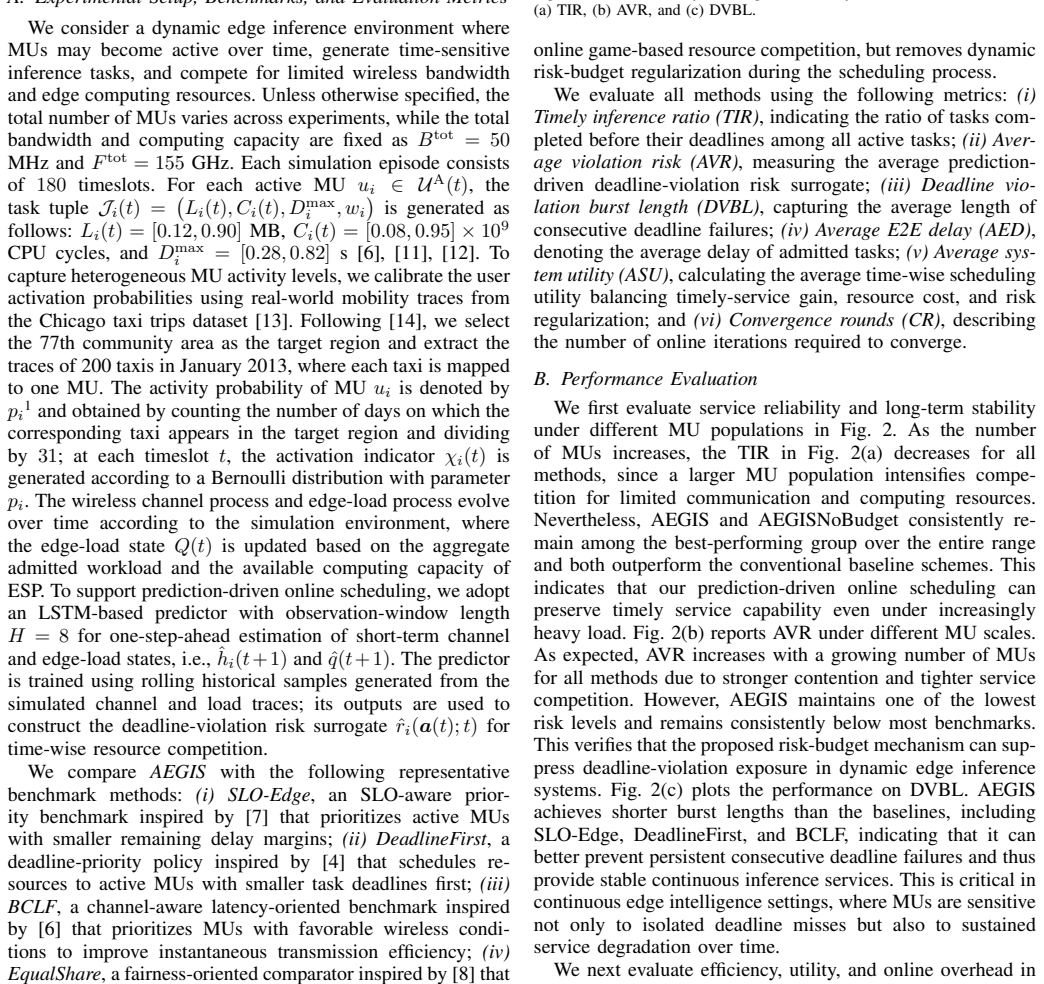
In a live edge deployment, if the fraction of timely inferences does not rise or if average violation-burst lengths increase relative to standard schedulers under the same channel and workload traces, the risk-budget mechanism would be shown not to deliver the claimed cross-time stability.
Figures


read the original abstract
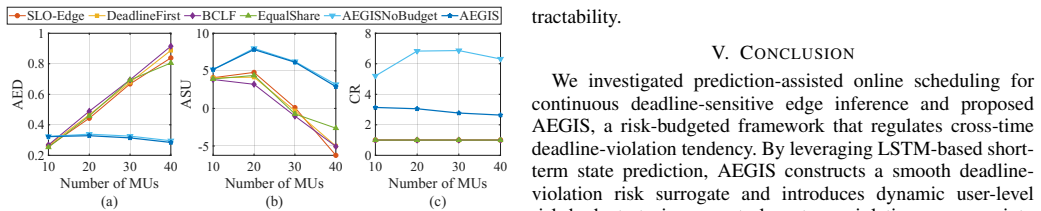
Continuous edge inference necessitates not merely low per-timeslot latency, but sustained timeliness guarantees in the presence of time-varying channels, fluctuating edge workloads, and coupled bandwidth-computing resource constraints. Existing studies predominantly optimize instantaneous delay or per-timeslot utility, while largely overlooking the regulation of cross-time deadline violation dynamics in continuous services. To address this, we propose AEGIS, a prediction-empowered risk-budgeted online scheduling framework for continuous edge inference. AEGIS models deadline-violation tendency as an updatable cross-time control state through dynamic user-level risk budgets, so that online scheduling accounts for both instantaneous efficiency and long-term service stability. To support proactive decision making, AEGIS leverages LSTM-based short-term state prediction to construct a smooth deadline-violation risk surrogate, and formulates the resulting time-wise resource competition as a potential-aligned game under coupled feasibility constraints. An asynchronous online algorithm is then developed with finite-step convergence. Experiments demonstrate that AEGIS improves the timely inference ratio, reduces average violation risk and violation burst length, and achieves a favorable delay--risk--convergence trade-off over representative baselines.
Editorial analysis
A structured set of objections, weighed in public.
Referee Report
Summary. The paper proposes AEGIS, a prediction-empowered risk-budgeted online scheduling framework for continuous edge inference. It models deadline-violation tendency as an updatable cross-time control state via dynamic user-level risk budgets, leverages LSTM-based short-term state prediction to construct a smooth deadline-violation risk surrogate, formulates time-wise resource competition as a potential-aligned game under coupled feasibility constraints, develops an asynchronous online algorithm with finite-step convergence, and reports experiments showing improved timely inference ratio, reduced average violation risk and violation burst length, plus a favorable delay-risk-convergence trade-off over baselines.
Significance. If the finite-step convergence holds under inexact predictions and the experimental gains are reproducible, the work could advance edge inference scheduling by incorporating long-term risk regulation rather than per-slot optimization alone, offering a structured approach to stability in time-varying bandwidth-computing environments.
major comments (2)
- Abstract: The claim that the asynchronous online algorithm achieves finite-step convergence is not accompanied by any explicit condition ensuring the potential function remains strictly monotonic or aligned when LSTM predictions are inexact and the bandwidth-computing coupling is active. This assumption is load-bearing for the stability of risk-budget updates and the reported reductions in violation burst length.
- Experiments (as described in the abstract): The central claims of improved timely inference ratio, lower violation risk, and shorter burst lengths lack any reported details on experimental setup, data characteristics (e.g., channel variability or workload traces), baseline algorithms, number of runs, or statistical tests. Without these, the support for the performance advantages cannot be assessed.
minor comments (1)
- The abstract is information-dense; expanding the contribution summary with explicit section references or a short enumerated list would improve readability.
Simulated Author's Rebuttal
We thank the referee for the constructive feedback on the convergence claim and experimental reporting. We address each major comment below and will revise the manuscript accordingly to strengthen the presentation.
read point-by-point responses
-
Referee: Abstract: The claim that the asynchronous online algorithm achieves finite-step convergence is not accompanied by any explicit condition ensuring the potential function remains strictly monotonic or aligned when LSTM predictions are inexact and the bandwidth-computing coupling is active. This assumption is load-bearing for the stability of risk-budget updates and the reported reductions in violation burst length.
Authors: We agree that the abstract would benefit from explicit qualification of the finite-step convergence result. The full manuscript provides a convergence proof for the asynchronous algorithm under the assumption of bounded prediction errors from the LSTM (with the potential function shown to remain strictly monotonic within those bounds), but we acknowledge that robustness to inexact predictions and active coupling constraints is not sufficiently highlighted. In the revision, we will update the abstract to reference the bounded-error assumption and add a short discussion subsection on how the risk-budget updates and violation-burst reductions remain stable under realistic LSTM error levels. revision: yes
-
Referee: Experiments (as described in the abstract): The central claims of improved timely inference ratio, lower violation risk, and shorter burst lengths lack any reported details on experimental setup, data characteristics (e.g., channel variability or workload traces), baseline algorithms, number of runs, or statistical tests. Without these, the support for the performance advantages cannot be assessed.
Authors: The abstract is necessarily concise and cannot contain full experimental details; however, the manuscript body includes a dedicated experiments section with setup parameters, real-world channel and workload traces, baseline descriptions, multiple independent runs, and statistical comparisons. To address the concern directly, we will expand the experimental section with additional clarity on data variability, exact run counts, and significance testing, and we will add a one-sentence pointer in the abstract to the detailed evaluation in Section 5. revision: yes
Circularity Check
No circularity in derivation chain
full rationale
The paper describes a modeling framework that treats deadline-violation tendency via dynamic risk budgets, employs LSTM for short-term prediction to build a risk surrogate, formulates resource competition as a potential-aligned game, and develops an asynchronous algorithm claiming finite-step convergence. No equations, fitted parameters renamed as predictions, self-definitional constructs, or load-bearing self-citations are present in the provided text. The central claims rest on external experimental comparisons to baselines rather than internal reductions to inputs by construction, making the derivation self-contained against the stated assumptions.
Axiom & Free-Parameter Ledger
Lean theorems connected to this paper
-
IndisputableMonolith/Cost/FunctionalEquation.leanwashburn_uniqueness_aczel (J=½(x+x⁻¹)−1) unclearΦ(a(t);t) = Σ [w_i ŝ_i − α_i b_i − β_i f_i − γ_i r̂_i/(B_i+ε)] ... Theorem 1 (Potential property): P(a;t) = Φ(a;t).
-
IndisputableMonolith/Foundation/AlphaCoordinateFixation.leanJ_uniquely_calibrated_via_higher_derivative unclearr̂_i(a;t) = 1/(1+exp(κ_i Δ_i(a;t))) — sigmoid risk surrogate over deadline margin.
-
IndisputableMonolith/Foundation/Atomicity.leanatomic_tick / sequential_preserves_conservation unclearAsynchronous online algorithm with finite-step convergence via FIP of potential games (Monderer–Shapley).
Reference graph
Works this paper leans on
-
[1]
Collaborative inference in the extreme edge: A proactive task allocation scheme,
R. F. El-Khatib, N. Zorba, and H. S. Hassanein, “Collaborative inference in the extreme edge: A proactive task allocation scheme,” inIEEE GLOBECOM 2025, pp. 980–985, IEEE, 2025
2025
-
[2]
Resource allocation for video diffusion task offloading in cloud-edge networks: A deep active inference approach,
J. Fang, Y . He, F. R. Yu, and J. Du, “Resource allocation for video diffusion task offloading in cloud-edge networks: A deep active inference approach,” inIEEE GLOBECOM 2024, pp. 2021–2026, IEEE, 2024
2024
-
[3]
Green edge ai: A contemporary survey,
Y . Mao, X. Yu, K. Huang, Y .-J. A. Zhang, and J. Zhang, “Green edge ai: A contemporary survey,”Proc. IEEE, vol. 112, no. 7, pp. 880–911, 2024
2024
-
[4]
Computation and communication co-scheduling for timely multi-task inference at the wireless edge,
M. K. C. Shisher, A. Piaseczny, Y . Sun, and C. G. Brinton, “Computation and communication co-scheduling for timely multi-task inference at the wireless edge,” inIEEE INFOCOM 2025, pp. 1–10, IEEE, 2025
2025
-
[5]
Optimal ai model splitting and resource allocation for device-edge co-inference in multi-user wireless sensing systems,
X. Li and S. Bi, “Optimal ai model splitting and resource allocation for device-edge co-inference in multi-user wireless sensing systems,”IEEE Trans. Wireless Commun., vol. 23, no. 9, pp. 11094–11108, 2024
2024
-
[6]
Resource allocation for multiuser edge inference with batching and early exiting,
Z. Liu, Q. Lan, and K. Huang, “Resource allocation for multiuser edge inference with batching and early exiting,”IEEE J. Sel. Areas Commun., vol. 41, no. 4, pp. 1186–1200, 2023
2023
-
[7]
Enabling slo-aware 5g multi-access edge computing with smec,
X. Zhang and D. Kim, “Enabling slo-aware 5g multi-access edge computing with smec,”arXiv preprint arXiv:2601.19162, 2026
-
[8]
Vehicular edge intelligence: Drl-based resource orchestration for task inference in vehicle-rsu-edge collaborative networks,
W. Fan, Y . Yu, C. Bao, and Y . Liu, “Vehicular edge intelligence: Drl-based resource orchestration for task inference in vehicle-rsu-edge collaborative networks,”IEEE Trans. Mobile Comput., vol. 24, no. 10, pp. 10927–10944, 2025
2025
-
[9]
Potential games,
D. Monderer and L. S. Shapley, “Potential games,”Games and economic behavior, vol. 14, no. 1, pp. 124–143, 1996
1996
-
[10]
A potential game theoretic approach to computation offloading strategy optimization in end-edge- cloud computing,
Y . Ding, K. Li, C. Liu, and K. Li, “A potential game theoretic approach to computation offloading strategy optimization in end-edge- cloud computing,”IEEE Trans. Parallel Distrib. Syst., vol. 33, no. 6, pp. 1503–1519, 2021
2021
-
[11]
Future resource bank for isac: Achieving fast and stable win-win matching for both individuals and coalitions,
H. Qi, M. Liwang, S. Hosseinalipour, L. Fu, S. Zou, and W. Ni, “Future resource bank for isac: Achieving fast and stable win-win matching for both individuals and coalitions,”IEEE J. Sel. Areas Commun., vol. 44, pp. 513–530, 2026
2026
-
[12]
5G; Study on Scenarios and Requirements for Next Generation Access Technologies,
3GPP, “5G; Study on Scenarios and Requirements for Next Generation Access Technologies,” Technical Report TR 38.913 V17.0.0, 3GPP, May
-
[13]
Taxi trips 2013
City of Chicago, “Taxi trips 2013.” [Online]. Available: https://data.cityofchicago.org/Transportation/Taxi-Trips-2013/6h2x- drp2, 2013
2013
-
[14]
Accelerating stable matching between workers and spatial-temporal tasks for dynamic mcs: a stagewise service trading approach,
H. Qi, M. Liwang, X. Wang, L. Fu, Y . Hong, L. Li, and Z. Cheng, “Accelerating stable matching between workers and spatial-temporal tasks for dynamic mcs: a stagewise service trading approach,”IEEE Trans. Mobile Comput., vol. 25, no. 2, pp. 2878–2894, 2026
2026
discussion (0)
Sign in with ORCID, Apple, or X to comment. Anyone can read and Pith papers without signing in.