Recognition: 3 theorem links
· Lean TheoremBeyond collective fluctuations: probing micro-image swarms in lensed quasars with intensity interferometry
Pith reviewed 2026-05-08 19:18 UTC · model grok-4.3
The pith
Intensity interferometry can determine the sizes of micro-image swarms in strongly lensed quasar images.
A machine-rendered reading of the paper's core claim, the machinery that carries it, and where it could break.
Core claim
The authors argue that intensity interferometry, via the Hanbury Brown and Twiss effect, can be used to determine the size of micro-image swarms in lensed quasar images by studying their features in visibility space. This is shown through analysis of both macro-minimum and macro-saddle-point images in QSO 2237+0305 and PS J0147+4630, unlocking information on the stellar mass functions that collective fluctuations hide.
What carries the argument
Intensity interferometry applied to micro-image swarms formed by microlensing caustics, measuring visibility to extract swarm sizes.
Load-bearing premise
That the sensitivity and baseline lengths of intensity interferometers will be sufficient to detect the visibility signatures from micro-image swarms in the brightest lensed quasars.
What would settle it
If intensity interferometry observations of QSO 2237+0305 or PS J0147+4630 show no detectable visibility signal at baselines corresponding to micro-image separations, the claim that swarms can be probed this way would be falsified.
Figures
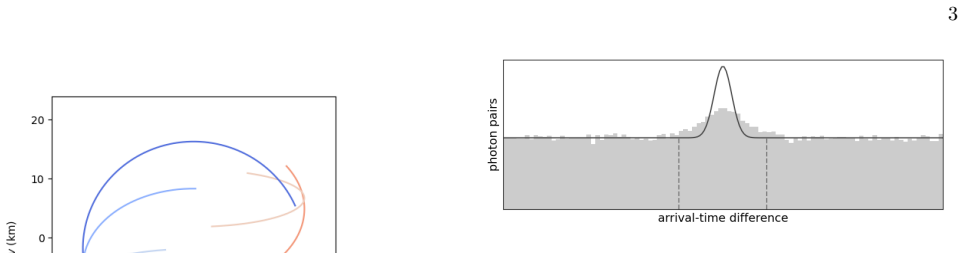


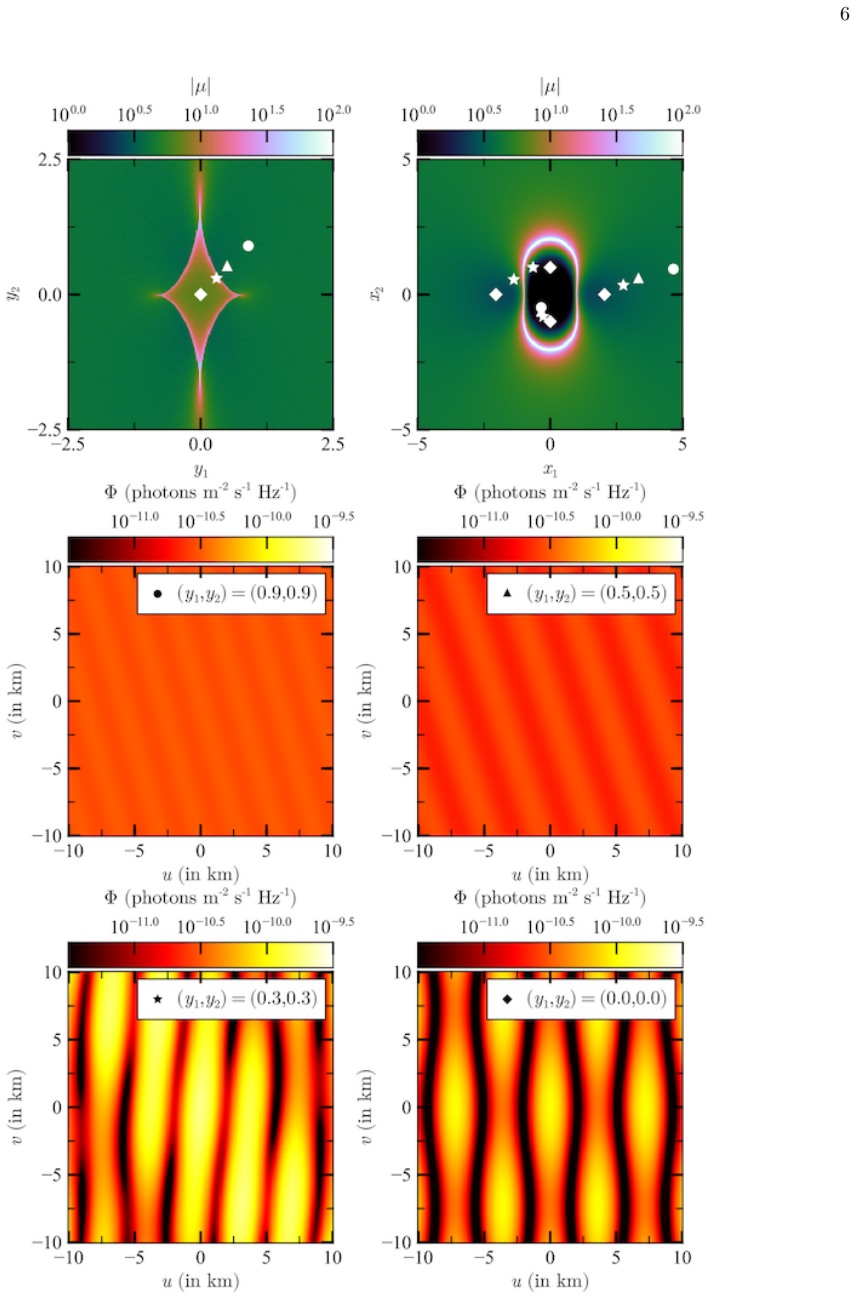

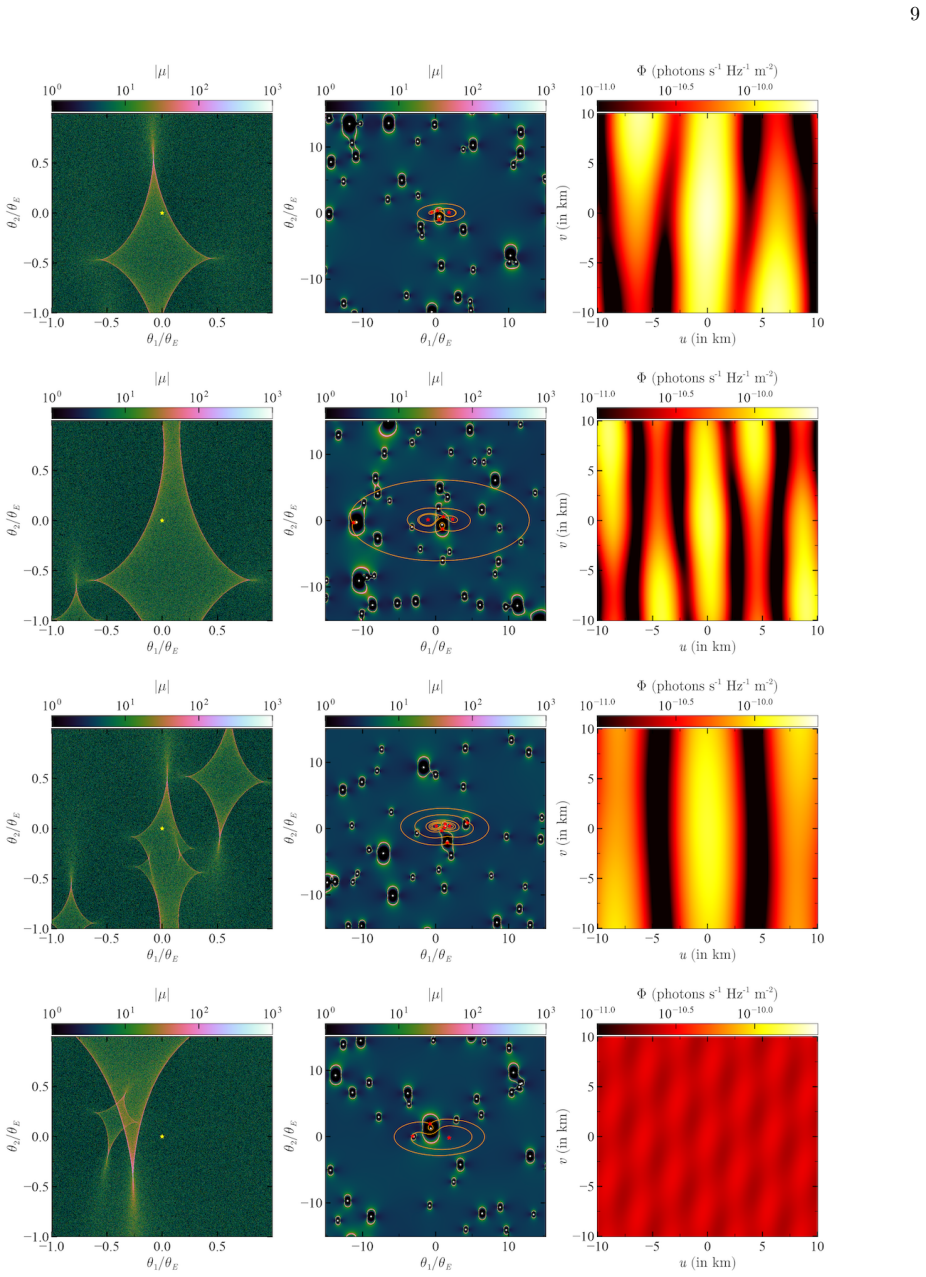


read the original abstract
Each strongly lensed image of a quasar behind a lensing galaxy (or galaxy cluster) is composed of a swarm of micro-images. This is a result of microlensing due to stellar-scale substructure in the lens. The presence of microlenses forms a network of micro-caustics, and a source transiting these micro-caustics gives rise to variation in observed strongly lensed images. These micro-image swarms are currently observable only through collective intensity fluctuations, which hide the underlying information on the stellar (and compact dark matter, if any) mass functions within the swarm. To unlock the information present in micro-image swarms, it is necessary to explore new techniques. In this work, we study the prospects of determining the micro-image swarm size in lensed quasar images using the intensity interferometry (i.e., the Hanbury Brown & Twiss effect). We consider QSO 2237+0305 and PS J0147+4630, two of the brightest lens quasars in the sky, and study micro-image swarm features in visibility space for both macro-minimum and macro-saddle-point images. At the end, we argue that, with ongoing and expected technical advances, observations of micro-image swarms are plausible, at least for the brightest lensed quasars.
Editorial analysis
A structured set of objections, weighed in public.
Referee Report
Summary. The manuscript proposes using intensity interferometry (Hanbury Brown-Twiss effect) to measure the sizes of micro-image swarms in strongly lensed quasars, which arise from stellar microlensing. Focusing on the bright systems QSO 2237+0305 and PS J0147+4630, it models second-order coherence signatures in visibility space for both macro-minimum and macro-saddle-point images and concludes that, with anticipated gains in sensitivity and baseline coverage, such observations are plausible and would reveal stellar (and compact dark matter) mass-function information currently hidden in collective intensity fluctuations.
Significance. If the modeled visibility-space features prove observable, the work would open a new route to constrain the mass functions of stars and compact objects in lens galaxies, independent of traditional light-curve monitoring. The paper is strengthened by its concrete choice of targets, explicit mapping from swarm size to correlation functions, and forward-looking assessment of instrumental prospects; these elements make the central plausibility claim falsifiable once the required sensitivity is achieved.
major comments (1)
- §4 (visibility modeling for macro-saddle images): the separation between micro-image swarm signatures and collective-fluctuation baselines is shown only for idealized source sizes; a quantitative demonstration (e.g., via the width of the second-order coherence peak versus baseline length) that the features remain distinguishable once realistic source structure and noise are included is needed to support the claim that swarm sizes can be isolated.
minor comments (3)
- Abstract: the phrase 'i.e., the Hanbury Brown & Twiss effect' would benefit from a brief parenthetical reference to the original 1956 paper or a modern review for readers unfamiliar with intensity interferometry.
- Figure captions (e.g., those showing correlation functions): axis labels and units for the visibility amplitude should be stated explicitly rather than relying on context from the text.
- §2 (system parameters): the adopted values for source size and microlens surface density for PS J0147+4630 are listed without an accompanying table; adding a compact table would improve readability and allow direct comparison with QSO 2237+0305.
Simulated Author's Rebuttal
We thank the referee for their constructive feedback and positive recommendation for minor revision. We address the major comment point by point below.
read point-by-point responses
-
Referee: §4 (visibility modeling for macro-saddle images): the separation between micro-image swarm signatures and collective-fluctuation baselines is shown only for idealized source sizes; a quantitative demonstration (e.g., via the width of the second-order coherence peak versus baseline length) that the features remain distinguishable once realistic source structure and noise are included is needed to support the claim that swarm sizes can be isolated.
Authors: We agree that extending the analysis to include realistic source structure and noise is important for strengthening the claim that swarm sizes can be isolated. In the revised manuscript we have expanded the modeling in §4 to incorporate realistic quasar source sizes drawn from observed luminosity profiles and to include representative noise levels consistent with anticipated instrumental performance. We now show the width of the second-order coherence peak versus baseline length for both the idealized and realistic cases, confirming that the micro-image swarm signatures remain distinguishable from the collective-fluctuation baseline at the sensitivities expected for the brightest targets. This quantitative demonstration is added as a new figure and accompanying text. revision: yes
Circularity Check
No significant circularity detected
full rationale
The paper constructs visibility functions for micro-image swarms in two specific lensed quasars by applying standard microlensing ray-tracing and the Hanbury Brown-Twiss second-order coherence formalism to macro-minimum and macro-saddle configurations. These steps rely on external physical models of stellar microlenses and interferometric observables rather than any self-referential definitions, fitted parameters renamed as predictions, or load-bearing self-citations. The final plausibility claim is conditioned on independent future instrumental advances, leaving the derivation chain self-contained against external benchmarks.
Axiom & Free-Parameter Ledger
axioms (1)
- domain assumption Microlensing by stellar-scale substructure creates a network of micro-caustics leading to micro-image swarms in each strongly lensed quasar image.
Lean theorems connected to this paper
-
Foundation.LogicAsFunctionalEquation / Cost.FunctionalEquationwashburn_uniqueness_aczel unclear?
unclearRelation between the paper passage and the cited Recognition theorem.
V(u, v) ∝ Σ_j μ(j) exp[2πi/λ (u θ_x + v θ_y)] ... HBT correlation r²(1+|γ(t)|²|V(u,v)|²)
What do these tags mean?
- matches
- The paper's claim is directly supported by a theorem in the formal canon.
- supports
- The theorem supports part of the paper's argument, but the paper may add assumptions or extra steps.
- extends
- The paper goes beyond the formal theorem; the theorem is a base layer rather than the whole result.
- uses
- The paper appears to rely on the theorem as machinery.
- contradicts
- The paper's claim conflicts with a theorem or certificate in the canon.
- unclear
- Pith found a possible connection, but the passage is too broad, indirect, or ambiguous to say the theorem truly supports the claim.
Reference graph
Works this paper leans on
-
[1]
Schneider, J
P. Schneider, J. Ehlers, and E. E. Falco,Gravitational Lenses(1992)
1992
-
[2]
Limits on the Macho Content of the Galactic Halo from the EROS-2 Survey of the Magellanic Clouds
P. Tisserand, L. Le Guillou, C. Afonso, J. N. Al- bert, J. Andersen, R. Ansari, ´E. Aubourg, P. Bareyre, J. P. Beaulieu, X. Charlot, C. Coutures, R. Ferlet, P. Fouqu´ e, J. F. Glicenstein, B. Goldman, A. Gould, D. Graff, M. Gros, J. Haissinski, C. Hamadache, J. de Kat, T. Lasserre, ´E. Lesquoy, C. Loup, C. Magneville, J. B. Marquette, ´E. Maurice, A. Maur...
work page Pith review arXiv 2007
-
[3]
Microlensing constraints on primordial black holes with the Subaru/HSC Andromeda observation
H. Niikura, M. Takada, N. Yasuda, R. H. Lupton, T. Sumi, S. More, T. Kurita, S. Sugiyama, A. More, M. Oguri, and M. Chiba, Nature Astronomy3, 524 (2019), arXiv:1701.02151 [astro-ph.CO]
work page Pith review arXiv 2019
-
[4]
P. Mr´ oz, A. Udalski, M. K. Szyma´ nski, I. Soszy´ nski, P. Pietrukowicz, S. Koz lowski, R. Poleski, J. Skowron, D. Skowron, K. Ulaczyk, M. Gromadzki, K. Rybicki, P. Iwanek, M. Wrona, and M. Ratajczak, ApJS280, 49 (2025), arXiv:2507.13794 [astro-ph.GA]
-
[5]
K. C. Wong, S. H. Suyu, G. C.-F. Chen, C. E. Rusu, M. Millon, D. Sluse, V. Bonvin, C. D. Fassnacht, S. Taubenberger, M. W. Auger, S. Birrer, J. H. H. Chan, F. Courbin, S. Hilbert, O. Tihhonova, T. Treu, A. Ag- nello, X. Ding, I. Jee, E. Komatsu, A. J. Shajib, A. Son- nenfeld, R. D. Blandford, L. V. E. Koopmans, P. J. Marshall, and G. Meylan, MNRAS498, 142...
-
[6]
M. Pascale, B. L. Frye, J. D. R. Pierel, W. Chen, P. L. Kelly, S. H. Cohen, R. A. Windhorst, A. G. Riess, P. S. Kamieneski, J. M. Diego, A. K. Meena, S. Cha, M. Oguri, A. Zitrin, M. J. Jee, N. Foo, R. Leimbach, A. M. Koeke- moer, C. J. Conselice, L. Dai, A. Goobar, M. R. Siebert, L. Strolger, and S. P. Willner, ApJ979, 13 (2025), arXiv:2403.18902 [astro-ph.CO]
-
[7]
S. H. Suyu, A. Acebron, C. Grillo, P. Bergamini, G. B. Caminha, S. Cha, J. M. Diego, S. Ertl, N. Foo, B. L. Frye, Y. Fudamoto, G. Granata, A. Halkola, M. J. Jee, P. S. Kamieneski, A. M. Koekemoer, A. K. Meena, A. B. Newman, S. Nishida, M. Oguri, P. Rosati, S. Schuldt, A. Zitrin, R. Ca˜ nameras, E. E. Hayes, C. Larison, E. Mamuzic, M. Millon, J. D. R. Pier...
work page internal anchor Pith review Pith/arXiv arXiv 2025
-
[8]
E. Mediavilla, J. Jim´ enez-Vicente, J. A. Mu˜ noz, H. Vives- Arias, and J. Calder´ on-Infante, ApJL836, L18 (2017), arXiv:1702.00947 [astro-ph.GA]
-
[9]
M. Oguri, J. M. Diego, N. Kaiser, P. L. Kelly, and T. Broadhurst, Phys. Rev. D97, 023518 (2018), arXiv:1710.00148 [astro-ph.CO]
work page Pith review arXiv 2018
-
[10]
P. L. Kelly, J. M. Diego, S. Rodney, N. Kaiser, T. Broad- hurst, A. Zitrin, T. Treu, P. G. P´ erez-Gonz´ alez, T. Mor- ishita, M. Jauzac, J. Selsing, M. Oguri, L. Pueyo, T. W. Ross, A. V. Filippenko, N. Smith, J. Hjorth, S. B. Cenko, X. Wang, D. A. Howell, J. Richard, B. L. Frye, S. W. Jha, 7 https://research.ast.cam.ac.uk/lensedquasars/indiv/ HS0810+2554...
-
[11]
B. Welch, D. Coe, J. M. Diego, A. Zitrin, E. Zackris- son, P. Dimauro, Y. Jim´ enez-Teja, P. Kelly, G. Mahler, M. Oguri, F. X. Timmes, R. Windhorst, M. Florian, S. E. de Mink, R. J. Avila, J. Anderson, L. Bradley, K. Sharon, A. Vikaeus, S. McCandliss, M. Bradaˇ c, J. Rigby, B. Frye, S. Toft, V. Strait, M. Trenti, S. Sharma, F. Andrade- Santos, and T. Broa...
-
[12]
A. K. Meena, A. Zitrin, Y. Jim´ enez-Teja, E. Zackrisson, W. Chen, D. Coe, J. M. Diego, P. Dimauro, L. J. Furtak, P. L. Kelly, M. Oguri, B. Welch, Abdurro’uf, F. Andrade- Santos, A. Adamo, R. Bhatawdekar, M. Bradaˇ c, L. D. Bradley, T. Broadhurst, C. J. Conselice, P. Dayal, M. Donahue, B. L. Frye, S. Fujimoto, T. Y.-Y. Hsiao, V. Kokorev, G. Mahler, E. Van...
-
[13]
C. Spingola, J. P. McKean, M. W. Auger, C. D. Fass- nacht, L. V. E. Koopmans, D. J. Lagattuta, and S. Veg- etti, MNRAS478, 4816 (2018), arXiv:1807.05566 [astro- ph.GA]
-
[14]
P. Hartley, N. Jackson, D. Sluse, H. R. Stacey, and H. Vives-Arias, MNRAS485, 3009 (2019), arXiv:1901.05791 [astro-ph.GA]
- [15]
-
[16]
A. A. Michelson and F. G. Pease, ApJ53, 249 (1921)
1921
-
[17]
T. S. Boyajian, H. A. McAlister, G. van Belle, D. R. Gies, T. A. ten Brummelaar, K. von Braun, C. Farrington, P. J. Goldfinger, D. O’Brien, J. R. Parks, N. D. Richard- son, S. Ridgway, G. Schaefer, L. Sturmann, J. Sturmann, Y. Touhami, N. H. Turner, and R. White, ApJ746, 101 (2012), arXiv:1112.3316 [astro-ph.SR]
-
[18]
T. S. Boyajian, K. von Braun, G. van Belle, H. A. McAlister, T. A. ten Brummelaar, S. R. Kane, P. S. Muirhead, J. Jones, R. White, G. Schaefer, D. Ciardi, T. Henry, M. L´ opez-Morales, S. Ridgway, D. Gies, W.-C. Jao, B. Rojas-Ayala, J. R. Parks, L. Sturmann, J. Stur- mann, N. H. Turner, C. Farrington, P. J. Goldfinger, and D. H. Berger, ApJ757, 112 (2012)...
-
[19]
T. Boyajian, K. von Braun, G. A. Feiden, D. Huber, S. Basu, P. Demarque, D. A. Fischer, G. Schaefer, A. W. Mann, T. R. White, V. Maestro, J. Brewer, C. B. Lamell, F. Spada, M. L´ opez-Morales, M. Ireland, C. Farrington, G. T. van Belle, S. R. Kane, J. Jones, T. A. ten Brum- melaar, D. R. Ciardi, H. A. McAlister, S. Ridgway, P. J. Goldfinger, N. H. Turner,...
- [20]
-
[21]
R. H. Brown,The intensity interferometer; its applica- 17 tion to astronomy(1974)
1974
-
[22]
Hanbury Brown, R
R. Hanbury Brown, R. C. Jennison, and M. K. D. Gupta, Nature (London)170, 1061 (1952)
1952
-
[23]
Hanbury Brown, J
R. Hanbury Brown, J. Davis, and L. R. Allen, MNRAS 167, 121 (1974)
1974
-
[24]
S. Abe, J. Abhir, V. A. Acciari, A. Aguasca-Cabot, I. Agudo, T. Aniello, S. Ansoldi, L. A. Antonelli, A. Ar- bet Engels, C. Arcaro, M. Artero, K. Asano, A. Babi´ c, A. Baquero, U. B. de Almeida, J. A. Barrio, I. Batkovi´ c, A. Bautista, J. Baxter, J. B. Gonz´ alez, E. Bernar- dini, M. Bernardos, J. Bernete, A. Berti, J. Besen- rieder, C. Bigongiari, A. Bi...
-
[25]
A. Archer, J. P. Aufdenberg, P. Bangale, J. T. Bartkoske, W. Benbow, J. H. Buckley, Y. Chen, N. B. Y. Chin, J. L. Christiansen, A. J. Chromey, A. Duerr, M. Esco- bar Godoy, S. Feldman, Q. Feng, S. Filbert, L. Fort- son, A. Furniss, W. Hanlon, O. Hervet, C. E. Hinrichs, J. Holder, Z. Hughes, T. B. Humensky, W. Jin, M. N. Johnson, M. Kertzman, M. Kherlakian...
- [26]
-
[27]
W. Guerin, J.-P. Rivet, M. Fouch´ e, G. Labeyrie, D. Ver- net, F. Vakili, and R. Kaiser, MNRAS480, 245 (2018), arXiv:1805.06653 [astro-ph.IM]
- [28]
-
[29]
N. Matthews, J.-P. Rivet, D. Vernet, M. Hugbart, G. Labeyrie, R. Kaiser, J. Chab´ e, C. Courde, O. Lai, F. Vakili, O. Garde, and W. Guerin, AJ165, 117 (2023), arXiv:2301.04878 [astro-ph.IM]
-
[30]
D. Dravins, S. LeBohec, H. Jensen, and P. D. Nu˜ nez, Na- ture Ast56, 143 (2012), arXiv:1207.0808 [astro-ph.IM]
-
[31]
P. Saha, J. Biteau, C. Carlile, D. Dravins, M. Fiori, T. Hassan, D. Kieda, M. Lisa, Q. Luce, A. Mitchell, A. Spolon, L. Stanic, N. Vogel, L. Zampieri, and A. Zmija, PoSICRC2025, 959 (2025)
2025
-
[32]
S. Baumgartner, M. Bernardini, J. R. Canivete Cuissa, H. de Laroussilhe, A. M. W. Mitchell, B. A. Neuen- schwander, P. Saha, T. Schaeffer, D. Soyuer, and L. Zwick, MNRAS498, 4577 (2020), arXiv:2008.11538 [astro-ph.IM]
- [33]
-
[34]
V. Sliusar, D. Della Volpe, B. Garcia, G. Koziol, E. Lyard, N. Produit, A. Raiola, P. Saha, L. Stanic, and R. Walter, arXiv e-prints , arXiv:2512.12470 (2025), arXiv:2512.12470 [astro-ph.GA]
-
[35]
R. Kaiser, W. Guerin, F. Vakili, J.-P. Berger, A. Nomerotski, S. Kulkov, P. Svihra, E. Santos, C. Carlile, D. Dravins, S. Funk, P. Saha, R. Wal- ter, M. Borges Fernandes, A. G. Kim, D. Dun- sky, K. Van Tilburg, M. Baryakhtar, M. Galanis, R. V. Wagoner, N. Dalal, J. Huang, C. Gammie, and N. W. Murray, arXiv e-prints , arXiv:2602.12717 (2026), arXiv:2602.12...
-
[36]
P. Padovani and M. Cirasuolo, Contemporary Physics 64, 47 (2023), arXiv:2312.04299 [astro-ph.IM]
-
[37]
R. Narayan and M. Bartelmann, arXiv e-prints , astro- ph/9606001 (1996), arXiv:astro-ph/9606001 [astro-ph]
-
[38]
Mandel and E
L. Mandel and E. Wolf, Reviews of Modern Physics37, 231 (1965)
1965
-
[39]
R. J. Glauber, Reviews of Modern Physics78, 1267 (2006)
2006
-
[40]
E. M. Purcell, Nature (London)178, 1449 (1956)
1956
-
[41]
Martienssen and E
W. Martienssen and E. Spiller, American Journal of Physics32, 919 (1964)
1964
-
[42]
K. N. Rai, S. Basak, S. Sarangi, and P. Saha, Reson30, 45 (2025)
2025
-
[43]
J. B. Oke and J. E. Gunn, ApJ266, 713 (1983)
1983
-
[44]
Kayser, S
R. Kayser, S. Refsdal, and R. Stabell, A&A166, 36 (1986). 18
1986
-
[45]
Chang and S
K. Chang and S. Refsdal, Nature (London)282, 561 (1979)
1979
-
[46]
Chang and S
K. Chang and S. Refsdal, A&A132, 168 (1984)
1984
-
[47]
G. van de Ven, J. Falc´ on-Barroso, R. M. McDermid, M. Cappellari, B. W. Miller, and P. T. de Zeeuw, ApJ 719, 1481 (2010), arXiv:0807.4175 [astro-ph]
-
[48]
Vernardos, MNRAS483, 5583 (2019), arXiv:1901.01246 [astro-ph.GA]
G. Vernardos, MNRAS483, 5583 (2019), arXiv:1901.01246 [astro-ph.GA]
-
[49]
E. E. Salpeter, ApJ121, 161 (1955)
1955
-
[50]
D. Khavinson and G. Neumann, arXiv Mathematics e-prints , math/0401188 (2004), arXiv:math/0401188 [math.CV]
-
[51]
P. Saha and L. L. R. Williams, MNRAS411, 1671 (2011), arXiv:1010.0006 [astro-ph.CO]
- [52]
-
[53]
Lee, A&A605, L8 (2017), arXiv:1708.05131 [astro- ph.GA]
C.-H. Lee, A&A605, L8 (2017), arXiv:1708.05131 [astro- ph.GA]
-
[54]
Lee, MNRAS475, 3086 (2018), arXiv:1801.01851 [astro-ph.GA]
C.-H. Lee, MNRAS475, 3086 (2018), arXiv:1801.01851 [astro-ph.GA]
-
[55]
A. J. Shajib, S. Birrer, T. Treu, M. W. Auger, A. Agnello, T. Anguita, E. J. Buckley-Geer, J. H. H. Chan, T. E. Col- lett, F. Courbin, C. D. Fassnacht, J. Frieman, I. Kayo, C. Lemon, H. Lin, P. J. Marshall, R. McMahon, A. More, N. D. Morgan, V. Motta, M. Oguri, F. Ostrovski, C. E. Rusu, P. L. Schechter, T. Shanks, S. H. Suyu, G. Meylan, T. M. C. Abbott, S...
- [56]
-
[57]
Walter, E
R. Walter, E. Charbon, D. della Volpe, E. Lyard, N. Produit, P. Saha, V. Sliusar, and A. Tramacere, PoS ICRC2023, 1491 (2023)
2023
-
[58]
Gramuglia, M.-L
F. Gramuglia, M.-L. Wu, C. Bruschini, M.-J. Lee, and E. Charbon, IEEE J. Sel. Top. Quant. Electron.28, 3800809 (2022)
2022
-
[59]
B. Korzh, Q.-Y. Zhao, J. P. Allmaras, S. Frasca, T. M. Autry, E. A. Bersin, A. D. Beyer, R. M. Briggs, B. Bum- ble, M. Colangelo, G. M. Crouch, A. E. Dane, T. Gerrits, A. E. Lita, F. Marsili, G. Moody, C. Pe˜ na, E. Ramirez, J. D. Rezac, N. Sinclair, M. J. Stevens, A. E. Ve- lasco, V. B. Verma, E. E. Wollman, S. Xie, D. Zhu, P. D. Hale, M. Spiropulu, K. L...
-
[60]
D. V. Reddy, R. R. Nerem, S. W. Nam, R. P. Mirin, and V. B. Verma, Optica7, 1649 (2020)
2020
-
[61]
I. Charaev, E. K. Batson, S. Cherednichenko, K. Reidy, V. Drakinskiy, Y. Yu, S. Lara-Avila, J. D. Thom- sen, M. Colangelo, F. Incalza, K. Ilin, A. Schilling, and K. K. Berggren, Nature Communications15, 3973 (2024), arXiv:2308.15228 [cond-mat.supr-con]
-
[62]
F. B. Davies, E. Ba˜ nados, S. E. I. Bosman, A. Gan- guly, S. Belladitta, J. Power, and J. Rees, arXiv e-prints , arXiv:2604.13152 (2026), arXiv:2604.13152 [astro-ph.GA]
work page internal anchor Pith review Pith/arXiv arXiv 2026
-
[63]
Julia: AFreshApproach to Numerical Computing.arXiv:1411.1607 [cs], July 2015
J. Bezanson, A. Edelman, S. Karpinski, and V. B. Shah, arXiv e-prints , arXiv:1411.1607 (2014), arXiv:1411.1607 [cs.MS]
discussion (0)
Sign in with ORCID, Apple, or X to comment. Anyone can read and Pith papers without signing in.