Recognition: unknown
Persephone's Torch: A 15th Magnitude Quadruply-Lensed Quasar From the Couch Discovered with SPHEREx and the LBT
Pith reviewed 2026-05-10 14:35 UTC · model grok-4.3
The pith
A quadruply-lensed quasar at redshift 2.22 is confirmed as the brightest such system known, with four images and total magnification near 56.
A machine-rendered reading of the paper's core claim, the machinery that carries it, and where it could break.
Core claim
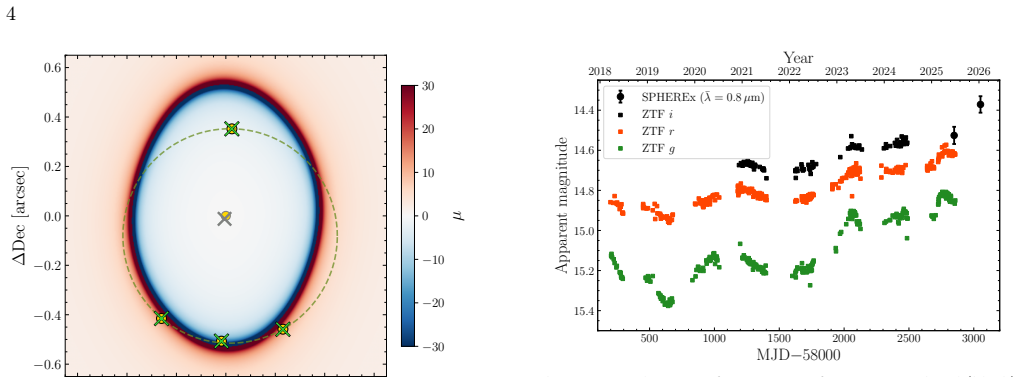
The central claim is that J1330-0905 is a quadruply-lensed quasar at redshift 2.22 whose four images are resolved by LBT adaptive optics in a compact configuration, with SPHEREx spectrophotometry providing the redshift and quasar classification from public data alone. The system is the brightest gravitationally lensed quasar yet found, and an elliptical power-law mass distribution plus external shear fits the image locations while predicting a total magnification of approximately 56, despite anomalous flux ratios among the images.
What carries the argument
SPHEREx full-sky infrared spectrophotometry combined with LBT adaptive optics imaging, which together establish the single-source quasar nature, measure the redshift, resolve the four images, and enable the elliptical power-law plus external shear mass model.
If this is right
- The anomalous image flux ratios combined with time delays of at most two days enable future microlensing monitoring campaigns to probe the quasar structure and lens substructure.
- The total magnification of approximately 56 makes the background quasar appear unusually bright for detailed follow-up at optical and infrared wavelengths.
- The compact Einstein radius of 0.45 arcseconds and accurate mass model fit demonstrate that simple lens models can still describe systems with highly anomalous flux ratios.
- SPHEREx-style all-sky spectrophotometry can identify other bright lensed quasars that optical surveys have missed due to their compactness or color.
Where Pith is reading between the lines
- Monitoring campaigns could measure the short time delays directly and test whether the flux anomalies persist across wavelengths or vary with time.
- The system adds a high-magnification anchor point that could refine statistical predictions for the number of bright lensed quasars detectable in future infrared surveys.
- If the mass model holds, the predicted image positions offer a clean target for high-resolution imaging to search for the lensing galaxy and any nearby perturbers.
Load-bearing premise
The four resolved images and the spectrophotometric signal all belong to one background quasar at redshift 2.22 instead of unrelated objects or chance alignments, and the elliptical power-law plus external shear model correctly describes the lens geometry.
What would settle it
Obtaining separate spectra of each of the four images and finding inconsistent redshifts or entirely different spectral features would disprove that they are multiple images of a single quasar at z=2.22.
Figures


read the original abstract
Here we report the spectroscopic and geometric confirmation of an extremely bright ($i=14.77$) and compact (Einstein radius of $\sim0.45''$) quadruply-lensed quasar at $z=2.22$, J1330$-$0905, which we dub Persephone's Torch. The system had been previously selected as a candidate lensed quasar based on large-area survey data; here we confirm its quasar nature and redshift using public spectrophotometry from the SPHEREx mission, a.k.a. "from the couch". Adaptive optics imaging with LBT/LUCI resolves four images in a "circular kite" configuration. The system is the brightest gravitationally-lensed quasar system ever found. While an elliptical power-law mass distribution plus external shear accurately reproduces the locations of the images and lensing galaxy, and predicts a total magnification of $\sim56$, the brightnesses of the lensed images present highly anomalous flux ratios. Together with short time delays between images ($\leq 2$ days), this makes Persephone's Torch a promising candidate for future microlensing studies. Our discovery highlights the potential of SPHEREx full-sky infrared spectrophotometry to uncover extraordinarily bright objects that have otherwise been overlooked.
Editorial analysis
A structured set of objections, weighed in public.
Referee Report
Summary. The manuscript reports the discovery and confirmation of an extremely bright (i=14.77) quadruply-lensed quasar J1330−0905 at z=2.22, dubbed Persephone's Torch, using public SPHEREx spectrophotometry for redshift and quasar identification together with LBT adaptive-optics imaging that resolves four images in a circular-kite configuration. An elliptical power-law lens model plus external shear reproduces the image positions and lens-galaxy location, predicts a total magnification of ∼56, and yields short time delays (≤2 days), while the anomalous flux ratios are attributed to microlensing; the system is claimed to be the brightest known lensed quasar.
Significance. If the single-source lensing interpretation is secure, the result is significant: it supplies the brightest known quadruply-imaged quasar, ideal for microlensing and time-delay cosmography studies, and illustrates the power of SPHEREx full-sky infrared spectrophotometry to recover bright, compact systems overlooked by optical surveys. The public-data approach and the compact Einstein radius (∼0.45″) are particular strengths.
major comments (2)
- [§3] §3 (SPHEREx spectrophotometry): the redshift z=2.22 and quasar classification rest on blended, unresolved spectrophotometry of the entire system. No per-image spectra are presented, so the possibility that the four LBT point sources are unrelated objects whose combined light mimics a single quasar spectrum is not directly excluded.
- [§4] §4 (lens modeling): the elliptical power-law plus external-shear model fits the four image positions and the lens-galaxy location but fails to reproduce the observed flux ratios (attributed to microlensing). Without an independent check from measured time delays or flux-ratio consistency, the geometric confirmation of a single macro-lens remains partially unverified.
minor comments (2)
- [Abstract] Abstract: the unqualified statement that the system is 'the brightest gravitationally-lensed quasar system ever found' should include a brief comparison to the previous record holder and a supporting reference.
- [Figure 1] Figure 1 or 2 (LBT imaging): labeling the four images (A–D) and the lens galaxy position directly on the figure would improve clarity for readers.
Simulated Author's Rebuttal
We thank the referee for their careful and constructive review. We address each major comment below and have revised the manuscript to incorporate clarifications where appropriate while preserving the core claims supported by the public data.
read point-by-point responses
-
Referee: [§3] §3 (SPHEREx spectrophotometry): the redshift z=2.22 and quasar classification rest on blended, unresolved spectrophotometry of the entire system. No per-image spectra are presented, so the possibility that the four LBT point sources are unrelated objects whose combined light mimics a single quasar spectrum is not directly excluded.
Authors: We agree that the SPHEREx spectrophotometry is blended and unresolved. The LBT adaptive-optics imaging, however, resolves four distinct point sources in a circular-kite configuration centered on an extended object consistent with the lens galaxy. The blended spectrum shows clear, single-redshift quasar emission lines at z=2.22 with no evidence of multiple components. The probability of four unrelated objects aligning in this precise geometry with a foreground galaxy is extremely low. We have added a paragraph to the revised Section 3 quantifying this low chance-alignment probability and noting that resolved spectroscopy would require future observations beyond the scope of this public-data discovery. revision: partial
-
Referee: [§4] §4 (lens modeling): the elliptical power-law plus external-shear model fits the four image positions and the lens-galaxy location but fails to reproduce the observed flux ratios (attributed to microlensing). Without an independent check from measured time delays or flux-ratio consistency, the geometric confirmation of a single macro-lens remains partially unverified.
Authors: The model is constrained by the four image positions and the lens-galaxy centroid, which together provide geometric confirmation of the macro-lens independent of fluxes. The mismatch in flux ratios is expected and is routinely attributed to microlensing in lensed quasars; we discuss this explicitly. The model predicts short time delays (≤2 days), enabling future monitoring to supply independent verification. We have expanded the text in the revised Section 4 to clarify that positional agreement constitutes the geometric confirmation while microlensing accounts for the flux anomalies. revision: partial
Circularity Check
Observational discovery paper with standard lens modeling shows no significant circularity
full rationale
The paper is an observational confirmation of a lensed quasar candidate using new SPHEREx spectrophotometry for redshift and LBT AO imaging to resolve four images. Image positions are fitted with a standard elliptical power-law + shear model to confirm consistency with a single lens, but this is not a derivation or prediction that reduces to prior inputs by construction. No self-citations are load-bearing for the central claim, no ansatz is smuggled, and no fitted parameters are renamed as independent predictions. The central result (discovery and confirmation of the system) is self-contained against external data.
Axiom & Free-Parameter Ledger
free parameters (2)
- power-law index of lens mass distribution
- external shear magnitude and direction
axioms (1)
- standard math General relativity accurately describes gravitational lensing by galaxies
Forward citations
Cited by 1 Pith paper
-
Beyond collective fluctuations: probing micro-image swarms in lensed quasars with intensity interferometry
Intensity interferometry offers a way to measure micro-image swarm sizes in lensed quasars, revealing stellar and compact dark matter mass functions beyond collective intensity fluctuations.
Reference graph
Works this paper leans on
-
[1]
Akeson, R., Dubois-Felsmann, G. P., Crill, B. P., et al. 2025, arXiv e-prints, arXiv:2511.15823, doi:10.48550/arXiv.2511.15823 Astropy Collaboration, Price-Whelan, A. M., Lim, P. L., et al. 2022, ApJ, 935, 167, doi:10.3847/1538-4357/ac7c74
-
[2]
2025, A&A, 699, A335, doi:10.1051/0004-6361/202554859
Belladitta, S., Bañados, E., Xie, Z.-L., et al. 2025, A&A, 699, A335, doi:10.1051/0004-6361/202554859
-
[3]
Bellm, E. C., Kulkarni, S. R., Graham, M. J., et al. 2019, PASP, 131, 018002, doi:10.1088/1538-3873/aaecbe
-
[4]
Dudik, R. P. 2017, ApJ, 844, 90, doi:10.3847/1538-4357/aa7aa6
-
[5]
2018, Physics of the Dark Universe, 22, 189, doi: 10.1016/j.dark.2018.11.002
Birrer, S., & Amara, A. 2018, Physics of the Dark Universe, 22, 189, doi:10.1016/j.dark.2018.11.002
-
[6]
2024, SSRv, 220, 48, doi: 10.1007/s11214-024-01079-w
Birrer, S., Millon, M., Sluse, D., et al. 2024, Space Sci. Rev., 220, 48, doi:10.1007/s11214-024-01079-w
-
[7]
Bock, J. J., Aboobaker, A. M., Adamo, J., et al. 2025, arXiv e-prints, arXiv:2511.02985, doi:10.48550/arXiv.2511.02985
-
[8]
A reference tool for identification of astronomical sources
Bonnarel, F., Fernique, P., Bienaymé, O., et al. 2000, A&AS, 143, 33, doi:10.1051/aas:2000331
-
[9]
2020, ApJS, 250, 26, doi:10.3847/1538-4365/abafc1
Boutsia, K., Grazian, A., Calderone, G., et al. 2020, ApJS, 250, 26, doi:10.3847/1538-4365/abafc1
-
[10]
Byrne, X., Meyer, R. A., Farina, E. P., et al. 2024, MNRAS, 530, 870, doi:10.1093/mnras/stae902
-
[11]
2024, A&A, 683, A34, doi:10.1051/0004-6361/202346625
Calderone, G., Guarneri, F., Porru, M., et al. 2024, A&A, 683, A34, doi:10.1051/0004-6361/202346625
-
[12]
Chambers, K. C., Magnier, E. A., Metcalfe, N., et al. 2016, arXiv e-prints, arXiv:1612.05560, doi:10.48550/arXiv.1612.05560
work page internal anchor Pith review Pith/arXiv arXiv doi:10.48550/arxiv.1612.05560 2016
-
[13]
2023, MNRAS, 522, 2019, doi:10.1093/mnras/stad1007
Cristiani, S., Porru, M., Guarneri, F., et al. 2023, MNRAS, 522, 2019, doi:10.1093/mnras/stad1007
-
[14]
Dalal, N., & Kochanek, C. S. 2002, ApJ, 572, 25, doi:10.1086/340303 D’Amato, Q., Mannucci, F., Sonnenfeld, A., et al. 2026, arXiv e-prints, arXiv:2604.01828. https://arxiv.org/abs/2604.01828
-
[15]
Davies, F. B., Bosman, S. E. I., Ganguly, A., et al. 2026, arXiv e-prints, arXiv:2603.10135, doi:10.48550/arXiv.2603.10135
-
[16]
2011, ApJL, 727, L24, doi:10.1088/2041-8205/727/1/L24 Doré, O., Bock, J., Ashby, M., et al
Dexter, J., & Agol, E. 2011, ApJL, 727, L24, doi:10.1088/2041-8205/727/1/L24 Doré, O., Bock, J., Ashby, M., et al. 2014, arXiv e-prints, arXiv:1412.4872, doi:10.48550/arXiv.1412.4872
-
[17]
Ducourant, C., Teixeira, R., Vale-Cunha, P. H., et al. 2026, A&A, 707, A345, doi:10.1051/0004-6361/202558049
-
[18]
Publications of the Astronomical Society of the Pacific , author =
Foreman-Mackey, D., Hogg, D. W., Lang, D., & Goodman, J. 2013, PASP, 125, 306, doi:10.1086/670067
-
[19]
2024, ApJS, 271, 54, doi:10.3847/1538-4365/ad2ae6 Gaia Collaboration, Prusti, T., de Bruijne, J
Fu, Y., Wu, X.-B., Li, Y., et al. 2024, ApJS, 271, 54, doi:10.3847/1538-4365/ad2ae6 Gaia Collaboration, Prusti, T., de Bruijne, J. H. J., et al. 2016, A&A, 595, A1, doi:10.1051/0004-6361/201629272
-
[20]
Giveon, U., Maoz, D., Kaspi, S., Netzer, H., & Smith, P. S. 1999, MNRAS, 306, 637, doi:10.1046/j.1365-8711.1999.02556.x
-
[21]
2022, MNRAS, 517, 2436, doi:10.1093/mnras/stac2733
Guarneri, F., Calderone, G., Cristiani, S., et al. 2022, MNRAS, 517, 2436, doi:10.1093/mnras/stac2733
-
[22]
Hale, C. L., McConnell, D., Thomson, A. J. M., et al. 2021, PASA, 38, e058, doi:10.1017/pasa.2021.47
-
[23]
2026, arXiv e-prints, arXiv:2601.16818, doi:10.48550/arXiv.2601.16818
Hou, S., Xiang, S., Sming Tsai, Y.-L., et al. 2026, arXiv e-prints, arXiv:2601.16818, doi:10.48550/arXiv.2601.16818
-
[24]
Hunter, J. D. 2007, Computing in Science Engineering, 9, 90
2007
-
[25]
2020, ApJ, 888, 73, doi:10.3847/1538-4357/ab5c1a Jiménez-Vicente, J., Mediavilla, E., Kochanek, C
Hwang, H.-C., Shen, Y., Zakamska, N., & Liu, X. 2020, ApJ, 888, 73, doi:10.3847/1538-4357/ab5c1a Jiménez-Vicente, J., Mediavilla, E., Kochanek, C. S., & Muñoz, J. A. 2015, ApJ, 799, 149, doi:10.1088/0004-637X/799/2/149
-
[26]
Keeton, C. R., Gaudi, B. S., & Petters, A. O. 2003, ApJ, 598, 138, doi:10.1086/378934
-
[27]
C., Bechtold, J., & Siemiginowska, A
Kelly, B. C., Bechtold, J., & Siemiginowska, A. 2009, ApJ, 698, 895, doi:10.1088/0004-637X/698/1/895
-
[28]
Kochanek, C. S. 2004, ApJ, 605, 58, doi:10.1086/382180
-
[29]
Kulkarni, G., Keating, L. C., Haehnelt, M. G., et al. 2019, MNRAS, 485, L24, doi:10.1093/mnrasl/slz025
-
[30]
Lacy, M., Baum, S. A., Chandler, C. J., et al. 2020, PASP, 132, 035001, doi:10.1088/1538-3873/ab63eb
-
[31]
2024, SSRv, 220, 23, doi: 10.1007/s11214-024-01042-9
Lemon, C., Courbin, F., More, A., et al. 2024, Space Sci. Rev., 220, 23, doi:10.1007/s11214-024-01042-9
-
[32]
2011, ApJ, 731, 53, doi: 10.1088/0004-637X/731/1/53
Mainzer, A., Bauer, J., Grav, T., et al. 2011, ApJ, 731, 53, doi:10.1088/0004-637X/731/1/53
-
[33]
Makarov, V. V., & Secrest, N. J. 2023, ApJS, 264, 4, doi:10.3847/1538-4365/ac97f0
-
[34]
2022, Nature Astronomy, 6, 1185, doi:10.1038/s41550-022-01761-5 6
Mannucci, F., Pancino, E., Belfiore, F., et al. 2022, Nature Astronomy, 6, 1185, doi:10.1038/s41550-022-01761-5 6
-
[35]
1998, MNRAS, 299, 433, doi: 10.1046/j.1365-8711.1998.01828.x
Mao, S., & Schneider, P. 1998, MNRAS, 295, 587, doi:10.1046/j.1365-8711.1998.01319.x Martínez-Ramírez, L. N., Wolf, J., Belladitta, S., et al. 2026, arXiv e-prints, arXiv:2603.08830, doi:10.48550/arXiv.2603.08830
-
[36]
Publications of the Astronomical Society of the Pacific , author =
Masci, F. J., Laher, R. R., Rusholme, B., et al. 2019, PASP, 131, 018003, doi:10.1088/1538-3873/aae8ac
work page internal anchor Pith review doi:10.1088/1538-3873/aae8ac 2019
-
[37]
McConnell, D., Hale, C. L., Lenc, E., et al. 2020, PASA, 37, e048, doi:10.1017/pasa.2020.41
-
[38]
2024, A&A, 682, A34, doi: 10.1051/0004-6361/202347165
Merloni, A., Lamer, G., Liu, T., et al. 2024, A&A, 682, A34, doi:10.1051/0004-6361/202347165
work page internal anchor Pith review doi:10.1051/0004-6361/202347165 2024
-
[39]
Nanni, R., Hennawi, J. F., Wang, F., et al. 2022, MNRAS, 515, 3224, doi:10.1093/mnras/stac1944
-
[40]
Nierenberg, A. M., Keeley, R. E., Sluse, D., et al. 2024, MNRAS, 530, 2960, doi:10.1093/mnras/stae499
-
[41]
Oke, J. B., & Gunn, J. E. 1983, ApJ, 266, 713, doi:10.1086/160817
-
[42]
Perez, F., & Granger, B. E. 2007, Computing in Science Engineering, 9, 21
2007
-
[43]
2016, in Society of Photo-Optical Instrumentation Engineers (SPIE) Conference
Pinna, E., Esposito, S., Hinz, P., et al. 2016, in Society of Photo-Optical Instrumentation Engineers (SPIE) Conference
2016
-
[44]
9909, Adaptive Optics Systems V, ed
Series, Vol. 9909, Adaptive Optics Systems V, ed. E. Marchetti, L. M. Close, & J.-P. Véran, 99093V, doi:10.1117/12.2234444 Planck Collaboration, Aghanim, N., Akrami, Y., et al. 2020, A&A, 641, A6, doi:10.1051/0004-6361/201833910
-
[45]
A., Rappaport, S., & Schechter, P
Pooley, D., Blackburne, J. A., Rappaport, S., & Schechter, P. L. 2007, ApJ, 661, 19, doi:10.1086/512115
-
[46]
Estimating the completeness of the QUBRICS Survey with 3501 QSO redshifts from Gaia DR3 spectra
Porru, M., Cristiani, S., Guarneri, F., et al. 2026, arXiv e-prints, arXiv:2603.06907, doi:10.48550/arXiv.2603.06907
work page internal anchor Pith review Pith/arXiv arXiv doi:10.48550/arxiv.2603.06907 2026
-
[47]
2025, Hamburg/ESO Survey Browser Service, VO resource provided by the GAVO Data Center.https://dc.g-vo.org/hamburg_eso/q/web/info
Reimers, D., Wisotzki, L., & Christlieb, N. 2025, Hamburg/ESO Survey Browser Service, VO resource provided by the GAVO Data Center.https://dc.g-vo.org/hamburg_eso/q/web/info
2025
-
[48]
Rubin, K. H. R., O’Meara, J. M., Cooksey, K. L., et al. 2018, ApJ, 859, 146, doi:10.3847/1538-4357/aaaeb7
-
[49]
Schechter, P. L. 2022, AJ, 164, 113, doi:10.3847/1538-3881/ac82b5
-
[50]
Schindler, J.-T., Fan, X., McGreer, I. D., et al. 2017, ApJ, 851, 13, doi:10.3847/1538-4357/aa9929
-
[51]
Schmidt, K. B., Rix, H.-W., Shields, J. C., et al. 2012, ApJ, 744, 147, doi:10.1088/0004-637X/744/2/147
-
[52]
2023, MNRAS, 518, 1260, doi:10.1093/mnras/stac2235
Schmidt, T., Treu, T., Birrer, S., et al. 2023, MNRAS, 518, 1260, doi:10.1093/mnras/stac2235
-
[53]
Secrest, N. J., Dudik, R. P., Dorland, B. N., et al. 2015, ApJS, 221, 12, doi:10.1088/0067-0049/221/1/12
-
[54]
2003, in Society of Photo-Optical Instrumentation Engineers (SPIE) Conference
Seifert, W., Appenzeller, I., Baumeister, H., et al. 2003, in Society of Photo-Optical Instrumentation Engineers (SPIE) Conference
2003
-
[55]
4841, Instrument Design and Performance for Optical/Infrared Ground-based Telescopes, ed
Series, Vol. 4841, Instrument Design and Performance for Optical/Infrared Ground-based Telescopes, ed. M. Iye & A. F. M. Moorwood, 962–973, doi:10.1117/12.459494
-
[56]
J., Birrer, S., Treu, T., et al
Shajib, A. J., Birrer, S., Treu, T., et al. 2019, MNRAS, 483, 5649, doi:10.1093/mnras/sty3397
-
[57]
Treu, T., & Marshall, P. J. 2016, A&A Rev., 24, 11, doi:10.1007/s00159-016-0096-8
-
[58]
Turner, E. L. 1980, ApJL, 242, L135, doi:10.1086/183418 van der Walt, S., Colbert, S. C., & Varoquaux, G. 2011, Computing in Science Engineering, 13, 22
-
[59]
Space Science Reviews arXiv:2306.11781 (2024)
Vegetti, S., Birrer, S., Despali, G., et al. 2024, Space Sci. Rev., 220, 58, doi:10.1007/s11214-024-01087-w
-
[60]
2024, SSRv, 220, 14, doi: 10.1007/s11214-024-01043-8
Vernardos, G., Sluse, D., Pooley, D., et al. 2024, Space Sci. Rev., 220, 14, doi:10.1007/s11214-024-01043-8
-
[61]
Virtanen, P., Gommers, R., Oliphant, T. E., et al. 2020, Nature Medicine, 17, 261, doi:10.1038/s41592-019-0686-2
-
[62]
1990, ApJL, 358, L33, doi:10.1086/185773
Wambsganss, J., Paczynski, B., & Schneider, P. 1990, ApJL, 358, L33, doi:10.1086/185773
-
[63]
2000, A&A, 358, 77, doi:10.48550/arXiv.astro-ph/0004162
Wisotzki, L., Christlieb, N., Bade, N., et al. 2000, A&A, 358, 77, doi:10.48550/arXiv.astro-ph/0004162
work page internal anchor Pith review doi:10.48550/arxiv.astro-ph/0004162 2000
-
[64]
Wolf, C., Lai, S., Onken, C. A., et al. 2024, Nature Astronomy, 8, 520, doi:10.1038/s41550-024-02195-x
-
[65]
Wright, E. L., Eisenhardt, P. R. M., Mainzer, A. K., et al. 2010, AJ, 140, 1868, doi:10.1088/0004-6256/140/6/1868
work page internal anchor Pith review doi:10.1088/0004-6256/140/6/1868 2010
-
[66]
2017, AJ, 153, 184, doi:10.3847/1538-3881/aa6577
Yang, J., Fan, X., Wu, X.-B., et al. 2017, AJ, 153, 184, doi:10.3847/1538-3881/aa6577
-
[67]
2024, ApJS, 275, 19, doi:10.3847/1538-4365/ad79ee
Ye, G., Zhang, H., & Wu, Q. 2024, ApJS, 275, 19, doi:10.3847/1538-4365/ad79ee
-
[68]
Zabludoff, A. 2016, MNRAS, 458, 2423, doi:10.1093/mnras/stw484 This paper was built using the Open Journal of Astro- physics LATEX template. The OJA is a journal which provides fast and easy peer review for new papers in theastro-ph section of the arXiv, making the reviewing process sim- pler for authors and referees alike. Learn more athttp: //astro.theoj.org
discussion (0)
Sign in with ORCID, Apple, or X to comment. Anyone can read and Pith papers without signing in.