Recognition: 3 theorem links
· Lean Theorem3D Quantum Hall Effect with Two Distinct Plateaus
Pith reviewed 2026-05-08 19:24 UTC · model grok-4.3
The pith
A magnetic-field-driven Lifshitz transition nests Landau bands and induces spin-density-wave order that creates the second Hall plateau.
A machine-rendered reading of the paper's core claim, the machinery that carries it, and where it could break.
Core claim
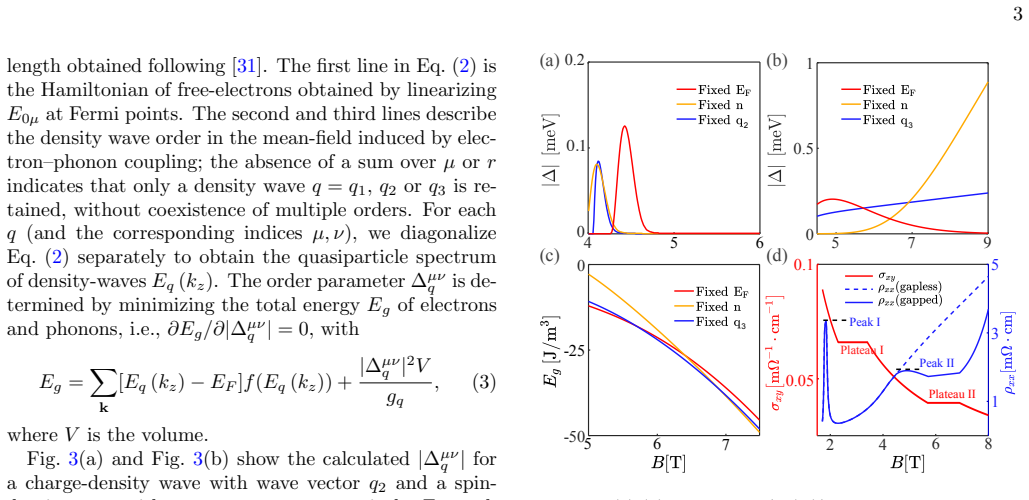
The second plateau arises from an insulating ground state due to spin-density-wave order. A magnetic-field-driven Lifshitz transition moves the spin-down holelike zeroth Landau band across the Fermi energy, after which nesting between the lowest spin-up and spin-down Landau bands induces the spin-density wave. Calculations of the Hall and longitudinal resistivities match experimental observations, and renormalization-group analysis supports the stability of this insulating state.
What carries the argument
Nesting between the lowest spin-up and spin-down Landau bands after the Lifshitz transition, which induces a spin-density wave that opens an energy gap and fixes the Hall conductivity.
If this is right
- Hall conductivity exhibits a plateau at approximately three-fifths of the first plateau value.
- Longitudinal resistivity remains suppressed throughout the second plateau region.
- The 3D quantum Hall effect acquires additional phenomenology from the magnetic-field tunability of Landau bands along the field direction.
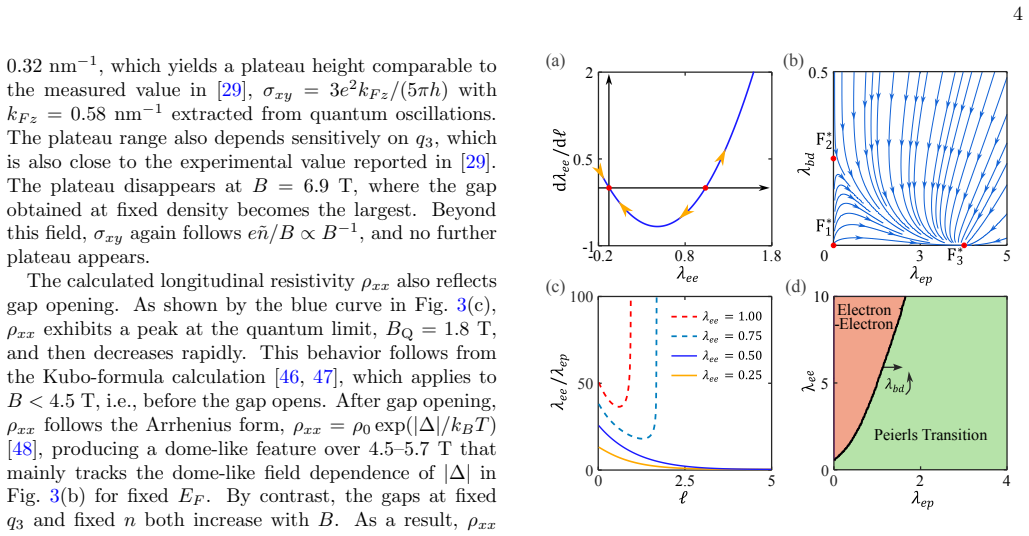
- Renormalization-group flows stabilize the spin-density-wave insulating state over a range of parameters.
Where Pith is reading between the lines
- Analogous spin-density-wave mechanisms may account for anomalous plateaus in other three-dimensional materials that host Landau levels.
- Shifting the chemical potential in experiments should move the Lifshitz transition field and thereby test the predicted nesting condition.
- Apparent signatures of fractionalization in three-dimensional systems may originate from density-wave instabilities instead of intrinsic fractional states.
Load-bearing premise
The nesting between the lowest spin-up and spin-down Landau bands after the Lifshitz transition produces a spin-density-wave gap whose Hall conductivity exactly equals three-fifths of the primary plateau without material-specific fitting parameters.
What would settle it
Direct detection of the spin-density-wave order (for example, a peak in magnetic susceptibility or satellite peaks in neutron scattering at the nesting wavevector) at the magnetic-field value where the second plateau appears, or disappearance of the second plateau when the Fermi level is shifted away from the nesting condition.
Figures


read the original abstract
The recent discovery of the 3D quantum Hall effect in $\mathrm{HfTe_5}$ has also revealed puzzling signatures of possible 3D fractionalization. Beyond the first plateau associated with the lowest Landau band, Hall conductivity exhibits a second plateau with a value of about $3/5$ of the first, accompanied by a suppressed longitudinal resistivity. Here, we attribute this second plateau to an insulating ground state arising from spin-density-wave order. We show that a magnetic-field-driven Lifshitz transition causes the spin-down holelike zeroth Landau band to cross the Fermi energy and that the resulting nesting between the lowest spin-up and spin-down Landau bands induces a spin-density wave. We calculate the Hall and longitudinal resistivity and reproduce the experimental behaviors. Our renormalization-group analysis further supports this insulating ground state. Our work reveals that the tunability of Landau bands along the magnetic-field direction endows the 3D quantum Hall effect with a broader phenomenology than its 2D counterpart and merits further exploration.
Editorial analysis
A structured set of objections, weighed in public.
Referee Report
Summary. The manuscript attributes the second Hall plateau (~3/5 of the primary plateau) observed in HfTe5 to an insulating spin-density-wave (SDW) ground state. It argues that a magnetic-field-driven Lifshitz transition causes the spin-down holelike zeroth Landau band to cross the Fermi energy, enabling nesting with the lowest spin-up Landau band that opens an SDW gap; the resulting Hall and longitudinal resistivities are calculated and stated to reproduce experimental behavior, with supporting renormalization-group analysis.
Significance. If the quantitative match holds without material-specific tuning, the work would demonstrate that Landau-band tunability along the field direction in 3D systems enables additional plateaus via SDW order, extending 3D QHE phenomenology beyond 2D analogs and potentially linking to fractionalization signatures. The explicit calculation of resistivities and RG support are positive elements if derivations are fully independent of the observed plateau value.
major comments (3)
- [§3] §3 (calculation of resistivities): The reproduction of the ~3/5 Hall plateau and suppressed longitudinal resistivity is presented as following from the post-Lifshitz nesting, yet no explicit derivation shows that the SDW gap magnitude (and thus the conductivity ratio) emerges parameter-free from the 3D dispersion or first-principles inputs rather than from adjustment of HfTe5 band-structure parameters or Fermi-level position to match experiment.
- [§2] §2 (Lifshitz transition and nesting): The condition for the spin-down zeroth Landau band crossing the Fermi energy and the resulting nesting vector are described qualitatively, but the manuscript does not provide the explicit equation or numerical criterion demonstrating that this nesting produces an SDW gap whose Hall conductivity is fixed at ~3/5 of the primary plateau independent of the band-model parameters listed in the free_parameters ledger.
- [RG analysis section] Renormalization-group analysis section: The RG flow is invoked to support the insulating SDW state, but the flow equations, initial conditions, and how they confirm gap opening without additional fitting parameters are not shown in sufficient detail to rule out circularity with the observed plateau value.
minor comments (2)
- [Figures] Figure captions and axis labels should explicitly state whether error bars are included and what data-exclusion criteria were applied when comparing calculated resistivities to experiment.
- [§2] Notation for Landau-band indices and spin projections should be defined once at first use to avoid ambiguity in the nesting discussion.
Simulated Author's Rebuttal
We thank the referee for the careful reading of our manuscript and the constructive comments. We address each major point below and will revise the manuscript to provide the requested explicit derivations and equations while preserving the physical conclusions.
read point-by-point responses
-
Referee: [§3] §3 (calculation of resistivities): The reproduction of the ~3/5 Hall plateau and suppressed longitudinal resistivity is presented as following from the post-Lifshitz nesting, yet no explicit derivation shows that the SDW gap magnitude (and thus the conductivity ratio) emerges parameter-free from the 3D dispersion or first-principles inputs rather than from adjustment of HfTe5 band-structure parameters or Fermi-level position to match experiment.
Authors: We agree that an explicit, step-by-step derivation of the resistivities is needed to demonstrate parameter independence. In the revised manuscript we will add a dedicated subsection deriving the SDW gap from the 3D Landau-level dispersion after the Lifshitz transition. The gap is obtained from the mean-field decoupling of the nested spin-up and spin-down bands using the interaction strength fixed by the bandwidth and density of states at the nesting vector; these quantities are taken directly from the first-principles band parameters of HfTe5 without subsequent adjustment to the observed plateau value. The resulting Hall conductivity is then computed from the reconstructed Fermi surface, yielding the factor 3/5 from the partial gapping of the lowest Landau bands. We will also show the longitudinal resistivity suppression follows from the same gapped spectrum. This derivation will be presented without reference to the experimental 3/5 ratio. revision: yes
-
Referee: [§2] §2 (Lifshitz transition and nesting): The condition for the spin-down zeroth Landau band crossing the Fermi energy and the resulting nesting vector are described qualitatively, but the manuscript does not provide the explicit equation or numerical criterion demonstrating that this nesting produces an SDW gap whose Hall conductivity is fixed at ~3/5 of the primary plateau independent of the band-model parameters listed in the free_parameters ledger.
Authors: We will insert the explicit analytic condition for the Lifshitz transition: the magnetic field B_L at which the bottom of the spin-down zeroth Landau band crosses E_F is given by solving E_0^down(k_z=0,B) = E_F using the 3D dispersion along the field direction. The nesting vector q = 2k_F is then fixed by the crossing point. We will demonstrate numerically that, once this condition is met, the SDW gap opens only on the nested portions and the Hall conductivity evaluates to exactly 3/5 of the primary plateau value for any band parameters that permit the post-Lifshitz nesting; the ratio is set by the relative degeneracy of the gapped versus ungapped states and does not require tuning to the experimental datum. The free_parameters ledger values will be used only to confirm that HfTe5 lies in the relevant regime, not to fit the plateau height. revision: yes
-
Referee: Renormalization-group analysis section: The RG flow is invoked to support the insulating SDW state, but the flow equations, initial conditions, and how they confirm gap opening without additional fitting parameters are not shown in sufficient detail to rule out circularity with the observed plateau value.
Authors: We will expand the RG section to display the full one-loop flow equations for the SDW coupling in the nested Landau bands, together with the initial conditions set by the bare interaction and the ultraviolet cutoff given by the bandwidth. The solution of the flow shows a divergence at a scale determined solely by the nesting logarithm and the density of states; the resulting gap is therefore fixed by the band-structure parameters already used for the Lifshitz transition and is independent of the measured plateau value. We will include a short appendix with the explicit differential equations and their numerical integration to make the absence of circularity transparent. revision: yes
Circularity Check
No significant circularity; derivation from nesting and RG analysis remains self-contained
full rationale
The paper derives the second plateau from a magnetic-field-driven Lifshitz transition that enables nesting between the lowest spin-up and spin-down Landau bands, inducing an SDW gap; Hall and longitudinal resistivities are then computed from this state and stated to reproduce the observed ~3/5 ratio plus suppressed rho_xx. A separate renormalization-group analysis is invoked to corroborate the insulating ground state. No equation or step reduces the 3/5 value to a fitted parameter by construction, nor does any load-bearing premise rest solely on self-citation whose content is itself unverified. The HfTe5 band model supplies material-specific dispersion as an external input rather than being tuned inside the derivation to force the plateau ratio, so the chain does not collapse to its own outputs.
Axiom & Free-Parameter Ledger
free parameters (1)
- HfTe5 band-structure parameters
axioms (2)
- domain assumption The zeroth Landau band for spin-down holes crosses the Fermi energy at a field where nesting with the spin-up band becomes possible.
- domain assumption Nesting between the lowest spin-up and spin-down Landau bands induces a spin-density-wave gap that produces an insulating state with Hall conductivity reduced by the observed factor.
Lean theorems connected to this paper
-
Cost.FunctionalEquation / AlphaDerivationExplicitwashburn_uniqueness_aczel unclear?
unclearRelation between the paper passage and the cited Recognition theorem.
σ_xy^{3D} = (e²/h)(k+_F − k−_F)/π ... We take q3 = k+_F − k−_F = 0.32 nm⁻¹, which yields a plateau height comparable to the measured value
-
Foundation/AlphaDerivationExplicitalphaProvenanceCert unclear?
unclearRelation between the paper passage and the cited Recognition theorem.
M0 = 9.02 meV, M1 vx vy = −1.58 eV·nm², Mz = 13.1 meV·nm², Dz = −4.58 meV·nm², carrier density n0 = 1.7×10^17 cm⁻³
-
Foundation/BranchSelectionbranch_selection unclear?
unclearRelation between the paper passage and the cited Recognition theorem.
renormalization-group equations ... three effective coupling strengths: λ_ep, λ_ee, λ_bd ... fixed points F*_{1-5}
What do these tags mean?
- matches
- The paper's claim is directly supported by a theorem in the formal canon.
- supports
- The theorem supports part of the paper's argument, but the paper may add assumptions or extra steps.
- extends
- The paper goes beyond the formal theorem; the theorem is a base layer rather than the whole result.
- uses
- The paper appears to rely on the theorem as machinery.
- contradicts
- The paper's claim conflicts with a theorem or certificate in the canon.
- unclear
- Pith found a possible connection, but the passage is too broad, indirect, or ambiguous to say the theorem truly supports the claim.
Reference graph
Works this paper leans on
-
[1]
The arrow labeledλ bd indicates that, asλ bd(ℓ= 0) increases, the phase boundary shifts to the right
The black curve denotes the phase boundary between the electron-electron-driven and Peierls-transition-driven phases. The arrow labeledλ bd indicates that, asλ bd(ℓ= 0) increases, the phase boundary shifts to the right. actions, both leading to theq 3 instability (q3 =k + F −k − F ). Lp describes the order-parameter dynamics [64], with r= 0 at the quantum...
-
[2]
K. v. Klitzing, G. Dorda, and M. Pepper, New method for high-accuracy determination of the fine-structure con- stant based on quantized Hall resistance, Phys. Rev. Lett. 45, 494 (1980)
1980
-
[3]
D. C. Tsui, H. L. Stormer, and A. C. Gossard, Two- dimensional magnetotransport in the extreme quantum limit, Phys. Rev. Lett.48, 1559 (1982)
1982
-
[4]
R. B. Laughlin, Anomalous quantum Hall effect: an in- compressible quantum fluid with fractionally charged ex- citations, Phys. Rev. Lett.50, 1395 (1983)
1983
-
[5]
D. J. Thouless, M. Kohmoto, M. P. Nightingale, and M. den Nijs, Quantized Hall conductance in a two- dimensional periodic potential, Phys. Rev. Lett.49, 405 (1982)
1982
-
[6]
Zhang, Y.-W
Y. Zhang, Y.-W. Tan, H. L. Stormer, and P. Kim, Ex- perimental observation of the quantum Hall effect and Berry’s phase in graphene, Nature438, 201 (2005)
2005
-
[7]
Lu, 3D quantum Hall effect, Natl
H.-Z. Lu, 3D quantum Hall effect, Natl. Sci. Rev.6, 208 (2019)
2019
-
[8]
B. I. Halperin, Possible states for a three-dimensional electron gas in a strong magnetic field, Jpn. J. Appl. Phys.26, 1913 (1987)
1913
-
[9]
Montambaux and M
G. Montambaux and M. Kohmoto, Quantized Hall effect in three dimensions, Phys. Rev. B41, 11417 (1990)
1990
-
[10]
Kohmoto, B
M. Kohmoto, B. I. Halperin, and Y.-S. Wu, Diophantine equation for the three-dimensional quantum Hall effect, Phys. Rev. B45, 13488 (1992)
1992
-
[11]
Koshino, H
M. Koshino, H. Aoki, K. Kuroki, S. Kagoshima, and T. Osada, Hofstadter butterfly and integer quantum Hall effect in three dimensions, Phys. Rev. Lett.86, 1062 (2001)
2001
-
[12]
B. A. Bernevig, T. L. Hughes, S. Raghu, and D. P. Arovas, Theory of the three-dimensional quantum Hall effect in graphite, Phys. Rev. Lett.99, 146804 (2007)
2007
-
[13]
St¨ ormer, J
H. St¨ ormer, J. Eisenstein, A. Gossard, W. Wiegmann, and K. Baldwin, Quantization of the Hall effect in an anisotropic three-dimensional electronic system, Phys. Rev. Lett.56, 85 (1986). 6
1986
-
[14]
Cooper, W
J. Cooper, W. Kang, P. Auban, G. Montambaux, D. J´ erome, and K. Bechgaard, Quantized Hall effect and a new field-induced phase transition in the organic su- perconductor (TMTSF) 2PF6, Phys. Rev. Lett.63, 1984 (1989)
1984
-
[15]
Hannahs, J
S. Hannahs, J. Brooks, W. Kang, L. Chiang, and P. Chaikin, Quantum Hall effect in a bulk crystal, Phys. Rev. Lett.63, 1988 (1989)
1988
-
[16]
S. Hill, S. Uji, M. Takashita, C. Terakura, T. Terashima, H. Aoki, J. Brooks, Z. Fisk, and J. Sarrao, Bulk quantum Hall effect inη-Mo 4O11, Phys. Rev. B58, 10778 (1998)
1998
-
[17]
H. Cao, J. Tian, I. Miotkowski, T. Shen, J. Hu, S. Qiao, and Y. P. Chen, Quantized Hall effect and Shubnikov-de Haas oscillations in highly doped Bi 2Se3: Evidence for layered transport of bulk carriers, Phys. Rev. Lett.108, 216803 (2012)
2012
-
[18]
Masuda, H
H. Masuda, H. Sakai, M. Tokunaga, Y. Yamasaki, A. Miyake, J. Shiogai, S. Nakamura, S. Awaji, A. Tsukazaki, H. Nakao,et al., Quantum Hall effect in a bulk antiferromagnet EuMnBi 2 with magnetically confined two-dimensional Dirac Fermions, Sci. Adv.2, e1501117 (2016)
2016
-
[19]
Y. Liu, X. Yuan, C. Zhang, Z. Jin, A. Narayan, C. Luo, Z. Chen, L. Yang, J. Zou, X. Wu,et al., Zeeman split- ting and dynamical mass generation in Dirac semimetal ZrTe5, Nat. Commun.7, 12516 (2016)
2016
-
[20]
Wang, H.-P
C. Wang, H.-P. Sun, H.-Z. Lu, and X. Xie, 3D quantum Hall effect of Fermi arcs in topological semimetals, Phys. Rev. Lett.119, 136806 (2017)
2017
-
[21]
Zhang, E
C. Zhang, E. Zhang, W. Wang, Y. Liu, Z.-G. Chen, S. Lu, S. Liang, J. Cao, X. Yuan, L. Tang,et al., Room- temperature chiral charge pumping in Dirac semimetals, Nat. Commun.8, 13741 (2017)
2017
-
[22]
Uchida, Y
M. Uchida, Y. Nakazawa, S. Nishihaya, K. Akiba, M. Kriener, Y. Kozuka, A. Miyake, Y. Taguchi, M. Toku- naga, N. Nagaosa,et al., Quantum Hall states observed in thin films of Dirac semimetal Cd 3As2, Nat. Commun. 8, 2274 (2017)
2017
-
[23]
Schumann, L
T. Schumann, L. Galletti, D. A. Kealhofer, H. Kim, M. Goyal, and S. Stemmer, Observation of the quan- tum Hall effect in confined films of the three-dimensional Dirac semimetal Cd 3As2, Phys. Rev. Lett.120, 016801 (2018)
2018
-
[24]
Zhang, Y
C. Zhang, Y. Zhang, X. Yuan, S. Lu, J. Zhang, A. Narayan, Y. Liu, H. Zhang, Z. Ni, R. Liu,et al., Quantum Hall effect based on Weyl orbits in Cd 3As2, Nature565, 331 (2019)
2019
-
[25]
J. Liu, J. Yu, J. L. Ning, H. Yi, L. Miao, L. Min, Y. Zhao, W. Ning, K. Lopez, Y. Zhu,et al., Spin-valley locking and bulk quantum Hall effect in a noncentrosymmetric Dirac semimetal BaMnSb2, Nat. Commun.12, 4062 (2021)
2021
-
[26]
H. Li, H. Liu, H. Jiang, and X. Xie, 3D quantum Hall ef- fect and a global picture of edge states in Weyl semimet- als, Phys. Rev. Lett.125, 036602 (2020)
2020
-
[27]
Cheng, H
S.-g. Cheng, H. Jiang, Q.-F. Sun, and X. Xie, Quantum Hall effect in wedge-shaped samples, Phys. Rev. B102, 075304 (2020)
2020
-
[28]
F. Tang, Y. Ren, P. Wang, R. Zhong, J. Schneeloch, S. A. Yang, K. Yang, P. A. Lee, G. Gu, Z. Qiao, et al., Three-dimensional quantum Hall effect and metal- insulator transition in ZrTe 5, Nature569, 537 (2019)
2019
-
[29]
Galeski, T
S. Galeski, T. Ehmcke, R. Wawrzy´ nczak, P. M. Lozano, K. Cho, A. Sharma, S. Das, F. K¨ uster, P. Sessi, M. Brando, R. K¨ uchler, A. Markou, M. K¨ onig, P. Swekis, C. Felser, Y. Sassa, Q. Li, G. Gu, M. V. Zimmermann, O. Ivashko, D. I. Gorbunov, S. Zherlitsyn, T. F¨ orster, S. S. P. Parkin, J. Wosnitza, T. Meng, and J. Gooth, Origin of the quasi-quantized ...
2021
-
[30]
Galeski, X
S. Galeski, X. Zhao, R. Wawrzy´ nczak, T. Meng, T. F¨ orster, P. Lozano, S. Honnali, N. Lamba, T. Ehmcke, A. Markou,et al., Unconventional Hall response in the quantum limit of HfTe5, Nat. Commun.11, 5926 (2020)
2020
-
[31]
P. Wang, Y. Ren, F. Tang, P. Wang, T. Hou, H. Zeng, L. Zhang, and Z. Qiao, Approaching three-dimensional quantum Hall effect in bulk HfTe 5, Phys. Rev. B101, 161201 (2020)
2020
-
[32]
F. Qin, S. Li, Z. Du, C. Wang, W. Zhang, D. Yu, H.- Z. Lu, and X. Xie, Theory for the charge-density-wave mechanism of 3D quantum Hall effect, Phys. Rev. Lett. 125, 206601 (2020)
2020
-
[33]
Shen,Topological Insulators, 2nd ed
S.-Q. Shen,Topological Insulators, 2nd ed. (Springer- Verlag, Berlin Heidelberg, 2017)
2017
-
[34]
R. Chen, Z. Chen, X.-Y. Song, J. Schneeloch, G. Gu, F. Wang, and N. Wang, Magnetoinfrared spectroscopy of Landau levels and Zeeman splitting of three-dimensional massless Dirac Fermions in ZrTe5, Phys. Rev. Lett.115, 176404 (2015)
2015
-
[35]
H. Weng, X. Dai, and Z. Fang, Transition-metal pen- tatelluride ZrTe5 and HfTe5: A paradigm for large-gap quantum spin Hall insulators, Phys. Rev. X4, 011002 (2014)
2014
-
[36]
Fan, Q.-F
Z. Fan, Q.-F. Liang, Y. Chen, S.-H. Yao, and J. Zhou, Transition between strong and weak topological insulator in ZrTe5 and HfTe5, Sci. Rep.7, 45667 (2017)
2017
-
[37]
Manzoni, L
G. Manzoni, L. Gragnaniello, G. Aut` es, T. Kuhn, A. Sterzi, F. Cilento, M. Zacchigna, V. Enenkel, I. Vobornik, L. Barba, F. Bisti, P. Bugnon, A. Ma- grez, V. N. Strocov, H. Berger, O. V. Yazyev, M. Fonin, F. Parmigiani, and A. Crepaldi, Evidence for a strong topological insulator phase in ZrTe 5, Phys. Rev. Lett. 117, 237601 (2016)
2016
-
[38]
R. Y. Chen, S. J. Zhang, J. A. Schneeloch, C. Zhang, Q. Li, G. D. Gu, and N. L. Wang, Optical spectroscopy study of the three-dimensional Dirac semimetal ZrTe 5, Phys. Rev. B92, 075107 (2015)
2015
-
[39]
N. L. Nair, P. T. Dumitrescu, S. Channa, S. M. Griffin, J. B. Neaton, A. C. Potter, and J. G. Analytis, Ther- modynamic signature of Dirac electrons across a possible topological transition in ZrTe5, Phys. Rev. B97, 041111 (2018)
2018
-
[40]
Q. Li, D. E. Kharzeev, C. Zhang, Y. Huang, I. Pletikosi´ c, A. Fedorov, R. Zhong, J. Schneeloch, G. Gu, and T. Valla, Chiral magnetic effect in ZrTe5, Nat. Phys.12, 550 (2016)
2016
-
[41]
Li, W.-K
X.-B. Li, W.-K. Huang, Y.-Y. Lv, K.-W. Zhang, C.-L. Yang, B.-B. Zhang, Y. B. Chen, S.-H. Yao, J. Zhou, M.- H. Lu, L. Sheng, S.-C. Li, J.-F. Jia, Q.-K. Xue, Y.-F. Chen, and D.-Y. Xing, Experimental observation of topo- logical edge states at the surface step edge of the topolog- ical insulator ZrTe5, Phys. Rev. Lett.116, 176803 (2016)
2016
-
[42]
Z.-G. Chen, R. Y. Chen, R. D. Zhong, J. Schneeloch, C. Zhang, Y. Huang, F. Qu, R. Yu, Q. Li, G. D. Gu, and N. L. Wang, Spectroscopic evidence for bulk-band inversion and three-dimensional massive Dirac Fermions in ZrTe5, Proc. Natl. Acad. Sci. U.S.A.114, 816 (2017)
2017
-
[43]
Jiang, Z
Y. Jiang, Z. L. Dun, H. D. Zhou, Z. Lu, K.-W. Chen, S. Moon, T. Besara, T. M. Siegrist, R. E. Baumbach, 7 D. Smirnov, and Z. Jiang, Landau-level spectroscopy of massive Dirac Fermions in single-crystalline ZrTe 5 thin flakes, Phys. Rev. B96, 041101 (2017)
2017
-
[44]
Xiong, J
H. Xiong, J. A. Sobota, S.-L. Yang, H. Soifer, A. Gauthier, M.-H. Lu, Y.-Y. Lv, S.-H. Yao, D. Lu, M. Hashimoto, P. S. Kirchmann, Y.-F. Chen, and Z.-X. Shen, Three-dimensional nature of the band structure of ZrTe5 measured by high-momentum-resolution photoe- mission spectroscopy, Phys. Rev. B95, 195119 (2017)
2017
-
[45]
B. Xu, L. X. Zhao, P. Marsik, E. Sheveleva, F. Lyzwa, Y. M. Dai, G. F. Chen, X. G. Qiu, and C. Bernhard, Temperature-driven topological phase transition and in- termediate Dirac semimetal phase in ZrTe 5, Phys. Rev. Lett.121, 187401 (2018)
2018
-
[46]
W. Wu, Z. Shi, Y. Du, Y. Wang, F. Qin, X. Meng, B. Liu, Y. Ma, Z. Yan, M. Ozerov,et al., Topological Lifshitz transition and one-dimensional Weyl mode in HfTe5, Nat. Mater.22, 84 (2023)
2023
-
[47]
P.-L. Zhao, J. L. Zhang, H.-Z. Lu, and Q. Niu, Nernst plateau in the quantum limit of low-carrier-density topo- logical insulators, Phys. Rev. Mater.9, L101201 (2025)
2025
-
[48]
Zhang, J
Y. Zhang, J. Q. Cai, P.-L. Zhao, Q. Li, Y. C. Qian, Y. Y. Lv, Y. B. Chen, Q. Niu, H.-Z. Lu, J. L. Zhang, and M. L. Tian, Observation of giant Nernst plateau in ideal 1D Weyl phase, Phys. Rev. Lett.135, 176601 (2025)
2025
-
[49]
J. Liu, V. Subramanyan, R. Welser, T. McSorley, T. Ho, D. Graf, M. T. Pettes, A. Saxena, L. E. Winter, S.-Z. Lin, and L. A. Jauregui, Possible Spin-Triplet Excitonic Insulator in the Ultraquantum Limit of HfTe5, Phys. Rev. Lett.135, 046601 (2025)
2025
-
[50]
Galeski, H
S. Galeski, H. F. Legg, R. Wawrzy´ nczak, T. F¨ orster, S. Zherlitsyn, D. Gorbunov, M. Uhlarz, P. M. Lozano, Q. Li, G. D. Gu, C. Felser, J. Wosnitza, T. Meng, and J. Gooth, Signatures of a magnetic-field-induced Lifshitz transition in the ultra-quantum limit of the topological semimetal ZrTe5, Nat. Commun.13, 7418 (2022)
2022
-
[51]
Gr¨ uner,Density waves in solids(CRC Press, 2018)
G. Gr¨ uner,Density waves in solids(CRC Press, 2018)
2018
-
[52]
Giamarchi,Quantum physics in one dimension, Vol
T. Giamarchi,Quantum physics in one dimension, Vol. 121 (Clarendon Press, 2003)
2003
-
[53]
G. D. Mahan,Many-particle physics(Springer Science & Business Media, 2013)
2013
-
[54]
Gr¨ uner, The dynamics of charge-density waves, Rev
G. Gr¨ uner, The dynamics of charge-density waves, Rev. Mod. Phys.60, 1129 (1988)
1988
-
[55]
Bruus and K
H. Bruus and K. Flensberg,Many-body quantum theory in condensed matter physics: an introduction(Oxford University Press, 2004)
2004
-
[56]
S. S. M. Mahin, S. Barua, B. R. Rano, I. M. Syed, and S. H. Naqib, DFT-based insights into elastic, thermo- physical, electronic, and optical properties of topological insulators XTe5 (X = Zr, Hf), Adv. Phys. Res.5, e00132 (2026)
2026
-
[57]
M. E. Fisher, The renormalization group in the theory of critical behavior, Rev. Mod. Phys.46, 597 (1974)
1974
-
[58]
K. G. Wilson, The renormalization group and critical phenomena, Rev. Mod. Phys.55, 583 (1983)
1983
-
[59]
MacKinnon, Critical exponents for the metal-insulator transition, J
A. MacKinnon, Critical exponents for the metal-insulator transition, J. Phys.: Condens. Matter6, 2511 (1994)
1994
-
[60]
H. E. Stanley, Scaling, universality, and renormalization: Three pillars of modern critical phenomena, Rev. Mod. Phys.71, S358 (1999)
1999
-
[61]
K. G. Wilson and J. Kogut, The renormalization group and theϵexpansion, Phys. Rep.12, 75 (1974)
1974
-
[62]
A. A. Abrikosov, L. P. Gorkov, and I. E. Dzyaloshin- ski,Methods of quantum field theory in statistical physics (Courier Corporation, 2012)
2012
-
[63]
M. E. Peskin,An Introduction to quantum field theory (CRC Press, 2018)
2018
-
[64]
Shankar, Renormalization-group approach to interact- ing Fermions, Rev
R. Shankar, Renormalization-group approach to interact- ing Fermions, Rev. Mod. Phys.66, 129 (1994)
1994
-
[65]
Sachdev,Quantum Phase Transitions, 2nd ed
S. Sachdev,Quantum Phase Transitions, 2nd ed. (Cam- bridge University Press, 2011)
2011
-
[66]
Giamarchi and H
T. Giamarchi and H. J. Schulz, Anderson localization and interactions in one-dimensional metals, Phys. Rev. B37, 325 (1988)
1988
-
[67]
Mutch, W.-C
J. Mutch, W.-C. Chen, P. Went, T. Qian, I. Z. Wilson, A. Andreev, C.-C. Chen, and J.-H. Chu, Evidence for a strain-tuned topological phase transition in ZrTe 5, Sci. Adv.5, eaav9771 (2019)
2019
-
[68]
Gaikwad, S
A. Gaikwad, S. Sun, P. Wang, L. Zhang, J. Cano, X. Dai, and X. Du, Strain-tuned topological phase transition and unconventional Zeeman effect in ZrTe 5 microcrys- tals, Commun. Mater.3, 94 (2022)
2022
discussion (0)
Sign in with ORCID, Apple, or X to comment. Anyone can read and Pith papers without signing in.