Recognition: no theorem link
Semi-hyponormality of commuting pairs of Hilbert space operators
Pith reviewed 2026-05-12 01:19 UTC · model grok-4.3
The pith
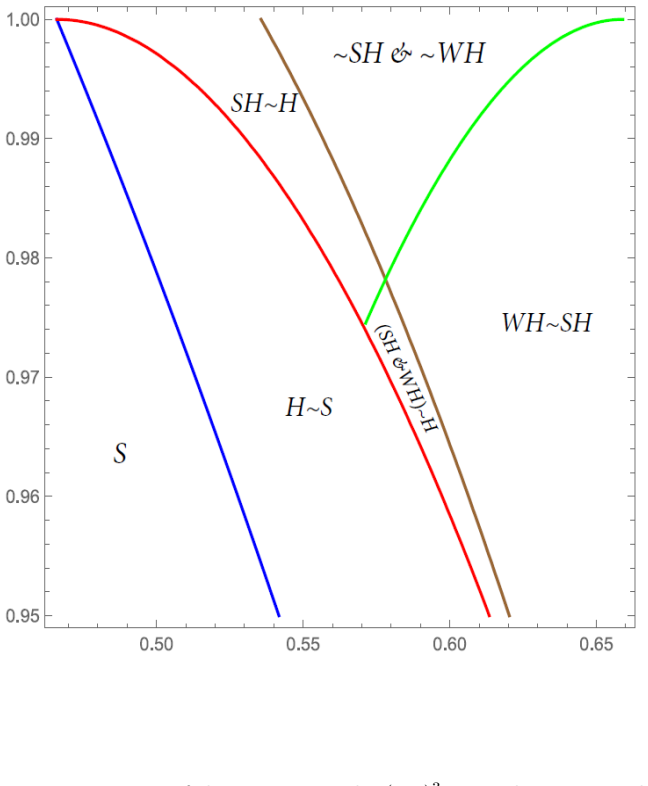
For a 3-parameter family of 2-variable weighted shifts, the exact regions in the unit cube are determined where subnormality, hyponormality, semi-hyponormality, and weak hyponormality each hold.
A machine-rendered reading of the paper's core claim, the machinery that carries it, and where it could break.
Core claim
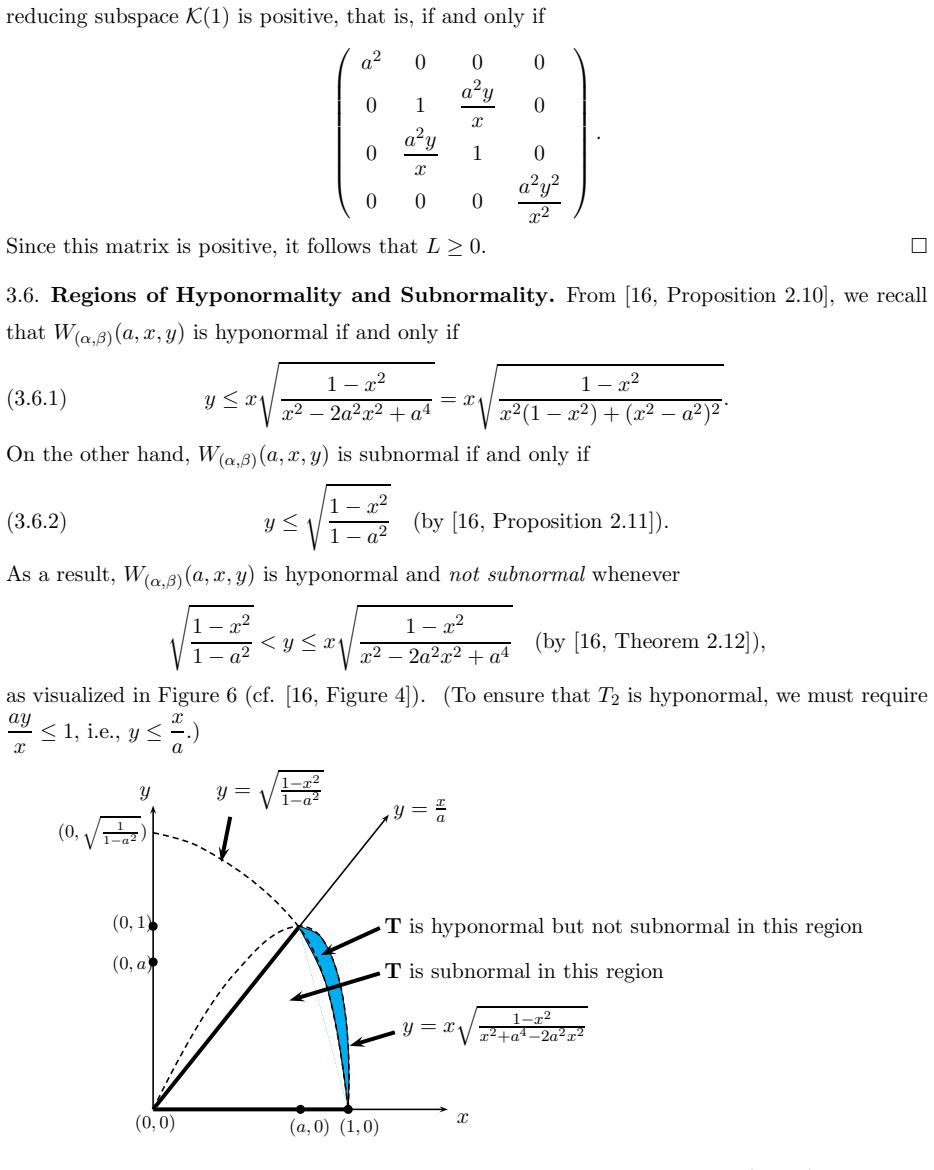
The central claim is that for the family W_{(α,β)}(a,x,y) of 2-variable weighted shifts with parameters in the open unit cube, the sets of points where the operator pair is subnormal, hyponormal, semi-hyponormal, or weakly hyponormal can be completely and explicitly described, with the semi-hyponormality condition reduced via homogeneous decomposition to positivity of certain 2x2 matrices, and with the Drury-Arveson shift shown to lie outside the semi-hyponormal region.
What carries the argument
The homogeneous orthogonal decomposition of ℓ²(ℤ₊²), which reduces semi-hyponormality of commuting pairs to positivity of a sequence of 2×2 scalar matrices, together with the explicit square-root formula for positive 2×2 operator matrices with commuting entries.
If this is right
- The specific sub-region where weak hyponormality holds but semi-hyponormality does not can be identified explicitly.
- The sub-region where semi-hyponormality holds but weak hyponormality fails can also be identified.
- The Drury-Arveson shift is not semi-hyponormal.
- These classifications provide a sharp contrast to the corresponding properties for one-variable weighted shifts.
- Concrete sub-regions for each of the four properties are described in detail.
Where Pith is reading between the lines
- This reduction technique may allow similar classifications for other families of commuting operator pairs in two or more variables.
- The separation between weak hyponormality and semi-hyponormality appears more pronounced in the multivariable setting than in the single-variable case.
- Applications could include checking these properties for other well-known shifts or operators in multivariable operator theory.
- The explicit square-root formula for 2x2 matrices might simplify computations in other problems involving positive operator matrices with commuting entries.
Load-bearing premise
The two operators in the pair must commute, so that the homogeneous orthogonal decomposition of the underlying space reduces the semi-hyponormality condition exactly to positivity of a sequence of 2 by 2 scalar matrices.
What would settle it
Compute the sequence of 2x2 matrices for the Drury-Arveson shift parameters and check whether any of them fails to be positive semidefinite; if all are positive then the claim that it is not semi-hyponormal would be false.
Figures



read the original abstract
We first find an explicit formula for the square root of positive $2 \times 2$ operator matrices with commuting entries, and then use it to define and study semi-hyponormality for commuting pairs of Hilbert space operators. \ For the well-known $3$--parameter family $W_{(\alpha,\beta)}(a,x,y)$ of $2$--variable weighted shifts, we completely identify the parametric regions in the open unit cube where $W_{(\alpha,\beta)}(a,x,y)$ is subnormal, hyponormal, semi-hyponormal, and weakly hyponormal. As a result, we describe in detail concrete sub-regions where each property holds. For instance, we identify the specific sub-region where weak hyponormality holds but semi-hyponormality does not hold, and vice versa. \ To accomplish this, we employ a new technique emanating from the homogeneous orthogonal decomposition of $\ell^2(\mathbb{Z}_+^2)$. The technique allows us to reduce the study of semi-hyponormality to positivity considerations of a sequence of $2 \times 2$ scalar matrices. It also requires a specific formula for the square root of $2 \times 2$ scalar and operator matrices, and we obtain that along the way. As an application of our main results, we show that the Drury-Arveson shift is {\it not} semi-hyponormal. Taken together, the new results offer a sharp contrast between the above-mentioned properties for unilateral weighted shifts and their $2$--variable counterparts.
Editorial analysis
A structured set of objections, weighed in public.
Referee Report
Summary. The paper derives an explicit formula for the square root of positive 2×2 operator matrices with commuting entries. It then applies a homogeneous orthogonal decomposition of ℓ²(ℤ₊²) to reduce semi-hyponormality of commuting pairs to positivity of a sequence of 2×2 scalar matrices. For the 3-parameter family W_{(α,β)}(a,x,y) of 2-variable weighted shifts, the paper claims to completely classify the open unit cube regions where the pair is subnormal, hyponormal, semi-hyponormal, or weakly hyponormal, and identifies concrete sub-regions distinguishing these properties. As an application, it shows that the Drury-Arveson shift is not semi-hyponormal.
Significance. If the classification and reduction hold, the work supplies the first complete parametric picture for these four properties on a standard 2-variable weighted shift family, highlighting concrete distinctions between weak hyponormality and semi-hyponormality that have no direct 1-variable analogue. The square-root formula for commuting 2×2 matrices is a self-contained technical contribution that may apply to other problems involving positive operator matrices.
major comments (2)
- [the section on the homogeneous orthogonal decomposition technique] The central reduction claim—that the homogeneous orthogonal decomposition reduces semi-hyponormality exactly to positivity of independent 2×2 scalar matrices—requires explicit verification that each (k+1)-dimensional block of RR* further decouples into 2-dimensional invariant subspaces with no cross terms. The standard grading gives blocks of size 2(k+1), so the decoupling step is load-bearing for the complete classification of semi-hyponormality regions.
- [the derivation of the square-root formula] The explicit square-root formula for positive 2×2 operator matrices with commuting entries is used to define semi-hyponormality; the paper should state the precise domain on which the formula is valid (e.g., whether the commuting entries must be normal or merely positive) and confirm that the formula applies without additional spectral assumptions to the weighted-shift blocks.
minor comments (2)
- [abstract] The abstract contains minor LaTeX artifacts (e.g., “{it not}”) that should be cleaned for the published version.
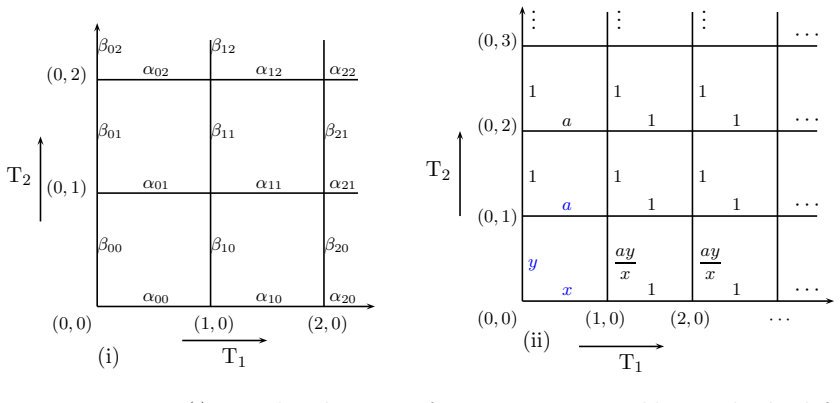
- [introduction] Notation for the family W_{(α,β)}(a,x,y) is introduced without an immediate reference to the precise weight definitions; a short displayed formula or table of the three parameters would improve readability.
Simulated Author's Rebuttal
We thank the referee for the careful reading of our manuscript and for the constructive major comments. We address each point below and will incorporate the suggested clarifications and verifications into the revised version.
read point-by-point responses
-
Referee: [the section on the homogeneous orthogonal decomposition technique] The central reduction claim—that the homogeneous orthogonal decomposition reduces semi-hyponormality exactly to positivity of independent 2×2 scalar matrices—requires explicit verification that each (k+1)-dimensional block of RR* further decouples into 2-dimensional invariant subspaces with no cross terms. The standard grading gives blocks of size 2(k+1), so the decoupling step is load-bearing for the complete classification of semi-hyponormality regions.
Authors: We appreciate the referee's emphasis on making the decoupling explicit. Section 3 of the manuscript introduces the homogeneous orthogonal decomposition of ℓ²(ℤ₊²) and shows that semi-hyponormality reduces to positivity of a sequence of 2×2 scalar matrices. To strengthen this, we will insert a new lemma immediately following the decomposition that computes the matrix entries of each (k+1)-dimensional block of RR* with respect to the standard grading. The lemma will verify by direct calculation that there are no cross terms between the 2-dimensional invariant subspaces, confirming that the blocks decouple independently. This addition will render the reduction fully rigorous and support the subsequent classification. revision: yes
-
Referee: [the derivation of the square-root formula] The explicit square-root formula for positive 2×2 operator matrices with commuting entries is used to define semi-hyponormality; the paper should state the precise domain on which the formula is valid (e.g., whether the commuting entries must be normal or merely positive) and confirm that the formula applies without additional spectral assumptions to the weighted-shift blocks.
Authors: We thank the referee for this clarification request. The square-root formula is derived in Section 2 for positive 2×2 operator matrices whose entries commute; the proof relies only on positivity and commutativity and does not assume normality of the entries. We will revise the statement of the theorem to specify this domain explicitly. In the application to the weighted-shift family, we will add a short paragraph confirming that each relevant block satisfies the positivity and commutativity hypotheses by construction of the weights, without invoking further spectral conditions. revision: yes
Circularity Check
Derivation self-contained via explicit square-root formula and homogeneous decomposition
full rationale
The paper first derives an explicit formula for the square root of positive 2×2 operator matrices with commuting entries, then applies the homogeneous orthogonal decomposition of ℓ²(ℤ₊²) to reduce semi-hyponormality checks for the 3-parameter weighted shift family W_{(α,β)}(a,x,y) to positivity of a sequence of 2×2 scalar matrices. The resulting parametric regions for subnormality, hyponormality, semi-hyponormality, and weak hyponormality are obtained directly from these positivity conditions and the new technique; no step reduces a claimed prediction or region to a fitted parameter by construction, nor does any load-bearing premise rest on a self-citation chain. The application to the Drury-Arveson shift provides an independent external check. The derivation is therefore self-contained.
Axiom & Free-Parameter Ledger
axioms (2)
- domain assumption Commuting positive operators admit a well-defined square root that can be expressed via an explicit 2×2 matrix formula when the entries commute.
- domain assumption The homogeneous orthogonal decomposition of ℓ²(ℤ₊²) reduces semi-hyponormality of the pair to positivity of a sequence of 2×2 scalar matrices.
Reference graph
Works this paper leans on
-
[1]
Ando, Operators with a norm condition, Acta Sci
T. Ando, Operators with a norm condition, Acta Sci. Math. (Szeged) 33(1972), 169–178
work page 1972
-
[2]
A. Aluthge, On p-hyponormal operators for 0 < p < 1, Integral Equations Operator Theory 13(1990), 307–315
work page 1990
-
[3]
Athavale, On joint hyponormality of operators, Proc
A. Athavale, On joint hyponormality of operators, Proc. Amer. Math. Soc. 103(1988), 417–423
work page 1988
-
[4]
A. Athavale and S. Podder, On the reflexivity of certain op erator tuples, Acta Sci. Math. (Szeged) 81(2015), 285–291
work page 2015
-
[5]
P. Auscher, S. Hofmann, M. Lacey, A. McIntosh and Ph. Tcha mitchian, The solution of the Kato square root problem for second order elliptic operators on Rn, Ann. of Math. (2) 156(2002), 633–654
work page 2002
-
[6]
Conway, The Theory of Subnormal Operators , Mathematical Surveys and Monographs, vol
J.B. Conway, The Theory of Subnormal Operators , Mathematical Surveys and Monographs, vol. 36, Amer. Math. Soc., Providence, 1991
work page 1991
-
[7]
J.B. Conway and W. Szymanski, Linear combinations of hyp onormal operators, Rocky Mountain J. Math. 18(1998), 695–705
work page 1998
-
[8]
Curto, Joint hyponormality: A bridge between hypon ormality and subnormality, Proc
R.E. Curto, Joint hyponormality: A bridge between hypon ormality and subnormality, Proc. Symposia Pure Math. 51(1990), 69–91
work page 1990
-
[9]
R.E. Curto and L.A. Fialkow, Recursively generated weig hted shifts and the subnormal completion problem, II, Integral Equations Operator Theory 18(1994), 369–426
work page 1994
-
[10]
R.E. Curto, S.H. Lee and J. Yoon, k-hyponormality of multivariable weighted shifts, J. Funct. Anal. 229(2005), 462–480
work page 2005
-
[11]
R.E. Curto, S.H. Lee and J. Yoon, Hyponormality and subn ormality for powers of commuting pairs of subnor- mal operators, J. Funct. Anal. 245(2007), 390–412
work page 2007
-
[12]
R.E. Curto, S.H. Lee and J. Yoon, Subnormality of 2–vari able weighted shifts with diagonal core, C.R. Acad. Sci. Paris, Ser. I 351(2013), 203-207
work page 2013
-
[13]
R. Curto, S.H. Lee and J. Yoon, Quasinormality of powers of commuting pairs of bounded operators, J. Funct. Anal. 278(2020), art. 108342
work page 2020
-
[14]
R.E. Curto, S.H. Lee and J. Yoon, Polynomial embeddings of unilateral weighted shifts into 2–variable weighted shifts, Integral Equations Operator Theory 93(2021), art. 64, 1-29
work page 2021
- [15]
-
[16]
R.E. Curto and J. Yoon, Jointly hyponormal pairs of subn ormal operators need not be jointly subnormal, Trans. Amer. Math. Soc. 358(2006), 5139–5159
work page 2006
-
[17]
R.E. Curto and J. Yoon, When is hyponormality for 2–vari able weighted shifts invariant under powers?, Indiana Univ. Math. J. 60(2011), 997–1032
work page 2011
-
[18]
R. Curto and J. Yoon, Aluthge transforms of 2–variable w eighted shifts, Integral Equations Operator Theory 90(2018), art. 52; 33 pp
work page 2018
-
[19]
R.E. Curto and J. Yoon, Spherical Aluthge transforms an d quasinormality for commuting pairs of operators, Trends in Mathematics , Birkh¨ auser Verlag, 2019, 213–237
work page 2019
- [20]
-
[21]
Furuta, Invitation to linear operators , Taylor and Francis, London, New York, 2002
T. Furuta, Invitation to linear operators , Taylor and Francis, London, New York, 2002. 36
work page 2002
-
[22]
R. Gellar and L.J. Wallen, Subnormal weighted shifts an d the Halmos-Bram criterion, Proc. Japan Acad. 46(1970), 375–378
work page 1970
-
[23]
Gleason, Quasinormality of Toeplitz tuples with ana lytic symbols, Houston J
J. Gleason, Quasinormality of Toeplitz tuples with ana lytic symbols, Houston J. Math. 32(2006), 293–298
work page 2006
-
[24]
N.P. Jewell and A.R. Lubin, Commuting weighted shifts a nd analytic function theory in several variables, J. Operator Theory 1(1979), 207–223
work page 1979
-
[25]
Kato, Integration of the equation of evolution in a Ba nach space, J
T. Kato, Integration of the equation of evolution in a Ba nach space, J. Math. Soc. Japan 5(1953), 208–234
work page 1953
-
[26]
H. Kim, J. Kim, and J. Yoon, Spherical Aluthge transform , spherical p and log–hyponormality of commuting pairs of operators, Linear Multilinear Algebra 70(2022), 2047–2064
work page 2022
-
[27]
H. Kim, J. Kim, and J. Yoon, Spherical Aluthge transform , spherical p and log–hyponormality of commuting pairs of operators II, Linear Multilinear Algebra 72(2023), 2134–2148
work page 2023
-
[28]
J. Mashreghi, M. Ptak and W.T. Ross, Square roots of some classical operators, Studia Math. 269(2023), 83–106
work page 2023
-
[29]
M.S. Moslehian, M. Kian, Q. Xu, Positivity of 2 × 2 block matrices of operators, Banach J. Math. Anal. 13(2019), 726–743
work page 2019
-
[30]
M.S. Moslehian and H. Osaka, Advanced Techniques with Block Matrices of Operators , Frontiers in Mathemat- ics, Birkh¨ auser, 2024
work page 2024
-
[31]
Smul’jan, An operator Hellinger integral Mat
J.L. Smul’jan, An operator Hellinger integral Mat. Sb. (N.S.) 49(1959), 381–430 (in Russian)
work page 1959
-
[32]
Mathematica, Version 13.2 , Wolfram Research Inc., Champaign, IL, 2022
Wolfram Research, Inc. Mathematica, Version 13.2 , Wolfram Research Inc., Champaign, IL, 2022
work page 2022
-
[33]
D. Xia, On the semi-hyponormal n-tuple of operators, Integral Equations Operator Theory 6(1983), 879–898. Department of Mathematics, The University of Iow a, Iow a Cit y, Iow a 52242 Email address : raul-curto@uiowa.edu School of Mathematical and Statistical Sciences, The Unive rsity of Texas Rio Grande V alley, Edinburg, Texas 78539, USA Email address : ...
work page 1983
discussion (0)
Sign in with ORCID, Apple, or X to comment. Anyone can read and Pith papers without signing in.