Recognition: 2 theorem links
· Lean TheoremHadronic Scenario for Galactic PeVatron LHAASO J1912+1014u Supported by Fermi-LAT γ-ray Data and FUGIN CO Data
Pith reviewed 2026-05-08 19:09 UTC · model grok-4.3
The pith
Fermi-LAT and FUGIN CO data favor a hadronic scenario for the PeVatron LHAASO J1912+1014u.
A machine-rendered reading of the paper's core claim, the machinery that carries it, and where it could break.
Core claim
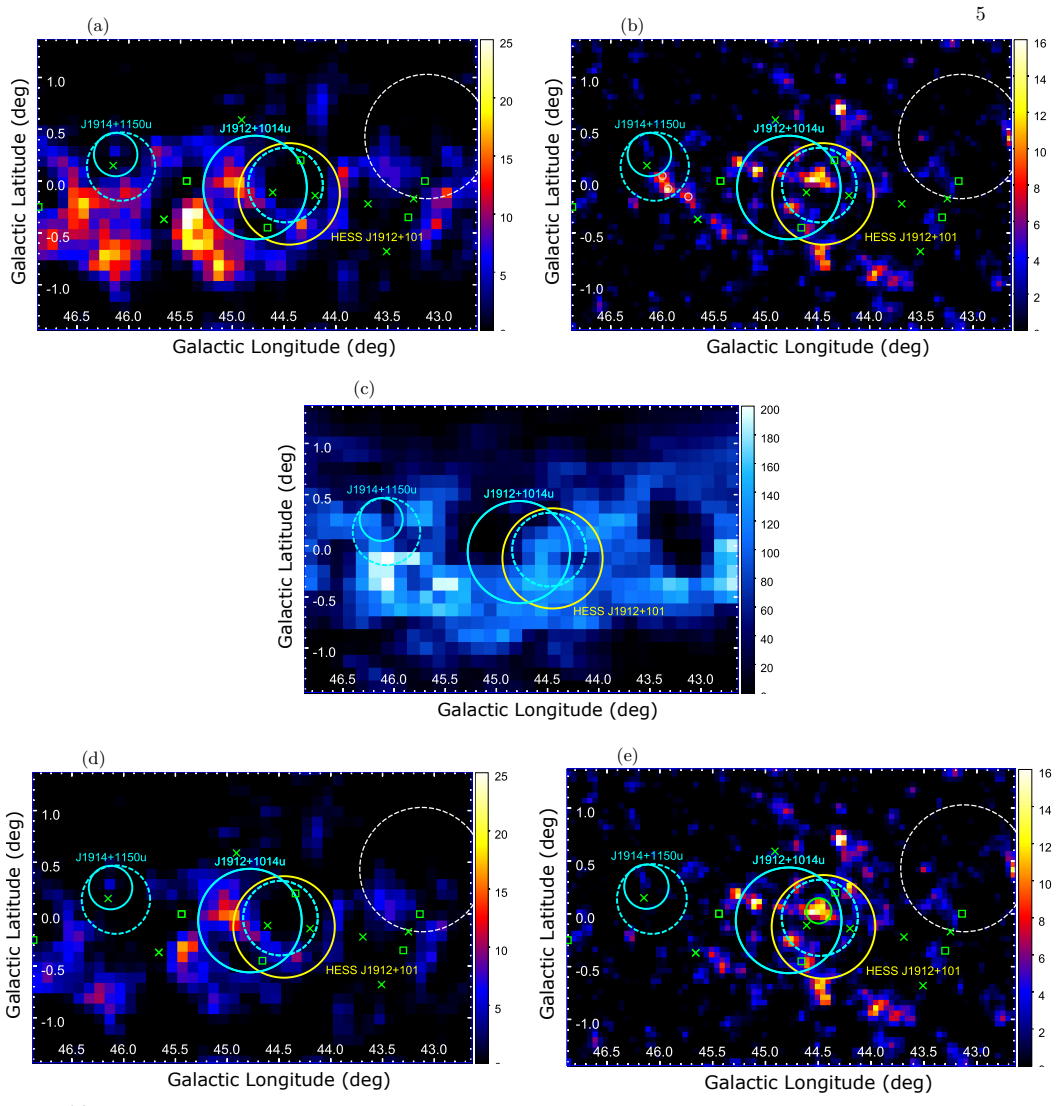
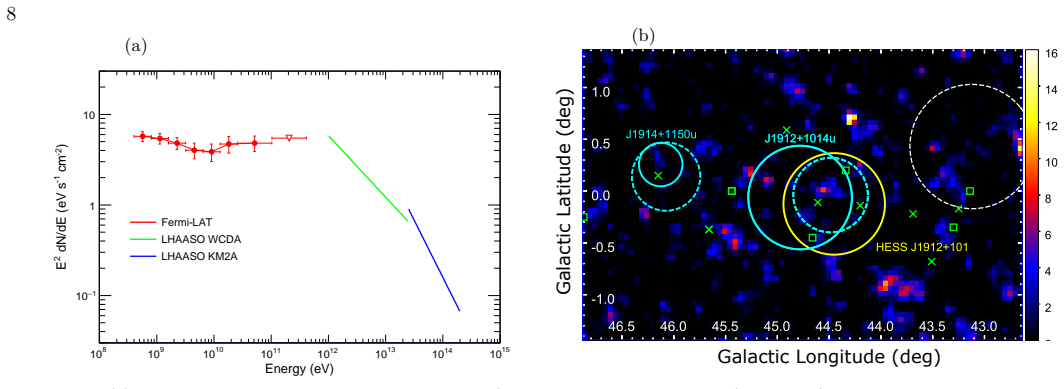
The authors establish that the gamma-ray emission from LHAASO J1912+1014u is produced by cosmic-ray protons interacting with dense interstellar gas, because the GeV excess exhibits a hard spectrum that aligns spatially and kinematically with CO-traced clouds at 25 or 60 km/s, and the resulting proton spectrum of index 2.2 with total energy (1-5) x 10^49 erg above 1 GeV naturally accounts for the sub-PeV emission observed by LHAASO and H.E.S.S.
What carries the argument
Kinematic and spatial association of the GeV gamma-ray excess with specific velocity components of interstellar gas traced by FUGIN CO data, used as templates in spectral energy distribution modeling that accounts for electron cooling.
If this is right
- The source accelerates cosmic-ray protons to at least PeV energies with a total energy budget of order 10^49 erg.
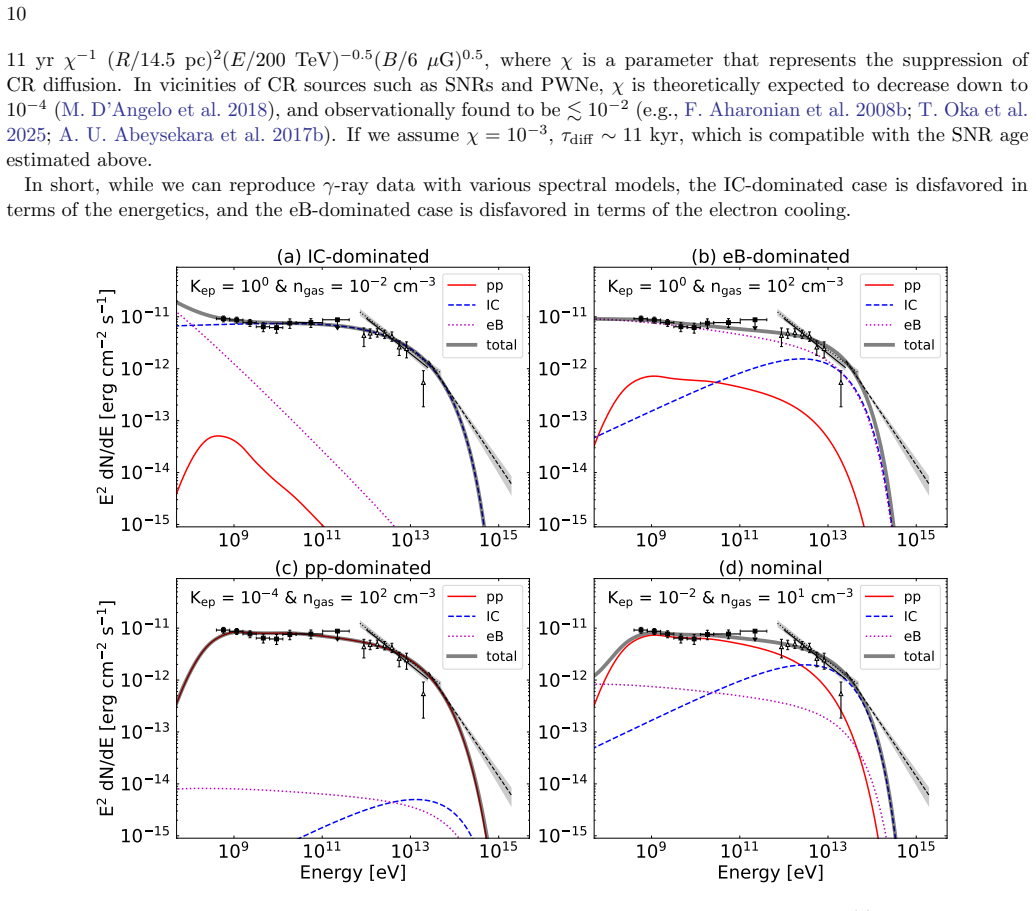
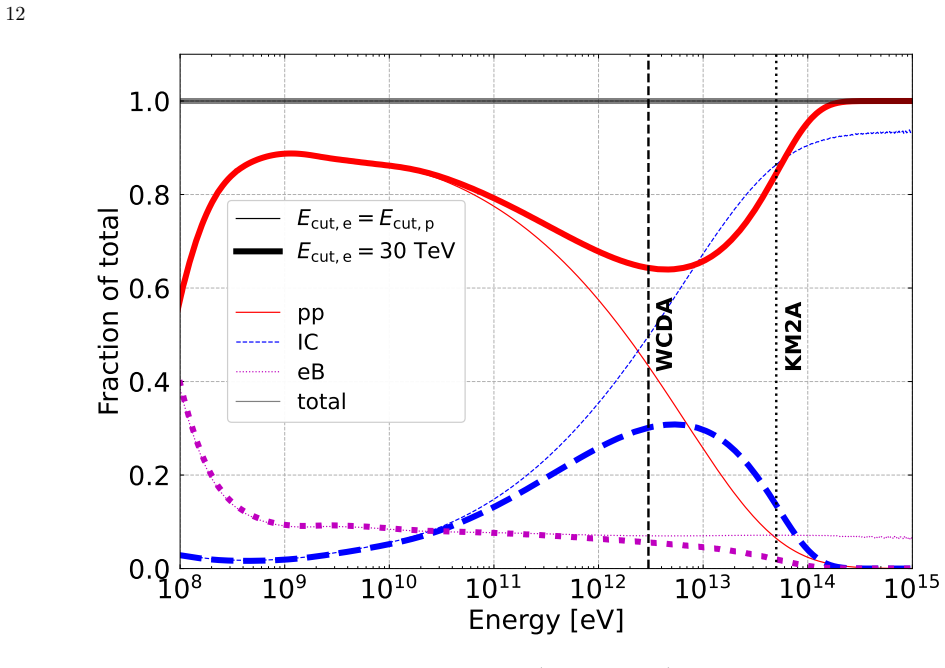
- Hadronic processes dominate the observed gamma-ray spectrum once electron energy losses are included.
- Similar velocity-resolved gas templates can help classify other LHAASO sub-PeV sources as proton or electron accelerators.
- Upper limits on diffuse X-rays constrain any leptonic contribution and reinforce the proton scenario.
Where Pith is reading between the lines
- Velocity-resolved CO maps combined with refined diffuse gamma-ray models offer a practical way to test hadronic origins for other unidentified PeVatrons.
- The inferred proton energy content suggests that a modest number of such Galactic sources could supply a noticeable fraction of the local cosmic-ray density at PeV energies.
- Future higher-resolution X-ray or neutrino observations could independently confirm or rule out the proton acceleration claim.
Load-bearing premise
The GeV excess is physically linked to the interstellar gas at 25 or 60 km/s rather than arising from residuals in the diffuse model or unrelated emission.
What would settle it
A clear spatial or kinematic mismatch between the GeV excess and the CO distribution at 25 or 60 km/s, or detection of diffuse X-ray emission above the reported upper limit, would undermine the hadronic PeVatron interpretation.
Figures






read the original abstract
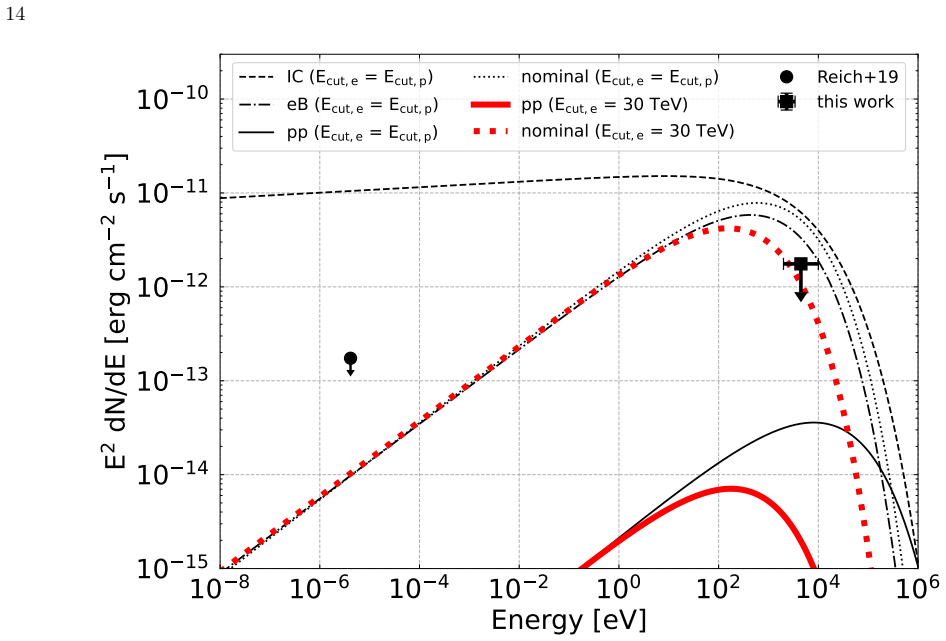
LHAASO has reported 43 sub-PeV $\gamma$-ray sources, which are promising candidates for cosmic-ray (CR) accelerators above the PeV energy, commonly called as PeVatrons. Multi-wavelength observations are crucial for identifying the underlying particle species and estimating the CR energy content of these sources. In this work we investigate the region around LHAASO J1912+1014u (and HESS J1912+101) using Fermi-LAT $\gamma$-ray data and FUGIN CO data. We analyzed 15 years of Fermi-LAT data in the 0.4--409.6 GeV energy range. By improving the standard Fermi-LAT diffuse emission model, we significantly reduced the large residuals around the source in the 1.6-12.8 GeV band. We detected a statistically significant excess above the diffuse background, which likely represents $\ge$10 GeV emission associated with the LHAASO/H.E.S.S. source. The GeV excess exhibits a hard spectrum (photon index of about 2.1) and is well reproduced by interstellar gas templates with systemic velocities of about 25 $\mathrm{km~s^{-1}}$ or 60 $\mathrm{km~s^{-1}}$. We performed a comprehensive fit to the GeV--TeV spectral energy distribution. Although a leptonic scenario can reproduce the observed spectrum, a hadronic scenario is favored once electron cooling is considered. The inferred CR proton spectrum has an index of $\sim$2.2, and the total CR proton energy above 1 GeV is (1--5) $\times 10^{49}~\mathrm{erg}$, depending on the assumed velocity range of the associated interstellar gas. A stringent upper limit on diffuse X-ray emission further supports the proton PeVatron scenario.
Editorial analysis
A structured set of objections, weighed in public.
Referee Report
Summary. The manuscript analyzes 15 years of Fermi-LAT data (0.4-409.6 GeV) around LHAASO J1912+1014u, improving the standard diffuse emission model to reduce residuals in the 1.6-12.8 GeV band and detect a statistically significant GeV excess with photon index ~2.1. This excess is spatially and kinematically matched to FUGIN CO templates at systemic velocities of ~25 or 60 km/s. A GeV-TeV SED fit shows that while a leptonic model can reproduce the data, a hadronic scenario is preferred once electron cooling is included, yielding a CR proton index of ~2.2 and total energy (1-5)×10^49 erg above 1 GeV (depending on velocity range). An X-ray upper limit is cited to further support the hadronic PeVatron interpretation.
Significance. If the kinematic association is robust, the result supplies multi-wavelength constraints on a candidate Galactic PeVatron, with the derived proton energy budget representing a plausible fraction of a supernova remnant's output and a hard spectrum consistent with efficient acceleration to PeV energies. The improved diffuse modeling and direct use of velocity-resolved gas templates are methodological strengths that could be applied to other LHAASO sources.
major comments (4)
- [Fermi-LAT analysis and CO template correlation] The physical association of the GeV excess with the specific 25 or 60 km/s CO components is load-bearing for the hadronic claim and the subsequent energy budget. The manuscript should quantify this association (e.g., via spatial correlation coefficients, TS maps, or explicit tests against other velocity slices) to address velocity crowding and distance ambiguity in the inner Galaxy.
- [SED fitting section] The preference for the hadronic scenario after including electron cooling requires explicit statistical support. The paper should report fit statistics (likelihood ratio or Δχ²) comparing leptonic and hadronic models both with and without cooling, and specify the assumed B-field strength and target photon fields used for the cooling calculation.
- [Results and discussion of energy content] The reported CR proton energy range (1-5)×10^49 erg depends on the chosen velocity component and associated distance. Systematic uncertainties from gas-mass estimation, distance ambiguity, and residual diffuse-model systematics must be propagated and discussed explicitly rather than presented as a simple range.
- [X-ray constraints paragraph] The X-ray upper limit is invoked to support the proton scenario, but the manuscript should derive the expected synchrotron flux from the best-fit leptonic electron spectrum (including the same cooling assumptions) and show that it exceeds the observed limit by a quantified factor.
minor comments (2)
- [Abstract and introduction] Clarify in the text whether LHAASO J1912+1014u and HESS J1912+101 refer to the same object or overlapping regions, and update the abstract accordingly.
- [Figures] Ensure residual maps (before/after diffuse-model improvement) and SED panels are labeled with exact energy bands, model components, and statistical significance values for clarity.
Simulated Author's Rebuttal
We thank the referee for their constructive and detailed comments, which have identified several areas where the manuscript can be strengthened. We address each major comment below and will incorporate the suggested revisions to improve the quantitative support for our conclusions.
read point-by-point responses
-
Referee: [Fermi-LAT analysis and CO template correlation] The physical association of the GeV excess with the specific 25 or 60 km/s CO components is load-bearing for the hadronic claim and the subsequent energy budget. The manuscript should quantify this association (e.g., via spatial correlation coefficients, TS maps, or explicit tests against other velocity slices) to address velocity crowding and distance ambiguity in the inner Galaxy.
Authors: We agree that explicit quantification of the spatial and kinematic association is valuable for addressing potential velocity crowding. In the revised manuscript we will add Pearson spatial correlation coefficients between the GeV residual map and the FUGIN CO templates for the 25 km/s and 60 km/s slices, together with the same coefficients for neighboring velocity slices. We will also include TS maps obtained by fitting the GeV excess with each velocity-resolved CO template to demonstrate the statistical preference for the cited components. revision: yes
-
Referee: [SED fitting section] The preference for the hadronic scenario after including electron cooling requires explicit statistical support. The paper should report fit statistics (likelihood ratio or Δχ²) comparing leptonic and hadronic models both with and without cooling, and specify the assumed B-field strength and target photon fields used for the cooling calculation.
Authors: We will revise the SED section to supply the requested statistical measures. We will report the likelihood-ratio test statistic (or Δχ² for the binned fits) between the leptonic and hadronic models, both with and without electron cooling. The assumed magnetic-field strength (10–20 μG) and the target photon fields (CMB, infrared, and optical) used in the cooling calculation will be stated explicitly. revision: yes
-
Referee: [Results and discussion of energy content] The reported CR proton energy range (1-5)×10^49 erg depends on the chosen velocity component and associated distance. Systematic uncertainties from gas-mass estimation, distance ambiguity, and residual diffuse-model systematics must be propagated and discussed explicitly rather than presented as a simple range.
Authors: We accept that the energy budget requires a more explicit treatment of systematics. In the revised text we will propagate uncertainties arising from the choice of X_CO conversion factor, the near/far kinematic distance ambiguity for each velocity component, and residual diffuse-model variations obtained by varying the diffuse-model parameters within their uncertainties. These contributions will be discussed separately and folded into the quoted (1–5)×10^49 erg range. revision: yes
-
Referee: [X-ray constraints paragraph] The X-ray upper limit is invoked to support the proton scenario, but the manuscript should derive the expected synchrotron flux from the best-fit leptonic electron spectrum (including the same cooling assumptions) and show that it exceeds the observed limit by a quantified factor.
Authors: We agree that a direct comparison strengthens the argument. We will add a calculation of the synchrotron X-ray flux predicted by the best-fit leptonic electron spectrum under the identical cooling assumptions used in the GeV–TeV fit. The predicted flux will be compared quantitatively to the reported X-ray upper limit, and the factor by which it exceeds the limit will be stated. revision: yes
Circularity Check
No significant circularity; derivation is self-contained from data fits
full rationale
The paper's chain starts from Fermi-LAT observations, improves the diffuse model to isolate a GeV excess, matches it to CO templates at specific velocities, and fits the resulting SED to standard leptonic/hadronic models. The proton index ~2.2 and energy (1-5)x10^49 erg are direct outputs of the SED fit to the observed spectrum, not inputs redefined as predictions. Electron cooling is applied as an external physical constraint to compare scenarios, without self-definition or renaming. No load-bearing self-citations, uniqueness theorems, or ansatze imported from prior work appear in the derivation; the association with velocity components is an explicit assumption tested against data rather than a tautology.
Axiom & Free-Parameter Ledger
free parameters (1)
- systemic velocity of associated gas
axioms (2)
- standard math Standard hadronic gamma-ray production via pion decay and leptonic production via inverse Compton and bremsstrahlung apply without modification.
- domain assumption The improved Fermi-LAT diffuse emission model accurately represents the Galactic background in the 1.6-12.8 GeV band after the described adjustments.
Lean theorems connected to this paper
-
Cost.FunctionalEquation (Jcost = ½(x+x⁻¹)−1)washburn_uniqueness_aczel unclear?
unclearRelation between the paper passage and the cited Recognition theorem.
We assume that CR spectra can be characterized by a power-law function with an exponential cutoff: f(E)∝(E/E0)^{-α} exp(-E/E_cut). We obtain the spectral index α, the cutoff energy E_cut, and the normalizations ... through SED model fitting.
-
Foundation (parameter-free derivations)reality_from_one_distinction unclear?
unclearRelation between the paper passage and the cited Recognition theorem.
we scan these two parameters over wide ranges, K_ep ∈[10^−5,10^2] and n_gas ∈[10^−3,10^3] cm^−3, and attempt to identify viable scenarios for plausible accelerators and environments
What do these tags mean?
- matches
- The paper's claim is directly supported by a theorem in the formal canon.
- supports
- The theorem supports part of the paper's argument, but the paper may add assumptions or extra steps.
- extends
- The paper goes beyond the formal theorem; the theorem is a base layer rather than the whole result.
- uses
- The paper appears to rely on the theorem as machinery.
- contradicts
- The paper's claim conflicts with a theorem or certificate in the canon.
- unclear
- Pith found a possible connection, but the passage is too broad, indirect, or ambiguous to say the theorem truly supports the claim.
Reference graph
Works this paper leans on
-
[1]
2022, ApJS, 260, 53, doi: 10.3847/1538-4365/ac6751
Abdollahi, S., Acero, F., Baldini, L., et al. 2022, ApJS, 260, 53, doi: 10.3847/1538-4365/ac6751
-
[2]
Abeysekara, A. U., Albert, A., Alfaro, R., et al. 2017a, ApJ, 843, 40, doi: 10.3847/1538-4357/aa7556 17 Energy (eV) 810 910 1010 1110 1210 1310 1410 1510 )-2 cm-1 dN/dE (eV s2E 1−10 1 10 Fermi-LAT LHAASO WCDA LHAASO KM2A (a) Galactic Longitude (deg) Galactic Latitude (deg) (b) Energy (eV) 810 910 1010 1110 1210 1310 1410 1510 )-2 cm-1 dN/dE (eV s2E 1−10 1...
-
[3]
Extended gamma-ray sources around pulsars constrain the origin of the positron flux at Earth
Abeysekara, A. U., Albert, A., Alfaro, R., et al. 2017b, Science, 358, 911, doi: 10.1126/science.aan4880
-
[4]
G., Barres de Almeida, U., et al
Aharonian, F., Akhperjanian, A. G., Barres de Almeida, U., et al. 2008a, A&A, 484, 435, doi: 10.1051/0004-6361:20078715
-
[5]
doi:10.1051/0004-6361:20077765 , Eprint =
Aharonian, F., Akhperjanian, A. G., Bazer-Bachi, A. R., et al. 2008b, A&A, 481, 401, doi: 10.1051/0004-6361:20077765
-
[6]
Arnaud, K. A. 1996, in Astronomical Society of the Pacific Conference Series, Vol. 101, Astronomical Data Analysis Software and Systems V, ed. G. H. Jacoby & J. Barnes, 17 Astropy Collaboration, Robitaille, T. P., Tollerud, E. J., et al. 2013, A&A, 558, A33, doi: 10.1051/0004-6361/201322068 Astropy Collaboration, Price-Whelan, A. M., Sip˝ ocz, B. M., et a...
-
[7]
Atwood, W., Albert, A., Baldini, L., et al. 2013, arXiv e-prints, arXiv:1303.3514, doi: 10.48550/arXiv.1303.3514
-
[8]
Atwood, W. B., Abdo, A. A., Ackermann, M., et al. 2009, ApJ, 697, 1071, doi: 10.1088/0004-637X/697/2/1071
-
[9]
A., Ackermann, M., Agudo, I., et al
Ballet, J., Bruel, P., Burnett, T. H., Lott, B., & The Fermi-LAT collaboration. 2023, arXiv e-prints, arXiv:2307.12546, doi: 10.48550/arXiv.2307.12546
-
[10]
Bertsch, D. L., Dame, T. M., Fichtel, C. E., et al. 1993, ApJ, 416, 587, doi: 10.1086/173261
-
[11]
1993, A&A, 275, 67
Brand, J., & Blitz, L. 1993, A&A, 275, 67
1993
-
[12]
Bruel, P., Burnett, T. H., Digel, S. W., et al. 2018, arXiv e-prints, arXiv:1810.11394, doi: 10.48550/arXiv.1810.11394
-
[13]
Cao, Z., Aharonian, F., An, Q., et al. 2024, ApJS, 271, 25, doi: 10.3847/1538-4365/acfd29
-
[14]
2008, ApJ, 682, 1177, doi: 10.1086/589225
Chang, C., Konopelko, A., & Cui, W. 2008, ApJ, 682, 1177, doi: 10.1086/589225
-
[15]
Crutcher, R. M. 2012, ARA&A, 50, 29, doi: 10.1146/annurev-astro-081811-125514 18 10 3 10 2 10 1 100 101 102 103 ngas [cm 3] 10 5 10 4 10 3 10 2 10 1 100 101 102 Kep (a) Wp (>1 GeV) 1e+48 1e+49 1e+50 10 3 10 2 10 1 100 101 102 103 ngas [cm 3] 10 5 10 4 10 3 10 2 10 1 100 101 102 Kep (b) We (>1 GeV) 1e+48 1e+49 10 3 10 2 10 1 100 101 102 103 ngas [cm 3] 10 ...
-
[16]
Cummings, A. C., Stone, E. C., Heikkila, B. C., et al. 2016, ApJ, 831, 18, doi: 10.3847/0004-637X/831/1/18
-
[17]
M., Hartmann, D., & Thaddeus, P
Dame, T. M., Hartmann, D., & Thaddeus, P. 2001, ApJ, 547, 792, doi: 10.1086/318388 D’Angelo, M., Morlino, G., Amato, E., & Blasi, P. 2018, MNRAS, 474, 1944, doi: 10.1093/mnras/stx2828
-
[18]
Dickey, J. M., & Lockman, F. J. 1990, ARA&A, 28, 215, doi: 10.1146/annurev.aa.28.090190.001243
-
[19]
2023, A&A, 672, A195, doi: 10.1051/0004-6361/202245819 Fermi Science Support Development Team
Duvidovich, L., & Petriella, A. 2023, A&A, 672, A195, doi: 10.1051/0004-6361/202245819 Fermi Science Support Development Team. 2019, Fermitools: Fermi Science Tools,, Astrophysics Source Code Library, record ascl:1905.011 http://ascl.net/1905.011
-
[20]
Foreman-Mackey, D., Hogg, D. W., Lang, D., & Goodman, J. 2013, PASP, 125, 306, doi: 10.1086/670067
-
[21]
Fruscione, A., McDowell, J. C., Allen, G. E., et al. 2006, in Society of Photo-Optical Instrumentation Engineers (SPIE) Conference Series, Vol. 6270, Observatory Operations: Strategies, Processes, and Systems, ed. D. R. Silva & R. E. Doxsey, 62701V, doi: 10.1117/12.671760
-
[22]
2015, ApJ, 798, 6, doi: 10.1088/0004-637X/798/1/6
Fukui, Y., Torii, K., Onishi, T., et al. 2015, ApJ, 798, 6, doi: 10.1088/0004-637X/798/1/6
-
[23]
2014, The Astrophysical Journal, 796, 59, doi: 10.1088/0004-637X/796/1/59
Fukui, Y., Okamoto, R., Kaji, R., et al. 2014, The Astrophysical Journal, 796, 59, doi: 10.1088/0004-637X/796/1/59
-
[24]
2017, ApJ, 850, 71, doi: 10.3847/1538-4357/aa9219
Fukui, Y., Sano, H., Sato, J., et al. 2017, ApJ, 850, 71, doi: 10.3847/1538-4357/aa9219
-
[25]
doi:10.1007/s10509-007-9427-6 , Eprint =
Gabici, S., Aharonian, F. A., & Blasi, P. 2007, Ap&SS, 309, 365, doi: 10.1007/s10509-007-9427-6
-
[26]
2025, ApJ, 981, 7, doi: 10.3847/1538-4357/adae90
Gong, Y., Zhou, L., Xia, Q., et al. 2025, ApJ, 981, 7, doi: 10.3847/1538-4357/adae90
-
[27]
Gorham, P. W. 1990, ApJ, 364, 187, doi: 10.1086/169401 H. E. S. S. Collaboration, Abdalla, H., Abramowski, A., et al. 2018a, A&A, 612, A1, doi: 10.1051/0004-6361/201732098 19 H. E. S. S. Collaboration, Abdalla, H., Abramowski, A., et al. 2018b, A&A, 612, A8, doi: 10.1051/0004-6361/201730737
-
[28]
Harris, C. R., Millman, K. J., van der Walt, S. J., et al. 2020, Nature, 585, 357, doi: 10.1038/s41586-020-2649-2
-
[29]
Heiles, C., & Troland, T. H. 2005, ApJ, 624, 773, doi: 10.1086/428896 HI4PI Collaboration, Ben Bekhti, N., Fl¥”oer, L., et al. 2016, A&A, 594, A116, doi: 10.1051/0004-6361/201629178
-
[30]
Kalberla, P. M. W., Burton, W. B., Hartmann, D., et al. 2005, A&A, 440, 775, doi: 10.1051/0004-6361:20041864
-
[31]
Kassim, N. E. 1988, ApJL, 328, L55, doi: 10.1086/185159
-
[32]
2025, arXiv e-prints, arXiv:2511.14126, doi: 10.48550/arXiv.2511.14126
Kuboike, Y., Sato, T., Suzuki, H., et al. 2025, arXiv e-prints, arXiv:2511.14126, doi: 10.48550/arXiv.2511.14126
-
[33]
2023, ApJ, 953, 100, doi: 10.3847/1538-4357/ace344
Li, Y., Liu, S., & He, Y. 2023, ApJ, 953, 100, doi: 10.3847/1538-4357/ace344
-
[34]
Ma, X.-H., Bi, Y.-J., Cao, Z., et al. 2022, Chinese Physics C, 46, 030001, doi: 10.1088/1674-1137/ac3fa6
-
[35]
Manchester, R. N., Hobbs, G. B., Teoh, A., & Hobbs, M. 2005, AJ, 129, 1993, doi: 10.1086/428488
-
[36]
Mattox, J. R., Bertsch, D. L., Chiang, J., et al. 1996, ApJ, 461, 396, doi: 10.1086/177068
-
[37]
2025, PASJ, 77, 965, doi: 10.1093/pasj/psaf069
Mizuno, T., Hayashi, K., Ochi, H., et al. 2025, PASJ, 77, 965, doi: 10.1093/pasj/psaf069
-
[38]
Morris, D. J., Hobbs, G., Lyne, A. G., et al. 2002, MNRAS, 335, 275, doi: 10.1046/j.1365-8711.2002.05551.x
-
[39]
2026, arXiv e-prints, arXiv:2601.18040, doi: 10.48550/arXiv.2601.18040
Murase, T., Sano, H., Matsubara, K., et al. 2026, arXiv e-prints, arXiv:2601.18040, doi: 10.48550/arXiv.2601.18040
-
[40]
Ohira, Y., Yamazaki, R., Kawanaka, N., & Ioka, K. 2012, Monthly Notices of the Royal Astronomical Society, 427, 91, doi: 10.1111/j.1365-2966.2012.21908.x
-
[41]
2025, ApJ, 989, 137, doi: 10.3847/1538-4357/adec80
Oka, T., Ishizaki, W., Mori, M., et al. 2025, ApJ, 989, 137, doi: 10.3847/1538-4357/adec80
-
[42]
A., J´ohannesson, G., & Moskalenko, I
Porter, T. A., J´ ohannesson, G., & Moskalenko, I. V. 2017, ApJ, 846, 67, doi: 10.3847/1538-4357/aa844d
-
[43]
Ranasinghe, S., & Leahy, D. 2023, ApJS, 265, 53, doi: 10.3847/1538-4365/acc1de
-
[44]
2019, Research in Astronomy and Astrophysics, 19, 045, doi: 10.1088/1674-4527/19/3/45
Reich, W., & Sun, X.-H. 2019, Research in Astronomy and Astrophysics, 19, 045, doi: 10.1088/1674-4527/19/3/45
-
[45]
2018, in Astronomical Society of Japan Annual Meeting (2018 Spring) Abstract book, Q15a
Sano, H., Yoshiike, S., Yamane, Y., et al. 2018, in Astronomical Society of Japan Annual Meeting (2018 Spring) Abstract book, Q15a
2018
-
[46]
2008, PASJ, 60, 445, doi: 10.1093/pasj/60.3.445
Sawada, T., Ikeda, N., Sunada, K., et al. 2008, PASJ, 60, 445, doi: 10.1093/pasj/60.3.445
-
[47]
Seta, A., & McClure-Griffiths, N. M. 2025, MNRAS, 539, 1024, doi: 10.1093/mnras/staf520
-
[48]
Stil, J. M., Taylor, A. R., Dickey, J. M., et al. 2006, AJ, 132, 1158, doi: 10.1086/505940
-
[49]
2017, ApJ, 845, 48, doi: 10.3847/1538-4357/aa7f2a
Su, Y., Zhou, X., Yang, J., et al. 2017, ApJ, 845, 48, doi: 10.3847/1538-4357/aa7f2a
-
[50]
Sun, X.-N., Yang, R.-Z., & Liang, E.-W. 2022, A&A, 659, A83, doi: 10.1051/0004-6361/202142394
-
[51]
2020, ApJ, 893, 147, doi: 10.3847/1538-4357/ab80ba
Suzuki, H., Bamba, A., Enokiya, R., et al. 2020, ApJ, 893, 147, doi: 10.3847/1538-4357/ab80ba
-
[52]
2022, ApJ, 924, 45, doi: 10.3847/1538-4357/ac33b5
Suzuki, H., Bamba, A., Yamazaki, R., & Ohira, Y. 2022, ApJ, 924, 45, doi: 10.3847/1538-4357/ac33b5
-
[53]
Suzuki, H., Plucinsky, P. P., Gaetz, T. J., & Bamba, A. 2021, A&A, 655, A116, doi: 10.1051/0004-6361/202141458
-
[54]
2025, ApJL, 978, L20, doi: 10.3847/2041-8213/ad9d11
Suzuki, H., Tsuji, N., Kanemaru, Y., et al. 2025, ApJL, 978, L20, doi: 10.3847/2041-8213/ad9d11
-
[55]
2013, ApJ, 768, 61, doi: 10.1088/0004-637X/768/1/61
Temim, T., Slane, P., Castro, D., et al. 2013, ApJ, 768, 61, doi: 10.1088/0004-637X/768/1/61
-
[56]
2015, ApJ, 808, 100, doi: 10.1088/0004-637X/808/1/100 The LHAASO Collaboration
Temim, T., Slane, P., Kolb, C., et al. 2015, ApJ, 808, 100, doi: 10.1088/0004-637X/808/1/100 The LHAASO Collaboration. 2026, arXiv e-prints, arXiv:2603.15537, doi: 10.48550/arXiv.2603.15537 Tibet ASγCollaboration, Amenomori, M., Bao, Y. W., et al. 2021, Nature Astronomy, 5, 460, doi: 10.1038/s41550-020-01294-9
-
[57]
Uchiyama, H., Nobukawa, M., Tsuru, T. G., & Koyama, K. 2013, PASJ, 65, 19, doi: 10.1093/pasj/65.1.19
-
[58]
2017, PASJ, 69, 78, doi: 10.1093/pasj/psx061 van Dishoeck, E
Umemoto, T., Minamidani, T., Kuno, N., et al. 2017, PASJ, 69, 78, doi: 10.1093/pasj/psx061
-
[59]
Virtanen, P., Gommers, R., Oliphant, T. E., et al. 2020, Nature Methods, 17, 261, doi: 10.1038/s41592-019-0686-2
-
[60]
2017, in International Cosmic Ray Conference, Vol
Wood, M., Caputo, R., Charles, E., et al. 2017, in International Cosmic Ray Conference, Vol. 301, 35th International Cosmic Ray Conference (ICRC2017), 824, doi: 10.22323/1.301.0824
-
[61]
34th International Cosmic Ray Conference (ICRC2015) , year = 2015, series =
Zabalza, V. 2015, in International Cosmic Ray Conference, Vol. 34, 34th International Cosmic Ray Conference (ICRC2015), 922, doi: 10.22323/1.236.0922
-
[62]
2021, ApJ, 910, 78, doi: 10.3847/1538-4357/abe37e
Zeng, H., Xin, Y., Zhang, S., & Liu, S. 2021, ApJ, 910, 78, doi: 10.3847/1538-4357/abe37e
-
[63]
2020, ApJ, 889, 12, doi: 10.3847/1538-4357/ab5af6
Zhang, H.-M., Xi, S.-Q., Liu, R.-Y., et al. 2020, ApJ, 889, 12, doi: 10.3847/1538-4357/ab5af6
discussion (0)
Sign in with ORCID, Apple, or X to comment. Anyone can read and Pith papers without signing in.