Recognition: 3 theorem links
· Lean TheoremRethinking Traffic Matrix Completion: Estimate the Process, Not the Entries
Pith reviewed 2026-05-08 18:35 UTC · model grok-4.3
The pith
Traffic matrix completion works better by inferring shared statistical parameters from multiple partial observations than by estimating individual missing entries.
A machine-rendered reading of the paper's core claim, the machinery that carries it, and where it could break.
Core claim
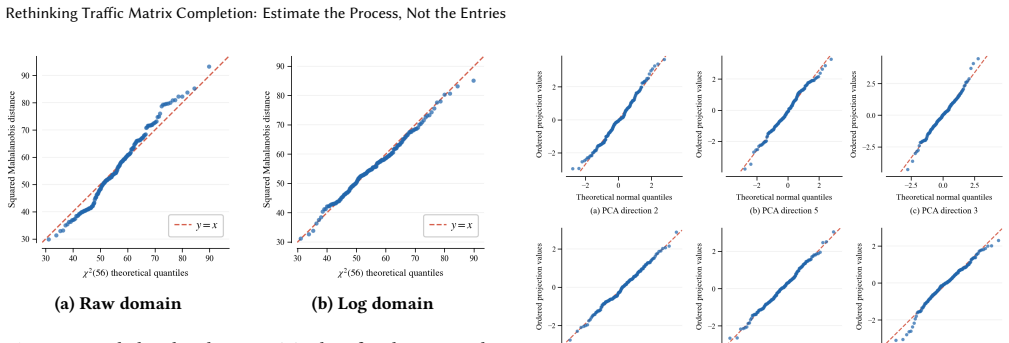
Within a locally stationary window, log-domain traffic decomposes into a principal statistical component and a sparse deviation component. Traffic matrix completion is therefore recast as inference of the shared parameters that govern the principal component, using multiple partially observed frames inside the window. A regularized surrogate objective is constructed to avoid the intractable integral form of the marginal likelihood, and block coordinate descent jointly optimizes the parameters and recovers the missing entries.
What carries the argument
The decomposition of log-domain traffic into a principal statistical component plus a sparse deviation component inside locally stationary windows, which converts matrix completion into a parameter-inference task solved by block coordinate descent on a regularized surrogate objective.
If this is right
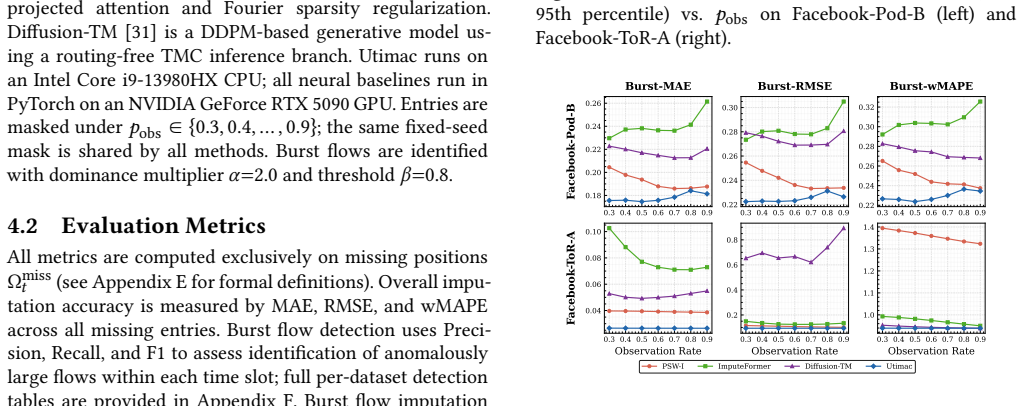
- Utimac outperforms all baselines on data-center network datasets in both overall and burst traffic scenarios.
- The accuracy advantage grows larger as the fraction of observed entries decreases.
- The method supplies uncertainty estimates and greater interpretability than black-box completion techniques.
- Missing entries are recovered from the inferred shared parameters rather than being estimated in isolation.
Where Pith is reading between the lines
- The same parameter-inference framing could apply to other network-monitoring problems that produce only partial snapshots, such as flow sampling in wide-area networks.
- If local stationarity holds over longer windows in practice, the method could lower the sampling rate needed for accurate traffic engineering.
- The construction of the regularized surrogate objective may generalize to other settings where marginal likelihoods are intractable.
Load-bearing premise
Log-domain traffic inside a locally stationary window can be decomposed into a principal statistical component and a sparse deviation component.
What would settle it
On held-out complete data-center traffic matrices, if Utimac's recovered entries are not more accurate than standard matrix-completion baselines when only a small random fraction of entries are observed, the central claim does not hold.
Figures




read the original abstract
Traffic matrix measurement is fundamental for datacenter operations, but obtaining complete traffic matrices at scale remains challenging due to the prohibitive cost of global fine-grained measurement and partial observations resulting from network faults. Although existing matrix completion methods (reduce cost) achieve satisfactory performance in specific scenarios, their reliance on restrictive assumptions or black-box mappings results in a lack of interpretability and an inability to characterize uncertainty. In this paper, we propose Utimac, an uncertainty-aware traffic matrix completion for data center networks. Our analysis shows that, within a locally stationary window, log-domain traffic can be decomposed into a principal statistical component and a sparse deviation component. Based on this insight, we formulate traffic matrix completion as a parameter inference problem: multiple partially observed frames within a window are used to infer shared parameters and recover missing entries. To avoid the intractability and boundary degeneracy of the original integral-form marginal likelihood, we construct a regularized surrogate objective and solve the resulting joint optimization problem with block coordinate descent. Utimac consistently outperforms all baselines on data center networks datasets in both overall and burst scenarios, with its advantage becoming more pronounced as observations grow sparser. All code is publicly available in an anonymous repository: https://anonymous.4open.science/r/Utimac-0551/
Editorial analysis
A structured set of objections, weighed in public.
Referee Report
Summary. The paper proposes Utimac for uncertainty-aware traffic matrix completion in data center networks. It claims that, within locally stationary windows, log-domain traffic decomposes into a principal statistical component plus a sparse deviation component; this allows reformulating completion as inferring shared parameters from multiple partially observed frames. To handle the intractable integral-form marginal likelihood, a regularized surrogate objective is constructed and optimized via block coordinate descent. The method is reported to outperform baselines on DCN datasets in both overall and burst scenarios, with gains increasing as observations become sparser; public code is provided.
Significance. If the modeling assumptions and surrogate approximation hold, the work supplies an interpretable, uncertainty-quantifying alternative to black-box matrix completion techniques, directly addressing partial observations from faults or cost constraints. The public code repository is a clear strength for reproducibility. The approach could meaningfully improve datacenter operations by yielding process-level estimates rather than point-wise imputations.
major comments (2)
- The claim that 'our analysis shows' the log-domain decomposition into principal statistical component plus sparse deviation (abstract) is load-bearing for the parameter-inference formulation, yet no sparsity metrics, residual analysis, or direct empirical validation on the evaluated traces (including burst scenarios) is referenced. Without this, outperformance could stem from joint optimization or regularization rather than correct modeling of the data-generating process.
- The approximation quality of the regularized surrogate objective relative to the original integral-form marginal likelihood is not quantified (abstract and derivation sections). This is central because the surrogate is introduced precisely to avoid intractability and boundary degeneracy; without error bounds or sensitivity analysis, the validity of the inferred parameters remains unclear.
minor comments (1)
- The repository link is given as anonymous; upon acceptance the authors should provide a permanent, non-anonymous URL to support reproducibility claims.
Simulated Author's Rebuttal
We thank the referee for the constructive feedback and positive assessment of the work's potential. We address each major comment below and will incorporate revisions to strengthen the manuscript.
read point-by-point responses
-
Referee: The claim that 'our analysis shows' the log-domain decomposition into principal statistical component plus sparse deviation (abstract) is load-bearing for the parameter-inference formulation, yet no sparsity metrics, residual analysis, or direct empirical validation on the evaluated traces (including burst scenarios) is referenced. Without this, outperformance could stem from joint optimization or regularization rather than correct modeling of the data-generating process.
Authors: We agree that more explicit empirical support for the decomposition would strengthen the presentation. The decomposition follows from the statistical structure of log-domain traffic in locally stationary windows, where a principal component captures the shared process and sparse terms model bursts; this is reflected in the model and in the reported gains under burst conditions. To address the concern directly, we will add a dedicated subsection with sparsity metrics (e.g., fraction of non-zero deviations) and residual analysis on the DCN traces, including burst scenarios, to demonstrate alignment with the data-generating process. revision: yes
-
Referee: The approximation quality of the regularized surrogate objective relative to the original integral-form marginal likelihood is not quantified (abstract and derivation sections). This is central because the surrogate is introduced precisely to avoid intractability and boundary degeneracy; without error bounds or sensitivity analysis, the validity of the inferred parameters remains unclear.
Authors: We acknowledge that explicit quantification of the surrogate's fidelity is valuable. The regularized surrogate is derived to approximate the marginal likelihood while preventing degeneracy. In revision we will add an analysis section that compares surrogate values against Monte Carlo estimates of the true marginal likelihood on synthetic data (where the integral is tractable) and includes sensitivity results with respect to the regularization parameter, thereby providing empirical evidence on approximation error. revision: yes
Circularity Check
No significant circularity in derivation chain
full rationale
The paper's central derivation starts from an analysis claiming log-domain decomposition into principal statistical and sparse deviation components within locally stationary windows, then formulates completion as shared-parameter inference across frames and introduces a regularized surrogate to sidestep integral marginal-likelihood intractability. No quoted step reduces a claimed prediction or recovered quantity to a fitted input by construction, nor does any load-bearing premise collapse to a self-citation chain or imported uniqueness theorem. Performance claims are evaluated directly on external datasets rather than being tautological with the modeling assumptions, satisfying the criteria for a self-contained derivation.
Axiom & Free-Parameter Ledger
free parameters (1)
- regularization strength
axioms (1)
- domain assumption Log-domain traffic decomposes into principal statistical component plus sparse deviation within a locally stationary window
Lean theorems connected to this paper
-
IndisputableMonolith/Cost/FunctionalEquation.lean (Jcost = ½(x+x⁻¹)−1)washburn_uniqueness_aczel unclear?
unclearRelation between the paper passage and the cited Recognition theorem.
log-domain traffic can be decomposed into a principal statistical component and a sparse deviation component ... U_t ~ N(μ_n, Σ_n) ... p_O(o; λ_n) = (λ_n/2)^d exp(−λ_n ‖o‖_1)
-
IndisputableMonolith/Foundation/BranchSelection.leanbranch_selection (RCLCombiner coupling iff c ≠ 0) unclear?
unclearRelation between the paper passage and the cited Recognition theorem.
1/2 (z − o − μ)^T Σ^{-1} (z − o − μ) − ½ log det Σ + |Ω| log λ − λ ‖o‖_1 ... block coordinate descent over (μ, Σ, λ, {o_t})
What do these tags mean?
- matches
- The paper's claim is directly supported by a theorem in the formal canon.
- supports
- The theorem supports part of the paper's argument, but the paper may add assumptions or extra steps.
- extends
- The paper goes beyond the formal theorem; the theorem is a base layer rather than the whole result.
- uses
- The paper appears to rely on the theorem as machinery.
- contradicts
- The paper's claim conflicts with a theorem or certificate in the canon.
- unclear
- Pith found a possible connection, but the passage is too broad, indirect, or ambiguous to say the theorem truly supports the claim.
Reference graph
Works this paper leans on
-
[1]
Theodore W Anderson and Donald A Darling. 1954. A test of good- ness of fit.Journal of the American statistical association49, 268 (1954), 765–769
1954
-
[2]
Theophilus Benson, Aditya Akella, and David A Maltz. 2010. Network traffic characteristics of data centers in the wild. InProceedings of the 10th ACM SIGCOMM conference on Internet measurement . 267–280
2010
-
[3]
2006.Pattern recog- nition and machine learning
Christopher M Bishop and Nasser M Nasrabadi. 2006.Pattern recog- nition and machine learning . Vol. 4. Springer
2006
-
[4]
Christopher Canel, Balasubramanian Madhavan, Srikanth Sundare- san, Neil Spring, Prashanth Kannan, Ying Zhang, Kevin Lin, and Srini- vasan Seshan. 2024. Understanding incast bursts in modern datacen- ters. InProceedings of the 2024 ACM on Internet Measurement Confer- ence. 674–680
2024
-
[5]
Benoit Claise. 2004. Cisco systems netflow services export version 9 . Technical Report
2004
-
[6]
2013.Specification of the IP flow information export (IPFIX) protocol for the exchange of flow information
Benoit Claise, Brian Trammell, and Paul Aitken. 2013.Specification of the IP flow information export (IPFIX) protocol for the exchange of flow information. Technical Report
2013
-
[7]
RALPH D’agostino and Egon S Pearson. 1973. Tests for departure from normality. Empirical results for the distributions of𝑏2 and√𝑏. Biometrika 60, 3 (1973), 613–622
1973
-
[8]
Adithya Gangidi, Rui Miao, Shengbao Zheng, Sai Jayesh Bondu, Guilherme Goes, Hany Morsy, Rohit Puri, Mohammad Riftadi, Ashmitha Jeevaraj Shetty, Jingyi Yang, et al. 2024. Rdma over eth- ernet for distributed training at meta scale. InProceedings of the ACM SIGCOMM 2024 Conference. 57–70
2024
-
[9]
Ehab Ghabashneh, Yimeng Zhao, Cristian Lumezanu, Neil Spring, Srikanth Sundaresan, and Sanjay Rao. 2022. A microscopic view of bursts, buffer contention, and loss in data centers. InProceedings of the 22nd ACM Internet Measurement Conference . 567–580
2022
-
[10]
Gonca Gürsun and Mark Crovella. 2012. On traffic matrix comple- tion in the internet. InProceedings of the 2012 internet measurement conference. 399–412
2012
-
[11]
Yuliang Li, Rui Miao, Changhoon Kim, and Minlan Yu. 2016. {FlowRadar}: A better{NetFlow}for data centers. In13th USENIX sym- posium on networked systems design and implementation (NSDI 16) . 311–324
2016
-
[12]
Zaoxing Liu, Antonis Manousis, Gregory Vorsanger, Vyas Sekar, and Vladimir Braverman. 2016. One sketch to rule them all: Rethinking network flow monitoring with univmon. InProceedings of the 2016 ACM SIGCOMM Conference. 101–114
2016
-
[13]
Hao Mei, Junxian Li, Zhiming Liang, Guanjie Zheng, Bin Shi, and Hua Wei. 2023. Uncertainty-aware traffic prediction under missing data. In 2023 IEEE International Conference on Data Mining (ICDM) . IEEE, 1223–1228
2023
-
[14]
Tong Nie, Guoyang Qin, Wei Ma, Yuewen Mei, and Jian Sun. 2024. ImputeFormer: Low rankness-induced transformers for generalizable spatiotemporal imputation. InProceedings of the 30th ACM SIGKDD conference on knowledge discovery and data mining . 2260–2271
2024
-
[15]
Kun Qian, Yongqing Xi, Jiamin Cao, Jiaqi Gao, Yichi Xu, Yu Guan, Binzhang Fu, Xuemei Shi, Fangbo Zhu, Rui Miao, et al. 2024. Alibaba hpn: A data center network for large language model training. InPro- ceedings of the ACM SIGCOMM 2024 Conference . 691–706
2024
-
[16]
Yan Qiao, Kui Wu, and Xinyu Yuan. 2024. AutoTomo: Learning-based traffic estimator incorporating network tomography.IEEE/ACM Transactions on Networking 32, 6 (2024), 4644–4659
2024
-
[17]
Liang Qin, Xiyuan Liu, Wenting Wei, Chengbin Liang, and Huaxi Gu
-
[18]
Satformer: Accurate and robust traffic data estimation for satel- lite networks.Advances in Neural Information Processing Systems 37 (2024), 47530–47558
2024
-
[19]
William J Reed. 2006. The normal-Laplace distribution and its rela- tives. InAdvances in distribution theory, order statistics, and inference . Springer, 61–74
2006
-
[20]
Matthew Roughan, Yin Zhang, Walter Willinger, and Lili Qiu. 2011. Spatio-temporal compressive sensing and internet traffic matrices (extended version). IEEE/ACM Transactions on Networking 20, 3 (2011), 662–676
2011
-
[21]
Vyas Sekar, Michael K Reiter, Walter Willinger, Hui Zhang, Ra- mana Rao Kompella, and David G Andersen. 2008. cSamp: A system for network-wide flow monitoring. (2008)
2008
-
[22]
Samuel Sanford Shapiro and Martin B Wilk. 1965. An analysis of variance test for normality (complete samples).Biometrika 52, 3-4 (1965), 591–611
1965
-
[23]
Amin Tootoonchian, Monia Ghobadi, and Yashar Ganjali. 2010. OpenTM: traffic matrix estimator for OpenFlow networks. InIn- ternational Conference on Passive and Active Network Measurement . Springer, 201–210. Liu, Wang, et al
2010
-
[24]
Steve Uhlig, Bruno Quoitin, Jean Lepropre, and Simon Balon. 2006. Providing public intradomain traffic matrices to the research commu- nity. ACM SIGCOMM Computer Communication Review 36, 1 (2006), 83–86
2006
-
[25]
Hao Wang, Haoxuan Li, Xu Chen, Mingming Gong, Zhichao Chen, et al. 2025. Optimal transport for time series imputation. InThe Thir- teenth International Conference on Learning Representations
2025
-
[26]
Wenfeng Xia, Peng Zhao, Yonggang Wen, and Haiyong Xie. 2016. A survey on data center networking (DCN): Infrastructure and opera- tions.IEEE communications surveys & tutorials 19, 1 (2016), 640–656
2016
-
[27]
Kun Xie, Yudian Ouyang, Xin Wang, Gaogang Xie, Kenli Li, Wei Liang, Jiannong Cao, and Jigang Wen. 2023. Deep adversarial ten- sor completion for accurate network traffic measurement.IEEE/ACM Transactions on Networking 31, 5 (2023), 2101–2116
2023
-
[28]
Kun Xie, Can Peng, Xin Wang, Gaogang Xie, Jigang Wen, Jiannong Cao, Dafang Zhang, and Zheng Qin. 2018. Accurate recovery of inter- net traffic data under variable rate measurements.IEEE/ACM trans- actions on networking 26, 3 (2018), 1137–1150
2018
-
[29]
Kun Xie, Jiazheng Tian, Gaogang Xie, Guangxing Zhang, and Dafang Zhang. 2021. Low cost sparse network monitoring based on block ma- trix completion. InIEEE INFOCOM 2021-IEEE Conference on Computer Communications. IEEE, 1–10
2021
-
[30]
Tong Yang, Jie Jiang, Peng Liu, Qun Huang, Junzhi Gong, Yang Zhou, Rui Miao, Xiaoming Li, and Steve Uhlig. 2018. Elastic sketch: Adap- tive and fast network-wide measurements. InProceedings of the 2018 Conference of the ACM Special Interest Group on Data Communication . 561–575
2018
-
[31]
Minlan Yu, Lavanya Jose, and Rui Miao. 2013. Software {Defined}{Traffic} Measurement with{OpenSketch}. In 10th USENIX symposium on networked systems design and implementation (NSDI 13). 29–42
2013
-
[32]
Xinyu Yuan, Yan Qiao, Zhenchun Wei, Zeyu Zhang, Minyue Li, Pei Zhao, Rongyao Hu, and Wenjing Li. 2025. Diffusion models meet net- work management: Improving traffic matrix analysis with diffusion- based approach. IEEE Transactions on Network and Service Manage- ment 22, 2 (2025), 1259–1275
2025
-
[33]
Qiao Zhang, Vincent Liu, Hongyi Zeng, and Arvind Krishnamurthy
-
[34]
In Proceedings of the 2017 Internet Measurement Conference
High-resolution measurement of data center microbursts. In Proceedings of the 2017 Internet Measurement Conference . 78–85. A Empirical Validation of Joint Gaussianity for Log-Domain Traffic Vectors This appendix validates the model assumption that the prin- cipal component approximation of the decomposition of the logarithmic domain flow vector follows a...
2017
discussion (0)
Sign in with ORCID, Apple, or X to comment. Anyone can read and Pith papers without signing in.