Recognition: 2 theorem links
· Lean TheoremValidity and Limits of Low Order Hybridization Expansion Approaches for Multi-Orbital Systems
Pith reviewed 2026-05-08 19:05 UTC · model grok-4.3
The pith
In multi-orbital systems the least correlated orbital governs the accuracy of low-order hybridization expansion solvers by suppressing correlation features in all others.
A machine-rendered reading of the paper's core claim, the machinery that carries it, and where it could break.
Core claim
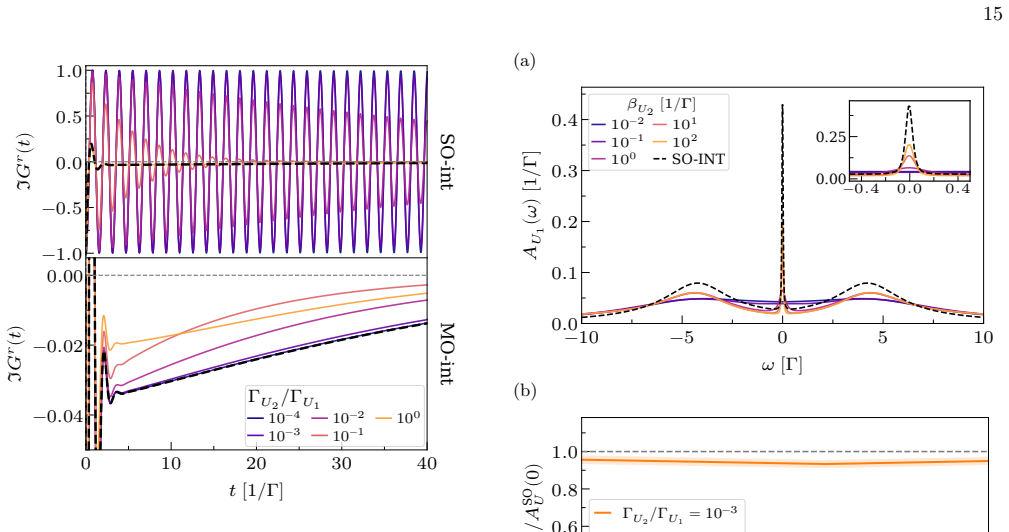
Using the decoupled orbital limit, analytic connections are established between multi-orbital restricted propagators and their single-orbital counterparts. Low-order truncations of the hybridization expansion generate spurious inter-orbital couplings that transfer the properties of the least correlated orbital—the one with the most rapidly decaying retarded Green's function—to all others. This transfer suppresses correlation-induced features such as the Kondo resonance, even in orbitals that appear strongly correlated within single-orbital calculations performed at the same order. The mechanism is confirmed numerically on representative two-orbital models, delineating the regimes of validity
What carries the argument
The spurious coupling generated by the truncated hybridization expansion, which propagates the fastest-decaying retarded Green's function across orbitals.
Load-bearing premise
The diagrammatic mechanisms identified in the decoupled orbital limit remain representative once orbitals are coupled by finite hybridization and interactions.
What would settle it
A numerical comparison of the low-order solver against an exact or high-order reference in a two-orbital Anderson model with one weakly correlated orbital and one strongly correlated orbital, checking whether the Kondo resonance is suppressed in the strong orbital as predicted.
Figures




read the original abstract
Low-order hybridization expansion methods such as the non-crossing approximation (NCA) and the one-crossing approximation (OCA) are widely used impurity solvers in the study of strongly correlated systems, yet their accuracy in genuine multi-orbital settings remains poorly understood. Using the decoupled orbital limit as a controlled reference point, we derive analytic results connecting multi-orbital restricted propagators and Green's functions to their single-orbital counterparts, identify the diagrammatic mechanisms responsible for the breakdown of low-order methods in multi-orbital settings, and determine their regimes of applicability. Our central finding is that the accuracy of these methods is governed by the least correlated orbital: i.e., the orbital with the most rapidly decaying retarded Green's function. That orbital's properties are transferred to all other orbitals through a spurious coupling generated by the truncated expansion, thereby suppressing correlation-induced features such as the Kondo resonance. This occurs even in orbitals that are themselves strongly correlated within single-orbital calculations using the same approximation scheme. We confirm this numerically across representative two-orbital model systems in the steady-state, systematically identifying the parameter regimes in which low-order methods succeed or fail. Our results provide a practical guide for assessing when insights from single-orbital calculations carry over to multi-orbital settings, and serve as a benchmark for the development and validation of higher-order multi-orbital impurity solvers.
Editorial analysis
A structured set of objections, weighed in public.
Referee Report
Summary. The manuscript analyzes the validity of low-order hybridization expansion impurity solvers such as NCA and OCA in multi-orbital settings. Using the decoupled orbital limit as a controlled reference, it derives analytic relations between multi-orbital restricted propagators/Green's functions and their single-orbital counterparts, identifies truncation-induced spurious inter-orbital couplings as the mechanism that transfers properties from the least correlated orbital (defined via fastest-decaying retarded Green's function) to others, and shows that this suppresses correlation features such as the Kondo resonance. The findings are confirmed numerically on representative two-orbital models to delineate success/failure regimes and provide guidance for when single-orbital insights apply to multi-orbital cases.
Significance. If the central claim holds, the work supplies a practical diagnostic for the limitations of widely used approximate solvers in multi-orbital DMFT and related calculations, explaining artificial suppression of strong-correlation signatures. The combination of analytic derivations in the decoupled limit with systematic numerical benchmarks on two-orbital systems is a strength, offering a benchmark for validating higher-order multi-orbital solvers.
major comments (2)
- [§4 (Numerical Benchmarks)] §4 (Numerical Benchmarks): the two-orbital calculations with finite hybridization demonstrate suppression of the Kondo resonance, but do not isolate whether the leading diagrammatic mechanism remains the truncation artifact identified in the decoupled limit or whether real hybridization lines generate competing corrections that could alter which orbital sets the accuracy scale.
- [Analytic Derivation (Decoupled Orbital Limit)] Analytic Derivation (Decoupled Orbital Limit): while the mapping to single-orbital quantities is derived, the manuscript does not provide an explicit expression or scaling argument showing that the spurious coupling remains dominant once finite inter-orbital hybridization and interactions are restored, which is load-bearing for extending the central claim beyond the decoupled reference point.
minor comments (2)
- [Introduction] Introduction: the literature review on prior NCA/OCA applications could cite more recent multi-orbital solver benchmarks for context.
- [Figures] Figure captions: parameters for the two-orbital models (e.g., interaction strengths, hybridizations) should be stated explicitly in each caption to improve reproducibility.
Simulated Author's Rebuttal
We thank the referee for the careful reading of our manuscript and the constructive comments, which help clarify the scope of our analytic and numerical results. We address the two major comments point by point below, indicating where revisions will be made to the manuscript.
read point-by-point responses
-
Referee: [§4 (Numerical Benchmarks)] §4 (Numerical Benchmarks): the two-orbital calculations with finite hybridization demonstrate suppression of the Kondo resonance, but do not isolate whether the leading diagrammatic mechanism remains the truncation artifact identified in the decoupled limit or whether real hybridization lines generate competing corrections that could alter which orbital sets the accuracy scale.
Authors: We agree that the numerical benchmarks in Section 4 demonstrate the suppression of correlation features such as the Kondo resonance in the presence of finite hybridization, but do not decompose individual diagrammatic contributions to isolate the truncation artifact from corrections due to real hybridization lines. The decoupled limit was used to identify the mechanism analytically in a controlled setting. In the numerical studies, we observe that the accuracy remains governed by the orbital with the most rapidly decaying retarded Green's function across a range of hybridization strengths, consistent with the identified mechanism. In the revised manuscript we will add a brief discussion acknowledging that competing corrections from finite hybridization lines cannot be ruled out at larger values and may modify quantitative details, while noting that the qualitative behavior persists in the regimes examined. This provides practical guidance for users of low-order solvers even without full diagrammatic isolation. revision: partial
-
Referee: [Analytic Derivation (Decoupled Orbital Limit)] Analytic Derivation (Decoupled Orbital Limit): while the mapping to single-orbital quantities is derived, the manuscript does not provide an explicit expression or scaling argument showing that the spurious coupling remains dominant once finite inter-orbital hybridization and interactions are restored, which is load-bearing for extending the central claim beyond the decoupled reference point.
Authors: The analytic mapping and identification of truncation-induced spurious couplings are derived in the decoupled orbital limit, which provides a clean reference point free of additional hybridization lines. An explicit expression or scaling argument for the finite-hybridization case would require a substantially more involved diagrammatic resummation that lies outside the scope of the present work. We instead rely on systematic numerical benchmarks on two-orbital models with finite hybridization and interactions to show that the central finding—that accuracy is governed by the least correlated orbital—holds qualitatively. In the revised manuscript we will clarify the distinction between the analytic results (decoupled limit) and the numerical support for the general multi-orbital case, and we will temper the language regarding extension of the claim accordingly. revision: partial
- An explicit analytic expression or scaling argument demonstrating dominance of the truncation-induced spurious coupling once finite inter-orbital hybridization and interactions are restored.
Circularity Check
No circularity: analytic derivation in decoupled limit is independent of target claim
full rationale
The paper derives analytic connections between multi-orbital and single-orbital propagators explicitly in the decoupled-orbital limit as a controlled reference, then performs separate numerical benchmarks on coupled two-orbital models. No step reduces a prediction to a fitted parameter by construction, no load-bearing self-citation chain is invoked to justify the central mechanism, and no ansatz or uniqueness theorem is smuggled in. The derivation chain remains self-contained against external benchmarks and does not equate its output to its inputs.
Axiom & Free-Parameter Ledger
axioms (1)
- domain assumption The decoupled orbital limit supplies a controlled reference whose diagrammatic mechanisms remain representative when orbitals are coupled.
Lean theorems connected to this paper
-
Cost.FunctionalEquation (washburn_uniqueness_aczel)Jcost uniqueness — not invoked or contradicted by this paper unclear?
unclearRelation between the paper passage and the cited Recognition theorem.
The full Hamiltonian H = H_S + H_B + H_SB ... ε^{σσ'}_{ij} d†_{iσ} d_{jσ'} + (1/2) Σ U^{σσ'}_{ijkl} d†...
What do these tags mean?
- matches
- The paper's claim is directly supported by a theorem in the formal canon.
- supports
- The theorem supports part of the paper's argument, but the paper may add assumptions or extra steps.
- extends
- The paper goes beyond the formal theorem; the theorem is a base layer rather than the whole result.
- uses
- The paper appears to rely on the theorem as machinery.
- contradicts
- The paper's claim conflicts with a theorem or certificate in the canon.
- unclear
- Pith found a possible connection, but the passage is too broad, indirect, or ambiguous to say the theorem truly supports the claim.
Reference graph
Works this paper leans on
-
[1]
Quantum Monte Carlo Method in the Steady State , author =. Phys. Rev. Lett. , volume =. 2023 , month =. doi:10.1103/PhysRevLett.130.186301 , url =
-
[2]
Multiorbital Quantum Impurity Solver for General Interactions and Hybridizations , author =. Phys. Rev. Lett. , volume =. 2020 , month =. doi:10.1103/PhysRevLett.124.206405 , url =
-
[3]
Dynamical mean-field theory of strongly correlated fermion systems and the limit of infinite dimensions , author =. Rev. Mod. Phys. , volume =. 1996 , month =. doi:10.1103/RevModPhys.68.13 , url =
-
[4]
Nonequilibrium Dynamical Mean-Field Theory , author =. Phys. Rev. Lett. , volume =. 2006 , month =. doi:10.1103/PhysRevLett.97.266408 , url =
-
[5]
Nonequilibrium dynamical mean-field theory and its applications , author =. Rev. Mod. Phys. , volume =. 2014 , month =. doi:10.1103/RevModPhys.86.779 , url =
-
[6]
Nano Lett
Shaping electronic flows with strongly correlated physics , author=. Nano Lett. , volume=. 2023 , publisher=
2023
-
[7]
Numerically Exact Simulation of Photodoped Mott Insulators , author =. Phys. Rev. Lett. , volume =. 2024 , month =. doi:10.1103/PhysRevLett.132.176501 , url =
-
[8]
Erpenbeck, A. and Blommel, T. and Zhang, L. and Lin, W.-T. and Cohen, G. and Gull, E. , title =. J. Chem. Phys. , volume =. 2024 , issn =. doi:10.1063/5.0226253 , url =
-
[9]
Efficient hybridization fitting for dynamical mean-field theory via semi-definite relaxation , author =. Phys. Rev. B , volume =. 2020 , month =. doi:10.1103/PhysRevB.101.035143 , url =
-
[10]
2025 , eprint=
Multi-orbital dynamical mean-field theory with a complex-time solver , author=. 2025 , eprint=
2025
-
[11]
Surrogate model solver for impurity-induced superconducting subgap states , author =. Phys. Rev. B , volume =. 2023 , month =. doi:10.1103/PhysRevB.108.L220506 , url =
-
[12]
Bath parameterization in multiband cluster dynamical mean-field theory , author =. Phys. Rev. B , volume =. 2025 , month =. doi:10.1103/lnhv-kvy4 , url =
-
[13]
Zhang, Lei and Erpenbeck, André and Yu, Yang and Gull, Emanuel , title =. J. Chem. Phys. , volume =. 2025 , issn =. doi:10.1063/5.0273763 , url =
-
[14]
Hierarchical equations of motion for an impurity solver in dynamical mean-field theory , author =. Phys. Rev. B , volume =. 2014 , month =. doi:10.1103/PhysRevB.90.045141 , url =
-
[15]
Nonequilibrium Dynamical Mean-Field Theory: An Auxiliary Quantum Master Equation Approach , author =. Phys. Rev. Lett. , volume =. 2013 , month =. doi:10.1103/PhysRevLett.110.086403 , url =
-
[16]
Auxiliary master equation approach to nonequilibrium correlated impurities , author =. Phys. Rev. B , volume =. 2014 , month =. doi:10.1103/PhysRevB.89.165105 , url =
-
[17]
Cui, Lei and Zhang, Hou-Dao and Zheng, Xiao and Xu, Rui-Xue and Yan, YiJing , title =. J. Chem. Phys. , volume =. 2019 , issn =. doi:10.1063/1.5096945 , url =
-
[18]
Chen, Zi-Hao and Wang, Yao and Zheng, Xiao and Xu, Rui-Xue and Yan, YiJing , title =. J. Chem. Phys. , volume =. 2022 , issn =. doi:10.1063/5.0095961 , url =
-
[19]
Takahashi, Hideaki and Rudge, Samuel and Kaspar, Christoph and Thoss, Michael and Borrelli, Raffaele , title =. J. Chem. Phys. , volume =. 2024 , issn =. doi:10.1063/5.0209348 , url =
-
[20]
Review of techniques in the large- N expansion for dilute magnetic alloys , author =. Rev. Mod. Phys. , volume =. 1987 , month =. doi:10.1103/RevModPhys.59.845 , xurl =
-
[21]
Nonequilibrium dynamical mean-field calculations based on the noncrossing approximation and its generalizations , author =. Phys. Rev. B , volume =. 2010 , doi =
2010
-
[22]
Cohen, Guy and Reichman, David R. and Millis, Andrew J. and Gull, Emanuel , year =. Green's Functions from Real-Time Bold-Line. doi:10.1103/PhysRevB.89.115139 , journal =
-
[23]
Diagrammatic approach to the intermediate-valence compounds , author =. Phys. Rev. B , volume =. 1981 , month =
1981
-
[24]
Perturbation Expansions for Systems with Strong Local Correlation , author =. 1983 , volume =. doi:10.1007/BF01307369 , journal =
-
[25]
New Approach to the Mixed-Valence Problem , author =. 1984 , volume =. doi:10.1103/PhysRevB.29.3035 , journal =
-
[26]
Meir, Yigal and Wingreen, Ned S. and Lee, Patrick A. , year =. Low-Temperature Transport through a Quantum Dot:. doi:10.1103/PhysRevLett.70.2601 , journal =
-
[27]
Anderson model out of equilibrium: Noncrossing-approximation approach to transport through a quantum dot , author =. Phys. Rev. B , volume =. 1994 , doi =
1994
-
[28]
Physical Review B64, 155111 (2001) https://doi.org/10.1103/PhysRevB.64.155111
Haule, K. and Kirchner, S. and Kroha, J. and W. Anderson Impurity Model at Finite. 2001 , month = sep, volume =. doi:10.1103/PhysRevB.64.155111 , journal =
-
[29]
and Reichman, David R
Chen, Hsing-Ta and Cohen, Guy and Millis, Andrew J. and Reichman, David R. , title =. Phys. Rev. B , year =
-
[30]
Revealing strong correlations in higher-order transport statistics: A noncrossing approximation approach , author =. Phys. Rev. B , volume =. 2021 , doi =
2021
-
[31]
Numerically exact long-time magnetization dynamics at the nonequilibrium Kondo crossover of the Anderson impurity model , author =. Phys. Rev. B , volume =. 2013 , doi =
2013
-
[32]
Qualitative breakdown of the noncrossing approximation for the symmetric one-channel Anderson impurity model at all temperatures , author =. Phys. Rev. B , volume =. 2016 , doi =
2016
-
[33]
doi:10.1088/1361-648x/ab5773 , year = 2019, month =
Bruno Max de Souza Melo and Luis G G V Dias da Silva and Alexandre Reily Rocha and Caio Lewenkopf , title =. doi:10.1088/1361-648x/ab5773 , year = 2019, month =
-
[34]
The Anderson model with finite Coulomb repulsion , author=. Z. Phys. B: Condens. Matter , volume=. 1989 , publisher=
1989
-
[35]
Frithjof B. Anders. Beyond the NCA: new results for the spectral properties of the Anderson model. Physica B. 1995. doi:https://doi.org/10.1016/0921-4526(94)00400-P
-
[36]
B Anders and N Grewe , title =
F. B Anders and N Grewe , title =. doi:10.1209/0295-5075/26/7/013 , year = 1994, month =
-
[37]
Norbert Grewe and Sebastian Schmitt and Torben Jabben and Frithjof B Anders , title =. J. Phys. Condens. Matter , doi =
-
[38]
Bold-line diagrammatic Monte Carlo method: General formulation and application to expansion around the noncrossing approximation , author =. Phys. Rev. B , volume =. 2010 , doi =
2010
-
[39]
Numerically exact long-time behavior of nonequilibrium quantum impurity models , author =. Phys. Rev. B , volume =. 2011 , doi =
2011
-
[40]
Cohen, Guy and Gull, Emanuel and Reichman, David R. and Millis, Andrew J. , year =. Green's. doi:10.1103/PhysRevLett.112.146802 , journal =
-
[41]
Taming the Dynamical Sign Problem in Real-Time Evolution of Quantum Many-Body Problems , author =. Phys. Rev. Lett. , volume =. 2015 , doi =
2015
-
[42]
Currents and Green's functions of impurities out of equilibrium: Results from inchworm quantum Monte Carlo , author =. Phys. Rev. B , volume =. 2017 , doi =
2017
-
[43]
Quantum Monte Carlo solution of the dynamical mean field equations in real time , author =. Phys. Rev. B , volume =. 2017 , doi =
2017
-
[44]
Inclusion-exclusion principle for many-body diagrammatics , author =. Phys. Rev. B , volume =. 2018 , doi =
2018
-
[45]
Numerically exact full counting statistics of the nonequilibrium Anderson impurity model , author =. Phys. Rev. B , volume =. 2018 , doi =
2018
-
[46]
Numerically exact full counting statistics of the energy current in the Kondo regime , author =. Phys. Rev. B , volume =. 2019 , month =
2019
-
[47]
Krivenko, Igor and Kleinhenz, Joseph and Cohen, Guy and Gull, Emanuel , year =. Dynamics of. doi:10.1103/PhysRevB.100.201104 , journal =
-
[48]
Dynamic Control of Nonequilibrium Metal-Insulator Transitions , author =. 2020 , volume =. doi:10.1103/PhysRevB.102.205138 , journal =
-
[49]
Quantum Monte Carlo algorithm for out-of-equilibrium Green's functions at long times , author =. Phys. Rev. B , volume =. 2019 , doi =
2019
-
[50]
Quantum quasi Monte Carlo algorithm for out-of-equilibrium Green functions at long times , author =. Phys. Rev. B , volume =. 2021 , month =. doi:10.1103/PhysRevB.103.155104 , url =
-
[51]
Bertrand, Corentin and Florens, Serge and Parcollet, Olivier and Waintal, Xavier , year =. Reconstructing. doi:10.1103/PhysRevX.9.041008 , journal =
-
[52]
Ma. Quantum. 2020 , volume =. doi:10.1103/PhysRevLett.125.047702 , journal =
-
[53]
Profumo, Rosario E. V. and Groth, Christoph and Messio, Laura and Parcollet, Olivier and Waintal, Xavier , year =. Quantum. doi:10.1103/PhysRevB.91.245154 , journal =
-
[54]
Perturbation Technique for the Anderson Hamiltonian , author =. Phys. Rev. Lett. , volume =. 1970 , doi =
1970
-
[55]
2013 , volume =
Nonequilibrium Transport through Magnetic Vibrating Molecules , journal =. 2013 , volume =
2013
-
[56]
Correlated nonequilibrium steady states without energy flux , author =. Phys. Rev. B , volume =. 2020 , doi =
2020
-
[57]
H. Keiter and Q. Qin. The NCA for the Anderson model extended to finite U. Physica B. 1990. doi:https://doi.org/10.1016/0921-4526(90)90279-4
-
[58]
Low-temperature transport through a quantum dot: Finite- U results and scaling behavior , author =. Phys. Rev. B , volume =. 2002 , doi =
2002
-
[59]
and W\"olfle ,P
Kroha ,J. and W\"olfle ,P. , title =. J. Phys. Soc. Jpn. , volume =. 2005 , doi =
2005
-
[60]
Hubbard model at infinite dimensions: Thermodynamic and transport properties , author =. Phys. Rev. B , volume =. 1993 , doi =
1993
-
[61]
and Kimball, J
Keiter, H. and Kimball, J. C. , title =. J. Appl. Phys. , volume =. 1971 , issn =
1971
-
[62]
Photoinduced States in a Mott Insulator , author =. Phys. Rev. Lett. , volume =. 2013 , doi =
2013
-
[63]
2021 , doi=
Andre Erpenbeck and Guy Cohen , journal=. 2021 , doi=
2021
-
[64]
Zemach, Ido and Erpenbeck, André and Gull, Emanuel and Cohen, Guy , title =. J. Chem. Phys. , volume =. 2024 , issn =
2024
-
[65]
Compact representation and long-time extrapolation of real-time data for quantum systems using the ESPRIT algorithm , author =. Phys. Rev. B , volume =. 2026 , month =. doi:10.1103/8vzv-y74m , url =
-
[66]
Self-consistent large-. Phys. Rev. B , author =. 1987 , pages =. doi:10.1103/PhysRevB.36.2036 , abstract =
-
[67]
New method for the Anderson model , volume =. J. Phys. F: Met. Phys. , author =. 1976 , pages =. doi:10.1088/0305-4608/6/7/018 , abstract =
-
[68]
Self-consistent perturbation theory for dynamics of valence fluctuations , author=. Z. Phys. B: Condens. Matter , volume=. 1983 , doi =
1983
-
[69]
Crystal. J. Phys. Soc. Jpn. , author =. 1985 , pages =. doi:10.1143/JPSJ.54.1955 , abstract =
-
[70]
Dynamical properties of the Anderson impurity model within a diagrammatic pseudoparticle approach , author =. Phys. Rev. B , volume =. 2004 , month =. doi:10.1103/PhysRevB.70.165102 , url =
-
[71]
Self-consistent perturbation theory of the anderson model:. Z. Phys. B: Condens. Matter , author =. 1984 , keywords =. doi:10.1007/BF01470417 , abstract =
-
[72]
Kroha, J. and Wölfle, P. and Costi, T. A. , month = jul, year =. Unified. Phys. Rev. Lett. , publisher =. doi:10.1103/PhysRevLett.79.261 , abstract =
-
[73]
Self-. J. Low Temp. Phys. , author =. 2002 , keywords =. doi:10.1023/A:1013835817652 , abstract =
-
[74]
Dynamic susceptibilities of the single-impurity
Schmitt, Sebastian and Jabben, Torben and Grewe, Norbert , month = dec, year =. Dynamic susceptibilities of the single-impurity. Phys. Rev. B , publisher =. doi:10.1103/PhysRevB.80.235130 , abstract =
-
[75]
Dynamical mean-field theory within the full-potential methods: Electronic structure of
Haule, Kristjan and Yee, Chuck-Hou and Kim, Kyoo , journal =. Dynamical mean-field theory within the full-potential methods: Electronic structure of. 2010 , month =. doi:10.1103/PhysRevB.81.195107 , url =
-
[76]
Continuous-time. Rev. Mod. Phys. , author =. 2011 , pages =. doi:10.1103/RevModPhys.83.349 , abstract =
-
[77]
Continuous-. Phys. Rev. Lett. , author =. 2006 , pages =. doi:10.1103/PhysRevLett.97.076405 , abstract =
-
[78]
Real-. Phys. Rev. Lett. , author =. 2008 , pages =. doi:10.1103/PhysRevLett.100.176403 , abstract =
-
[79]
Diagrammatic. Phys. Rev. B , author =. 2009 , pages =. doi:10.1103/PhysRevB.79.035320 , abstract =
-
[80]
Application of a semiclassical model for the second-quantized many-electron. J. Chem. Phys. , author =. 2011 , pages =. doi:doi:10.1063/1.3583366 , abstract =
discussion (0)
Sign in with ORCID, Apple, or X to comment. Anyone can read and Pith papers without signing in.