Recognition: unknown
Momentum-Anchored Multi-Scale Fusion Model for Long-Tailed Chest X-Ray Classification
Pith reviewed 2026-05-09 16:10 UTC · model grok-4.3
The pith
Selective EMA updates on the final EfficientNet block anchor features against drift in long-tailed chest X-ray classification.
A machine-rendered reading of the paper's core claim, the machinery that carries it, and where it could break.
Core claim
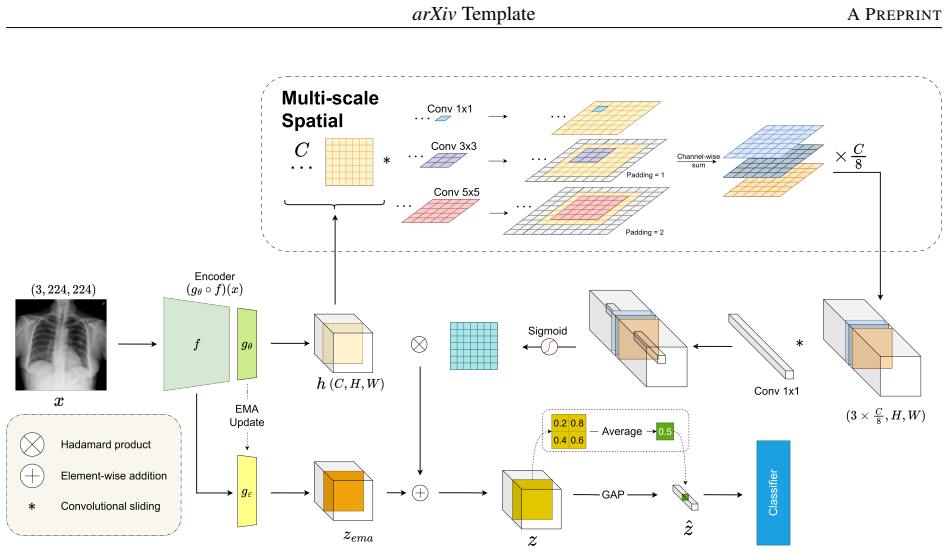
The central claim is that selective momentum updates applied only to the final expansion block of an EfficientNet backbone create a slowly-evolving reference branch that resists gradient-induced feature drift, and when paired with 1x1, 3x3 and 5x5 convolutions for multi-scale fusion this anchoring preserves discriminative patterns for minority classes under long-tailed distributions, producing an average AUC of 0.8682 on ChestX-ray14 with specific gains on rare labels such as Hernia at 0.9470 and Pneumonia at 0.8165.
What carries the argument
The central mechanism is selective exponential moving average (EMA) updating of the final expansion block, which acts as a temporal anchor that evolves more slowly than the rest of the network to retain minority-class patterns while multi-scale spatial fusion combines features from kernels of different sizes.
If this is right
- The anchoring strategy yields higher average AUC than prior methods on the ChestX-ray14 benchmark.
- Gains concentrate on rare pathologies, with Hernia reaching 0.9470 AUC and Pneumonia reaching 0.8165 AUC.
- Feature drift toward majority classes is reduced because the reference branch changes slowly.
- Multi-scale fusion combined with anchoring keeps representational stability across the full training run.
Where Pith is reading between the lines
- The same selective EMA placement might transfer to other backbone architectures used for imbalanced medical imaging without retraining the entire momentum schedule.
- Controlling update speed in only the deepest block could complement existing rebalancing techniques rather than replace them.
- If the anchor prevents drift, similar layer-specific momentum rules might be tested on other long-tailed vision tasks such as object detection in medical scans.
Load-bearing premise
That applying EMA only to the final expansion block will stabilize minority-class features without the momentum process itself introducing new biases or requiring dataset-specific hyperparameter search that accounts for the reported gains.
What would settle it
Train the identical EfficientNet backbone with and without the selective EMA updates on the same ChestX-ray14 split, then compare both the change in feature embeddings for minority classes over training epochs and the final AUC scores on those classes.
Figures

read the original abstract
Chest X-ray classification suffers from severe class imbalance where gradient updates bias toward majority classes, causing feature drift and poor performance on rare but critical pathologies. We propose a Momentum-Anchored Multi-Scale Fusion Network that uses exponential moving averages (EMA) as a temporal anchoring mechanism to stabilize feature representations under long-tailed distributions. Our approach applies selective momentum updates to the final expansion block of an EfficientNet backbone, creating a slowly-evolving reference branch that resists gradient-induced drift while preserving discriminative patterns for minority classes. Combined with multi-scale spatial fusion ($1\times 1$, $3 \times 3$, $5 \times 5$ convolutions), this anchoring strategy maintains representational stability throughout training. On ChestX-ray14, our method achieves 0.8682 average AUC, outperforming state-of-the-art approaches and showing particular improvements on rare pathologies like Hernia (0.9470) and Pneumonia (0.8165). The results demonstrate that momentum anchoring effectively counters feature instability in long-tailed medical image classification.
Editorial analysis
A structured set of objections, weighed in public.
Referee Report
Summary. The manuscript proposes a Momentum-Anchored Multi-Scale Fusion Network for long-tailed chest X-ray classification. It applies selective exponential moving average (EMA) updates exclusively to the final expansion block of an EfficientNet backbone to form a slowly-evolving reference branch intended to resist gradient-induced feature drift on minority classes. This is combined with multi-scale spatial fusion using 1×1, 3×3, and 5×5 convolutions. On the ChestX-ray14 benchmark the method reports an average AUC of 0.8682, with per-class gains on rare pathologies (Hernia 0.9470, Pneumonia 0.8165) and claims to outperform prior state-of-the-art approaches.
Significance. If the performance gains can be rigorously attributed to the selective EMA anchoring rather than ancillary design choices, the technique would constitute a lightweight, training-time stabilization strategy useful for imbalanced medical imaging tasks. The core idea of using a momentum-updated reference branch to preserve minority-class patterns is conceptually sound and aligns with existing EMA practices in semi-supervised and long-tailed learning. However, the current manuscript provides no ablation controls, experimental protocol, or statistical tests, so the practical significance remains unverified.
major comments (2)
- [Experimental evaluation / results] The central claim that selective EMA updates to the final expansion block are the primary driver of the reported 0.8682 average AUC (and the specific gains on Hernia and Pneumonia) is not supported by any ablation or isolation experiments. No comparisons are shown with the same backbone and multi-scale fusion but without the momentum branch, nor with EMA applied to different blocks or with varying decay rates. Without these controls the attribution of gains to the anchoring mechanism cannot be established.
- [Abstract and §4 (Experiments)] The abstract and method description state concrete AUC numbers on ChestX-ray14 but supply no experimental protocol, baseline implementations, training details, or statistical significance tests. This omission prevents verification of the link between the proposed momentum anchoring and the observed improvements.
minor comments (2)
- [Method] The multi-scale fusion is described only at a high level (1×1, 3×3, 5×5 convolutions); the exact fusion operator, channel reduction, and placement relative to the EMA branch should be clarified with a diagram or equations.
- [Implementation details] The EMA decay rate is listed as a free hyperparameter; any sensitivity analysis or default value used in the reported experiments should be stated.
Simulated Author's Rebuttal
We thank the referee for the constructive feedback, which identifies key areas where additional experimental rigor will strengthen the manuscript. We address each major comment below and commit to the necessary revisions.
read point-by-point responses
-
Referee: The central claim that selective EMA updates to the final expansion block are the primary driver of the reported 0.8682 average AUC (and the specific gains on Hernia and Pneumonia) is not supported by any ablation or isolation experiments. No comparisons are shown with the same backbone and multi-scale fusion but without the momentum branch, nor with EMA applied to different blocks or with varying decay rates. Without these controls the attribution of gains to the anchoring mechanism cannot be established.
Authors: We agree that ablation studies are required to isolate the contribution of the selective EMA updates. In the revised manuscript we will add a dedicated ablation subsection in §4 that reports results for: (i) the EfficientNet backbone plus multi-scale fusion without any momentum branch, (ii) EMA applied to earlier blocks instead of the final expansion block, and (iii) a sweep over decay rates. These controls will be presented alongside the original 0.8682 AUC figure and per-class scores to allow direct attribution of the observed gains on rare classes such as Hernia and Pneumonia. revision: yes
-
Referee: The abstract and method description state concrete AUC numbers on ChestX-ray14 but supply no experimental protocol, baseline implementations, training details, or statistical significance tests. This omission prevents verification of the link between the proposed momentum anchoring and the observed improvements.
Authors: We acknowledge that the current §4 lacks sufficient detail for independent verification. In the revision we will expand the experimental section to include the full training protocol (dataset splits, preprocessing, optimizer, learning-rate schedule, batch size, and number of epochs), exact baseline re-implementations with their reported hyperparameters, and statistical significance analysis (bootstrap 95 % confidence intervals and paired tests on the AUC differences). These additions will be placed before the main results table so that readers can directly assess the link between the momentum-anchoring design and the reported performance. revision: yes
Circularity Check
No circularity: empirical benchmark claims with no self-referential derivations
full rationale
The paper proposes a Momentum-Anchored Multi-Scale Fusion Network that applies selective EMA updates to the final expansion block of EfficientNet combined with 1x1/3x3/5x5 spatial fusion convolutions. It reports an average AUC of 0.8682 on ChestX-ray14 with gains on rare classes. No equations, first-principles derivations, or predictions appear in the provided text. The method description and results rest on external dataset evaluation rather than any quantity defined in terms of itself or fitted parameters renamed as predictions. No self-citations are invoked to justify uniqueness or load-bearing assumptions. The derivation chain is therefore self-contained and non-circular.
Axiom & Free-Parameter Ledger
free parameters (1)
- EMA decay rate
axioms (1)
- domain assumption EMA-based anchoring can counteract gradient-induced feature drift in long-tailed settings
invented entities (1)
-
slowly-evolving reference branch
no independent evidence
Reference graph
Works this paper leans on
-
[1]
Medical image analysis using convolutional neural networks: a review.Journal of medical systems, 42:1–13, 2018
Syed Muhammad Anwar, Muhammad Majid, Adnan Qayyum, Muhammad Awais, Majdi Alnowami, and Muham- mad Khurram Khan. Medical image analysis using convolutional neural networks: a review.Journal of medical systems, 42:1–13, 2018
2018
-
[2]
Chestx-ray8: Hospital-scale chest x-ray database and benchmarks on weakly-supervised classification and localization of common thorax diseases
Xiaosong Wang, Yifan Peng, Le Lu, Zhiyong Lu, Mohammadhadi Bagheri, and Ronald M Summers. Chestx-ray8: Hospital-scale chest x-ray database and benchmarks on weakly-supervised classification and localization of common thorax diseases. InProceedings of the IEEE conference on computer vision and pattern recognition, pages 2097–2106, 2017
2097
-
[3]
arXiv preprint arXiv:1711.05225 , year=
Pranav Rajpurkar, Jeremy Irvin, Kaylie Zhu, Brandon Yang, Hershel Mehta, Tony Duan, Daisy Ding, Aarti Bagul, Curtis Langlotz, Katie Shpanskaya, et al. Chexnet: Radiologist-level pneumonia detection on chest x-rays with deep learning.arXiv preprint arXiv:1711.05225, 2017. 7 arXivTemplateA PREPRINT
-
[4]
Towards long-tailed, multi-label disease classification from chest x-ray: Overview of the cxr-lt challenge.Medical Image Analysis, page 103224, 2024
Gregory Holste, Yiliang Zhou, Song Wang, Ajay Jaiswal, Mingquan Lin, Sherry Zhuge, Yuzhe Yang, Dongkyun Kim, Trong-Hieu Nguyen-Mau, Minh-Triet Tran, et al. Towards long-tailed, multi-label disease classification from chest x-ray: Overview of the cxr-lt challenge.Medical Image Analysis, page 103224, 2024
2024
-
[5]
Survey on deep learning with class imbalance.Journal of big data, 6(1):1–54, 2019
Justin M Johnson and Taghi M Khoshgoftaar. Survey on deep learning with class imbalance.Journal of big data, 6(1):1–54, 2019
2019
-
[6]
A review of medical image data augmentation techniques for deep learning applications.Journal of medical imaging and radiation oncology, 65(5):545–563, 2021
Phillip Chlap, Hang Min, Nym Vandenberg, Jason Dowling, Lois Holloway, and Annette Haworth. A review of medical image data augmentation techniques for deep learning applications.Journal of medical imaging and radiation oncology, 65(5):545–563, 2021
2021
-
[7]
Deep learning based classification of multi-label chest x-ray images via dual-weighted metric loss.Computers in biology and medicine, 157:106683, 2023
Yufei Jin, Huijuan Lu, Wenjie Zhu, and Wanli Huo. Deep learning based classification of multi-label chest x-ray images via dual-weighted metric loss.Computers in biology and medicine, 157:106683, 2023
2023
-
[8]
Handling class imbalance in covid-19 chest x-ray images classification: Using smote and weighted loss.Applied Soft Computing, 129:109588, 2022
Ekram Chamseddine, Nesrine Mansouri, Makram Soui, and Mourad Abed. Handling class imbalance in covid-19 chest x-ray images classification: Using smote and weighted loss.Applied Soft Computing, 129:109588, 2022
2022
-
[9]
Unsupervised anomaly detection in medical images with a memory-augmented multi-level cross-attentional masked autoencoder
Yu Tian, Guansong Pang, Yuyuan Liu, Chong Wang, Yuanhong Chen, Fengbei Liu, Rajvinder Singh, Johan W Verjans, Mengyu Wang, and Gustavo Carneiro. Unsupervised anomaly detection in medical images with a memory-augmented multi-level cross-attentional masked autoencoder. InInternational workshop on machine learning in medical imaging, pages 11–21. Springer, 2023
2023
-
[10]
Triple attention learning for classification of 14 thoracic diseases using chest radiography.Medical Image Analysis, 67:101846, 2021
Hongyu Wang, Shanshan Wang, Zibo Qin, Yanning Zhang, Ruijiang Li, and Yong Xia. Triple attention learning for classification of 14 thoracic diseases using chest radiography.Medical Image Analysis, 67:101846, 2021
2021
-
[11]
A feature fusion module based on complementary attention for medical image segmentation.Displays, 84:102811, 2024
Mingyue Yang, Xiaoxuan Dong, Wang Zhang, Peng Xie, Chuan Li, and Shanxiong Chen. A feature fusion module based on complementary attention for medical image segmentation.Displays, 84:102811, 2024
2024
-
[12]
A multibranch and multiscale neural network based on semantic perception for multimodal medical image fusion.Scientific Reports, 14(1):17609, 2024
Cong Lin, Yinjie Chen, Siling Feng, and Mengxing Huang. A multibranch and multiscale neural network based on semantic perception for multimodal medical image fusion.Scientific Reports, 14(1):17609, 2024
2024
-
[13]
Synthensemble: a fusion of cnn, vision transformer, and hybrid models for multi-label chest x-ray classification
SM Nabil Ashraf, Md Adyelullahil Mamun, Hasnat Md Abdullah, and Md Golam Rabiul Alam. Synthensemble: a fusion of cnn, vision transformer, and hybrid models for multi-label chest x-ray classification. In2023 26th International Conference on Computer and Information Technology (ICCIT), pages 1–6. IEEE, 2023
2023
-
[14]
Pavel Izmailov, Dmitrii Podoprikhin, Timur Garipov, Dmitry Vetrov, and Andrew Gordon Wilson. Averaging weights leads to wider optima and better generalization.arXiv preprint arXiv:1803.05407, 2018
-
[15]
Momentum contrast for unsupervised visual representation learning
Kaiming He, Haoqi Fan, Yuxin Wu, Saining Xie, and Ross Girshick. Momentum contrast for unsupervised visual representation learning. InProceedings of the IEEE/CVF conference on computer vision and pattern recognition, pages 9729–9738, 2020
2020
-
[16]
Bootstrap your own latent-a new approach to self-supervised learning.Advances in neural information processing systems, 33:21271–21284, 2020
Jean-Bastien Grill, Florian Strub, Florent Altché, Corentin Tallec, Pierre Richemond, Elena Buchatskaya, Carl Doersch, Bernardo Avila Pires, Zhaohan Guo, Mohammad Gheshlaghi Azar, et al. Bootstrap your own latent-a new approach to self-supervised learning.Advances in neural information processing systems, 33:21271–21284, 2020
2020
-
[17]
Densely connected convolutional networks
Gao Huang, Zhuang Liu, Laurens Van Der Maaten, and Kilian Q Weinberger. Densely connected convolutional networks. InProceedings of the IEEE conference on computer vision and pattern recognition, pages 4700–4708, 2017
2017
-
[18]
Efficientnet: Rethinking model scaling for convolutional neural networks
Mingxing Tan and Quoc Le. Efficientnet: Rethinking model scaling for convolutional neural networks. In International conference on machine learning, pages 6105–6114. PMLR, 2019
2019
-
[19]
An Image is Worth 16x16 Words: Transformers for Image Recognition at Scale
Alexey Dosovitskiy, Lucas Beyer, Alexander Kolesnikov, Dirk Weissenborn, Xiaohua Zhai, Thomas Unterthiner, Mostafa Dehghani, Matthias Minderer, Georg Heigold, Sylvain Gelly, et al. An image is worth 16x16 words: Transformers for image recognition at scale.arXiv preprint arXiv:2010.11929, 2020
work page internal anchor Pith review Pith/arXiv arXiv 2010
-
[20]
Qingji Guan, Yaping Huang, Zhun Zhong, Zhedong Zheng, Liang Zheng, and Yi Yang. Diagnose like a radiologist: Attention guided convolutional neural network for thorax disease classification.arXiv preprint arXiv:1801.09927, 2018
work page Pith review arXiv 2018
-
[21]
A review of deep learning-based information fusion techniques for multimodal medical image classification.Computers in Biology and Medicine, page 108635, 2024
Yihao Li, Mostafa El Habib Daho, Pierre-Henri Conze, Rachid Zeghlache, Hugo Le Boité, Ramin Tadayoni, Béatrice Cochener, Mathieu Lamard, and Gwenolé Quellec. A review of deep learning-based information fusion techniques for multimodal medical image classification.Computers in Biology and Medicine, page 108635, 2024
2024
-
[22]
Imagegcn: Multi-relational image graph convolutional networks for disease identification with chest x-rays.IEEE transactions on medical imaging, 41(8):1990–2003, 2022
Chengsheng Mao, Liang Yao, and Yuan Luo. Imagegcn: Multi-relational image graph convolutional networks for disease identification with chest x-rays.IEEE transactions on medical imaging, 41(8):1990–2003, 2022
1990
-
[23]
Moco pretraining improves representation and transferability of chest x-ray models
Hari Sowrirajan, Jingbo Yang, Andrew Y Ng, and Pranav Rajpurkar. Moco pretraining improves representation and transferability of chest x-ray models. InMedical Imaging with Deep Learning, pages 728–744. PMLR, 2021. 8 arXivTemplateA PREPRINT
2021
-
[24]
Medaug: Contrastive learning leveraging patient metadata improves representations for chest x-ray interpretation
Yen Nhi Truong Vu, Richard Wang, Niranjan Balachandar, Can Liu, Andrew Y Ng, and Pranav Rajpurkar. Medaug: Contrastive learning leveraging patient metadata improves representations for chest x-ray interpretation. InMachine Learning for Healthcare Conference, pages 755–769. PMLR, 2021
2021
-
[25]
Contrastive learning of medical visual representations from paired images and text
Yuhao Zhang, Hang Jiang, Yasuhide Miura, Christopher D Manning, and Curtis P Langlotz. Contrastive learning of medical visual representations from paired images and text. InMachine learning for healthcare conference, pages 2–25. PMLR, 2022
2022
-
[26]
Going deeper with convolutions
Christian Szegedy, Wei Liu, Yangqing Jia, Pierre Sermanet, Scott Reed, Dragomir Anguelov, Dumitru Erhan, Vincent Vanhoucke, and Andrew Rabinovich. Going deeper with convolutions. InProceedings of the IEEE conference on computer vision and pattern recognition, pages 1–9, 2015
2015
-
[27]
Sina Taslimi, Soroush Taslimi, Nima Fathi, Mohammadreza Salehi, and Mohammad Hossein Rohban. Swinchex: Multi-label classification on chest x-ray images with transformers.arXiv preprint arXiv:2206.04246, 2022
-
[28]
Medvit: a robust vision transformer for generalized medical image classification.Computers in biology and medicine, 157:106791, 2023
Omid Nejati Manzari, Hamid Ahmadabadi, Hossein Kashiani, Shahriar B Shokouhi, and Ahmad Ayatollahi. Medvit: a robust vision transformer for generalized medical image classification.Computers in biology and medicine, 157:106791, 2023. 9
2023
discussion (0)
Sign in with ORCID, Apple, or X to comment. Anyone can read and Pith papers without signing in.