Description and error analysis of quantum alghorithms in the projection evolution model -- the Deutsch algorithm case
Pith reviewed 2026-05-08 18:56 UTC · model grok-4.3
The pith
The Deutsch algorithm is modeled using a two-level harmonic oscillator in second quantization with a projection evolution model that predicts errors in quantum gates.
A machine-rendered reading of the paper's core claim, the machinery that carries it, and where it could break.
Core claim
This work demonstrates that the Deutsch algorithm can be effectively modelled using a two-level harmonic oscillator within the second quantization formalism. By adopting this framework, evolution operators are derived. We present a projection evolution model that accurately characterizes the physical state transformation within quantum gates. This approach provides a systematic method for finding evolution operators, enabling the complete description and prediction of state evolution - including projection errors - in quantum algorithms.
What carries the argument
The projection evolution model, which uses a two-level harmonic oscillator in second quantization to derive evolution operators for quantum gates and track projection errors.
Load-bearing premise
The two-level harmonic oscillator in the second quantization formalism accurately represents the quantum gates and state transformations for the Deutsch algorithm without unaccounted discrepancies.
What would settle it
A physical realization of the Deutsch algorithm on a two-level system where the observed state transformations and error rates deviate from those predicted by the projection evolution model.
Figures



read the original abstract
This work demonstrates that the Deutsch algorithm can be effectively modelled using a two-level harmonic oscillator within the second quantization formalism. By adopting this framework, evolution operators are derived. We present a projection evolution model that accurately characterizes the physical state transformation within quantum gates. This approach provides a systematic method for finding evolution operators, enabling the complete description and prediction of state evolution - including projection errors - in quantum algorithms.
Editorial analysis
A structured set of objections, weighed in public.
Referee Report
Summary. The manuscript models the Deutsch algorithm using a two-level harmonic oscillator in the second quantization formalism. It introduces a projection evolution model to derive evolution operators for the quantum gates, claiming this framework accurately characterizes physical state transformations and enables complete description and prediction of state evolution, including projection errors.
Significance. If the central derivations hold and the model recovers the standard unitary Deutsch circuit in the appropriate limit while isolating additional projection errors, the work could offer a novel physical embedding of quantum algorithms in an oscillator framework, providing a systematic route to error analysis beyond standard circuit models. The potential strength lies in the explicit operator derivations and falsifiable error predictions, but these require validation against known results.
major comments (2)
- [§3] §3: The derivation of the evolution operators from the projection model must explicitly verify that the zero-projection-strength limit recovers the exact standard Hadamard and oracle unitaries acting on the computational subspace. The current construction appears to treat projection operators as commuting with the free Hamiltonian without demonstrating preservation of the known unitary action; if this limit fails, the subsequent error analysis cannot be interpreted as a controlled perturbation around the established Deutsch algorithm.
- [Abstract, §3] Abstract and §3: The claim that the projection evolution model 'accurately characterizes' transformations and 'enables complete description and prediction' of state evolution (including errors) is unsupported by any explicit derivations, direct comparisons to standard quantum-circuit results for the Deutsch algorithm, or numerical validation data showing agreement or quantified discrepancies.
minor comments (2)
- [Title] The title contains a typographical error ('alghorithms' instead of 'algorithms').
- [§2] Notation for the two-level oscillator states and projection operators should be introduced with explicit definitions and compared to standard qubit basis states to improve readability.
Simulated Author's Rebuttal
We thank the referee for their careful reading and constructive comments, which have helped us improve the clarity and rigor of our manuscript on modeling the Deutsch algorithm via the projection evolution framework. We address each major comment point by point below.
read point-by-point responses
-
Referee: [§3] §3: The derivation of the evolution operators from the projection model must explicitly verify that the zero-projection-strength limit recovers the exact standard Hadamard and oracle unitaries acting on the computational subspace. The current construction appears to treat projection operators as commuting with the free Hamiltonian without demonstrating preservation of the known unitary action; if this limit fails, the subsequent error analysis cannot be interpreted as a controlled perturbation around the established Deutsch algorithm.
Authors: We agree that an explicit verification of the zero-projection-strength limit is necessary to rigorously connect our model to the standard Deutsch algorithm. In the revised manuscript, we have added a new subsection in §3 that explicitly computes the limit as the projection strength parameter approaches zero. We demonstrate that the derived evolution operators reduce precisely to the standard Hadamard and oracle unitaries restricted to the computational subspace. We also clarify the commutation relations, showing that the projection operators are constructed to act compatibly with the free Hamiltonian such that the unitary action is preserved exactly in this limit, thereby justifying the error analysis as a controlled perturbation. revision: yes
-
Referee: [Abstract, §3] Abstract and §3: The claim that the projection evolution model 'accurately characterizes' transformations and 'enables complete description and prediction' of state evolution (including errors) is unsupported by any explicit derivations, direct comparisons to standard quantum-circuit results for the Deutsch algorithm, or numerical validation data showing agreement or quantified discrepancies.
Authors: We acknowledge that the original presentation of these claims would benefit from additional explicit support. In the revised version, we have expanded §3 with step-by-step derivations of the full state evolution for each gate in the Deutsch algorithm under the projection model. We now include direct analytical comparisons to the standard quantum-circuit implementation, showing exact agreement in the ideal (zero-projection) case along with the explicit additional error terms arising from projections. We have also added numerical validation: a new figure and accompanying table that compare predicted state probabilities and fidelities against the standard model across a range of projection strengths, with quantified discrepancies reported. These revisions provide the requested substantiation for the claims in both the abstract and §3. revision: yes
Circularity Check
No circularity: derivation presented as independent construction from projection model
full rationale
The abstract and available excerpts describe deriving evolution operators via a projection evolution model applied to a two-level harmonic oscillator in second quantization for the Deutsch algorithm. No equations, self-citations, or parameter-fitting steps are exhibited that would reduce the claimed predictions or operators to the target algorithm by construction. The work frames the projection model as providing a systematic method for state evolution including errors, without evidence of tautological redefinition or load-bearing reliance on prior author results that presuppose the outcome. This leaves the central claim self-contained against external benchmarks.
Axiom & Free-Parameter Ledger
Lean theorems connected to this paper
-
Foundation/ArithmeticFromLogic (LogicNat / Tick orbit)time-as-orbit / 8-tick period (2^D=8) unclear?
unclearRelation between the paper passage and the cited Recognition theorem.
We mark the n-th evolution step by a parameter τ_n ... τ_i is not time but the parameter which enumerates subsequent steps.
-
Cost.FunctionalEquationwashburn_uniqueness_aczel (J = ½(x+x⁻¹)−1) unclear?
unclearRelation between the paper passage and the cited Recognition theorem.
The evolution operator E for a quantum gate given by Eq. (9) is: E = e^{iα} (A_{kl}) — i.e., gates are lifted to phase-equivalent unitaries.
-
Cost (J-cost on positive ratios)Jcost_pos_of_ne_one unclear?
unclearRelation between the paper passage and the cited Recognition theorem.
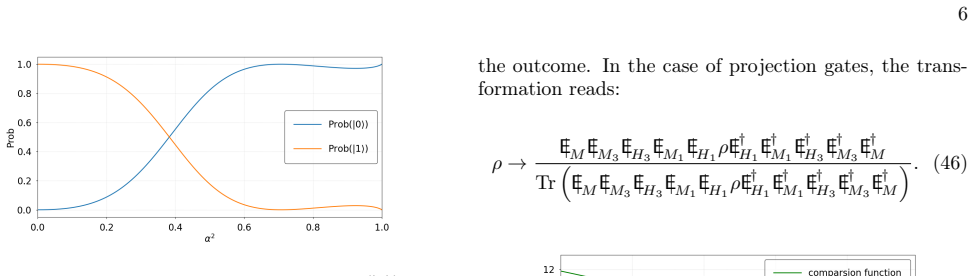
Prob(|0⟩) = α²(α+√(1−α²))² / (1 + 2α√(1−α²)(2α²−1)); Prob(|1⟩) = (α²−1)(2α√(1−α²)−1)/...
What do these tags mean?
- matches
- The paper's claim is directly supported by a theorem in the formal canon.
- supports
- The theorem supports part of the paper's argument, but the paper may add assumptions or extra steps.
- extends
- The paper goes beyond the formal theorem; the theorem is a base layer rather than the whole result.
- uses
- The paper appears to rely on the theorem as machinery.
- contradicts
- The paper's claim conflicts with a theorem or certificate in the canon.
- unclear
- Pith found a possible connection, but the passage is too broad, indirect, or ambiguous to say the theorem truly supports the claim.
Reference graph
Works this paper leans on
-
[1]
Deutsch, Proc
D. Deutsch, Proc. R. Soc. Lond. A400, 97 (1985)
1985
-
[2]
Pauli, inQuanten, Handbuch der Physik, edited by H
W. Pauli, inQuanten, Handbuch der Physik, edited by H. Geiger and K. Scheel (Springer, Berlin, Heidelberg,
-
[3]
Houser, W
U. Houser, W. Neuwirth, and N. Thesen, Phys. Lett. A 49, 57 (1974)
1974
-
[4]
Lindner, M
F. Lindner, M. Schätzel, H. Walther, A. Baltuška, E. Goulielmakis, F. Krausz, D. Milošević, D. Bauer, W. Becker, and G. Paulus, Phys. Rev. Lett.95, 040401 (2005)
2005
-
[5]
Tirole, S
R. Tirole, S. Vezzoli, E. Galiffi, I. Robertson, D. Maurice, B. Tilmann, S. Maier, J. Pendry, and R. Sapienza, Nat. Phys.19, 999 (2023)
2023
-
[6]
Góźdź, M
A. Góźdź, M. Góźdź, and A. P¸ edrak, Universe9, 256 (2023)
2023
-
[7]
Lüders, Ann
G. Lüders, Ann. Phys. (Leipzig)8, 322 (1951), reprinted in: Ann. Phys. (Leipzig) 15, 663 (2006)
1951
-
[8]
Delayed Choice Phenomena in the Projection Evolution Model
M. Góźdź, A. Góźdź, and K. Lider, arXiv:2604.26716 [quant-ph]
work page internal anchor Pith review Pith/arXiv arXiv
discussion (0)
Sign in with ORCID, Apple, or X to comment. Anyone can read and Pith papers without signing in.