Delayed Choice Phenomena in the Projection Evolution Model
Pith reviewed 2026-05-07 10:40 UTC · model grok-4.3
The pith
Delayed-choice interference arises from temporal overlap between a photon's wave function and interferometer devices in the projection evolution model.
A machine-rendered reading of the paper's core claim, the machinery that carries it, and where it could break.
Core claim
In the projection evolution model the wave function is defined in both space and time, permitting construction of a time operator. For a photon traveling through a Mach-Zehnder interferometer the delayed-choice experiments are explained by the temporal overlap of the photon and the devices in the interferometer.
What carries the argument
Temporal overlap of the photon's four-dimensional wave function with the time-dependent configuration of the interferometer components.
If this is right
- Delayed-choice results do not require backward-in-time influences.
- Interference visibility is determined by an overlap integral that includes both spatial and temporal coordinates.
- Quantum evolution proceeds consistently inside four-dimensional spacetime without an external time parameter.
- Standard predictions of quantum optics are recovered whenever the temporal profiles overlap as in conventional setups.
Where Pith is reading between the lines
- Ultrafast control of optical elements synchronized to photon wave-packet duration could test whether overlap alone sets the observed fringe visibility.
- The same spacetime-overlap mechanism may apply to other time-dependent quantum effects such as the quantum Zeno effect or time-bin entanglement.
- If the model is correct, precise timing measurements could distinguish it from interpretations that treat time as strictly classical.
Load-bearing premise
The projection evolution model is a valid description of quantum processes and temporal overlap by itself reproduces all observed delayed-choice interference patterns.
What would settle it
An experiment that eliminates temporal overlap between the photon wave packet and the active interferometer devices yet still produces the interference or which-path statistics predicted by standard quantum mechanics.
Figures



read the original abstract
In the Schr\"odinger evolution of a quantum state time enters as a real parameter representing the coordinate. In a more consistent approach time should be defined as a quantum observable, with the evolution taking place in a four-dimensional spacetime. This is possible in the projection evolution model in which the wave function is defined in both space and time. This allows to construct the time operator and discuss the temporal structure of quantum processes. In this paper we discuss a photon travelling through a Mach-Zehnder interferometer, focusing the description on the temporal profile of the wave function. We show that in this approach the delayed-choice experiments can be explained by the temporal overlap of the photon and the devices in the interferometer.
Editorial analysis
A structured set of objections, weighed in public.
Referee Report
Summary. The manuscript proposes that delayed-choice experiments in a Mach-Zehnder interferometer can be accounted for in the projection evolution model by treating time as a quantum observable. The wave function is defined over four-dimensional spacetime, and the observed interference patterns are attributed to the temporal overlap between the photon's wave packet and the time-dependent configurations of the interferometer devices (such as beam splitters), rather than retrocausality.
Significance. If the temporal-overlap mechanism is shown to reproduce the exact output-port probabilities and visibility limits of standard quantum mechanics for delayed-choice setups, the work would offer a spacetime-based alternative interpretation that embeds time explicitly in the dynamics. This could inform discussions of the role of time in quantum theory. However, its broader significance is constrained by dependence on a non-standard framework whose equivalence to conventional QM predictions is not demonstrated quantitatively in the provided description.
major comments (2)
- [Abstract] Abstract: The claim that delayed-choice phenomena are explained by temporal overlap requires an explicit derivation of the detection probabilities using the 4D photon wave function and time-projection operators. No overlap integrals, time-dependent device operators, or computed visibilities (e.g., confirming 0 % / 100 % limits) are referenced, leaving open whether the model matches standard QM or deviates.
- [Main text] Main text (Mach-Zehnder description): The explanation hinges on the temporal overlap determining which-path information, yet the manuscript does not supply the concrete form of the spacetime wave function or the projection operators that would allow verification that the output-port statistics coincide with ordinary quantum mechanics for time-dependent beam-splitter insertion/removal.
minor comments (1)
- [Abstract] Abstract: The phrase 'temporal profile of the wave function' is used without specifying the coordinate representation or normalization conventions in the four-dimensional spacetime.
Simulated Author's Rebuttal
We thank the referee for the careful reading and constructive comments. The points raised correctly identify that the manuscript emphasizes the conceptual role of temporal overlap in the projection evolution model but does not yet include the full quantitative derivations needed to verify exact agreement with standard quantum mechanics. We will incorporate these explicit calculations in the revised version.
read point-by-point responses
-
Referee: [Abstract] The claim that delayed-choice phenomena are explained by temporal overlap requires an explicit derivation of the detection probabilities using the 4D photon wave function and time-projection operators. No overlap integrals, time-dependent device operators, or computed visibilities (e.g., confirming 0 % / 100 % limits) are referenced, leaving open whether the model matches standard QM or deviates.
Authors: We agree that the abstract and current text present the mechanism descriptively. In the revision we will add the explicit 4D Gaussian wave-packet form, the time-dependent projection operators for the beam splitters, and the resulting overlap integrals. These will be shown to reproduce the standard 0 % / 100 % visibility limits and output-port probabilities for the relevant temporal configurations. revision: yes
-
Referee: [Main text] The explanation hinges on the temporal overlap determining which-path information, yet the manuscript does not supply the concrete form of the spacetime wave function or the projection operators that would allow verification that the output-port statistics coincide with ordinary quantum mechanics for time-dependent beam-splitter insertion/removal.
Authors: The manuscript currently focuses on the conceptual picture. We will supply the concrete spacetime wave function and the explicit time-projection operators in a new subsection, together with sample calculations demonstrating that the output-port statistics match those of ordinary quantum mechanics for time-dependent insertion and removal of the beam splitters. revision: yes
Circularity Check
No circularity: explanation follows from independent model framework
full rationale
The paper defines its framework (projection evolution with time as observable and 4D wave functions) as an alternative to standard Schrödinger evolution, then applies it to Mach-Zehnder delayed-choice setups via temporal overlap of the photon wave packet with time-dependent devices. No step reduces a claimed prediction to a fitted parameter, self-referential definition, or load-bearing self-citation that itself assumes the target result. The abstract and described derivation treat the model as given input whose consequences are then inspected; the output (reproduction of interference patterns via overlap) is not shown to be identical to the input by construction. External benchmarks (standard QM visibility limits) are referenced as consistency checks rather than smuggled in via ansatz or renaming.
Axiom & Free-Parameter Ledger
axioms (1)
- domain assumption Time can be defined as a quantum observable with the wave function defined in four-dimensional spacetime.
invented entities (1)
-
Temporal overlap between photon and devices
no independent evidence
Forward citations
Cited by 1 Pith paper
-
Description and error analysis of quantum alghorithms in the projection evolution model -- the Deutsch algorithm case
The Deutsch algorithm is modeled using a two-level harmonic oscillator in second quantization formalism, with derived evolution operators and a projection evolution model that describes quantum gate transformations in...
Reference graph
Works this paper leans on
-
[1]
Delayed Choice Phenomena in the Projection Evolution Model
Introduction In the standard approach to non-relativistic quantum mechanics the time evolution of a quantum stateψis given by the equation ψ(t,x) =U(t)ψ(x, 0), (1) where U(t) is a unitary evolution operator generated by a Hamiltonian H and t denotes time. In the case of time independent Hamiltonian U(t) =exp(−iHt) , where here and in the following we set ...
work page internal anchor Pith review Pith/arXiv arXiv doi:10.3390/e0000000arxiv:2604.26716v1 1978
-
[2]
We start from a four-dimensional formulation in which time is a quantum observable similar to the three spatial coordinates
The projection evolution We describe the time evolution of a quantum state using the projection evolution (PEv) formalism [ 13]. We start from a four-dimensional formulation in which time is a quantum observable similar to the three spatial coordinates. It follows that the wave function ψ=ψ(x) depends on all four coordinates x= (x 0, x1, x2, x3) and the s...
2026
-
[3]
one dimensional photon
The Mach-Zehnder interferometer The Mach-Zehnder interferometer consists of two beamsplitters, two mirrors, and two detectors, as shown in Fig. 1. k= 1 k= 1 k= 1 k= 1 t x( , ) = (0,0) BS 2 1BS mirror mirror D1 D2 k= k= k= 2 2 2 source Figure 1.The Mach-Zehnder interferometer The state space of the interferometer consists of two quantum channels based on f...
2026
-
[4]
In the following we assumeκ 1 =κ 2 =π
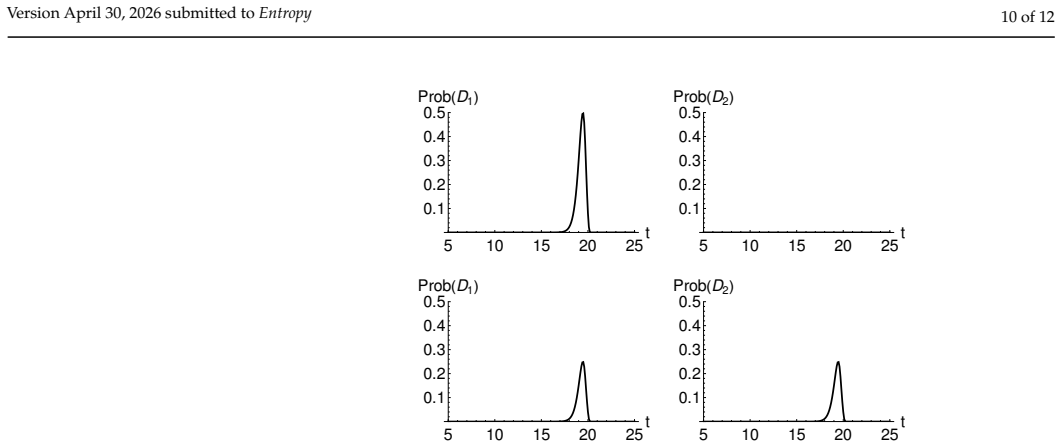
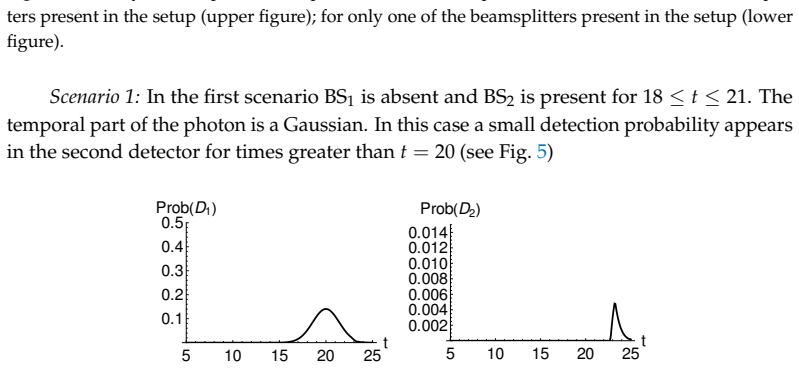
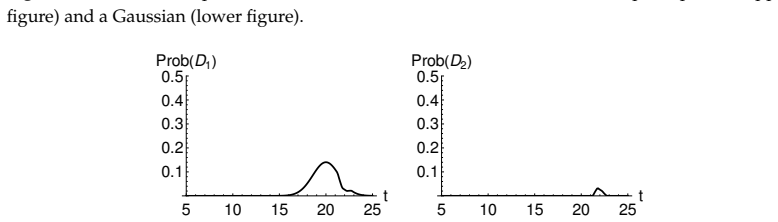
Discussion We assume that the photon enters the interferometer at (t, x) = ( 0, 0), and that the first beamsplitter, the mirrors, the second beamsplitter, and the detectors are all 5 units of space apart, ie., BS1 can be reached at x= 5, the mirrors at x= 10, BS2 at x= 15, and the detectors atx=20. In the following we assumeκ 1 =κ 2 =π. If there is only o...
2026
-
[5]
In this paper we have shown that the delayed-choice experiment on the example of a Mach- Zehnder interferometer can be successfully described by the temporal interaction
Closing remarks The temporal part of the wave function provides a natural way to describe the time structure of quantum events like the temporal interference, time-of-arrival, nuclear fission and fusion processes, time structure of elementary particles interactions and many more. In this paper we have shown that the delayed-choice experiment on the exampl...
2026
-
[6]
Wheeler.Mathematical Foundations of Quantum Theory; Academic Press, 1978
J.A. Wheeler.Mathematical Foundations of Quantum Theory; Academic Press, 1978
1978
-
[7]
Walborn, M.O
S.P . Walborn, M.O. Terra Cunha, S. Pádua, C.H. Monken. A double-slit quantum eraser.Phys. Rev. A2002,65, 033818
-
[8]
Jacques, E
V . Jacques, E. Wu, F. Grosshans, F. Treussart, P . Grangier, A. Aspect, J-F. Roch. Experimental Realization of Wheeler’s Delayed-Choice Gedanken Experiment.Science2007,315, 966–968
-
[9]
Houser, W
U. Houser, W. Neuwirth, N. Thesen. Time-dependent modulation of the probability amplitude of single photons.Phys. Lett. A1974,49, 57–58
-
[10]
Lindner, M
F. Lindner, M. Schätzel, H. Walther, A. Baltuška, E. Goulielmakis, F. Krausz, D. Miloševi´ c, D. Bauer, W. Becker, G. Paulus. Attosecond Double-Slit Experiment.Phys. Rev. Lett.2005, 95, 040401
2005
-
[11]
Tirole, S
R. Tirole, S. Vezzoli, E. Galiffi, I. Robertson, D. Maurice, B. Tilmann, S.A. Maier, J.B. Pendry, R. Sapienza. Double-slit time diffraction at optical frequencies.Nature Physics2023,19, 999–1002
-
[12]
Aharonov, D
Y. Aharonov, D. Bohm. Time in the Quantum Theory and the Uncertainty Relation for Time and Energy.Phys. Rev.1961,122, 1649
1961
-
[13]
Rosenbaum
D.M. Rosenbaum. Super Hilbert Space and the Quantum-Mechanical Time Operators.J. Math. Phys.1969,10, 1127–1144. Version April 30, 2026 submitted toEntropy 12 of 12
1969
-
[14]
N.N. Grot, C. Rovelli, R.S. Tate. Time of arrival in quantum mechanics.Phys. Rev. A1996, 54, 4676
-
[15]
Olkhovsky, E
V .S. Olkhovsky, E. Recami, A.J. Gerasimchuk. Time operator in quantum mechanics.Il Nuovo Cimento A1974,22, 263–278
-
[16]
Kijowski
J. Kijowski. On the time operator in quantum mechanics and the heisenberg uncertainty relation for energy and time.Rep. Math. Phys.1974,6, 361–386
1974
-
[17]
E. Galapon. Pauli’s theorem and quantum canonical pairs: the consistency of a bounded, self–adjoint time operator canonically conjugate to a Hamiltonian with non–empty point spec- trum.Proc. R. Soc. Lond. A2002,458, 451–472
-
[18]
Gó´ zd´ z, M
A. Gó´ zd´ z, M. Gó´ zd´ z, A. P˛ edrak. Quantum Time and Quantum Evolution.Universe2023,9, 256
-
[19]
M. Choi. Completely positive linear maps on complex matrices.Lin. Alg. App.1975,10, 285–290
1975
-
[20]
Krauss.States, Effects and Operations: Fundamental Notions of Quantum Theory; Springer: Berlin/Heidelberg, Germany, 1983
K. Krauss.States, Effects and Operations: Fundamental Notions of Quantum Theory; Springer: Berlin/Heidelberg, Germany, 1983
1983
-
[21]
Gó´ zd´ z, M
A. Gó´ zd´ z, M. Gó´ zd´ z. Quantum Clock in the Projection Evolution Formalism.Universe2024, 10, 116
-
[22]
Szpikowski.Podstawy mechaniki kwantowej; Wydawnictwo UMCS, Poland, 2011
S. Szpikowski.Podstawy mechaniki kwantowej; Wydawnictwo UMCS, Poland, 2011. (in Polish)
2011
discussion (0)
Sign in with ORCID, Apple, or X to comment. Anyone can read and Pith papers without signing in.