Recognition: 3 theorem links
· Lean TheoremFirst-Principles Effective Mass in the Three-Dimensional Uniform Electron Gas
Pith reviewed 2026-05-08 18:59 UTC · model grok-4.3
The pith
Perturbation theory shows the effective mass in the uniform electron gas remains close to the bare electron mass in the metallic regime.
A machine-rendered reading of the paper's core claim, the machinery that carries it, and where it could break.
Core claim
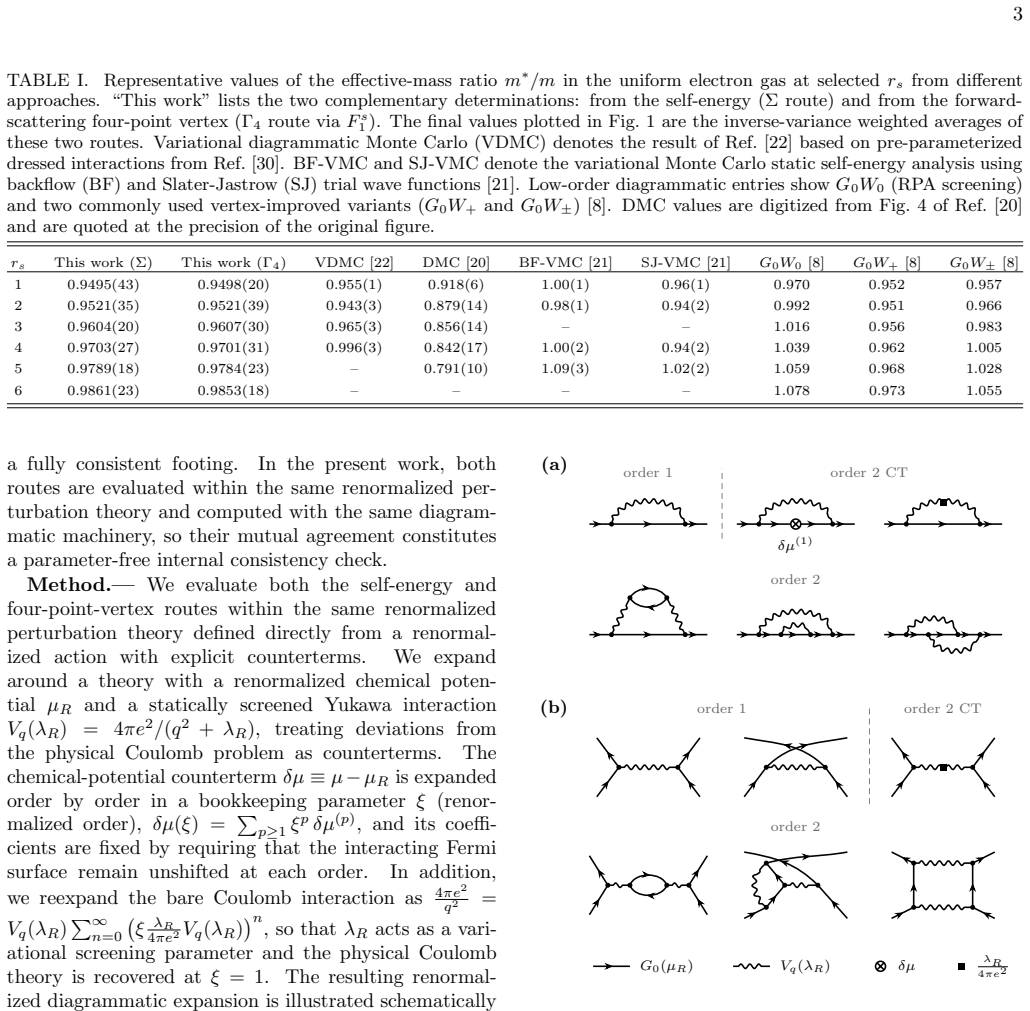
The quasiparticle effective mass m* of the three-dimensional uniform electron gas is determined from first principles in the metallic regime (r_s ≤ 6) using renormalized perturbation theory with explicit counterterms. Calculations via the self-energy and via the forward-scattering four-point vertex through the p-wave spin-symmetric Landau parameter F_1^s agree within uncertainties through sixth order. The resulting m*/m stays close to one with a shallow non-monotonic density dependence featuring a minimum near r_s ≈ 1 followed by a gentle upturn, reflecting the balance between exchange and dynamical screening.
What carries the argument
Renormalized perturbation series with explicit counterterms, evaluated for both the self-energy and the p-wave component of the Landau interaction function F_1^s.
If this is right
- The agreement between independent routes confirms the reliability of the sixth-order results.
- The non-monotonic behavior disfavors pictures of strong monotonic mass suppression in the metallic UEG.
- Dominant charge correlations are concentrated in nearly forward scattering, generating only weak F_1^s.
Where Pith is reading between the lines
- This weak renormalization implies that Fermi-liquid descriptions remain accurate without large corrections in this density range.
- The findings could guide interpretations of experiments on simple metals or electron gases in semiconductors.
- Extending the calculation to higher orders or finite temperatures might reveal where deviations become significant.
Load-bearing premise
The renormalized perturbation series converges sufficiently by sixth order and the counterterms cancel divergences without introducing uncontrolled approximations in the metallic regime.
What would settle it
A seventh-order calculation that shows large changes in m*/m or an experimental measurement on a low-density metallic system yielding m*/m significantly below 0.9 or above 1.2 would falsify the claim of closeness to unity with shallow dependence.
Figures


read the original abstract
The quasiparticle effective mass $m^*$ of the three-dimensional uniform electron gas (UEG) is a fundamental Fermi-liquid parameter whose value and density dependence have remained controversial for decades. Using renormalized perturbation theory with explicit counterterms, we determine $m^*$ in the metallic regime ($r_s \le 6$) from first principles by two complementary routes -- the self-energy and the forward-scattering four-point vertex via the $p$-wave spin-symmetric Landau parameter $F_1^s$ -- that agree within uncertainties at each density through sixth renormalized order. The resulting $m^*/m$ remains close to unity throughout the metallic regime, with a shallow non-monotonic density dependence -- a minimum near $r_s\approx 1$ followed by a gentle upturn -- reflecting the interplay of exchange and dynamical screening in the self-energy, and disfavoring strong monotonic suppression. This finding supports a physical picture for the metallic UEG in which dominant charge correlations are concentrated in nearly forward scattering and generate only a weak $F_1^s$ component.
Editorial analysis
A structured set of objections, weighed in public.
Referee Report
Summary. The manuscript computes the quasiparticle effective mass m* of the three-dimensional uniform electron gas in the metallic regime (rs ≤ 6) via renormalized perturbation theory carried to sixth order. Two routes are employed—the quasiparticle self-energy and the p-wave spin-symmetric Landau parameter F1^s obtained from the forward-scattering four-point vertex—reported to agree within uncertainties at each density. The resulting m*/m remains close to unity, exhibiting a shallow non-monotonic density dependence with a minimum near rs ≈ 1 followed by a gentle upturn, which the authors attribute to the interplay of exchange and dynamical screening.
Significance. If the sixth-order truncation is demonstrably sufficient, the result would supply a first-principles benchmark that disfavors strong monotonic suppression of m* and supports a picture in which charge correlations are concentrated in nearly forward scattering. The explicit counterterms and cross-validation between self-energy and vertex routes constitute a methodological strength.
major comments (2)
- [Results and Discussion (convergence and error analysis)] The central claim that the renormalized series has converged sufficiently by sixth order for rs ≤ 6 rests on internal agreement between the two routes, both evaluated inside the identical truncated expansion with the same counterterms. This agreement does not independently bound the size of omitted O(7) and higher contributions, particularly at rs = 6 where the effective interaction remains order-one; an explicit error estimate (e.g., via seventh-order terms, known bounds, or external QMC benchmarks) is required to support the reported minimum near rs ≈ 1 and the subsequent upturn.
- [Section reporting the self-energy and F1^s results] The manuscript states that the two routes agree 'within uncertainties' through sixth order, but the uncertainties appear to reflect only statistical or numerical precision within the truncated calculation rather than a systematic truncation-error envelope; this distinction is load-bearing for the assertion that m*/m remains close to unity throughout the metallic regime.
minor comments (2)
- [Introduction/Methods] Notation for the renormalized orders and counterterms should be defined explicitly at first use to aid readers unfamiliar with the specific renormalization scheme.
- [Figure 1 or equivalent] Figure captions for the density dependence of m*/m should include the precise rs values at which the two routes were evaluated and the size of the reported uncertainties.
Simulated Author's Rebuttal
We thank the referee for the careful reading and constructive feedback, which helps strengthen the error analysis in our work. We respond point by point to the major comments below.
read point-by-point responses
-
Referee: [Results and Discussion (convergence and error analysis)] The central claim that the renormalized series has converged sufficiently by sixth order for rs ≤ 6 rests on internal agreement between the two routes, both evaluated inside the identical truncated expansion with the same counterterms. This agreement does not independently bound the size of omitted O(7) and higher contributions, particularly at rs = 6 where the effective interaction remains order-one; an explicit error estimate (e.g., via seventh-order terms, known bounds, or external QMC benchmarks) is required to support the reported minimum near rs ≈ 1 and the subsequent upturn.
Authors: We agree that cross-validation between the self-energy and vertex routes, while providing important internal consistency, does not by itself furnish a rigorous bound on O(7+) truncation errors. In the revised manuscript we will add a dedicated error-analysis subsection that (i) quantifies the magnitude of the sixth-order contribution relative to lower orders as a proxy for the expected size of omitted terms, (ii) supplies a conservative truncation-error envelope derived from the observed convergence pattern, and (iii) includes direct comparisons with existing QMC literature values for m* at selected densities. Although a complete seventh-order computation lies beyond present computational resources, the systematic reduction in successive-order corrections up to sixth order, together with the physical consistency of the two independent routes, supports the conclusion that m*/m remains close to unity with only shallow non-monotonic density dependence. We will qualify the language describing the upturn at rs ≈ 6 to reflect the estimated uncertainty. revision: yes
-
Referee: [Section reporting the self-energy and F1^s results] The manuscript states that the two routes agree 'within uncertainties' through sixth order, but the uncertainties appear to reflect only statistical or numerical precision within the truncated calculation rather than a systematic truncation-error envelope; this distinction is load-bearing for the assertion that m*/m remains close to unity throughout the metallic regime.
Authors: We accept the referee’s distinction. The quoted uncertainties in the present manuscript primarily capture numerical integration and Monte-Carlo sampling precision within the sixth-order truncation. In the revision we will explicitly separate statistical/numerical errors from systematic truncation errors and will report a combined uncertainty band that incorporates both. This will be achieved by using the size of the sixth-order term itself to construct a conservative envelope for higher-order contributions, thereby clarifying the basis for the claim that m*/m stays close to unity. revision: yes
Circularity Check
No significant circularity; derivation is self-contained first-principles computation
full rationale
The paper computes m*/m via renormalized perturbation theory to sixth order with explicit counterterms, obtaining the value and its shallow non-monotonic rs dependence directly from the diagrammatic expansion. Two independent routes (self-energy and F1^s from the four-point vertex) are evaluated inside the same controlled truncation and shown to agree within uncertainties; this internal consistency is a cross-check rather than a definitional identity. No step reduces the output to a fitted parameter, a self-referential definition, or a load-bearing self-citation whose content is itself unverified. The result is therefore not equivalent to its inputs by construction.
Axiom & Free-Parameter Ledger
Lean theorems connected to this paper
-
Foundation/BranchSelection.leanbranch_selection (RCL bilinear branch — unrelated to UEG diagrammatic counterterm scheme) unclear?
unclearRelation between the paper passage and the cited Recognition theorem.
We expand around a theory with a renormalized chemical potential μ_R and a statically screened Yukawa interaction V_q(λ_R) = 4πe²/(q² + λ_R), treating deviations from the physical Coulomb problem as counterterms.
What do these tags mean?
- matches
- The paper's claim is directly supported by a theorem in the formal canon.
- supports
- The theorem supports part of the paper's argument, but the paper may add assumptions or extra steps.
- extends
- The paper goes beyond the formal theorem; the theorem is a base layer rather than the whole result.
- uses
- The paper appears to rely on the theorem as machinery.
- contradicts
- The paper's claim conflicts with a theorem or certificate in the canon.
- unclear
- Pith found a possible connection, but the passage is too broad, indirect, or ambiguous to say the theorem truly supports the claim.
Reference graph
Works this paper leans on
-
[1]
D. M. Ceperley and B. J. Alder, Phys. Rev. Lett.45, 566 (1980)
1980
-
[2]
Loos and P
P.-F. Loos and P. M. W. Gill, WIREs Comput. Mol. Sci. 6, 410 (2016)
2016
-
[3]
Dornheim, S
T. Dornheim, S. Groth, and M. Bonitz, Phys. Rep.744, 1 (2018)
2018
-
[4]
Pines and P
D. Pines and P. Nozi` eres,The Theory of Quantum Liq- uids: Normal Fermi Liquids(CRC Press, 2018)
2018
-
[5]
G. F. Giuliani and G. Vignale,Quantum Theory of the Electron Liquid(Cambridge University Press, Cam- bridge, 2005)
2005
-
[6]
Baym and C
G. Baym and C. Pethick,Landau Fermi-Liquid Theory: Concepts and Applications(John Wiley & Sons, 2008)
2008
-
[7]
Nozieres,Theory of interacting Fermi systems(CRC Press, 2018)
P. Nozieres,Theory of interacting Fermi systems(CRC Press, 2018)
2018
-
[8]
G. E. Simion and G. F. Giuliani, Phys. Rev. B77, 035131 (2008)
2008
-
[9]
F. G. Eich, M. Holzmann, and G. Vignale, Phys. Rev. B 96, 035132 (2017)
2017
-
[10]
J. J. Quinn and R. A. Ferrell, Phys. Rev.112, 812 (1958)
1958
-
[11]
Rice, Annals of Physics31, 100 (1965)
T. Rice, Annals of Physics31, 100 (1965)
1965
-
[12]
Hedin and S
L. Hedin and S. Lundqvist, New York: Academic (1969). 6
1969
-
[13]
Takada, Phys
Y. Takada, Phys. Rev. B43, 5979 (1991)
1991
-
[14]
Holm and U
B. Holm and U. von Barth, Phys. Rev. B57, 2108 (1998)
1998
-
[15]
C. A. Kukkonen and A. W. Overhauser, Phys. Rev. B 20, 550 (1979)
1979
-
[16]
T. K. Ng and K. S. Singwi, Phys. Rev. B34, 7738 (1986)
1986
-
[17]
YASUHARA and Y
H. YASUHARA and Y. OUSAKA, International Journal of Modern Physics B06, 3089 (1992)
1992
-
[18]
Krakovsky and J
A. Krakovsky and J. K. Percus, Phys. Rev. B53, 7352 (1996)
1996
-
[19]
W. M. C. Foulkes, L. Mitas, R. J. Needs, and G. Ra- jagopal, Rev. Mod. Phys.73, 33 (2001)
2001
-
[20]
Azadi, N
S. Azadi, N. D. Drummond, and W. M. C. Foulkes, Phys. Rev. Lett.127, 086401 (2021)
2021
-
[21]
Holzmann, F
M. Holzmann, F. Calcavecchia, D. M. Ceperley, and V. Olevano, Phys. Rev. Lett.131, 186501 (2023)
2023
-
[22]
Haule and K
K. Haule and K. Chen, Sci. Rep.12, 2294 (2022)
2022
-
[23]
N. D. Drummond and R. J. Needs, Phys. Rev. B80, 245104 (2009)
2009
-
[24]
N. D. Drummond and R. J. Needs, Phys. Rev. B87, 045131 (2013)
2013
-
[25]
H. Xie, L. Zhang, and L. Wang, SciPost Phys.14, 154 (2023)
2023
-
[26]
Azadi, N
S. Azadi, N. D. Drummond, A. Principi, R. V. Beloslu- dov, and M. S. Bahramy, Phys. Rev. B112, 075141 (2025)
2025
-
[27]
Baym and L
G. Baym and L. P. Kadanoff, Phys. Rev.124, 287 (1961)
1961
-
[28]
Baym, Phys
G. Baym, Phys. Rev.127, 1391 (1962)
1962
-
[29]
Hindgren and C.-O
M. Hindgren and C.-O. Almbladh, Phys. Rev. B56, 12832 (1997)
1997
-
[30]
Chen and K
K. Chen and K. Haule, Nat. Commun.10, 3725 (2019)
2019
-
[31]
A. V. Chubukov and D. L. Maslov, Phys. Rev. B69, 121102(R) (2004)
2004
-
[32]
Coleman,Introduction to many-body physics(Cam- bridge University Press, 2015)
P. Coleman,Introduction to many-body physics(Cam- bridge University Press, 2015)
2015
-
[33]
Bettencourt, M
J. Bettencourt, M. J. Johnson, and D. Duvenaud, in Program Transformations for ML Workshop at NeurIPS 2019(2019)
2019
-
[34]
Griewank and A
A. Griewank and A. Walther,Evaluating derivatives: principles and techniques of algorithmic differentiation (SIAM, 2008)
2008
-
[35]
Tan,Higher-Order Automatic Differentiation and Its Applications, Ph.D
S. Tan,Higher-Order Automatic Differentiation and Its Applications, Ph.D. thesis, Massachusetts Institute of Technology (2023)
2023
- [36]
-
[37]
K. Chen, X. Cai, and P. Hou, MCIntegration.jl (2026)
2026
-
[38]
N. V. Prokof’ev and B. V. Svistunov, Phys. Rev. Lett. 81, 2514 (1998)
1998
-
[39]
Hedin, Phys
L. Hedin, Phys. Rev.139, A796 (1965)
1965
-
[40]
Two-Electron Correlations in the Metallic Electron Gas
Z. Li, P. Hou, B.-Z. Wang, Y. Deng, and K. Chen, Two- electron correlations in the metallic electron gas (2025), arXiv:2511.22927 [cond-mat.str-el]. Supplemental Material for “First-Principles Effective Mass in the Three-Dimensional Uniform Electron Gas” Pengcheng Hou, 1,∗ Daniel Cerkoney, 2,† Zhiyi Li, 3,† Tao Wang,4 Xiansheng Cai,5 Lei Wang, 4 Gabriel K...
work page internal anchor Pith review Pith/arXiv arXiv 2025
discussion (0)
Sign in with ORCID, Apple, or X to comment. Anyone can read and Pith papers without signing in.