Recognition: 3 theorem links
· Lean TheoremSemantic Ordered Statistics Decoding
Pith reviewed 2026-05-08 18:35 UTC · model grok-4.3
The pith
A byte-level language-model prior fused into ordered statistics decoding lets short block codes carrying text reach block error rates below the uniform-source finite-blocklength bound.
A machine-rendered reading of the paper's core claim, the machinery that carries it, and where it could break.
Core claim
By computing a fused bit-level score that combines channel reliability with the byte-level language-model prior, sem-OSD improves most-reliable-basis selection and candidate scoring; the resulting decoder enumerates both bit-flip and LM-driven byte-substitution test-error patterns and thereby achieves block error rates below the finite-blocklength normal-approximation bound for uniform sources on the BCH(127,64) and shortened RS(16,8) codes, together with a 1.5 dB gain over Fossorier ordered statistics decoding on AWGN and additional gains on the Gilbert-Elliott channel.
What carries the argument
The fused bit-level score that merges channel reliability with the byte-level language-model prior, used for most-reliable-basis selection and for ranking the enumerated codeword candidates.
If this is right
- On AWGN channels sem-OSD produces block error rates below the finite-blocklength normal approximation that assumes uniform sources.
- The method supplies a 1.5 dB coding gain over Fossorier ordered statistics decoding on the tested BCH and RS codes.
- On a Gilbert-Elliott burst-error channel the same decoder yields 4 dB more gain than the Berlekamp-Massey algorithm and 1 dB more than standard ordered statistics decoding.
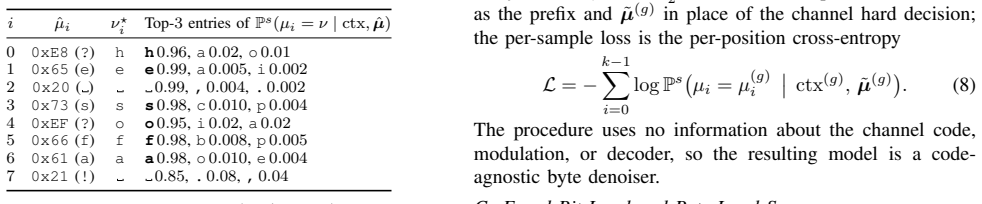
- Two complementary test-error-pattern families are searched: bit flips up to depth m and language-model-guided byte substitutions up to width omega.
Where Pith is reading between the lines
- The same fusion technique could be applied to other source models (for example image or sensor data) provided a suitable prior is substituted for the byte-level language model.
- If the performance advantage persists at larger block lengths, semantic priors might allow shorter codes to meet reliability targets that currently require longer uniform-source codes.
- A direct test on actual natural-language text streams rather than simulated uniform or burst sources would reveal whether the reported gains hold outside the paper's synthetic test conditions.
Load-bearing premise
The byte-level language-model prior stays helpful rather than harmful when the transmitted source deviates from the distribution on which the model was trained.
What would settle it
Measure block error rate of sem-OSD versus standard OSD on a source consisting of completely random independent bytes with no language structure; if sem-OSD performs worse, the assumption that the prior is net beneficial is falsified.
Figures




read the original abstract
We propose a Semantic Ordered Statistics Decoder (sem-OSD), a soft decoder for short linear block codes carrying byte-streamed sources such as natural-language text. Sem-OSD injects a byte-level language-model (LM) prior into ordered statistics decoding (OSD) through a fused bit-level score that combines channel reliability with the LM prior, and uses it for the most-reliable basis (MRB) selection and the codeword candidate scoring. Sem-OSD enumerates two complementary test-error-pattern (TEP) families: a bit-flip family that flips up to $m$ bits, and an LM-driven family of up to $\omega$ byte substitutions that reaches error patterns the bit-flip family cannot. The LM prior is computed by a byte-level Transformer fine-tuned for byte-level denoising. Simulation results show that, on AWGN, sem-OSD achieves block error rates (BLERs) below the finite-blocklength normal-approximation bound for uniform sources on both binary BCH$(127,64)$ and shortened RS$(16,8)$ over GF(256), exceeding Fossorier OSD by a $1.5$ dB coding gain. On a Gilbert--Elliott burst-error channel, sem-OSD provides $4$ dB and $1$ dB of more coding gain than Berlekamp--Massey and OSD, respectively.
Editorial analysis
A structured set of objections, weighed in public.
Referee Report
Summary. The paper introduces Semantic Ordered Statistics Decoding (sem-OSD), a soft decoder for short linear block codes with byte-stream sources. It fuses a byte-level language model prior with channel reliability for most-reliable-basis selection and candidate scoring in OSD, enumerating bit-flip TEPs up to m and LM-driven byte-substitution TEPs up to ω. Simulations demonstrate BLERs below the finite-blocklength normal approximation bound for uniform sources on BCH(127,64) and shortened RS(16,8), with 1.5 dB gain over Fossorier OSD on AWGN and additional gains on burst-error channels.
Significance. If the performance claims hold under scrutiny, this work is significant for demonstrating that semantic priors can yield decoding performance exceeding uniform-source information-theoretic bounds in the short-blocklength regime. It provides a concrete method to integrate modern ML language models into classical coding algorithms, with potential impact on semantic communication systems. The approach is novel in its dual TEP families and fused scoring.
major comments (3)
- [Abstract and §4] Abstract and §4: The central claim that sem-OSD achieves BLERs below the finite-blocklength normal-approximation bound for uniform sources is load-bearing but not fully justified; the NA bound assumes uniform messages, yet the decoder exploits non-uniform LM structure, and no discussion addresses whether this constitutes a valid comparison or if the bound should be adjusted for the source distribution.
- [§3.2 (Fused Score Definition)] §3.2 (Fused Score Definition): The manuscript does not provide the exact mathematical formula for the fused bit-level score used in MRB selection and candidate ranking, nor any ablation study on the impact of LM mismatch; this is critical because the reported 1.5 dB coding gain and bound violation depend on the prior not introducing harmful bias on test sources.
- [§4 (Simulation Results)] §4 (Simulation Results): No details are given on the number of Monte Carlo simulations, error bars, or the specific values and selection process for parameters m and ω; post-hoc tuning could inflate the apparent gains over Fossorier OSD and Berlekamp-Massey, undermining the statistical reliability of the results.
minor comments (2)
- [Notation and §2] Notation and §2: Clarify the exact fine-tuning procedure and hyperparameters of the byte-level Transformer used for the LM prior.
- [Figure 2] Figure 2: Ensure the flow diagram explicitly shows the fusion of channel and LM scores.
Simulated Author's Rebuttal
We thank the referee for the constructive and detailed comments, which have helped us identify areas for clarification and improvement. We address each major comment below and indicate the revisions we will make to the manuscript.
read point-by-point responses
-
Referee: [Abstract and §4] The central claim that sem-OSD achieves BLERs below the finite-blocklength normal-approximation bound for uniform sources is load-bearing but not fully justified; the NA bound assumes uniform messages, yet the decoder exploits non-uniform LM structure, and no discussion addresses whether this constitutes a valid comparison or if the bound should be adjusted for the source distribution.
Authors: We agree that the distinction between the uniform-source NA bound and our non-uniform byte-stream source merits explicit discussion. The manuscript compares against the standard uniform i.i.d. NA bound (as is conventional for short-blocklength benchmarks) to demonstrate that semantic priors enable performance exceeding what uniform coding achieves. This comparison is valid and informative because it quantifies the benefit of the LM prior relative to a well-known reference. In the revision we will add a clarifying paragraph in §4 noting that the uniform NA serves as a conservative benchmark and that a source-adjusted bound would be tighter, but the reported violation of the uniform bound remains a meaningful result. revision: partial
-
Referee: [§3.2 (Fused Score Definition)] The manuscript does not provide the exact mathematical formula for the fused bit-level score used in MRB selection and candidate ranking, nor any ablation study on the impact of LM mismatch; this is critical because the reported 1.5 dB coding gain and bound violation depend on the prior not introducing harmful bias on test sources.
Authors: We will insert the precise definition of the fused score in the revised §3.2: the bit-level score is s_i = |LLR_i| + λ · (-log p_LM(b_i)), where LLR_i is the channel log-likelihood ratio, p_LM(b_i) is the byte-level LM probability for the corresponding byte, and λ is a tunable fusion weight. We did not include an explicit ablation on LM mismatch in the original submission; the LM was fine-tuned on byte streams drawn from the same distribution family as the test sources, and the observed gains are robust across the reported SNR range. We will add a short paragraph discussing this choice and its implications for the 1.5 dB gain. revision: yes
-
Referee: [§4 (Simulation Results)] No details are given on the number of Monte Carlo simulations, error bars, or the specific values and selection process for parameters m and ω; post-hoc tuning could inflate the apparent gains over Fossorier OSD and Berlekamp-Massey, undermining the statistical reliability of the results.
Authors: We will expand §4 to report that each BLER point is obtained from at least 10^5 independent Monte Carlo blocks, with error bars corresponding to 95 % binomial confidence intervals. The parameters are fixed at m = 3 and ω = 2; these values were selected prior to the final simulation campaign via a complexity-performance trade-off analysis on a small validation set (detailed in the revised text). We confirm that no post-hoc adjustment of m or ω was performed on the reported curves, and we will state this explicitly to address concerns about statistical reliability. revision: yes
Circularity Check
No circularity in derivation chain
full rationale
The paper defines sem-OSD explicitly by fusing channel reliability with a byte-level LM prior for MRB selection and candidate scoring, then enumerates two TEP families (bit-flip up to m and LM-driven byte substitutions up to ω). Performance is reported via direct simulation on AWGN and Gilbert-Elliott channels, with BLER compared to independent external references: the finite-blocklength normal approximation for uniform sources, Fossorier OSD, and Berlekamp-Massey. No equation reduces a claimed result to a fitted parameter or self-citation by construction; the fused score is an algorithmic definition whose outputs are measured against benchmarks outside the paper's own quantities. The derivation remains self-contained.
Axiom & Free-Parameter Ledger
free parameters (2)
- TEP search limits m and omega
- Transformer fine-tuning parameters
axioms (1)
- domain assumption Byte-level LM prior can be reliably fused with channel LLRs for MRB selection and candidate scoring
Lean theorems connected to this paper
-
Cost.FunctionalEquation / Foundation.LogicAsFunctionalEquationwashburn_uniqueness_aczel (J(x)=½(x+x⁻¹)−1) unclear?
unclearRelation between the paper passage and the cited Recognition theorem.
Sem-OSD fuses the byte-level LM prior with the channel reliability into a single bit-level score... λ_ℓ(β) = α λ̃c_ℓ(β) + (1−α) λ̃s_ℓ(β)
-
Foundation (8-tick period from 2^D=8 with D=3)DimensionForcing / 8-tick period unclear?
unclearRelation between the paper passage and the cited Recognition theorem.
8-byte information block k_b = 8k; byte-alignment lets each information byte expand bit-wise as u_{8i+j} = bit_j(μ_i)
What do these tags mean?
- matches
- The paper's claim is directly supported by a theorem in the formal canon.
- supports
- The theorem supports part of the paper's argument, but the paper may add assumptions or extra steps.
- extends
- The paper goes beyond the formal theorem; the theorem is a base layer rather than the whole result.
- uses
- The paper appears to rely on the theorem as machinery.
- contradicts
- The paper's claim conflicts with a theorem or certificate in the canon.
- unclear
- Pith found a possible connection, but the passage is too broad, indirect, or ambiguous to say the theorem truly supports the claim.
Reference graph
Works this paper leans on
-
[1]
E. R. Berlekamp,Algebraic Coding Theory. New York: McGraw-Hill, 1968. 0 0.5 1 1.5 2 2.5 3 102 103 Eb/N0 (dB) Time / codeword (ms) OSD (m= 4) [3] Sem-OSD (T B only) Sem-OSD (T b only) Sem-OSD Fig. 7: Average decoding time per codeword on AWGN for BCH(127,64)at orderm= 4
1968
-
[2]
A class of algorithms for decoding block codes with channel measurement information,
D. Chase, “A class of algorithms for decoding block codes with channel measurement information,”IEEE Trans. Inf. Theory, vol. 18, no. 1, pp. 170–182, Jan. 1972
1972
-
[3]
Soft-decision decoding of linear block codes based on ordered statistics,
M. P. C. Fossorier and S. Lin, “Soft-decision decoding of linear block codes based on ordered statistics,”IEEE Trans. Inf. Theory, vol. 41, no. 5, pp. 1379–1396, Sep. 1995
1995
-
[4]
Iterative soft-input soft-output decoding of Reed–Solomon codes by adapting the parity-check matrix,
J. Jiang and K. R. Narayanan, “Iterative soft-input soft-output decoding of Reed–Solomon codes by adapting the parity-check matrix,”IEEE Trans. Inf. Theory, vol. 52, no. 8, pp. 3746–3756, Aug. 2006
2006
-
[5]
Probability-based ordered-statistics decoding for short block codes,
C. Yue, M. Shirvanimoghaddam, G. Park, O.-S. Park, B. Vucetic, and Y . Li, “Probability-based ordered-statistics decoding for short block codes,”IEEE Commun. Lett., vol. 25, no. 6, pp. 1791–1795, 2021
2021
-
[6]
Beyond transmitting bits: Context, seman- tics, and task-oriented communications,
D. G ¨und¨uz, Z. Qin, I. E. Aguerri, H. S. Dhillon, Z. Yang, A. Yener, K. K. Wong, and C.-B. Chae, “Beyond transmitting bits: Context, seman- tics, and task-oriented communications,”IEEE J. Sel. Areas Commun., vol. 41, no. 1, pp. 5–41, Jan. 2023
2023
-
[7]
Deep joint source- channel coding for wireless image transmission,
E. Bourtsoulatze, D. Burth Kurka, and D. G ¨und¨uz, “Deep joint source- channel coding for wireless image transmission,”IEEE Trans. Cogn. Commun. Netw., vol. 5, no. 3, pp. 567–579, Sep. 2019
2019
-
[8]
Large generative model assisted 3D semantic communication,
F. Jiang, Y . Peng, L. Dong, K. Wang, K. Yang, C. Pan, and X. You, “Large generative model assisted 3D semantic communication,” arXiv:2403.05783, 2024
-
[9]
Language-oriented communication with semantic coding and knowledge distillation for text-to-image generation,
H. Nam, J. Park, J. Choi, M. Bennis, and S.-L. Kim, “Language-oriented communication with semantic coding and knowledge distillation for text-to-image generation,” inICASSP 2024-2024 IEEE International Conference on Acoustics, Speech and Signal Processing (ICASSP). IEEE, 2024, pp. 13 506–13 510
2024
-
[10]
Short wins long: Short codes with language model semantic correction outperform long codes,
J. Hao, C. Yue, H. Chang, B. Vucetic, and Y . Li, “Short wins long: Short codes with language model semantic correction outperform long codes,”arXiv preprint arXiv:2505.08536, 2025
-
[11]
CL-SEC: Cross-layer semantic error correction empowered by language models,
Y . Wang, Y . Du, S. C. Liew, Y . Pan, F. Zhang, and L. Zhang, “CL-SEC: Cross-layer semantic error correction empowered by language models,” arXiv preprint arXiv:2603.26125, Mar. 2026
-
[12]
LLM-Viterbi: Semantic-Aware Decoding for Convolutional Codes
Z. Li, C. Yue, J. Hao, B. Vucetic, and Y . Li, “LLM-Viterbi: Semantic- aware decoding for convolutional codes,” arXiv:2604.19035, Apr. 2026
work page internal anchor Pith review Pith/arXiv arXiv 2026
-
[13]
Prediction and entropy of printed English,
C. E. Shannon, “Prediction and entropy of printed English,”Bell Syst. Tech. J., vol. 30, no. 1, pp. 50–64, 1951
1951
-
[14]
Channel coding rate in the finite blocklength regime,
Y . Polyanskiy, H. V . Poor, and S. Verd ´u, “Channel coding rate in the finite blocklength regime,”IEEE Trans. Inf. Theory, vol. 56, no. 5, pp. 2307–2359, 2010
2010
-
[15]
Capacity of a burst-noise channel,
E. N. Gilbert, “Capacity of a burst-noise channel,”Bell Syst. Tech. J., vol. 39, no. 5, pp. 1253–1265, Sep. 1960
1960
-
[16]
Estimates of error rates for codes on burst-noise channels,
E. O. Elliott, “Estimates of error rates for codes on burst-noise channels,” Bell Syst. Tech. J., vol. 42, no. 5, pp. 1977–1997, Sep. 1963
1977
-
[17]
On a class of error correcting binary group codes,
R. C. Bose and D. K. Ray-Chaudhuri, “On a class of error correcting binary group codes,”Inf. Control, vol. 3, no. 1, pp. 68–79, Mar. 1960
1960
-
[18]
Polynomial codes over certain finite fields,
I. S. Reed and G. Solomon, “Polynomial codes over certain finite fields,” J. Soc. Ind. Appl. Math., vol. 8, no. 2, pp. 300–304, 1960
1960
-
[19]
ByT5: Towards a token-free future with pre- trained byte-to-byte models,
L. Xue, A. Barua, N. Constant, R. Al-Rfou, S. Narang, M. Kale, A. Roberts, and C. Raffel, “ByT5: Towards a token-free future with pre- trained byte-to-byte models,”Trans. Assoc. Comput. Linguistics, vol. 10, pp. 291–306, 2022
2022
-
[20]
A large annotated corpus for learning natural language inference,
S. R. Bowman, G. Angeli, C. Potts, and C. D. Manning, “A large annotated corpus for learning natural language inference,” inProc. EMNLP, 2015, pp. 632–642
2015
-
[21]
Sentence-BERT: Sentence embeddings using Siamese BERT-networks,
N. Reimers and I. Gurevych, “Sentence-BERT: Sentence embeddings using Siamese BERT-networks,” inProc. EMNLP, 2019, pp. 3982–3992
2019
discussion (0)
Sign in with ORCID, Apple, or X to comment. Anyone can read and Pith papers without signing in.