Recognition: unknown
A Variational Kolosov--Muskhelishvili Network for Elasticity and Fracture
Pith reviewed 2026-05-08 02:20 UTC · model grok-4.3
The pith
Representing elastic fields with two holomorphic potentials and training them solely on total potential energy solves 2D elasticity and fracture problems accurately with a single loss term.
A machine-rendered reading of the paper's core claim, the machinery that carries it, and where it could break.
Core claim
The central claim is that the variational Kolosov-Muskhelishvili informed neural network, whose solution is expressed by two holomorphic potentials and whose training minimizes a single total-potential-energy integral, accurately reproduces both smooth elastic fields and fields containing crack discontinuities, including reliable extraction of stress intensity factors, while requiring fewer loss terms than residual-based formulations.
What carries the argument
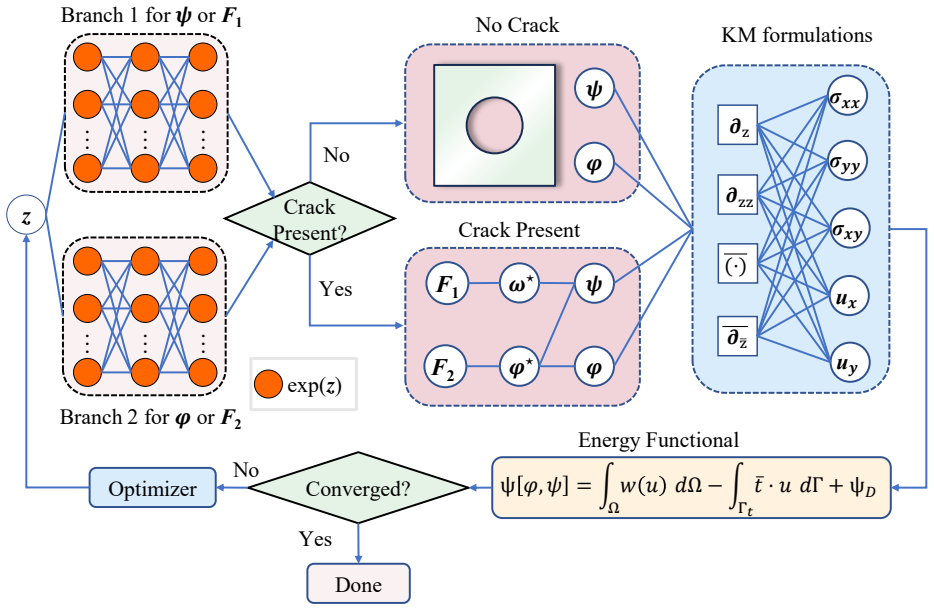
The representation of displacement and stress by two holomorphic Kolosov-Muskhelishvili potentials, optimized via a single energy integral from the minimum total potential energy principle; for cracks, a discontinuous stress-potential ansatz that embeds traction-free faces and tip singularities directly into the network.
If this is right
- The network recovers stress and displacement fields to high accuracy on both cracked and uncracked benchmark problems.
- Stress intensity factors are obtained directly as part of the solution without post-processing or special meshing.
- Loss construction is reduced to a single energy term that automatically satisfies all boundary conditions.
- Training converges faster than displacement-based neural networks on the tested cases.
- The same framework applies uniformly to problems with and without cracks.
Where Pith is reading between the lines
- The discontinuous-potential idea could be adapted to model other sharp interfaces such as material boundaries in composites.
- If the energy-only loss remains stable under mesh-free sampling, the method may support real-time or parametric studies of crack paths without repeated remeshing.
- Because the potentials are analytic, the framework might extend naturally to related plane problems in electrostatics or incompressible flow.
- The approach suggests a route to hybrid solvers that combine neural networks with classical complex-variable methods for selected subdomains.
Load-bearing premise
The holomorphic Kolosov-Muskhelishvili potentials, even when made discontinuous across cracks, remain expressive enough to represent arbitrary two-dimensional elastic fields while the single energy integral alone enforces all boundary and interface conditions.
What would settle it
On the standard infinite plate with central crack under remote tension, if the network's predicted stress intensity factor deviates by more than a few percent from the known analytical value or if the computed displacement field shows large errors near the crack tip when compared with an independent finite-element solution.
Figures






read the original abstract
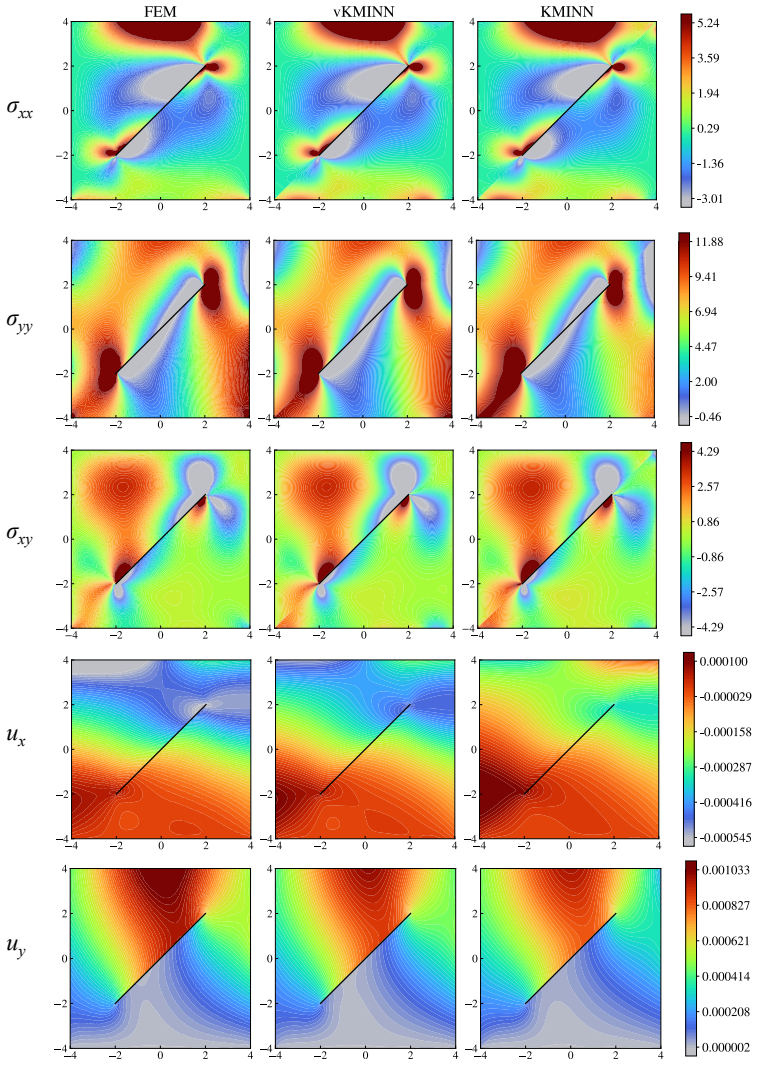
Physics-informed neural networks provide a mesh-free framework for solving partial differential equation-governed problems in solid mechanics. However, most existing formulations in linear elasticity still learn the displacement field directly, which does not explicitly exploit the analytic structure of two-dimensional elasticity and becomes restrictive for fracture problems with crack face discontinuities and crack tip singularities. Moreover, existing Kolosov--Muskhelishvili informed neural network formulations still rely on residual-based loss functions with multiple boundary and interface terms, whereas a variational concept has not yet been established. To address these issues, a variational Kolosov--Muskhelishvili informed neural network framework for two-dimensional linear elastic problems with and without cracks is proposed in this work. The solution is represented by two holomorphic Kolosov--Muskhelishvili potentials and trained through an energy-based loss function derived from the principle of minimum total potential energy. For crack problems, a discontinuous stress potential representation is further introduced to embed the crack face condition and crack tip singularity directly into the solution ansatz. The proposed framework is validated on a series of benchmark problems with or without crack problems. The results show that variational Kolosov--Muskhelishvili informed neural network can accurately predict stress and displacement field as well as stress intensity factors. Compared with traditional neural network models, it achieves higher accuracy, simpler loss construction, and faster convergence in the considered cases. Overall, the proposed variational Kolosov--Muskhelishvili informed neural network provides an effective and physically consistent variational framework for two-dimensional linear elastic fracture analysis.
Editorial analysis
A structured set of objections, weighed in public.
Referee Report
Summary. The manuscript proposes a variational Kolosov-Muskhelishvili informed neural network (vKMNN) for two-dimensional linear elasticity and fracture problems. The solution is represented by two holomorphic potentials, trained by minimizing the total potential energy derived from the principle of minimum potential energy. For problems with cracks, a discontinuous stress potential representation is introduced to embed the traction-free crack face conditions and the 1/r^{1/2} singularity. The framework is validated on benchmark problems, with claims of accurate prediction of displacement and stress fields as well as stress intensity factors, and advantages over traditional neural networks in accuracy, loss simplicity, and convergence speed.
Significance. If the central claims hold, the work offers a mesh-free variational approach that exploits the analytic structure of 2D elasticity via holomorphic potentials and an energy-based loss, potentially simplifying PINN formulations for fracture by reducing explicit boundary residual terms. Embedding discontinuities and singularities in the ansatz while relying on the variational principle could yield more physically consistent predictions of fields and SIFs, with benefits for problems where mesh-based methods require heavy refinement.
major comments (2)
- In the section introducing the discontinuous stress potential representation for crack problems, the central claim is that the single total-potential-energy loss automatically enforces traction-free crack faces and far-field conditions once the ansatz is adopted. However, no explicit verification is provided (such as post-training residual evaluation on crack faces or a demonstration that the NN parameterization is dense enough in the admissible space) to show that deviations from the exact holomorphic functions are penalized by the energy integral alone; any mismatch in the branch-cut behavior would remain invisible to the loss and undermine the assertion that all interface conditions are satisfied without additional terms.
- In the validation and results section, the claims of higher accuracy, simpler loss construction, and faster convergence compared to traditional neural network models are load-bearing for the contribution. The manuscript must include quantitative error tables (e.g., L2 norms for displacements and stresses), convergence plots versus iterations or epochs, and direct baseline comparisons with specific metrics on the benchmark problems to substantiate these performance advantages; the absence of such data in the reported summary leaves the superiority assertions unverified.
minor comments (1)
- The abstract contains the redundant phrase 'benchmark problems with or without crack problems'; rephrase for conciseness.
Simulated Author's Rebuttal
We thank the referee for the thoughtful and constructive review. The comments identify key areas where additional verification and quantitative evidence would strengthen the manuscript. We address each major comment below and will revise the manuscript accordingly to incorporate the suggested improvements.
read point-by-point responses
-
Referee: In the section introducing the discontinuous stress potential representation for crack problems, the central claim is that the single total-potential-energy loss automatically enforces traction-free crack faces and far-field conditions once the ansatz is adopted. However, no explicit verification is provided (such as post-training residual evaluation on crack faces or a demonstration that the NN parameterization is dense enough in the admissible space) to show that deviations from the exact holomorphic functions are penalized by the energy integral alone; any mismatch in the branch-cut behavior would remain invisible to the loss and undermine the assertion that all interface conditions are satisfied without additional terms.
Authors: We appreciate the referee's emphasis on explicit verification. The variational loss is derived from the principle of minimum potential energy, which enforces traction-free conditions as natural boundary conditions when the ansatz is kinematically admissible. Nevertheless, to directly address the concern, we will add post-training residual evaluations of tractions on the crack faces and far-field boundaries in the revised manuscript. We will also include a brief discussion on the approximation properties of the neural network parameterization for holomorphic functions to confirm that deviations are penalized by the energy integral. These additions will substantiate that the embedded ansatz and variational loss together satisfy the interface conditions without supplementary residual terms. revision: yes
-
Referee: In the validation and results section, the claims of higher accuracy, simpler loss construction, and faster convergence compared to traditional neural network models are load-bearing for the contribution. The manuscript must include quantitative error tables (e.g., L2 norms for displacements and stresses), convergence plots versus iterations or epochs, and direct baseline comparisons with specific metrics on the benchmark problems to substantiate these performance advantages; the absence of such data in the reported summary leaves the superiority assertions unverified.
Authors: We agree that quantitative substantiation is essential for the performance claims. While the manuscript presents results on benchmark problems demonstrating accurate field predictions and SIFs, we acknowledge that more detailed tabular and graphical comparisons would better support the assertions of higher accuracy, simpler loss, and faster convergence. In the revision, we will add L2-norm error tables for displacements and stresses, convergence plots of loss and error versus epochs, and direct numerical comparisons against standard PINN baselines using specific metrics (e.g., relative L2 errors and iteration counts) for all considered cases. These enhancements will provide the required evidence without altering the core methodology. revision: yes
Circularity Check
No significant circularity; derivation relies on standard variational principle and classical elasticity theory
full rationale
The loss function is constructed directly from the principle of minimum total potential energy, a foundational and independent physical law in solid mechanics that does not depend on the neural network outputs or fitted parameters. The Kolosov-Muskhelishvili potentials are drawn from established analytic theory of 2D elasticity, and the discontinuous ansatz for cracks is introduced as a representation choice to embed known boundary behavior rather than being fitted or self-referential. Validation occurs via comparison to benchmark solutions on independent test cases, providing external falsifiability. No load-bearing step reduces by construction to a self-citation, a fitted input renamed as prediction, or an ansatz smuggled through prior work by the same authors. This is the common case of a self-contained numerical method.
Axiom & Free-Parameter Ledger
axioms (1)
- standard math Principle of minimum total potential energy
invented entities (1)
-
Discontinuous stress potential representation
no independent evidence
Reference graph
Works this paper leans on
- [1]
-
[2]
X. Ge, L. Zhou, Y . Ying, S. Bagherifard, M. Guagliano, Combining phase field method and critical distance theory for predicting fatigue life of notched specimens, International Journal of Mechanical Sciences 282 (2024) 109608.doi:10.1016/j.ijmecsci.2024.109608
-
[4]
J. Liu, Z. Gao, S. Liang, Y . Zhu, L. Zhao, M. Huang, Z. Li, A hybrid peridynamic framework incorporating entanglement effect for hyperelastic materials, International Journal of Mechanical Sciences 308 (2025) 110955. doi:10.1016/j.ijmecsci.2025.110955
-
[5]
S. Zhou, M. Huang, C. Häffner, S. Stebner, M. Cai, Z. Wei, B. Yang, S. Münstermann, Microstructure-sensitive crystal plasticity and fatigue indicator modeling for lz50 steel, International Journal of Fatigue 203 (2026) 109302.doi:10.1016/j.ijfatigue.2025.109302
-
[6]
Z. Wei, G. Mao, S. Gerke, S. Münstermann, M. Brünig, Experimental analysis and modeling of anisotropic ductile damage in non-proportional extreme low-cycle biaxial loading with shear-tension histories, International Journal of Plasticity 194 (2025) 104474.doi:10.1016/j.ijplas.2025.104474. 26
-
[7]
H. Liu, X. Yang, S. Li, D. Shi, H. Qi, Modeling fatigue crack growth for a through thickness crack: An out-of- plane constraint-based approach considering thickness effect, International Journal of Mechanical Sciences 178 (2020) 105625.doi:10.1016/j.ijmecsci.2020.105625
-
[8]
C. Skamniotis, M. van de Noort, A. C. Cocks, P. Ireland, Fatigue-creep design of transpiration cooled nickel gas turbine blades via low order aerothermal-stress and crystal plasticity finite element modelling, International Journal of Mechanical Sciences 287 (2025) 109955.doi:10.1016/j.ijmecsci.2025.109955
-
[10]
Y . Leng, L. Svolos, I. Boureima, G. Manzini, J. N. Plohr, H. M. Mourad, Arbitrary order virtual element meth- ods for high–order phase–field modeling of dynamic fracture, International Journal for Numerical Methods in Engineering 126 (1) (2025).doi:10.1002/nme.7605
-
[11]
Gradient-annihilated pinns for solving riemannproblems:Applicationtorelativistichydrodynamics
B.-B. Xu, W.-L. Fan, P. Wriggers, High-order 3d virtual element method for linear and nonlinear elasticity, Computer Methods in Applied Mechanics and Engineering 431 (2024) 117258.doi:10.1016/j.cma.2024. 117258
-
[12]
H. Chen, H. Xing, H. Imtiaz, B. Liu, How to obtain a more accurate maximum energy release rate for mixed mode fracture, Forces in Mechanics 7 (2022) 100077.doi:10.1016/j.finmec.2022.100077
-
[13]
Y . Gu, C. Zhang, Novel special crack-tip elements for interface crack analysis by an efficient boundary element method, Engineering Fracture Mechanics 239 (2020) 107302.doi:10.1016/j.engfracmech.2020.107302
-
[14]
Z. Wei, S. Gerke, M. Brünig, Ductile damage and fracture characterizations in bi-cyclic biaxial experiments, International Journal of Mechanical Sciences 276 (2024) 109380.doi:10.1016/j.ijmecsci.2024.109380
-
[15]
F. Shen, S. Münstermann, J. Lian, Cryogenic ductile and cleavage fracture of bcc metallic structures – influence of anisotropy and stress states, Journal of the Mechanics and Physics of Solids 176 (2023) 105299.doi: 10.1016/j.jmps.2023.105299
-
[16]
S. Goswami, C. Anitescu, S. Chakraborty, T. Rabczuk, Transfer learning enhanced physics informed neural network for phase-field modeling of fracture, Theoretical and Applied Fracture Mechanics 106 (2020) 102447. doi:10.1016/j.tafmec.2019.102447
- [17]
-
[18]
T. T. Nguyen, J. Yvonnet, Q.-Z. Zhu, M. Bornert, C. Chateau, A phase field method to simulate crack nucleation and propagation in strongly heterogeneous materials from direct imaging of their microstructure, Engineering Fracture Mechanics 139 (2015) 18–39.doi:10.1016/j.engfracmech.2015.03.045
-
[20]
R. Roy, M. Topping, M. R. Daymond, In-situ assessment of microscale crack tip fields in zirconium, International Journal of Mechanical Sciences 264 (2024) 108812.doi:10.1016/j.ijmecsci.2023.108812
-
[21]
X. Lu, C. Li, Y . Tie, Y . Hou, C. Zhang, Crack propagation simulation in brittle elastic materials by a phase field method, Theoretical and Applied Mechanics Letters 9 (6) (2019) 339–352.doi:10.1016/j.taml.2019.06. 001. 27
-
[22]
L.-X. Wang, L.-F. Wen, R. Tian, C. Feng, Improved xfem (ixfem): Arbitrary multiple crack initiation, propa- gation and interaction analysis, Computer Methods in Applied Mechanics and Engineering 421 (2024) 116791. doi:10.1016/j.cma.2024.116791
-
[24]
Z. Wei, M. Zistl, S. Gerke, M. Brünig, Analysis of ductile damage and fracture under reverse loading, Interna- tional Journal of Mechanical Sciences 228 (2022) 107476.doi:10.1016/j.ijmecsci.2022.107476
-
[25]
L. Wang, G. Liu, G. Wang, K. Zhang, M–pinn : A mesh–based physics–informed neural network for linear elastic problems in solid mechanics, International Journal for Numerical Methods in Engineering 125 (9) (2024). doi:10.1002/nme.7444
-
[27]
J. A. Esterhuizen, B. R. Goldsmith, S. Linic, Interpretable machine learning for knowledge generation in hetero- geneous catalysis, Nature Catalysis 5 (3) (2022) 175–184.doi:10.1038/s41929-022-00744-z
-
[28]
S. Zhou, B. Yang, S. Xiao, G. Yang, T. Zhu, Interpretable machine learning method for modelling fatigue short crack growth behaviour, Metals and Materials International (2024).doi:10.1007/s12540-024-01628-6
-
[29]
O. Ibragimova, A. Brahme, W. Muhammad, D. Connolly, J. Lévesque, K. Inal, A convolutional neural network based crystal plasticity finite element framework to predict localised deformation in metals, International Journal of Plasticity 157 (2022) 103374.doi:10.1016/j.ijplas.2022.103374
-
[30]
G.-J. Sim, M.-G. Lee, M. I. Latypov, Fip-gnn: Graph neural networks for scalable prediction of grain-level fatigue indicator parameters, Scripta Materialia 255 (2025) 116407.doi:10.1016/j.scriptamat.2024. 116407
-
[31]
D. C. Pagan, C. R. Pash, A. R. Benson, M. P. Kasemer, Graph neural network modeling of grain-scale anisotropic elastic behavior using simulated and measured microscale data, npj Computational Materials 8 (259) (2022). doi:10.1038/s41524-022-00952-y
-
[32]
N. Fehlemann, A. L. Suarez Aguilera, S. Sandfeld, F. Bexter, M. Neite, D. Lenz, M. Könemann, S. Mün- stermann, Identification of martensite bands in dual–phase steels: A deep learning object detection approach using faster region–based–convolutional neural network, Steel Research International 94 (7) (2023).doi: 10.1002/srin.202200836
-
[33]
L. Kong, B. Pan, M. Henrich, S. Stebner, S. Münstermann, A novel genetic algorithm-based calibration frame- work for crystal plasticity parameters in dp780 steels using multiscale mechanical testing, Computational Mate- rials Science 258 (2025) 114088.doi:10.1016/j.commatsci.2025.114088
-
[34]
V . Babu Rao, A. D. Spear, A deep learning framework to predict microstructurally small fatigue crack growth in three-dimensional polycrystals, Computer Methods in Applied Mechanics and Engineering 437 (2025) 117689. doi:10.1016/j.cma.2024.117689
-
[35]
P. Zhang, K. Tang, A. Wang, H. Wu, Z. Zhong, Neural network integrated with symbolic regression for multiaxial fatigue life prediction, International Journal of Fatigue 188 (2024) 108535.doi:10.1016/j.ijfatigue. 2024.108535
-
[36]
Y . Hu, Y . She, S. Wu, Q. Kan, H. Yu, G. Kang, Critical physics-informed fatigue life prediction of laser 3d printed alsi10mg alloys with mass internal defects, International Journal of Mechanical Sciences 284 (2024) 109730.doi:10.1016/j.ijmecsci.2024.109730. 28
-
[37]
X. Peng, S. Wu, W. Qian, J. Bao, Y . Hu, Z. Zhan, G. Guo, P. J. Withers, The potency of defects on fatigue of additively manufactured metals, International Journal of Mechanical Sciences 221 (2022) 107185.doi: 10.1016/j.ijmecsci.2022.107185
-
[38]
Y . Wang, X. Li, Z. Yan, S. Ma, J. Bai, B. Liu, X. Zhuang, T. Rabczuk, Y . Liu, A pretraining-finetuning com- putational framework for material homogenization, International Journal of Mechanical Sciences 314 (2026) 111388.doi:10.1016/j.ijmecsci.2026.111388
-
[39]
P. Xu, X. Ji, M. Li, W. Lu, Small data machine learning in materials science, npj Computational Materials 9 (1) (2023) 1–15.doi:10.1038/s41524-023-01000-z
-
[40]
H. Hu, L. Qi, X. Chao, Physics-informed neural networks (pinn) for computational solid mechanics: Numer- ical frameworks and applications, Thin-Walled Structures 205 (2024) 112495.doi:10.1016/j.tws.2024. 112495
- [41]
-
[42]
S. Zhou, B. Yang, S. Xiao, G. Yang, T. Zhu, Crack growth rate model derived from domain knowledge- guided symbolic regression, Chinese Journal of Mechanical Engineering 36 (1) (2023).doi:10.1186/ s10033-023-00876-8
2023
-
[43]
J. Yin, Z. Rao, D. Wu, H. Lv, H. Ma, T. Long, J. Kang, Q. Wang, Y . Wang, R. Su, Interpretable predicting creep rupture life of superalloys: Enhanced by domain-specific knowledge, Advanced science (2024) e2307982doi: 10.1002/advs.202307982
-
[44]
B. Zhu, H. Li, Q. Zhang, Extended physics-informed extreme learning machine for linear elastic fracture me- chanics, Computer Methods in Applied Mechanics and Engineering 435 (2025) 117655.doi:10.1016/j.cma. 2024.117655
-
[45]
M. Raissi, P. Perdikaris, G. E. Karniadakis, Physics-informed neural networks: A deep learning framework for solving forward and inverse problems involving nonlinear partial differential equations, Journal of Computa- tional Physics 378 (2019) 686–707.doi:10.1016/j.jcp.2018.10.045
-
[46]
S. Cuomo, V . S. Di Cola, F. Giampaolo, G. Rozza, M. Raissi, F. Piccialli, Scientific machine learning through physics–informed neural networks: Where we are and what’s next, Journal of Scientific Computing 92 (3) (2022).doi:10.1007/s10915-022-01939-z
-
[47]
Y . Gu, L. Xie, W. Qu, S. Zhao, Interface crack analysis in 2d bounded dissimilar materials using an enriched physics-informed neural networks, Engineering Analysis with Boundary Elements 163 (2024) 465–473.doi: 10.1016/j.enganabound.2024.03.030
-
[48]
L. Lu, X. Meng, Z. Mao, G. E. Karniadakis, Deepxde: A deep learning library for solving differential equations, SIAM Review 63 (1) (2021) 208–228.doi:10.1137/19M1274067
-
[49]
S. Cai, Z. Wang, S. Wang, P. Perdikaris, G. E. Karniadakis, Physics-informed neural networks for heat transfer problems, Journal of Heat Transfer 143 (6) (2021).doi:10.1115/1.4050542
-
[50]
Z. Meng, Q. Qian, M. Xu, B. Yu, A. R. Yıldız, S. Mirjalili, Pinn-form: A new physics-informed neural net- work for reliability analysis with partial differential equation, Computer Methods in Applied Mechanics and Engineering 414 (2023) 116172.doi:10.1016/j.cma.2023.116172
-
[51]
E. Salvati, A. Tognan, L. Laurenti, M. Pelegatti, F. de Bona, A defect-based physics-informed machine learning framework for fatigue finite life prediction in additive manufacturing, Materials and Design 222 (2022) 111089. doi:10.1016/j.matdes.2022.111089. 29
-
[52]
F. Feng, T. Zhu, B. Yang, Z. Zhang, S. Zhou, S. Xiao, Probabilistic fatigue life prediction in additive manufactur- ing materials with a physics-informed neural network framework, Expert Systems with Applications 275 (2025) 127098.doi:10.1016/j.eswa.2025.127098
-
[53]
S. Zhou, M. Henrich, Z. Wei, F. Feng, B. Yang, S. Münstermann, A general physics-informed neural network framework for fatigue life prediction of metallic materials, Engineering Fracture Mechanics 322 (2025) 111136. doi:10.1016/j.engfracmech.2025.111136
-
[54]
F. Feng, T. Zhu, B. Yang, S. Zhou, S. Xiao, A physics-informed neural network approach for predicting fatigue life of slm 316l stainless steel based on defect features, International Journal of Fatigue 188 (2024) 108486. doi:10.1016/j.ijfatigue.2024.108486
-
[55]
H. Weng, F. Bamer, C. Luo, B. Markert, H. Yuan, Physics-informed neural network for constitutive modeling of cyclic crystal plasticity considering deformation mechanism, International Journal of Mechanical Sciences 302 (2025) 110491.doi:10.1016/j.ijmecsci.2025.110491
-
[56]
W. Xiong, X. Long, S. P. Bordas, C. Jiang, The deep finite element method: A deep learning framework in- tegrating the physics-informed neural networks with the finite element method, Computer Methods in Applied Mechanics and Engineering 436 (2025) 117681.doi:10.1016/j.cma.2024.117681
-
[57]
E. Haghighat, M. Raissi, A. Moure, H. Gomez, R. Juanes, A physics-informed deep learning framework for inversion and surrogate modeling in solid mechanics, Computer Methods in Applied Mechanics and Engineering 379 (2021) 113741.doi:10.1016/j.cma.2021.113741
-
[58]
K. Wang, Y . Chen, M. Mehana, N. Lubbers, K. C. Bennett, Q. Kang, H. S. Viswanathan, T. C. Germann, A physics-informed and hierarchically regularized data-driven model for predicting fluid flow through porous media, Journal of Computational Physics 443 (2021) 110526.doi:10.1016/j.jcp.2021.110526
-
[59]
S. Rezaei, A. Harandi, A. Moeineddin, B.-X. Xu, S. Reese, A mixed formulation for physics-informed neural networks as a potential solver for engineering problems in heterogeneous domains: Comparison with finite element method, Computer Methods in Applied Mechanics and Engineering 401 (2022) 115616.doi:10. 1016/j.cma.2022.115616
-
[60]
E. Samaniego, C. Anitescu, S. Goswami, V . M. Nguyen-Thanh, H. Guo, K. Hamdia, X. Zhuang, T. Rabczuk, An energy approach to the solution of partial differential equations in computational mechanics via machine learn- ing: Concepts, implementation and applications, Computer Methods in Applied Mechanics and Engineering 362 (2020) 112790.doi:10.1016/j.cma.20...
-
[61]
Y . Wang, J. Sun, W. Li, Z. Lu, Y . Liu, Cenn: Conservative energy method based on neural networks with subdo- mains for solving variational problems involving heterogeneous and complex geometries, Computer Methods in Applied Mechanics and Engineering 400 (2022) 115491.doi:10.1016/j.cma.2022.115491
-
[62]
B. Zheng, T. Li, H. Qi, L. Gao, X. Liu, L. Yuan, Physics-informed machine learning model for computational fracture of quasi-brittle materials without labelled data, International Journal of Mechanical Sciences 223 (2022) 107282.doi:10.1016/j.ijmecsci.2022.107282
-
[63]
X. Wang, J. Zhao, Z.-Y . Yin, X. Zhuang, Failure mechanisms and resolution in deep energy method, International Journal of Mechanical Sciences 313 (2026) 111278.doi:10.1016/j.ijmecsci.2026.111278
-
[64]
Y . Gu, C. Zhang, P. Zhang, M. V . Golub, B. Yu, Enriched physics-informed neural networks for 2d in-plane crack analysis: Theory and matlab code, International Journal of Solids and Structures 276 (2023) 112321. doi:10.1016/j.ijsolstr.2023.112321
-
[65]
P. Zhang, Y . Gu, L. Xie, O. Altay, C. Zhang, V . Babeshko, A novel boundary-based machine learning approach for 2d crack analysis in elastic and piezoelectric materials, Computer Methods in Applied Mechanics and Engi- neering 449 (2026) 118531.doi:10.1016/j.cma.2025.118531. 30
-
[66]
S. Bock, K. Gürlebeck, D. Legatiuk, H. M. Nguyen,ψ-hyperholomorphic functions and a kolosov– muskhelishvili formula, Mathematical Methods in the Applied Sciences 38 (18) (2015) 5114–5123.doi: 10.1002/mma.3431
-
[67]
M. Calafà, E. Hovad, A. P. Engsig-Karup, T. Andriollo, Physics-informed holomorphic neural networks (pihnns): Solving 2d linear elasticity problems, Computer Methods in Applied Mechanics and Engineering 432 (2024) 117406.doi:10.1016/j.cma.2024.117406
-
[68]
M. Calafà, H. M. Jensen, T. Andriollo, Solving plane crack problems via enriched holomorphic neural networks, Engineering Fracture Mechanics 322 (2025) 111133.doi:10.1016/j.engfracmech.2025.111133
-
[70]
L. Wang, W. Ye, F. Yang, Y . Zhou, Improved back propagation neural network based on the enrichment for the crack propagation, International Journal for Numerical Methods in Engineering 125 (6) (2024).doi:10.1002/ nme.7413
2024
-
[71]
S. Zhou, C. Häffner, S. Wang, S. Stebner, Z. Liao, B. Yang, Z. Wei, S. Münstermann, Transfer-learned kolosov– muskhelishvili informed neural networks for fracture mechanics, Theoretical and Applied Fracture Mechanics 144 (2026) 105582.doi:10.1016/j.tafmec.2026.105582
- [72]
-
[74]
J. Yang, K. Zhou, Analysis of the plastic zones of cracks in an elastic-perfectly plastic half-space under con- tact loading, International Journal of Mechanical Sciences 121 (2017) 143–150.doi:10.1016/j.ijmecsci. 2016.12.018
- [75]
-
[76]
Y .-G. Oh, Analysis of contact cauchy–riemann maps iii: Energy, bubbling and fredholm theory, Bulletin of Mathematical Sciences 13 (01) (2023).doi:10.1142/S1664360722500114
-
[77]
K. He, X. Zhang, S. Ren, J. Sun, Delving deep into rectifiers: Surpassing human-level performance on imagenet classification, in: 2015 IEEE International Conference on Computer Vision (ICCV), IEEE, Santiago, Chile, 2015, pp. 1026–1034.doi:10.1109/ICCV.2015.123
-
[78]
J. R. Rice, Mathematical analysis in the mechanics of fracture, Fracture: an advanced treatise 2 (1968) 191–311
1968
-
[79]
D. Jiang, Y .-T. Zhou, Role of crack length, crack spacing and layer thickness ratio in the electric potential and temperature of thermoelectric bi-materials systems, Engineering Fracture Mechanics 259 (2022) 108170. doi:10.1016/j.engfracmech.2021.108170
- [80]
-
[81]
W, W ANG Y
WOO C. W, W ANG Y . H, CHEUNG Y . K, The mixed mode problems for the cracks emanating from a circular hole in a finite plate, Engineering Fracture Mechanics 22 (2) (1989) 279–288
1989
-
[82]
M. Su, C. Feng, C. Peng, L. Xu, Y . Han, L. Zhao, A unified approach for describing metallic fatigue short and long crack growth behaviors via plastic accumulated damage, International Journal of Fatigue 166 (2023) 107258.doi:10.1016/j.ijfatigue.2022.107258
-
[84]
Y . Zhang, H. Yu, S. Zhu, J. Wang, Fracture mechanics analysis of auxetic chiral materials, International Journal of Mechanical Sciences 295 (2025) 110281.doi:10.1016/j.ijmecsci.2025.110281
-
[85]
H. Tada, P. C. Paris, G. R. Irwin, The stress analysis of cracks, Handbook, Del Research Corporation 34 (1973) (1973)
1973
-
[86]
C. Wu, M. Zhu, Q. Tan, Y . Kartha, L. Lu, A comprehensive study of non-adaptive and residual-based adaptive sampling for physics-informed neural networks, Computer Methods in Applied Mechanics and Engineering 403 (2023) 115671.doi:10.1016/j.cma.2022.115671
-
[87]
J. Li, Y . Hu, N. Ao, H. Miao, X. Zhang, G. Kang, Q. Kan, An adaptive cycle jump method for elasto-plastic phase field modeling addressing fatigue crack propagation, Computer Methods in Applied Mechanics and Engineering 442 (2025) 118074.doi:10.1016/j.cma.2025.118074
-
[88]
L. Zhao, Q. Shao, Denns: Discontinuity-embedded neural networks for fracture mechanics, Computer Methods in Applied Mechanics and Engineering 446 (2025) 118184.doi:10.1016/j.cma.2025.118184
discussion (0)
Sign in with ORCID, Apple, or X to comment. Anyone can read and Pith papers without signing in.