Recognition: 3 theorem links
· Lean TheoremA Real-Time Scalable Heuristic DSS Framework for Capacity-Constrained Retail Allocation under Supply Chain Uncertainty
Pith reviewed 2026-05-08 18:19 UTC · model grok-4.3
The pith
A heuristic DSS framework improves retail allocation metrics by using scalable filtering to handle capacity constraints and supply uncertainty in real time.
A machine-rendered reading of the paper's core claim, the machinery that carries it, and where it could break.
Core claim
The authors treat pooled inventory allocation as an extended constrained multidimensional knapsack problem and embed a computationally efficient heuristic DSS based on set-oriented cumulative filtering. The system evaluates cumulative flow-through deductions, third-party logistics routing, category-specific volume caps, warehouse activation filters, and user-defined priority ranks. In the case study covering 212,278 order records, switching to the framework after January 2026 produced the reported metric gains in ship-to-order ratio, same-day coverage, and capacity compliance.
What carries the argument
Set-oriented cumulative filtering heuristic inside a real-time DSS that enforces multiple capacity, routing, and priority constraints on an extended multidimensional knapsack problem.
If this is right
- The heuristic replaces slow exact solvers while still respecting all stated capacity, routing, and priority constraints in daily operations.
- Store-days exceeding receiving limits drop sharply, freeing capacity for higher-priority orders.
- User-defined warehouse ranks allow planners to retain strategic control without manual intervention on every allocation.
- The same filtering approach scales to networks of hundreds of stores and hundreds of thousands of orders without requiring overnight batch runs.
Where Pith is reading between the lines
- The same cumulative-filtering structure could be tested on non-retail problems that combine knapsack-style selection with time-varying capacities, such as hospital bed allocation or cloud-resource scheduling.
- Embedding demand forecasts inside the filtering step might further reduce the impact of order uncertainty, though that extension is not tested here.
- If the metric gains persist across multiple retailers, the framework could become a standard real-time layer between warehouse management systems and execution planning.
Load-bearing premise
The measured improvements after the January 2026 go-live are caused by the heuristic DSS rather than by concurrent changes in demand patterns, operations, or data collection.
What would settle it
A controlled before-and-after comparison or randomized trial that holds demand, supplier performance, and store operations fixed while toggling only the allocation method, then measures the same three weighted metrics.
Figures



read the original abstract
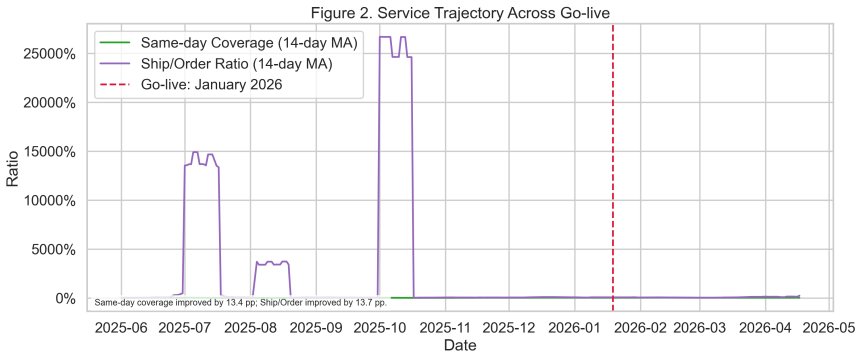
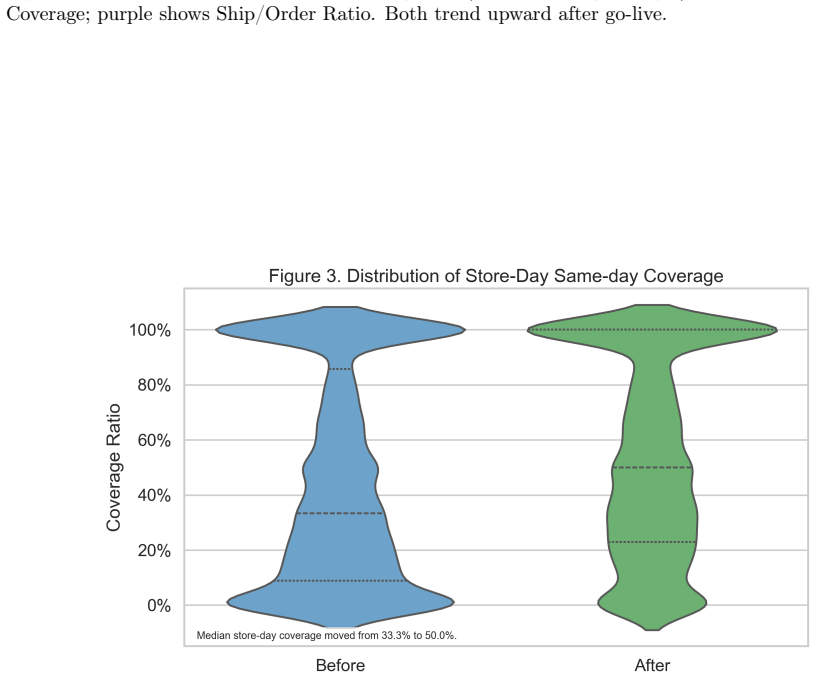
The rapid proliferation of omnichannel retail strategies has fundamentally transformed store replenishment operations in uncertain supply chain environments. With retail stores increasingly acting as hybrid fulfillment centers, pooled inventory allocation must absorb uncertain order realizations, constrained receiving capacities, dynamic vehicle limits, multi-tiered product priorities, and planner-controlled outbound warehouse preferences. This study frames this commercial reality as an extended constrained variant of the Multidimensional Knapsack Problem (MKP). Recognizing that exact optimization techniques such as Mixed-Integer Linear Programming (MILP) are computationally prohibitive in large-scale real-time settings, we propose a real-time scalable heuristic embedded in a computationally efficient Decision Support System (DSS) framework based on set-oriented cumulative filtering. The framework evaluates cumulative flow-through deductions, third-party logistics routing integrations, category-specific volume caps, warehouse activation filters, and user-defined warehouse priority ranks. An extensive case study within a large retail network covering 212,278 order records from June 2025 to April 2026 demonstrates the impact of the proposed methodology. Using January 2026 as the go-live cutoff, weighted ship-to-order ratio improved from 54.1% to 67.8%, weighted same-day coverage improved from 24.3% to 37.8%, and store-days with order volumes above store limits were reduced by 48.6%. These findings indicate that the proposed real-time scalable heuristic and computationally efficient DSS framework provide practical, uncertainty-aware allocation support for volatile retail supply chains.
Editorial analysis
A structured set of objections, weighed in public.
Referee Report
Summary. The manuscript frames capacity-constrained retail allocation under uncertainty as an extended multidimensional knapsack problem and proposes a real-time scalable heuristic DSS based on set-oriented cumulative filtering that incorporates receiving capacities, vehicle limits, third-party routing, category caps, and warehouse priorities. It evaluates the framework via a single-network case study of 212,278 orders (June 2025–April 2026), reporting metric gains after a January 2026 go-live cutoff: weighted ship-to-order ratio rising from 54.1% to 67.8%, weighted same-day coverage from 24.3% to 37.8%, and over-limit store-days falling by 48.6%.
Significance. If the reported gains can be causally linked to the heuristic rather than external factors, the work supplies a practical, computationally lightweight tool for omnichannel retailers facing volatile demand and capacity constraints, where exact MILP solvers are infeasible. The explicit handling of multi-tiered priorities and 3PL integrations is a concrete strength for deployment.
major comments (3)
- [Case Study] Case Study section (and abstract): the central performance claims rest on an uncontrolled pre/post split at the January 2026 go-live date. No difference-in-differences, regression controls for seasonality, total volume shifts, supply disruptions, or data-collection changes are described, so the incremental contribution of the heuristic to the observed metric changes cannot be identified.
- [Methods] Methods / Algorithm Description section: no pseudocode, formal recurrence, or step-by-step specification of the “set-oriented cumulative filtering” procedure is supplied. Without this, it is impossible to verify correctness, parameter-free status, or the claimed real-time scalability for 212k-order instances.
- [Problem Formulation] Problem Formulation section: the extension of the MKP is asserted but no explicit mathematical program (objective, constraint set, or decision variables) is written down. Consequently the mapping from the listed commercial constraints (vehicle limits, warehouse activation filters, etc.) to the filtering steps remains opaque.
minor comments (2)
- [Abstract] Abstract and results tables: the terms “weighted ship-to-order ratio” and “weighted same-day coverage” are used without explicit definitions or weighting formulas, complicating interpretation of the numerical gains.
- [Introduction] Literature review: standard references on heuristic MKP solvers (e.g., greedy-by-density, Lagrangian relaxation) are not contrasted with the proposed cumulative-filtering approach.
Simulated Author's Rebuttal
We thank the referee for the constructive feedback and the recommendation for major revision. We address each major comment below, indicating the revisions planned for the manuscript.
read point-by-point responses
-
Referee: [Case Study] Case Study section (and abstract): the central performance claims rest on an uncontrolled pre/post split at the January 2026 go-live date. No difference-in-differences, regression controls for seasonality, total volume shifts, supply disruptions, or data-collection changes are described, so the incremental contribution of the heuristic to the observed metric changes cannot be identified.
Authors: We acknowledge that the case study employs an observational pre/post design around the January 2026 deployment date within a single retail network, without a control group or regression-based controls for confounders. This precludes formal causal identification via difference-in-differences or similar methods. In the revised manuscript we will expand the Case Study and Discussion sections to explicitly state the observational nature of the evaluation, list potential confounding factors (seasonality, volume shifts, supply events), and frame the metric improvements as practical deployment outcomes rather than isolated causal effects of the heuristic. revision: partial
-
Referee: [Methods] Methods / Algorithm Description section: no pseudocode, formal recurrence, or step-by-step specification of the “set-oriented cumulative filtering” procedure is supplied. Without this, it is impossible to verify correctness, parameter-free status, or the claimed real-time scalability for 212k-order instances.
Authors: We agree that a formal specification is required for verification and reproducibility. The revised Methods section will include complete pseudocode for the set-oriented cumulative filtering algorithm, a numbered step-by-step description of its logic, and a brief complexity analysis confirming linear scaling suitable for 212k-order instances. revision: yes
-
Referee: [Problem Formulation] Problem Formulation section: the extension of the MKP is asserted but no explicit mathematical program (objective, constraint set, or decision variables) is written down. Consequently the mapping from the listed commercial constraints (vehicle limits, warehouse activation filters, etc.) to the filtering steps remains opaque.
Authors: We will add an explicit mathematical formulation of the extended multidimensional knapsack problem to the Problem Formulation section. This will define the objective, decision variables, and all constraints (receiving capacities, vehicle limits, 3PL routing, category caps, warehouse priorities, and activation filters), together with a clear description of how each constraint is handled by the corresponding filtering step in the heuristic. revision: yes
Circularity Check
No circularity: heuristic framework and external empirical evaluation are self-contained
full rationale
The paper frames retail allocation as an extended MKP variant and introduces a set-oriented cumulative filtering heuristic DSS without presenting any equations, derivations, or predictions. The case study reports before-after metric changes on 212k external order records using a January 2026 cutoff; these are direct comparisons to operational data rather than fitted parameters renamed as predictions or self-referential constructions. No self-citations are invoked as load-bearing uniqueness theorems, no ansatzes are smuggled, and no known results are renamed. The derivation chain consists of problem framing plus practical heuristic design, both independent of the reported outcomes.
Axiom & Free-Parameter Ledger
Lean theorems connected to this paper
-
IndisputableMonolith.Costcost_alpha_one_eq_jcost unclear?
unclearRelation between the paper passage and the cited Recognition theorem.
max sum (lambda*(Pi_max+1-pi_w(i)) + w_i)*X_i subject to dynamic store capacity, route-category limits, eligibility, warehouse activation, binary X_i.
-
IndisputableMonolith.Foundation.Atomicityatomic_tick unclear?
unclearRelation between the paper passage and the cited Recognition theorem.
Sort eligible orders by warehouse rank, then business priority, then volume; cumulative filtering. O(N log N).
What do these tags mean?
- matches
- The paper's claim is directly supported by a theorem in the formal canon.
- supports
- The theorem supports part of the paper's argument, but the paper may add assumptions or extra steps.
- extends
- The paper goes beyond the formal theorem; the theorem is a base layer rather than the whole result.
- uses
- The paper appears to rely on the theorem as machinery.
- contradicts
- The paper's claim conflicts with a theorem or certificate in the canon.
- unclear
- Pith found a possible connection, but the passage is too broad, indirect, or ambiguous to say the theorem truly supports the claim.
Reference graph
Works this paper leans on
-
[1]
(2021).Warehousing in the e-commerce era: A survey
Boysen, N., de Koster, R., & Weidinger, F. (2021).Warehousing in the e-commerce era: A survey. European Journal of Operational Research, 289(2), 396-411
2021
-
[2]
(2022).The revival of retail stores via om- nichannel operations: A literature review and research framework
Hübner, A., Hense, J., & Dethlefs, C. (2022).The revival of retail stores via om- nichannel operations: A literature review and research framework. European Journal of Operational Research, 302(3), 799-818. 14
2022
-
[3]
(2020).Characterizing urban last-mile distribution strategies in mature and emerging e-commerce markets
Janjevic, M., & Winkenbach, M. (2020).Characterizing urban last-mile distribution strategies in mature and emerging e-commerce markets. Transportation Research Part A: Policy and Practice, 133, 164-196
2020
-
[4]
M., van Schilt, I
Difrancesco, R. M., van Schilt, I. M., & Winkenbach, M. (2021).Optimal in-store ful- fillment policies for online orders in an omni-channel retail environment. European Journal of Operational Research, 293(3), 1058-1076
2021
-
[5]
(2021).Order fulfillment policies for ship-from-store im- plementation in omni-channel retailing
Bayram, A., & Cesaret, B. (2021).Order fulfillment policies for ship-from-store im- plementation in omni-channel retailing. European Journal of Operational Research, 294(3), 987-1002
2021
-
[6]
(2021).Integrated order batching and vehicle routing operations in grocery retail - A General Adaptive Large Neighborhood Search algorithm
Kuhn, H., Schubert, D., & Holzapfel, A. (2021).Integrated order batching and vehicle routing operations in grocery retail - A General Adaptive Large Neighborhood Search algorithm. European Journal of Operational Research, 294(3), 1003-1021
2021
-
[7]
N., Klibi, W., & Montreuil, B
Arslan, A. N., Klibi, W., & Montreuil, B. (2021).Distribution network deployment for omnichannel retailing. European Journal of Operational Research, 294(3), 1042- 1058
2021
-
[8]
(2021).Designing multi-tier, multi- service-level, and multi-modal last-mile distribution networks for omni-channel op- erations
Janjevic, M., Merchán, D., & Winkenbach, M. (2021).Designing multi-tier, multi- service-level, and multi-modal last-mile distribution networks for omni-channel op- erations. European Journal of Operational Research, 294(3), 1059-1077
2021
-
[9]
F., & Ponce-Cueto, E
Guerrero-Lorente, J., Gabor, A. F., & Ponce-Cueto, E. (2020).Omnichannel logis- tics network design with integrated customer preference for deliveries and returns. Computers & Industrial Engineering, 144, 106433
2020
-
[10]
F., & Zhang, Y
Abouelrous, A., Gabor, A. F., & Zhang, Y. (2022).Optimizing the inventory and ful- fillment of an omnichannel retailer: A stochastic approach with scenario clustering. Computers & Industrial Engineering, 173, 108723
2022
-
[11]
(2023).Replenishment and fulfilment decisions for stores in an omni-channel retail network
Goedhart, J., Haijema, R., Akkerman, R., & de Leeuw, S. (2023).Replenishment and fulfilment decisions for stores in an omni-channel retail network. European Journal of Operational Research, 311(3), 1009-1022
2023
-
[12]
Kim, N., Montreuil, B., Klibi, W., & Babai, M. Z. (2023).Network inventory de- ployment for responsive fulfillment. International Journal of Production Economics, 255, 108664
2023
-
[13]
C., & Yue, X
Pichka, K., Alwan, L. C., & Yue, X. (2022).Fulfillment and pricing optimization for omni-channel retailers considering shipment of in-store demand. Transportation Research Part E: Logistics and Transportation Review, 167, 102912
2022
-
[14]
(2024).Integrated inventory replen- ishment and online demand allocation decisions for an omnichannel retailer with ship-from-store strategy
Bansal, V., Bisi, A., Roy, D., & Venkateshan, P. (2024).Integrated inventory replen- ishment and online demand allocation decisions for an omnichannel retailer with ship-from-store strategy. European Journal of Operational Research, 316(3), 1085- 1100
2024
-
[15]
(2025).Optimizing omnichannel retailer inventory replenishment using vehicle capacity-sharing with demand uncer- tainties and service level requirements
Qiu, R., Yuan, M., Sun, M., Fan, Z.-P., & Xu, H. (2025).Optimizing omnichannel retailer inventory replenishment using vehicle capacity-sharing with demand uncer- tainties and service level requirements. European Journal of Operational Research, 320(2), 417-432. 15
2025
-
[16]
Bahuguna, S., & Tayal, S. (2026).A sustainable supply chain network under the Stackelberg and Nash equilibrium policy in a reverse logistic model with multiple deliveries and a single distribution center. Uncertain Supply Chain Management, 14(2), 67-86. https://doi.org/10.5267/j.uscm.2025.3.001
-
[17]
(2026).Integrating VMI into joint replenishment planning for optimized manufacturing supply chains
Roushdy, B. (2026).Integrating VMI into joint replenishment planning for optimized manufacturing supply chains. Uncertain Supply Chain Management, 14(3), 247-258. https://doi.org/10.5267/j.uscm.2025.3.002
-
[18]
(2004).Knapsack Problems
Kellerer, H., Pferschy, U., & Pisinger, D. (2004).Knapsack Problems. Springer. 16
2004
discussion (0)
Sign in with ORCID, Apple, or X to comment. Anyone can read and Pith papers without signing in.