Recognition: 3 theorem links
· Lean TheoremSkillCom: Decomposing LLM-based Semantic Communication into Task and Channel Aware Skills
Pith reviewed 2026-05-08 18:49 UTC · model grok-4.3
The pith
Decomposing LLM-based semantic communication into four explicit skills creates a more robust and diagnosable system than monolithic models.
A machine-rendered reading of the paper's core claim, the machinery that carries it, and where it could break.
Core claim
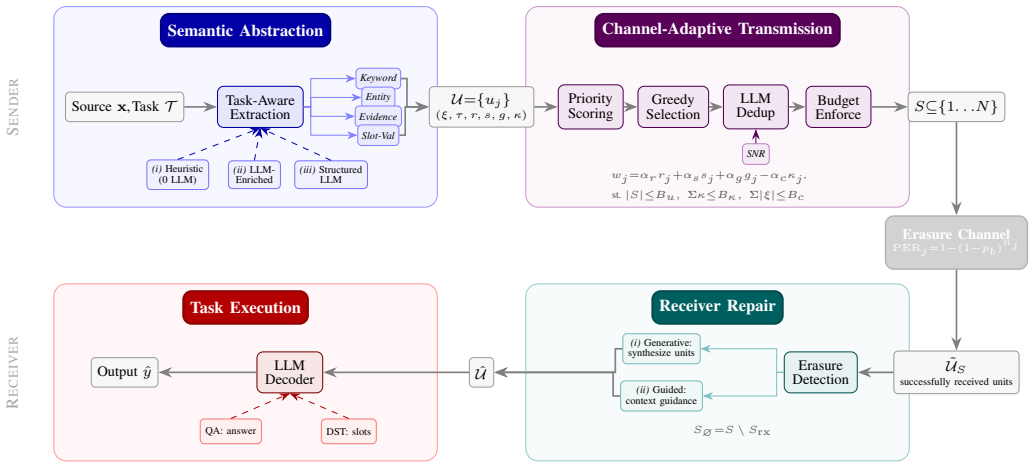
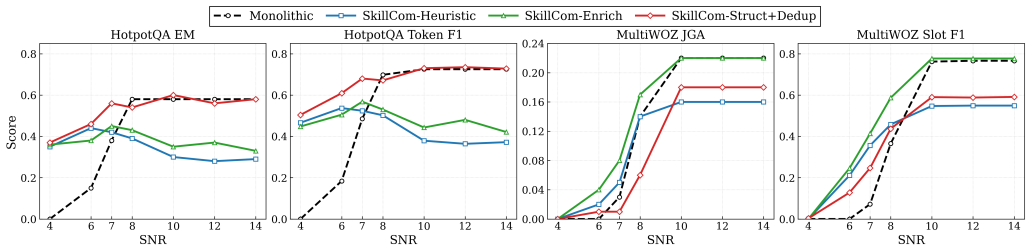
SkillCom decomposes LLM-based semantic communication into four explicit skills—semantic abstraction skill, channel-adaptive transmission skill, receiver-side repair skill, and task execution skill—interconnected through typed semantic-unit interfaces. Transmission therefore operates on structured unit-level representations rather than one monolithic text block. This localizes channel impairment, enables targeted repair from successfully received units, and supports stage-wise ablation plus single-skill replacement under matched constraints. Experiments on multi-hop question answering and dialogue state tracking show consistent outperformance over the monolithic LLM baseline, greater channel-
What carries the argument
The SkillCom framework of four skills linked by typed semantic-unit interfaces that turn communication into structured unit-level exchanges rather than a single text block.
If this is right
- The modular system outperforms monolithic LLM baselines on multi-hop question answering and dialogue state tracking tasks.
- Channel impairments can be localized and repaired at the semantic-unit level without corrupting the entire representation.
- Individual skills can be ablated or replaced while preserving overall communication constraints.
- Different skill realizations show task-dependent performance preferences under the same channel conditions.
Where Pith is reading between the lines
- The unit-based interfaces could allow mixing LLM skills with conventional channel-coding modules in the same pipeline.
- Stage-wise testing might reveal which skill is most sensitive to specific channel distortions, guiding future specialization.
- Diagnosability of separate skills could support automated monitoring that flags and reroutes around failing units in real time.
Load-bearing premise
The four skills can be implemented and interconnected through typed semantic-unit interfaces without losing essential semantic information or creating new failure modes that cancel the modularity benefits.
What would settle it
An experiment in which SkillCom under controlled channel noise shows no improvement in robustness or performance over the monolithic baseline and no benefit from unit-level repair.
Figures

read the original abstract
Large language models (LLMs) are increasingly used as semantic encoders and decoders in semantic communication. However, current LLM based systems mostly remain monolithic: a single prompted model, or a tightly coupled transmitter/receiver pair, must jointly perform semantic encoding, channel adaptation, and semantic decoding. Such coupling makes intermediate decisions difficult to control, diagnose, or replace, and may cause channel corruption to propagate through a compressed source representation. To address the limitations, we propose \textbf{SkillCom}, a modular framework that decomposes LLM-based semantic communication into four explicit skills: semantic abstraction skill, channel-adaptive transmission skill, receiver-side repair skill, and task execution skill. These skills are interconnected through typed semantic-unit interfaces. Thus, transmission operates on structured unit-level representations rather than on one monolithic text block. This design localizes channel impairment, enables targeted repair from successfully received units, and supports stage-wise ablation and single-skill replacement under matched communication constraints. Experiments on multi-hop question answering and dialogue state tracking show that SkillCom consistently outperforms the monolithic LLM baseline, remains more robust under varying channel conditions, and exhibits task-dependent preferences over skill realizations. The results suggest that explicit skill decomposition provides a more robust and diagnosable foundation for LLM-based semantic communication than monolithic methods.
Editorial analysis
A structured set of objections, weighed in public.
Referee Report
Summary. The paper proposes SkillCom, a modular framework that decomposes LLM-based semantic communication into four explicit skills—semantic abstraction, channel-adaptive transmission, receiver-side repair, and task execution—interconnected via typed semantic-unit interfaces. This design aims to localize channel impairments, enable targeted repairs, and support ablation studies, contrasting with monolithic LLM approaches. Experiments on multi-hop question answering and dialogue state tracking demonstrate consistent outperformance over baselines, greater robustness under varying channel conditions, and task-dependent skill preferences.
Significance. If the central claims hold, the work provides a valuable modular alternative to monolithic LLM semantic communication systems, improving diagnosability and adaptability. The explicit skill decomposition and interface design directly address error propagation issues, with experimental results on robustness and task-specific preferences offering practical insights. The framework's support for stage-wise analysis and single-skill replacement is a notable strength for future extensions in semantic communication.
major comments (2)
- [§3.2] §3.2 (Framework description): The typed semantic-unit interfaces are central to the claim of preserving essential semantics and localizing impairments, yet the manuscript provides only high-level descriptions of the typing mechanism without formal definitions or pseudocode for unit serialization/deserialization; this leaves open whether the interfaces introduce new failure modes that could offset modularity gains, as assumed in the weakest point of the argument.
- [§4.3] §4.3 (Experimental results on robustness): While consistent outperformance is reported under varying channels for both multi-hop QA and DST tasks, the absence of statistical significance tests (e.g., p-values or confidence intervals across multiple runs) and details on prompt engineering for skill realizations makes it difficult to confirm that the gains are attributable to the decomposition rather than implementation specifics.
minor comments (3)
- [Abstract] The abstract mentions 'task-dependent preferences over skill realizations' but does not specify the exact realizations tested (e.g., prompt variants); adding this would improve clarity for readers.
- [§4] Figure captions in the experimental section could more explicitly link visual results to the four-skill decomposition to aid interpretation of ablation studies.
- [§5] A brief discussion of potential limitations, such as overhead from unit typing in low-latency scenarios, would strengthen the presentation without altering the core claims.
Simulated Author's Rebuttal
We thank the referee for the positive evaluation and constructive comments. We address each major point below and will revise the manuscript to incorporate the suggested clarifications and additional details.
read point-by-point responses
-
Referee: [§3.2] §3.2 (Framework description): The typed semantic-unit interfaces are central to the claim of preserving essential semantics and localizing impairments, yet the manuscript provides only high-level descriptions of the typing mechanism without formal definitions or pseudocode for unit serialization/deserialization; this leaves open whether the interfaces introduce new failure modes that could offset modularity gains, as assumed in the weakest point of the argument.
Authors: We agree that the description of the typed semantic-unit interfaces would benefit from greater formality. In the revised manuscript, we will add formal definitions of the semantic unit types (including their fields, typing rules, and constraints), along with pseudocode for serialization and deserialization. We will also include a dedicated discussion of potential interface-induced failure modes and explain why the modular design still localizes impairments more effectively than monolithic baselines, consistent with the framework's stated goals. revision: yes
-
Referee: [§4.3] §4.3 (Experimental results on robustness): While consistent outperformance is reported under varying channels for both multi-hop QA and DST tasks, the absence of statistical significance tests (e.g., p-values or confidence intervals across multiple runs) and details on prompt engineering for skill realizations makes it difficult to confirm that the gains are attributable to the decomposition rather than implementation specifics.
Authors: We acknowledge that statistical tests and prompt details would strengthen the evidence. In the revision, we will report p-values and confidence intervals computed over multiple independent runs for the key metrics. We will also expand the experimental section with explicit prompt templates and hyperparameters used for each skill realization. These changes will better isolate the contribution of the skill decomposition while preserving the original experimental setup and results. revision: yes
Circularity Check
No significant circularity in framework proposal
full rationale
The paper introduces SkillCom as an explicit design choice: a modular decomposition of LLM-based semantic communication into four skills (semantic abstraction, channel-adaptive transmission, receiver-side repair, task execution) interconnected by typed semantic-unit interfaces. This is motivated by limitations of monolithic approaches and evaluated experimentally on multi-hop QA and dialogue state tracking tasks, showing outperformance and robustness. No equations, derivations, fitted parameters, or self-referential definitions appear that would reduce the claimed benefits to inputs by construction. The central claim rests on experimental results and the direct address of error propagation via modularity, which is independent of any self-citation chain or renaming of known results. This is a standard honest non-finding for a framework paper without load-bearing mathematical reductions.
Axiom & Free-Parameter Ledger
invented entities (1)
-
typed semantic-unit interfaces
no independent evidence
Lean theorems connected to this paper
-
Cost.FunctionalEquation (J = ½(x+x⁻¹)−1, parameter-free)washburn_uniqueness_aczel unclear?
unclearRelation between the paper passage and the cited Recognition theorem.
w_j = α_r r_j + α_s s_j + α_g g_j − α_c κ_j, with non-negative weights (α_r, α_s, α_g, α_c)
What do these tags mean?
- matches
- The paper's claim is directly supported by a theorem in the formal canon.
- supports
- The theorem supports part of the paper's argument, but the paper may add assumptions or extra steps.
- extends
- The paper goes beyond the formal theorem; the theorem is a base layer rather than the whole result.
- uses
- The paper appears to rely on the theorem as machinery.
- contradicts
- The paper's claim conflicts with a theorem or certificate in the canon.
- unclear
- Pith found a possible connection, but the passage is too broad, indirect, or ambiguous to say the theorem truly supports the claim.
Reference graph
Works this paper leans on
-
[1]
C. E. Shannon and W. Weaver,The Mathematical Theory of Communi- cation. Urbana, IL, USA: Univ. Illinois Press, 1949
1949
-
[2]
Towards a theory of semantic communication,
J. Bao, P. Basu, M. Dean, C. Partridge, A. Swami, W. Leland, and J. A. Hendler, “Towards a theory of semantic communication,” inProc. IEEE Netw. Sci. Workshop, 2011, pp. 110–117
2011
-
[3]
Deep learning enabled semantic communication systems,
H. Xie, Z. Qin, G. Y . Li, and B.-H. Juang, “Deep learning enabled semantic communication systems,”IEEE Trans. Signal Process., vol. 69, pp. 2663–2675, 2021
2021
-
[4]
Semantic communication: A survey on research landscape, challenges, and future directions,
T. M. Getu, G. Kaddoum, and M. Bennis, “Semantic communication: A survey on research landscape, challenges, and future directions,”Proc. IEEE, vol. 112, no. 11, pp. 1649–1685, Nov. 2024
2024
-
[5]
Large language model (LLM) for telecommunications: A comprehensive survey on principles, key techniques, and opportunities,
H. Zhou, C. Hu, Y . Yuan, Y . Cui, Y . Jin, C. Chen, H. Wu, D. Yuan, L. Jiang, D. Wu, X. Liu, C. Zhang, X. Wang, and J. Liu, “Large language model (LLM) for telecommunications: A comprehensive survey on principles, key techniques, and opportunities,”IEEE Commun. Surveys Tuts., vol. 27, pp. 1955–2005, 2024
1955
-
[6]
On large language model-based joint source channel coding for semantic communication,
S. R. Pokhrel and A. Walid, “On large language model-based joint source channel coding for semantic communication,” inProc. 2024 2nd Int. Conf. F ound. Large Lang. Models (FLLM), Dubai, United Arab Emirates, 2024, pp. 322–329, doi: 10.1109/FLLM63129.2024.10852431
-
[7]
On the uses of large language models to design end-to-end learning semantic communication,
Y . Wang, Z. Sun, J. Fan, and H. Ma, “On the uses of large language models to design end-to-end learning semantic communication,” inProc. IEEE Wireless Commun. Netw. Conf. (WCNC), 2024, pp. 1–6, doi: 10.1109/WCNC57260.2024.10570717
-
[8]
LaMoSC: Large language model-driven semantic communication system for visual trans- mission,
Y . Zhao, Y . Yue, S. Hou, B. Cheng, and Y . Huang, “LaMoSC: Large language model-driven semantic communication system for visual trans- mission,”IEEE Trans. Cogn. Commun. Netw., vol. 10, no. 6, pp. 2005– 2018, Dec. 2024, doi: 10.1109/TCCN.2024.3401712
-
[9]
Task-oriented communication for multi-device cooperative edge inference,
Y . Shao, S. C. Liew, and D. G ¨und¨uz, “Task-oriented communication for multi-device cooperative edge inference,”IEEE Trans. Wireless Commun., vol. 22, no. 1, pp. 73–87, Jan. 2023
2023
-
[10]
Computation-resource- efficient task-oriented communications,
J. Fu, M. Xiao, C. Ren, and M. Skoglund, “Computation-resource- efficient task-oriented communications,”IEEE Trans. Commun., early access, 2025, doi: 10.1109/TCOMM.2025.3587076
-
[11]
Robust multi-modal task-oriented communications with redundancy-aware representations,
J. Fu, M. Xiao, Z. Lyu, M. Skoglund, and C. Wu, “Robust multi-modal task-oriented communications with redundancy-aware representations,” arXiv preprint arXiv:2511.08642, 2025
-
[12]
Large model-based agents: State-of-the-art, cooperation paradigms, security and privacy, and future trends,
Y . Wang, Y . Pan, Z. Su, Y . Deng, Q. Zhao, L. Du, T. H. Luan, J. Kang, and D. Niyato, “Large model-based agents: State-of-the-art, cooperation paradigms, security and privacy, and future trends,”IEEE Commun. Surveys Tuts., vol. 28, pp. 1906–1949, 2025
1906
-
[13]
SkillsBench: Benchmarking How Well Agent Skills Work Across Diverse Tasks
X. Liet al., “SkillsBench: Benchmarking how well agent skills work across diverse tasks,”arXiv preprint arXiv:2602.12670, 2026
work page internal anchor Pith review arXiv 2026
-
[14]
J. G. Proakis and M. Salehi,Digital Communications, 5th ed. New York, NY , USA: McGraw-Hill, 2008
2008
-
[15]
HotpotQA: A dataset for diverse, explainable multi-hop question answering,
Z. Yang, P. Qi, S. Zhang, Y . Bengio, W. Cohen, R. Salakhutdinov, and C. D. Manning, “HotpotQA: A dataset for diverse, explainable multi-hop question answering,” inProc. EMNLP, 2018, pp. 2369–2380
2018
-
[16]
MultiWOZ – A large-scale multi-domain Wizard-of-Oz dataset for task-oriented dialogue modelling,
P. Budzianowski, T.-H. Wen, B.-H. Tseng, I. Casanueva, S. Ultes, O. Ramadan, and M. Ga ˇsi´c, “MultiWOZ – A large-scale multi-domain Wizard-of-Oz dataset for task-oriented dialogue modelling,” inProc. EMNLP, 2018, pp. 5016–5026
2018
discussion (0)
Sign in with ORCID, Apple, or X to comment. Anyone can read and Pith papers without signing in.