Efficient Multi-Market Scheduling of Virtual Power Plants via Spectral Representation of Uncertainty
Pith reviewed 2026-05-08 19:28 UTC · model grok-4.3
The pith
Intrusive polynomial chaos expansion reformulates stochastic multi-market virtual power plant scheduling into a compact deterministic problem that matches scenario-based accuracy at far lower cost.
A machine-rendered reading of the paper's core claim, the machinery that carries it, and where it could break.
Core claim
The central claim is that intrusive polynomial chaos expansion converts a multi-stage stochastic program for virtual power plant bidding into a low-dimensional deterministic counterpart whose optimal solution preserves the probabilistic structure of the original problem and yields market decisions of comparable quality to scenario-based methods while requiring substantially fewer computational resources.
What carries the argument
Intrusive polynomial chaos expansion, which expands uncertain parameters as polynomials in a chosen basis and substitutes the expansion into the original stochastic constraints to obtain an equivalent deterministic system of equations.
If this is right
- The spectral reformulation keeps problem size manageable even when the number of uncertain parameters or markets increases.
- Virtual power plants can obtain near-optimal bids across day-ahead, intraday, and reserve markets without enumerating thousands of scenarios.
- The same projection technique extends to any single- or two-stage stochastic program once the open-source tool is used to generate the deterministic equivalent.
- Computational effort drops enough to allow more frequent re-optimization as new forecasts arrive.
Where Pith is reading between the lines
- Operators could embed the spectral model inside rolling-horizon controllers that update bids every few minutes using fresh price and weather data.
- The approach may scale to larger aggregations of distributed resources if the polynomial basis is chosen to match the dominant uncertainty sources in each market.
- Integration with distribution-system operators could let the same framework enforce network constraints inside the bidding problem without adding scenario explosion.
Load-bearing premise
The uncertainties in prices, generation, and loads must admit an accurate low-order polynomial representation that keeps the key statistical dependencies intact for the resulting bidding decisions.
What would settle it
Apply the method to a test case whose price or generation uncertainty has strong skewness or multimodality that low-order polynomials cannot capture, then check whether the obtained bids differ materially from those of a large scenario-based benchmark on the same data.
Figures

read the original abstract
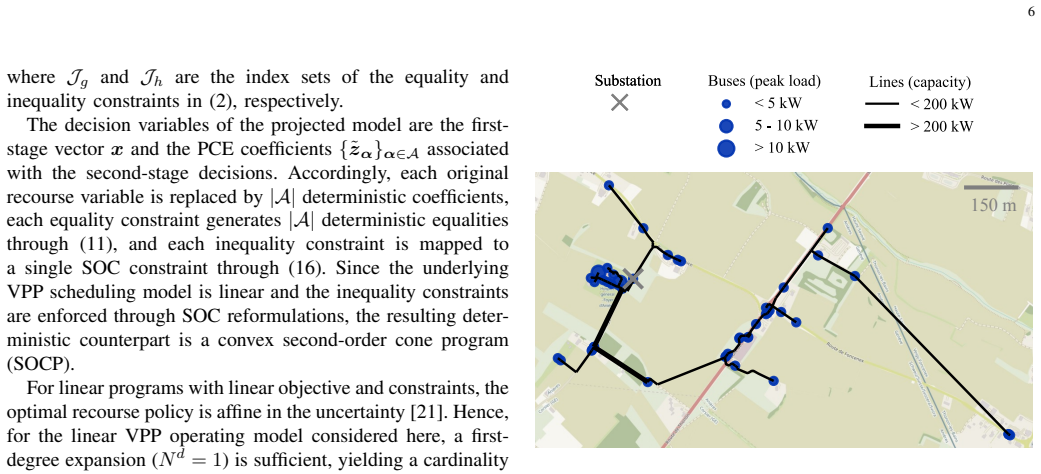
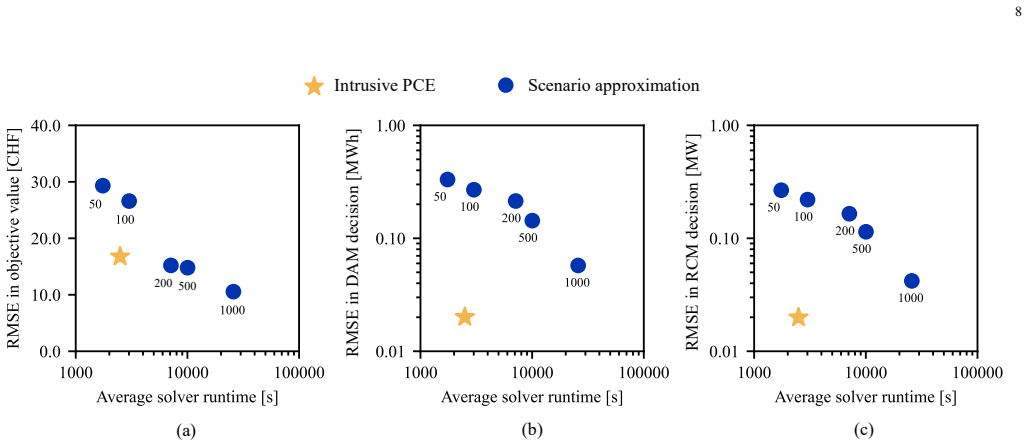
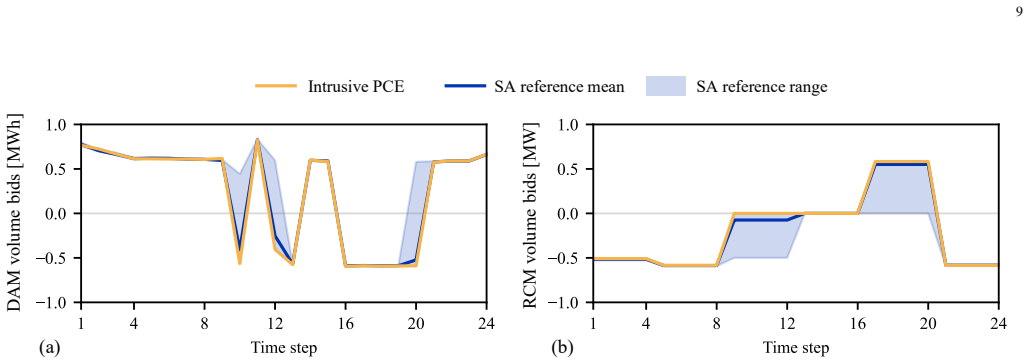
As the penetration of distributed energy resources increases, harnessing their flexibility becomes critical for power system operations. Virtual power plants (VPPs) offer a promising solution. However, existing VPP market scheduling tools exhibit a tradeoff between economic performance and tractability. Stochastic formulations provide probabilistically optimal decisions but are computationally intractable for large systems due to scenario explosion. Robust approaches are more tractable but often yield conservative decisions. This paper addresses this gap by proposing a stochastic multi-market VPP scheduling framework that represents uncertainty in the spectral domain via intrusive Polynomial Chaos Expansion (PCE). The resulting reformulation yields a low-dimensional deterministic spectral counterpart that preserves the stochastic structure and can be solved efficiently with standard optimization tools. The proposed spectral approach is demonstrated on a DER-based VPP operating on a realistic Swiss low-voltage grid and benchmarked against a state-of-the-art scenario-based solution. Results show that intrusive PCE achieves solution quality comparable to the scenario-based benchmark, with up to a 137 times reduction in computational effort, while yielding highly accurate bidding decisions. Finally, to facilitate adoption and reproducibility, we release an open-source, application-agnostic projection tool that automates the spectral reformulation for generic single- and two-stage stochastic programs.
Editorial analysis
A structured set of objections, weighed in public.
Referee Report
Summary. The manuscript proposes a multi-market VPP scheduling framework that applies intrusive polynomial chaos expansion (PCE) to represent joint uncertainty in prices, DER generation, and loads. This converts the two-stage stochastic program into a low-dimensional deterministic spectral counterpart that is solved with standard solvers. The method is tested on a realistic Swiss low-voltage grid VPP, where it produces bidding decisions of quality comparable to a scenario-based benchmark while achieving up to 137× computational speedup; an open-source projection tool for generic stochastic programs is also released.
Significance. If the accuracy claims hold, the approach offers a scalable route to probabilistically optimal VPP decisions that avoids both the conservatism of robust methods and the scenario explosion of full stochastic programs. The release of an application-agnostic open-source tool for intrusive PCE reformulation is a clear strength for reproducibility and reuse across other two-stage stochastic programs in power systems.
major comments (2)
- [§5 (Numerical Results) and Table 2] §5 (Numerical Results) and Table 2: The claim that intrusive PCE yields 'highly accurate bidding decisions' and 'solution quality comparable to the scenario-based benchmark' is supported only by a single fixed-order comparison. No convergence study (e.g., first-stage bids and objective values for PCE degrees 2–5) or a posteriori error bound on the optimal first-stage decisions is provided, leaving open the possibility that truncation error in the tails of price or load distributions distorts the bids.
- [§3.3 (Intrusive PCE Reformulation), Eq. (12)–(15)] §3.3 (Intrusive PCE Reformulation), Eq. (12)–(15): The two-stage structure requires that the spectral expansion correctly propagates uncertainty through the recourse problem. It is not shown whether the polynomial basis is applied to second-stage variables or only to the expectation operator; without this detail or a small-scale verification against Monte Carlo, it is unclear whether the stochastic structure is fully preserved.
minor comments (2)
- [Abstract and §1] The abstract and §1 cite a 137× speedup; the exact number of scenarios used in the benchmark and the PCE order should be stated explicitly in the main text for reproducibility.
- [Figure 4] Figure 4 (bidding curves): Axis labels and legend entries could be enlarged for clarity when printed.
Simulated Author's Rebuttal
We are grateful to the referee for the detailed and insightful comments, which have helped us identify areas for improvement in the manuscript. We address each major comment below and will incorporate revisions to enhance the clarity and rigor of our presentation.
read point-by-point responses
-
Referee: [§5 (Numerical Results) and Table 2] §5 (Numerical Results) and Table 2: The claim that intrusive PCE yields 'highly accurate bidding decisions' and 'solution quality comparable to the scenario-based benchmark' is supported only by a single fixed-order comparison. No convergence study (e.g., first-stage bids and objective values for PCE degrees 2–5) or a posteriori error bound on the optimal first-stage decisions is provided, leaving open the possibility that truncation error in the tails of price or load distributions distorts the bids.
Authors: We appreciate this observation. While the manuscript demonstrates comparable performance for the chosen PCE order, we agree that a convergence analysis would strengthen the claims. In the revised manuscript, we will include a study varying the PCE degree from 2 to 5, reporting the resulting first-stage bids and expected objective values, along with a comparison to the scenario-based benchmark. Additionally, we will discuss the truncation error and its impact on the tails of the distributions based on the Swiss grid data. This will provide evidence that the selected order is sufficient for the accuracy claimed. revision: yes
-
Referee: [§3.3 (Intrusive PCE Reformulation), Eq. (12)–(15)] §3.3 (Intrusive PCE Reformulation), Eq. (12)–(15): The two-stage structure requires that the spectral expansion correctly propagates uncertainty through the recourse problem. It is not shown whether the polynomial basis is applied to second-stage variables or only to the expectation operator; without this detail or a small-scale verification against Monte Carlo, it is unclear whether the stochastic structure is fully preserved.
Authors: We thank the referee for highlighting this point of potential ambiguity. In the intrusive PCE approach for two-stage problems, the decision variables in both stages are expanded in the polynomial chaos basis, and the constraints and objective are projected onto the basis functions, resulting in a deterministic system of equations. The second-stage variables are indeed represented spectrally to capture the recourse decisions under uncertainty. To clarify this, we will revise Section 3.3 to explicitly state that both first- and second-stage variables are expanded, with the projection applied to the full stochastic program. Furthermore, we will add a small-scale verification example comparing the PCE reformulation against Monte Carlo sampling on a simplified two-stage problem to demonstrate preservation of the stochastic structure. revision: yes
Circularity Check
No circularity: standard PCE reformulation applied to VPP scheduling with external benchmarking
full rationale
The derivation applies intrusive PCE to obtain a deterministic spectral counterpart of the two-stage stochastic program. This is a standard projection technique whose output is not defined in terms of the bidding decisions or accuracy metrics being claimed; the paper instead benchmarks the resulting first-stage bids against an independent scenario-based solver on a Swiss LV grid instance. No self-citation is load-bearing for the central reformulation, no fitted parameters are relabeled as predictions, and the open-source projection tool simply automates an existing method without creating self-referential loops. The speedup and quality claims rest on numerical comparison rather than construction.
Axiom & Free-Parameter Ledger
Lean theorems connected to this paper
-
IndisputableMonolith.Cost.FunctionalEquation (Aczél–Kannappan classification of reciprocal cost)washburn_uniqueness_aczel unclear?
unclearRelation between the paper passage and the cited Recognition theorem.
intrusive Polynomial Chaos Expansion (PCE) ... yields a low-dimensional deterministic spectral counterpart ... For standard distributions, the polynomial bases are selected according to the Askey scheme. Examples are Hermite polynomials for Gaussian distributions, Legendre polynomials for uniform distributions...
What do these tags mean?
- matches
- The paper's claim is directly supported by a theorem in the formal canon.
- supports
- The theorem supports part of the paper's argument, but the paper may add assumptions or extra steps.
- extends
- The paper goes beyond the formal theorem; the theorem is a base layer rather than the whole result.
- uses
- The paper appears to rely on the theorem as machinery.
- contradicts
- The paper's claim conflicts with a theorem or certificate in the canon.
- unclear
- Pith found a possible connection, but the passage is too broad, indirect, or ambiguous to say the theorem truly supports the claim.
Reference graph
Works this paper leans on
-
[1]
Grid codes for renewable powered systems,
IRENA, “Grid codes for renewable powered systems,” International Renewable Energy Agency, Tech. Rep., 2022. 10
work page 2022
-
[2]
Unlocking the potential of distributed energy resources,
IEA, “Unlocking the potential of distributed energy resources,” International Energy Agency, Tech. Rep., 2022, [online]. Available: https://www.iea.org/reports/ unlocking-the-potential-of-distributed-energy-resources. Accessed: May 26, 2025
work page 2022
-
[3]
On feasibility and flexibility operating regions of virtual power plants and TSO/DSO interfaces,
S. Riaz and P. Mancarella, “On feasibility and flexibility operating regions of virtual power plants and TSO/DSO interfaces,” in2019 IEEE Milan PowerTech, 2019, pp. 1–6
work page 2019
-
[4]
Risk averse optimal operation of a virtual power plant using two stage stochastic program- ming,
M. A. Tajeddini, A. Rahimi-Kian, and A. Soroudi, “Risk averse optimal operation of a virtual power plant using two stage stochastic program- ming,”Energy, vol. 73, pp. 958–967, 8 2014
work page 2014
-
[5]
Risk assessment of virtual power plants offering in energy and reserve markets,
S. R. Dabbagh and M. K. Sheikh-El-Eslami, “Risk assessment of virtual power plants offering in energy and reserve markets,”IEEE Transactions on Power Systems, vol. 31, pp. 3572–3582, 9 2016
work page 2016
-
[6]
A. Baringo, L. Baringo, and J. M. Arroyo, “Day-ahead self-scheduling of a virtual power plant in energy and reserve electricity markets under uncertainty,”IEEE Transactions on Power Systems, vol. 34, pp. 1881– 1894, 5 2019
work page 2019
-
[7]
M. Vahedipour-Dahraie, H. Rashidizadeh-Kermani, M. Shafie-Khah, and J. P. Catal ˜ao, “Risk-averse optimal energy and reserve scheduling for virtual power plants incorporating demand response programs,”IEEE Transactions on Smart Grid, vol. 12, pp. 1405–1415, 3 2021
work page 2021
-
[8]
Stochastic optimization of trading strategies in sequential electricity markets,
E. Kraft, M. Russo, D. Keles, and V . Bertsch, “Stochastic optimization of trading strategies in sequential electricity markets,”European Journal of Operational Research, vol. 308, pp. 400–421, 7 2023
work page 2023
-
[9]
A. Fusco, D. Gioffr `e, A. F. Castelli, C. Bovo, and E. Martelli, “A multi-stage stochastic programming model for the unit commitment of conventional and virtual power plants bidding in the day-ahead and ancillary services markets,”Applied Energy, vol. 336, p. 120739, 4 2023
work page 2023
-
[10]
D. Falabretti, F. Gulotta, and D. Siface, “Scheduling and operation of res- based virtual power plants with e-mobility: A novel integrated stochastic model,”International Journal of Electrical Power & Energy Systems, vol. 144, p. 108604, 1 2023
work page 2023
-
[11]
Risk-Aware Multi-Market Scheduling of Virtual Power Plants with Dynamic Network Tariffs
L. Zapparoli, P. F ¨ath, B. Gjorgiev, and G. Sansavini, “Risk-aware multi-market scheduling of virtual power plants with dynamic network tariffs,” 2026. [Online]. Available: https://arxiv.org/abs/2604.26424
work page internal anchor Pith review Pith/arXiv arXiv 2026
-
[12]
M. Rahimiyan and L. Baringo, “Strategic bidding for a virtual power plant in the day-ahead and real-time markets: A price-taker robust optimization approach,”IEEE Transactions on Power Systems, vol. 31, pp. 2676–2687, 7 2016
work page 2016
-
[13]
Robust optimization based bidding strategy for virtual power plants in electricity markets,
L. Zheming and Y . Guo, “Robust optimization based bidding strategy for virtual power plants in electricity markets,”IEEE Power and Energy Society General Meeting, vol. 2016-November, 11 2016
work page 2016
-
[14]
X. Liu, “Research on bidding strategy of virtual power plant considering carbon-electricity integrated market mechanism,”International Journal of Electrical Power & Energy Systems, vol. 137, p. 107891, 5 2022
work page 2022
-
[15]
Y . Ma, Z. Li, R. Liu, B. Liu, S. S. Yu, X. Liao, and P. Shi, “Data- driven interval robust optimization method of vpp bidding strategy in spot market under multiple uncertainties,”Applied Energy, vol. 384, p. 125366, 4 2025
work page 2025
-
[16]
H. Nemati, P. S ´anchez-Mart´ın, A. Baringo, and ´Alvaro Ortega, “Single- level flexible robust optimal bidding of renewable-only virtual power plant in energy and secondary reserve markets,”Energy, vol. 328, p. 136421, 8 2025
work page 2025
-
[17]
H. Nemati, ´Alvaro Ortega, and P. S ´anchez-Mart´ın, “Two-stage robust optimization strategy for vpp participation in the energy and reserve markets considering intertemporal carbon trading,”International Journal of Electrical Power & Energy Systems, vol. 172, p. 111093, 11 2025
work page 2025
-
[18]
H. Nemati, P. S ´anchez-Mart´ın, ´Alvaro Ortega, L. Sigrist, E. Lobato, and L. Rouco, “Flexible robust optimal bidding of renewable virtual power plants in sequential markets under asymmetric uncertainties,” Sustainable Energy, Grids and Networks, vol. 43, p. 101801, 9 2025
work page 2025
-
[19]
Xiu,Numerical Methods for Stochastic Computations: A Spectral Method Approach
D. Xiu,Numerical Methods for Stochastic Computations: A Spectral Method Approach. Princeton University Press, 2010
work page 2010
-
[20]
Power systems optimization under uncertainty: A review of methods and applications,
L. A. Roald, D. Pozo, A. Papavasiliou, D. K. Molzahn, J. Kazempour, and A. Conejo, “Power systems optimization under uncertainty: A review of methods and applications,”Electric Power Systems Research, vol. 214, p. 108725, 1 2023
work page 2023
-
[21]
A generalized framework for chance-constrained optimal power flow,
T. M ¨uhlpfordt, T. Faulwasser, and V . Hagenmeyer, “A generalized framework for chance-constrained optimal power flow,”Sustainable Energy, Grids and Networks, vol. 16, pp. 231–242, 12 2018
work page 2018
-
[22]
Chance-constrained ac optimal power flow: A polynomial chaos ap- proach,
T. Muhlpfordt, L. Roald, V . Hagenmeyer, T. Faulwasser, and S. Misra, “Chance-constrained ac optimal power flow: A polynomial chaos ap- proach,”IEEE Transactions on Power Systems, vol. 34, pp. 4806–4816, 11 2019
work page 2019
-
[23]
Efficient polynomial chaos expansion for uncertainty quantification in power systems,
D. M ´etivier, M. Vuffray, and S. Misra, “Efficient polynomial chaos expansion for uncertainty quantification in power systems,”Electric Power Systems Research, vol. 189, p. 106791, 12 2020
work page 2020
-
[24]
General polynomial chaos in the current–voltage formulation of the optimal power flow problem,
T. V . Acker, F. Geth, A. Koirala, and H. Ergun, “General polynomial chaos in the current–voltage formulation of the optimal power flow problem,”Electric Power Systems Research, vol. 211, p. 108472, 10 2022
work page 2022
-
[25]
K. Yurtseven, A. Koirala, H. Ergun, and D. V . Hertem, “Stochastic optimal power flow for hybrid ac/dc grids considering continuous non- gaussian uncertainty,”International Journal of Electrical Power & Energy Systems, vol. 170, p. 110828, 9 2025
work page 2025
-
[26]
——, “Congestion management through stochastic optimal transmission switching in hybrid ac/dc grids considering continuous non-gaussian uncertainty,”IEEE Transactions on Power Systems, pp. 1–14, 2025
work page 2025
-
[27]
A. Koirala, T. V . Acker, M. U. Hashmi, R. D’Hulst, and D. V . Hertem, “Chance-constrained optimization based pv hosting capacity calculation using general polynomial chaos,”IEEE Transactions on Power Systems, vol. 39, pp. 2284–2295, 1 2024
work page 2024
-
[28]
Day-ahead dynamic operating envelopes using stochastic unbalanced optimal power flow,
A. Koirala, F. Geth, and T. V . Acker, “Day-ahead dynamic operating envelopes using stochastic unbalanced optimal power flow,”Sustainable Energy, Grids and Networks, vol. 40, p. 101528, 12 2024
work page 2024
-
[29]
P. F. Austnes, M. Jacobs, L. Wang, and M. Paolone, “Empowering prosumers: Incentive design for local electricity markets under generalized uncertainty and grid constraints,” 2025. [Online]. Available: https://arxiv.org/abs/2510.12318
-
[30]
Polychaos.jl — a julia package for polynomial chaos in systems and control,
T. M ¨uhlpfordt, F. Zahn, V . Hagenmeyer, and T. Faulwasser, “Polychaos.jl — a julia package for polynomial chaos in systems and control,”IFAC- PapersOnLine, vol. 53, pp. 7210–7216, 1 2020
work page 2020
-
[31]
StochasticPowerModels.jl repository,
“StochasticPowerModels.jl repository,” [Online]. Available: https://github.com/Electa-Git/StochasticPowerModels.jl
-
[32]
L. Zapparoli, “Spectralstochopt,” https://github.com/lorenzozapparoli/ SpectralStochOpt, 2026
work page 2026
-
[33]
Polynomial chaos expansion for sensitivity analysis of model output with dependent inputs,
T. A. Mara and W. E. Becker, “Polynomial chaos expansion for sensitivity analysis of model output with dependent inputs,”Reliability Engineering & System Safety, vol. 214, p. 107795, 2021
work page 2021
-
[34]
T. J. Sullivan,Introduction to Uncertainty Quantification, 1st ed., ser. Texts in Applied Mathematics. Cham: Springer, 2015
work page 2015
-
[35]
A. Oneto, B. Gjorgiev, F. Tettamanti, and G. Sansavini, “Large-scale generation of geo-referenced power distribution grids from open data with load clustering,”Sustainable Energy, Grids and Networks, vol. 42, p. 101678, 2025
work page 2025
-
[36]
L. Zapparoli, A. Oneto, M. P. Herrera, B. Gjorgiev, G. Hug, and G. Sansavini, “Future deployment and flexibility of distributed energy resources in the distribution grids of switzerland,”Scientific Data, vol. 12, no. 1, p. 1491, 2025
work page 2025
-
[37]
ENTSO-E, “Transparency platform,” https://newtransparency.entsoe.eu/ market/energyPrices, 2024, accessed: 2025-8-10
work page 2024
-
[38]
Ancillary services tenders and auction results,
Swissgrid AG, “Ancillary services tenders and auction results,” https://www.swissgrid.ch/en/home/customers/topics/ancillary-services/ tenders.html, 2025, accessed: 2025-08-06
work page 2025
-
[39]
(2025) Regelleistung.net – data center: afrr capacity market data
50Hertz Transmission GmbH, Amprion GmbH, TenneT TSO GmbH, and TransnetBW GmbH. (2025) Regelleistung.net – data center: afrr capacity market data. Accessed: 2025-08-18. [Online]. Available: https://www.regelleistung.net/apps/datacenter/tenders/
work page 2025
-
[40]
EWZ, “Stromtarife 2024,” https://ewz.ch/dam/ewz/Privatkunden/Strom/ Tarife/Dokumente/Uebersicht Tarife ewz 2024.pdf, Tramstrasse 35, 8050 Z ¨urich, 2024, accessed: 2024-10-23
work page 2024
-
[41]
Power reserve capacity from virtual power plants with reliability and cost guarantees,
L. Zapparoli, B. Gjorgiev, and G. Sansavini, “Power reserve capacity from virtual power plants with reliability and cost guarantees,”IEEE Transactions on Power Systems, pp. 1–12, 2026
work page 2026
-
[42]
Short-term residential load forecasting based on lstm recurrent neural network,
W. Kong, Z. Y . Dong, Y . Jia, D. J. Hill, Y . Xu, and Y . Zhang, “Short-term residential load forecasting based on lstm recurrent neural network,” IEEE Transactions on Smart Grid, vol. 10, no. 1, pp. 841–851, 2019
work page 2019
-
[43]
J. Lago, G. Marcjasz, B. De Schutter, and R. Weron, “Forecasting day- ahead electricity prices: A review of state-of-the-art algorithms, best practices and an open-access benchmark,”Applied Energy, vol. 293, p. 116983, 2021
work page 2021
-
[44]
J. Cardo-Miota, E. P ´erez, and H. Beltran, “Deep learning-based fore- casting of the automatic frequency reserve restoration band price in the iberian electricity market,”Sustainable Energy, Grids and Networks, vol. 35, 2023
work page 2023
-
[45]
J. M. Failing, J. Cardo-Miota, E. P ´erez, H. Beltran, and J. Segarra- Tamarit, “Deep learning approaches for predicting the upward and downward energy prices in the spanish automatic frequency restoration reserve market,”Energy, vol. 320, 2025
work page 2025
discussion (0)
Sign in with ORCID, Apple, or X to comment. Anyone can read and Pith papers without signing in.