Recognition: 4 theorem links
· Lean TheoremExchange-frustrated quadrupoles on the honeycomb lattice: Flavor-wave spectra, classical degeneracies and parton constructions
Pith reviewed 2026-05-08 18:54 UTC · model grok-4.3
The pith
Frustrated quadrupolar interactions on the honeycomb lattice produce an extensively degenerate classical ground-state manifold.
A machine-rendered reading of the paper's core claim, the machinery that carries it, and where it could break.
Core claim
Using an SU(3) variational approach, the model exhibits an extensively degenerate manifold of classical mean-field ground states. In the bond-anisotropic limit, perturbation theory yields effective low-energy Hamiltonians sensitive to the presence of a residual symmetry combining lattice reflection and spin rotation. A Majorana parton construction establishes an exact Z2 gauge structure and identifies possible confined and deconfined phases from gauge-charge condensation. Different Majorana mean-field states produce both gapless and gapped quantum-disordered candidates, distinguished by their linear or projective realization of the residual symmetry.
What carries the argument
SU(3) flavor-wave variational analysis combined with Majorana parton construction that exposes the underlying Z2 gauge structure.
If this is right
- Quantum fluctuations may lift the extensive classical degeneracy into a quantum-disordered phase.
- Effective low-energy theories in the anisotropic limit depend on the survival of the residual symmetry M.
- The Z2 gauge structure permits both confined and deconfined disordered regimes.
- Majorana mean-field states can be either gapless or gapped according to symmetry implementation.
Where Pith is reading between the lines
- The same approach could be applied to other S greater than or equal to 1 Kitaev-like materials to search for quantum-disordered phases.
- Rydberg-atom simulators could be programmed to realize the anisotropic limits and directly probe the predicted effective Hamiltonians.
- Further variational or numerical work could determine which of the gapless or gapped parton states is selected when fluctuations are included.
Load-bearing premise
Quantum fluctuations will stabilize a quantum-disordered phase rather than selecting conventional order from the classical degeneracy.
What would settle it
Exact diagonalization or tensor-network calculations on finite clusters, or experiments in Rydberg arrays realizing the model, that find either long-range quadrupolar order or a specific gapped spectrum would test whether the predicted disordered states exist.
Figures



read the original abstract
We study the quadrupolar Kitaev model, an $S=1$ honeycomb-lattice model with frustrated bond-dependent quadrupolar interactions. Using complementary methods and expanding around controlled limits, we uncover several intertwined structures. First, a semiclassical variational analysis based on $\mathrm{SU}(3)$ flavor theory reveals an extensively degenerate manifold of classical mean-field ground states, suggesting that quantum fluctuations may stabilize a quantum-disordered phase. Second, in the bond-anisotropic limit, perturbation theory is used to derive effective low-energy Hamiltonians, which crucially depend on the presence (or absence) of a residual symmetry $\mathcal{M}$ of combined lattice reflection and discrete spin rotation. A Majorana parton construction uncovers an exact $\mathbb Z_2$ gauge structure and motivates possible confined and deconfined phases driven by gauge-charge condensation, consistent with the effective theories obtained in anisotropic limit. Further, within the same parton formalism, different Majorana mean-field ans\"atze produce both gapless and gapped candidate quantum-disordered states, distinguished by linear versus projective implementations of $\mathcal M$. Our results highlight frustrated quadrupolar interactions as a route to quantum-disordered phases, relevant to $S \geq 1$ Kitaev materials and Rydberg-array quantum simulators.
Editorial analysis
A structured set of objections, weighed in public.
Referee Report
Summary. The manuscript studies the quadrupolar Kitaev model on the honeycomb lattice with frustrated bond-dependent quadrupolar interactions for S=1 spins. It reports an SU(3) flavor variational analysis that identifies an extensively degenerate classical mean-field ground-state manifold, suggesting possible stabilization of a quantum-disordered phase by fluctuations. In the bond-anisotropic limit, perturbation theory yields effective low-energy Hamiltonians whose form depends on the presence or absence of a residual symmetry M combining lattice reflection and discrete spin rotation. A Majorana parton construction is introduced that reveals an exact Z2 gauge structure, motivates confined and deconfined phases via gauge-charge condensation, and produces both gapped and gapless candidate mean-field states distinguished by linear versus projective realizations of M. The results are framed as identifying frustrated quadrupolar interactions as a route to quantum-disordered phases relevant to S≥1 Kitaev materials and Rydberg simulators.
Significance. If the central findings hold, the work supplies a concrete theoretical framework linking classical degeneracy, symmetry-protected effective models, and parton constructions to candidate quantum-disordered phases in an S=1 setting. The exact Z2 gauge structure uncovered in the parton formalism and the controlled expansions around anisotropic limits constitute clear strengths that allow falsifiable distinctions between gapped and gapless states. These elements make the manuscript a useful reference for both material searches and quantum-simulator design.
major comments (2)
- [SU(3) variational analysis] SU(3) variational analysis section: the claim that the identified manifold is extensively degenerate and therefore susceptible to fluctuation-driven disorder is load-bearing for the central suggestion of a quantum-disordered phase, yet the manuscript does not report the explicit flavor-wave dispersion or the associated zero-point energy correction that would quantify the scale of fluctuations around representative states in the manifold.
- [Majorana parton construction] Majorana parton construction: the statement that the Z2 gauge structure is exact rests on the mapping from the original quadrupolar Hamiltonian to the parton bilinear form; the manuscript should supply the explicit operator identity or commutation relations that establish this exactness rather than leaving it implicit in the mean-field ansatz.
minor comments (2)
- The definition and action of the residual symmetry M should be stated once in a dedicated paragraph and then referenced uniformly in the perturbation-theory and parton sections to avoid ambiguity in how linear versus projective implementations are distinguished.
- Figure captions for the flavor-wave spectra and mean-field band structures should explicitly indicate the parameter values (e.g., anisotropy ratios) and the symmetry sector used for each panel.
Simulated Author's Rebuttal
We thank the referee for the careful reading of our manuscript and the constructive comments. We address the two major points below and will revise the manuscript to incorporate the requested clarifications and additions.
read point-by-point responses
-
Referee: SU(3) variational analysis section: the claim that the identified manifold is extensively degenerate and therefore susceptible to fluctuation-driven disorder is load-bearing for the central suggestion of a quantum-disordered phase, yet the manuscript does not report the explicit flavor-wave dispersion or the associated zero-point energy correction that would quantify the scale of fluctuations around representative states in the manifold.
Authors: We agree that explicit flavor-wave dispersions and zero-point energy corrections would provide a more quantitative assessment of fluctuation effects around the degenerate manifold. Although the title and abstract highlight flavor-wave spectra, the main text presents the variational results primarily through the identification of the manifold without displaying the dispersions or corrections for representative points. In the revised manuscript we will add these calculations, including the flavor-wave spectra and the associated zero-point energies, to the SU(3) variational analysis section. revision: yes
-
Referee: Majorana parton construction: the statement that the Z2 gauge structure is exact rests on the mapping from the original quadrupolar Hamiltonian to the parton bilinear form; the manuscript should supply the explicit operator identity or commutation relations that establish this exactness rather than leaving it implicit in the mean-field ansatz.
Authors: We agree that the exactness of the Z2 gauge structure should be demonstrated explicitly rather than left implicit. The mapping arises because the quadrupolar operators can be rewritten exactly as bilinears of the Majorana fermions, preserving the Z2 gauge redundancy at the operator level. In the revised manuscript we will insert the explicit operator identity relating the original Hamiltonian to the parton bilinear form together with the relevant commutation relations that confirm the gauge structure is exact and not an artifact of the mean-field approximation. revision: yes
Circularity Check
No significant circularity; derivation chain is self-contained
full rationale
The paper's central results rest on three complementary, explicitly constructed approaches: an SU(3) variational analysis that identifies an extensively degenerate classical manifold, bond-anisotropic perturbation theory that derives effective Hamiltonians conditioned on the presence or absence of symmetry M, and a Majorana parton construction that reveals an exact Z2 gauge structure plus symmetry-distinguished mean-field ansatze. None of these steps reduce to their inputs by construction; the parton ansatze are varied and classified by linear versus projective implementations of M, the effective Hamiltonians are obtained via controlled expansion, and the degeneracy is a direct output of the variational minimization. Results are framed as suggestive candidates rather than closed predictions, with no load-bearing self-citations or fitted parameters renamed as independent forecasts. The chain therefore remains externally falsifiable and does not collapse to tautology.
Axiom & Free-Parameter Ledger
axioms (2)
- domain assumption SU(3) flavor theory provides a controlled semiclassical variational framework for S=1 quadrupolar moments
- domain assumption Residual symmetry M (combined lattice reflection and discrete spin rotation) controls the form of effective low-energy Hamiltonians
invented entities (1)
-
Majorana parton representation with Z2 gauge structure
no independent evidence
Lean theorems connected to this paper
-
Cost/FunctionalEquation.lean; Constants (phi); Foundation/DimensionForcing.leanwashburn_uniqueness_aczel unclear?
unclearRelation between the paper passage and the cited Recognition theorem.
We study the quadrupolar Kitaev model, an S=1 honeycomb-lattice model with frustrated bond-dependent quadrupolar interactions ... a semiclassical variational analysis based on SU(3) flavor theory reveals an extensively degenerate manifold of classical mean-field ground states
-
Foundation/AlexanderDuality.lean (Z2 / topology context)alexander_duality_circle_linking unclear?
unclearRelation between the paper passage and the cited Recognition theorem.
A Majorana parton construction uncovers an exact Z2 gauge structure ... u_ij commutes with the Hamiltonian and defines a static Z2 gauge field
What do these tags mean?
- matches
- The paper's claim is directly supported by a theorem in the formal canon.
- supports
- The theorem supports part of the paper's argument, but the paper may add assumptions or extra steps.
- extends
- The paper goes beyond the formal theorem; the theorem is a base layer rather than the whole result.
- uses
- The paper appears to rely on the theorem as machinery.
- contradicts
- The paper's claim conflicts with a theorem or certificate in the canon.
- unclear
- Pith found a possible connection, but the passage is too broad, indirect, or ambiguous to say the theorem truly supports the claim.
Reference graph
Works this paper leans on
-
[1]
Since [H, WL] = 0,(22) acting withW L on a given mean-field ground state pro- duces another mean-field ground state by reversing the FIG
Topological sectors in the mean-field ground state manifold Different topological sectors within the manifold of mean-field ground states can be characterized by loop operators defined as WL = Y i∈L eiπS α i ,(21) where the product runs over sites along a closed loopL. Since [H, WL] = 0,(22) acting withW L on a given mean-field ground state pro- duces ano...
-
[2]
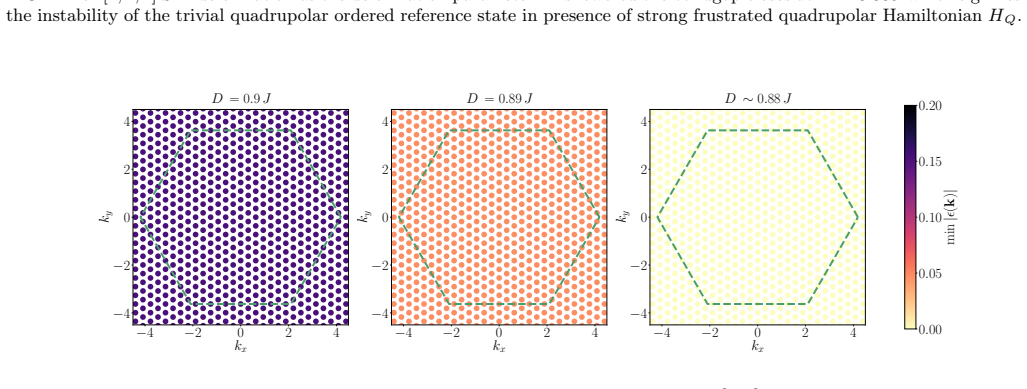
Field-polarized deformation and single-ion anisotropy The extensive mean-field degeneracy persists up to a finite single-ion anisotropy. Indeed, evaluating the defor- mationH ′ D within the four-color manifold, one finds ⟨H ′ D⟩=D X i ⟨ ˜Qx i ⟩+⟨ ˜Qy i ⟩+⟨ ˜Qz i ⟩+ 2 = 2N D(23) Since every four-color state satisfies⟨ ˜Qα i ⟩ ⟨ ˜Qα j ⟩=−4/9 on eachα-bond, ...
-
[3]
Mean-field configurations for anisotropic couplings Jz ̸=J x, Jy We now extend the mean-field analysis to anisotropic couplings of the quadrupolar model, as a preparation to the quantum perturbative treatment in Sec. V. As in the isotropic case, we consider product states |ψ⟩= Y i |ψi⟩ and minimize the variational energy⟨HQ⟩. Guided by the isotropic solut...
-
[4]
The resulting state could either exhibit symmetry-breaking order, corresponding to an order-by- disorder mechanism, or remain quantum disordered and liquid-like
Fluctuations beyond mean-field theory: absence of order-by-disorder Given the extensive degeneracy of mean-field ground states, quantum fluctuations beyond mean field are ex- pected to lift this degeneracy and select a quantum ground state. The resulting state could either exhibit symmetry-breaking order, corresponding to an order-by- disorder mechanism, ...
-
[5]
cycl.(xyz)
shows that the leading fluctuation corrections are identical for all four-color configurations and therefore do not select a symmetry-broken state (see Appendix D for details). At the same time, the four-color states areovercom- plete: although a localS= 1moment may be assigned one of four colors, only three of these states are linearly independent. This ...
-
[6]
ForJ z ≫J x, Jy, the low-energy Hilbert space on each z-bondb=⟨ij⟩ z is spanned by (recall the definition of the eigenstates of ˜Qz ≡Q xy in Eq
Low-energyz-bond manifold. ForJ z ≫J x, Jy, the low-energy Hilbert space on each z-bondb=⟨ij⟩ z is spanned by (recall the definition of the eigenstates of ˜Qz ≡Q xy in Eq. (27)) |↑⟩b ≡ | i j⟩,|↓⟩ b ≡ | i j⟩.(70) We denote byPthe projector onto the tensor product of these local two-dimensional spaces. The single-siteπ-spin rotations act on| ⟩and| ⟩ as eiπS...
-
[7]
As discussed above, the plaquette operatorW p acts trivially on the top and bottomz-bonds and flips the left 14 and right pseudospins
Projection of the plaquette operator. As discussed above, the plaquette operatorW p acts trivially on the top and bottomz-bonds and flips the left 14 and right pseudospins. Explicitly, P W p P= ˜σx bL ˜σx bR ,(73) whereb L andb R are the two parallelz-bonds of the hexagon. This identity will be the basic input for the string expectation values below
-
[8]
” in the third line contain all remaining distinct contractions, and “const
String operators in the anisotropic limit. Intheanisotropicz-bondregime, thebehaviorofstring operators is controlled by their projection onto the low- energyz-bond manifold. A generic open string ending with an incompletez-bond and carrying anx- ory-type endpoint is projected out, PU S P= 0,(74) because the endpoint operator takes the state out of the low...
-
[9]
Up to the gauge redundancy discussed in Sec
Linearly implementedM z-symmetric ansatz We first solve the mean-field self-consistency equations constrained bybothC 6 andM z symmetry. Up to the gauge redundancy discussed in Sec. VIIB, we find that in the diagonal gauge the independent mean-field param- eters reduce to wxx(y)≈0.551andM A =M B =±1,(90) □ K M □ −1.0 −0.5 0.0 0.5 1.0 ϵ(k) (a) −4 −2 0 2 4 ...
-
[10]
QO- QTIB
Projectively implementedM z-symmetric ansatz ThelinearlyM z-symmetricansatzdiscussedabovehas nodal lines in the parton band structure and may there- fore be susceptible to a large number of instabilities when accounting for fluctuations beyond the mean-field ap- proximation. It also appears to be in tension with the DMRG simulations presented in Ref. 24 w...
-
[11]
Savary and L
L. Savary and L. Balents, Quantum spin liquids: a re- view, Reports on Progress in Physics80, 016502 (2016)
2016
-
[12]
Knolle and R
J. Knolle and R. Moessner, A field guide to spin liq- uids, Annual Review of Condensed Matter Physics10, 19 451 (2019)
2019
-
[13]
Kitaev, Anyons in an exactly solved model and be- yond, Annals of Physics321, 2 (2006), january Special Issue
A. Kitaev, Anyons in an exactly solved model and be- yond, Annals of Physics321, 2 (2006), january Special Issue
2006
-
[14]
Hermanns, I
M. Hermanns, I. Kimchi, and J. Knolle, Physics of the ki- taev model: Fractionalization, dynamic correlations, and material connections, Annual Review of Condensed Mat- ter Physics9, 17 (2018)
2018
-
[15]
Takagi, T
H. Takagi, T. Takayama, G. Jackeli, G. Khaliullin, and S. E. Nagler, Concept and realization of kitaev quantum spin liquids, Nature Reviews Physics1, 264 (2019)
2019
-
[16]
Jackeli and G
G. Jackeli and G. Khaliullin, Mott insulators in the strong spin-orbit coupling limit: From heisenberg to a quantum compass and kitaev models, Phys. Rev. Lett. 102, 017205 (2009)
2009
-
[17]
Kurita, H
T.Yokoi, S.Ma, Y.Kasahara, S.Kasahara, T.Shibauchi, N. Kurita, H. Tanaka, J. Nasu, Y. Motome, C. Hickey, S. Trebst, and Y. Matsuda, Half-integer quantized anomalous thermal hall effect in the kitaev material can- didateα-RuCl 3, Science373, 568 (2021)
2021
-
[18]
C. L. Sarkis, K. D. Dixit, P. Rao, G. Khundzakishvili, C. Balz, J.-Q. Yan, B. Winn, T. J. Williams, A. Unnikr- ishnan, R. Moessner, D. A. Tennant, J. Knolle, S. E. Na- gler, and A. Banerjee, Intermediate field spin(on) dynam- ics inα-RuCl 3 (2026), arXiv:2601.16850 [cond-mat.str- el]
-
[19]
Nakatsuji, Y
S. Nakatsuji, Y. Nambu, H. Tonomura, O. Sakai, S. Jonas, C. Broholm, H. Tsunetsugu, Y. Qiu, and Y. Maeno, Spin disorder on a triangular lattice, Science 309, 1697 (2005)
2005
-
[20]
Läuchli, F
A. Läuchli, F. Mila, and K. Penc, Quadrupolar phases of theS= 1bilinear-biquadratic heisenberg model on the triangular lattice, Phys. Rev. Lett.97, 087205 (2006)
2006
-
[21]
Szasz, C
A. Szasz, C. Wang, and Y.-C. He, Phase diagram of a bilinear-biquadratic spin-1 model on the triangular lat- tice from density matrix renormalization group simula- tions, Phys. Rev. B106, 115103 (2022)
2022
-
[22]
Pohle, N
R. Pohle, N. Shannon, and Y. Motome, Spin nematics meet spin liquids: Exotic quantum phases in the spin- 1 bilinear-biquadratic model with kitaev interactions, Phys. Rev. B107, L140403 (2023)
2023
-
[23]
Penc and A
K. Penc and A. M. Läuchli, Spin nematic phases in quantum spin systems, inIntroduction to Frustrated Magnetism: Materials, Experiments, Theory, edited by C. Lacroix, P. Mendels, and F. Mila (Springer Berlin Hei- delberg, Berlin, Heidelberg, 2011) pp. 331–362
2011
-
[24]
Jiang, J
S. Jiang, J. Romhányi, S. R. White, M. E. Zhitomirsky, and A. L. Chernyshev, Where is the quantum spin ne- matic?, Phys. Rev. Lett.130, 116701 (2023)
2023
-
[25]
Bai, S.-S
X. Bai, S.-S. Zhang, Z. Dun, H. Zhang, Q. Huang, H. Zhou, M. B. Stone, A. I. Kolesnikov, F. Ye, C. D. Batista,et al., Hybridized quadrupolar excitations in the spin-anisotropic frustrated magnet FeI2, Nature Physics 17, 467 (2021)
2021
-
[26]
U. F. P. Seifert and L. Savary, Phase diagrams and ex- citations of anisotropicS= 1quantum magnets on the triangular lattice, Phys. Rev. B106, 195147 (2022)
2022
- [27]
-
[28]
J. G. Rau and M. J. Gingras, Frustrated quantum rare- earth pyrochlores, Annual Review of Condensed Matter Physics10, 357 (2019)
2019
-
[29]
Guitteny, J
S. Guitteny, J. Robert, P. Bonville, J. Ollivier, C. Decorse, P. Steffens, M. Boehm, H. Mutka, I. Mire- beau, and S. Petit, Anisotropic propagating excitations andquadrupolareffectsintb 2ti2o7,Phys.Rev.Lett.111, 087201 (2013)
2013
-
[30]
Rayyan, D
A. Rayyan, D. Churchill, and H.-Y. Kee, Field-induced kitaev multipolar liquid in spin-orbit coupledd2 honey- combmottinsulators,Phys.Rev.B107,L020408(2023)
2023
-
[31]
Khaliullin, D
G. Khaliullin, D. Churchill, P. P. Stavropoulos, and H.- Y. Kee, Exchange interactions, jahn-teller coupling, and multipole orders in pseudospin one-half5d2 mott insula- tors, Phys. Rev. Res.3, 033163 (2021)
2021
- [32]
-
[33]
Verresen, M
R. Verresen, M. D. Lukin, and A. Vishwanath, Prediction of toric code topological order from rydberg blockade, Phys. Rev. X11, 031005 (2021)
2021
-
[34]
Verresen and A
R. Verresen and A. Vishwanath, Unifying kitaev mag- nets, kagomé dimer models, and ruby rydberg spin liq- uids, Phys. Rev. X12, 041029 (2022)
2022
-
[35]
Wang and L
Z. Wang and L. Pollet, Renormalized classical spin liquid on the ruby lattice, Phys. Rev. Lett.134, 086601 (2025)
2025
-
[36]
Semeghini, H
G. Semeghini, H. Levine, A. Keesling, S. Ebadi, T. T. Wang, D. Bluvstein, R. Verresen, H. Pichler, M. Kali- nowski, R. Samajdar, A. Omran, S. Sachdev, A. Vish- wanath, M. Greiner, V. Vuletić, and M. D. Lukin, Prob- ing topological spin liquids on a programmable quantum simulator, Science374, 1242 (2021)
2021
-
[37]
Khait, P
I. Khait, P. P. Stavropoulos, H.-Y. Kee, and Y. B. Kim, Characterizing spin-one kitaev quantum spin liq- uids, Phys. Rev. Res.3, 013160 (2021)
2021
-
[38]
Ma,Z 2 spin liquids in the higher spin-Skitaev hon- eycomb model: An exact deconfinedZ2 gauge structure in a nonintegrable model, Phys
H. Ma,Z 2 spin liquids in the higher spin-Skitaev hon- eycomb model: An exact deconfinedZ2 gauge structure in a nonintegrable model, Phys. Rev. Lett.130, 156701 (2023). [29]Q x2−y2 = 1 2(Qxx −Q yy)andQ 3z2−r2 =− 1 2 √ 3(Qxx + Qyy −2Q zz)
2023
-
[39]
Nussinov and J
Z. Nussinov and J. van den Brink, Compass models: The- ory and physical motivations, Rev. Mod. Phys.87, 1 (2015)
2015
-
[40]
Baskaran, D
G. Baskaran, D. Sen, and R. Shankar, Spin-Skitaev model: Classical ground states, order from disorder, and exact correlation functions, Phys. Rev. B78, 115116 (2008)
2008
-
[41]
R. Liu, H. T. Lam, H. Ma, and L. Zou, Symme- tries and anomalies of Kitaev spin-S models: Identify- ing symmetry-enforced exotic quantum matter, SciPost Phys.16, 100 (2024)
2024
-
[42]
R. A. Muniz, Y. Kato, and C. D. Batista, Gen- eralized spin-wave theory: Application to the bilin- ear–biquadratic model, Progress of Theoretical and Ex- perimental Physics2014, 083I01 (2014)
2014
-
[43]
See Supplemental Material for further details on the linear-flavor wave spectra and additional information and analysis of Majorana mean-field theory calculations
-
[44]
Yan and R
H. Yan and R. Pohle, ClassicalZ 2 spin liquid on the generalized four-color kitaev model, Phys. Rev. Res.7, L012052 (2025)
2025
-
[45]
W. B. Fontana, F. G. Oliviero, R. G. Pereira, and W. M. H. Natori, Spin-orbital kitaev model: From kagome spin ice to classical fractons, Phys. Rev. B111, 20 195112 (2025)
2025
-
[46]
Misguich, D
G. Misguich, D. Serban, and V. Pasquier, Quantum dimer model on the kagome lattice: Solvable dimer- liquidandisinggaugetheory,Phys.Rev.Lett.89,137202 (2002)
2002
-
[47]
Elser and C
V. Elser and C. Zeng, Kagomé spin-1/2 antiferromagnets in the hyperbolic plane, Phys. Rev. B48, 13647 (1993)
1993
-
[48]
Hwang, Y
K. Hwang, Y. Huh, and Y. B. Kim,Z2 gauge theory for valence bond solids on the kagome lattice, Phys. Rev. B 92, 205131 (2015)
2015
-
[49]
M. E. Zhitomirsky, Real-space perturbation theory for frustrated magnets: application to magnetization plateaus, Journal of Physics: Conference Series592, 012110 (2015)
2015
-
[50]
Minakawa, J
T. Minakawa, J. Nasu, and A. Koga, Quantum and clas- sical behavior of spin-Skitaev models in the anisotropic limit, Phys. Rev. B99, 104408 (2019)
2019
-
[51]
Wen, Quantum orders and symmetric spin liquids, Phys
X.-G. Wen, Quantum orders and symmetric spin liquids, Phys. Rev. B65, 165113 (2002)
2002
-
[52]
Y.-Z. You, I. Kimchi, and A. Vishwanath, Doping a spin- orbit mott insulator: Topological superconductivity from the kitaev-heisenberg model and possible application to (Na2/Li2)IrO3, Phys. Rev. B86, 085145 (2012)
2012
-
[53]
U. F. P. Seifert, T. Meng, and M. Vojta, Fractionalized fermi liquids and exotic superconductivity in the kitaev- kondo lattice, Phys. Rev. B97, 085118 (2018)
2018
-
[54]
P. P. Stavropoulos, D. Pereira, and H.-Y. Kee, Micro- scopic Mechanism for a Higher-Spin Kitaev Model, Phys. Rev. Lett.123, 037203 (2019)
2019
-
[55]
Mashiko and T
T. Mashiko and T. Okubo, Quantum phase transition between spin liquid and spin nematics in spin-1 kitaev honeycomb model, Phys. Rev. Res.6, 033110 (2024)
2024
-
[56]
Colpa, Diagonalization of the quadratic boson hamil- tonian, Physica A: Statistical Mechanics and its Appli- cations93, 327 (1978)
J. Colpa, Diagonalization of the quadratic boson hamil- tonian, Physica A: Statistical Mechanics and its Appli- cations93, 327 (1978)
1978
-
[57]
Corresponding to the three possible pairings of the four Majoranas. Appendix A:d-vector formalism for mean-field ground states To characterize a local spin-1 state, it is convenient to work in the time-reversal-invariant basis |x⟩= i |+1⟩ − |−1⟩√ 2 ,|y⟩= |+1⟩+|−1⟩√ 2 ,|z⟩=−i|0⟩, (A1) where{|+1⟩,|0⟩,|−1⟩}is the usualS z-eigenbasis of the spin-1 Hilbert spa...
-
[58]
(18) is straightforwardly minimized when|⟨ ⃗Qi⟩|2 = 4 3 andλ=−1
Constrained minimization The energy in Eq. (18) is straightforwardly minimized when|⟨ ⃗Qi⟩|2 = 4 3 andλ=−1. At the same time, the two quadrupolar components not appearing inH Q vanish, ⟨Qx2−y2 ⟩=⟨Q 3z2−r2 ⟩= 0. For a reald-vector|d⟩= (dx, dy, dz)T, these conditions read d2 x −d 2 y = 0,2d 2 z −d 2 x −d 2 y = 0, d 2 x +d 2 y +d 2 z = 1. They imply d2 x =d ...
-
[59]
Variational problem for anisotropic couplings With Eq. (26), the minimization of the Hamiltonian (25) maps onto the constrained maxmization problem f(u, v, w) = 4 Jzuv+J xvw+J ywu − µ 4 (u+v+w−1), (C1) withµdenoting a Lagrange multiplier to enforceu+v+ w= 1. An interior stationary point satisfies Jzv+J yw=µ, J zu+J xw=µ, J xv+J yu=µ,(C2) which can be solv...
-
[60]
(75), the resulting mean-field Hamiltonian takes the form of Eq
Mean-field decoupling and Hamiltonian Upon performing the mean-field decoupling of the in- teracting parton Hamiltonian in (45) as schematically in- dicated in Eq. (75), the resulting mean-field Hamiltonian takes the form of Eq. (77), whereHxyz =−M AMB(Hx + Hy +H z)contains the dispersive Majorana fermions of flavorsα=x, y, z, together with the self-consi...
-
[61]
square root
Bilinear forms of the Majorana Hilbert-space constraints The local constraint defining the physical parton Hilbert space in Eq. (39) is quartic in the Majorana oper- ators. In order to implement it within a noninteracting- fermion mean-field treatment, it is convenient to impose instead the bilinear conditions iγ0 aγz a + iγx a γy a = 0, a= 1,2.(F4) Indee...
-
[62]
mixing parameter
Solution of mean-field self-consistency conditions To solve the mean-field self consistency conditions, we exploit translational invariance to work in momentum space. The Majorana fermions can be expanded as γµ a,(i,s) = r 2 Nc X k∈BZ/2 γµ a,(k,s)eik·ri + h.c. ,(F9) 24 wheres=A, Bis a sublattice index, and the momentum- space sum extends over onlyhalfof t...
2026
discussion (0)
Sign in with ORCID, Apple, or X to comment. Anyone can read and Pith papers without signing in.