Recognition: 2 theorem links
Design, Testing, and Commissioning of the Sun Yat-sen University (SYSU) 80 cm Infrared Telescope
Pith reviewed 2026-05-08 18:28 UTC · model grok-4.3
The pith
The SYSU 80 cm telescope achieves background-limited J-band imaging with a limiting magnitude of 17 in single 20 s exposures.
A machine-rendered reading of the paper's core claim, the machinery that carries it, and where it could break.
Core claim
The commissioned SYSU 80 cm telescope, equipped with InGaAs cameras on its J-band Nasmyth focus, delivers background-limited performance with a dark current of approximately 14 e-/s/pix and readout noise of approximately 11 e-, attaining a limiting magnitude of J approximately 17 in single 20 s exposures and J approximately 19.4 with 30-minute stacks, together with millimagnitude-level photometric precision for a J approximately 14 variable.
What carries the argument
The reflective Cassegrain design with two Nasmyth foci, paired with InGaAs detectors (initially 640 by 512 and later 1280 by 1024) that achieve background-limited operation at the Lenghu site.
If this is right
- The telescope has already observed gamma-ray bursts, supernovae, comets, active galactic nuclei, high-redshift quasars, brown dwarfs, and deep fields reaching J approximately 20.5.
- Millimagnitude precision on J approximately 14 objects supports time-domain studies of variables.
- The results validate off-the-shelf and science-grade InGaAs cameras for astronomical use.
- The facility functions as a testbed that can encourage other sites to add dedicated infrared imaging.
Where Pith is reading between the lines
- InGaAs cameras could be added to existing optical telescopes to gain near-infrared time-domain capability without building entirely new facilities.
- The 4100 m site performance may extend to other high-altitude locations for similar NIR observations of transients.
- Further upgrades to the K-band channel could broaden the wavelength coverage for the same optical design.
Load-bearing premise
The reported dark current, readout noise, limiting magnitudes, and photometric precision were measured under representative on-sky conditions without significant unaccounted systematics or post-processing effects.
What would settle it
Independent on-sky tests that find the dark current substantially above 14 e-/s/pix or the single-exposure limiting magnitude worse than J approximately 17 would show the claimed background-limited performance does not hold.
Figures
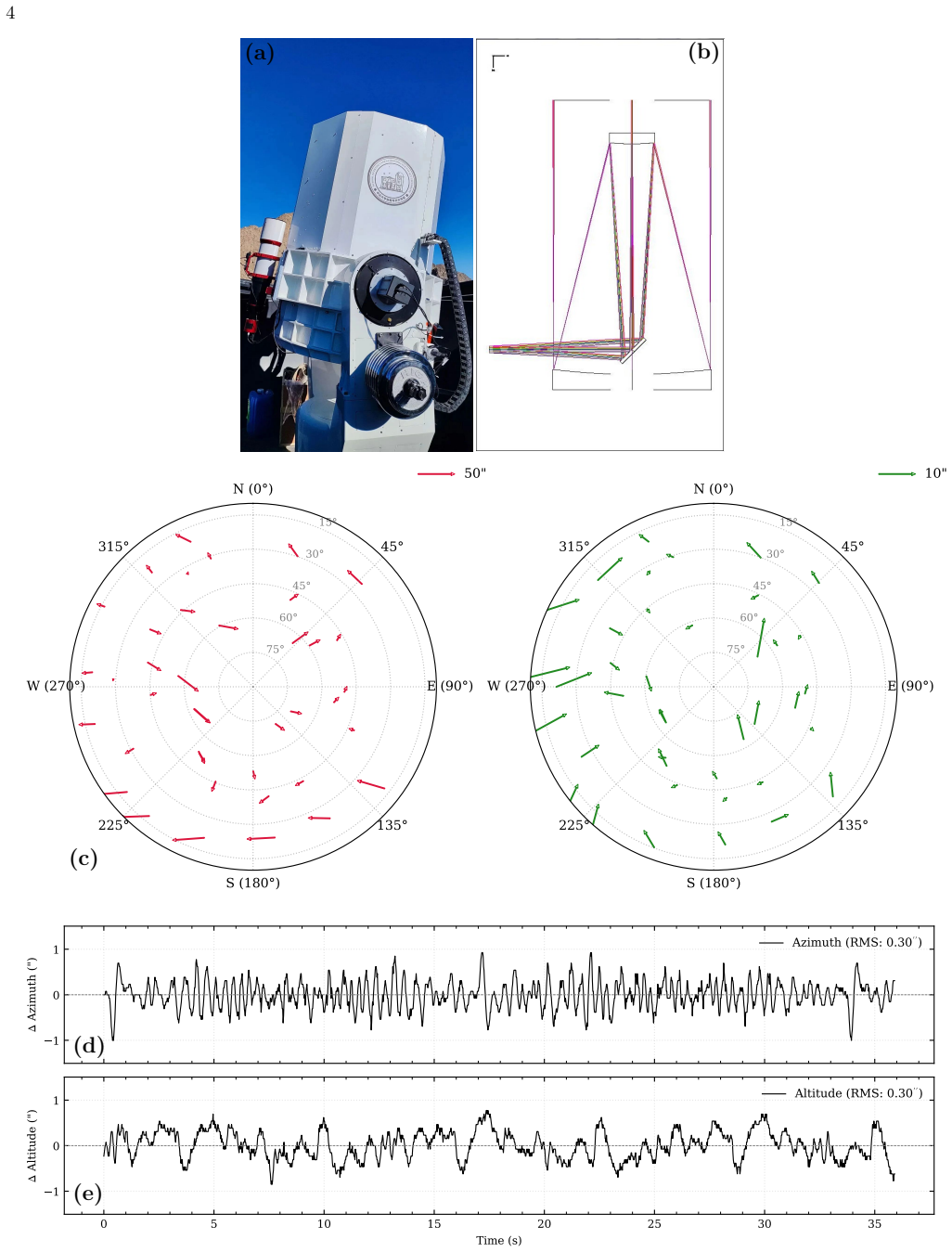


read the original abstract
The Sun Yat-sen University (SYSU) 80 cm telescope is a new generation near-infrared (NIR) facility in China dedicated to time-domain astronomy, while also serving as a testbed for emerging NIR cameras. Commissioned in October 2024 at the 4100 m Lenghu site on the Tibetan Plateau in China, the telescope adopts a reflective Cassegrain design with two Nasmyth foci for J and K bands. The J band imaging system, initially equipped with a 640 x 512 off-the-shelf InGaAs camera (INS Mars640) and upgraded in June 2025 to a 1280 x 1024 science-grade, deeply cooled camera (YNAOIR), achieves background-limited performance with a dark current of ~ 14 e-/s/pix and a readout noise of ~ 11 e-. The system reaches a limiting magnitude of J ~ 17 mag (Vega system) in single 20 s exposures and depths of J ~ 19.4 mag with stacked 30 minute exposures. For a variable with J ~ 14 mag during on-sky tests, the system delivers millimagnitude-level photometric precision. Since commissioning, the telescope observed transients such as gamma-ray bursts (GRBs), supernovae and comets, variables including active galactic nuclei (AGNs), high-redshift quasars (z > 6), and brown dwarfs, as well as deep-field imaging reaching J ~ 20.5 mag. This validates the feasibility of using InGaAs cameras for astronomical observations, encouraging other institutions to develop dedicated infrared telescopes or integrate infrared cameras into existing optical telescopes.
Editorial analysis
A structured set of objections, weighed in public.
Referee Report
Summary. The manuscript describes the design, testing, and commissioning of the SYSU 80 cm infrared telescope at the 4100 m Lenghu site. It details a reflective Cassegrain system with two Nasmyth foci for J and K bands, initially using an off-the-shelf 640x512 InGaAs camera (INS Mars640) and upgraded to a 1280x1024 science-grade cooled camera (YNAOIR). The paper reports lab and on-sky results showing background-limited performance with dark current ~14 e-/s/pix and readout noise ~11 e-, limiting magnitudes of J~17 (Vega) in single 20 s exposures and J~19.4 with 30 min stacks, millimagnitude photometric precision for J~14 mag variables, and successful observations of GRBs, supernovae, comets, AGNs, z>6 quasars, brown dwarfs, and deep fields to J~20.5 mag. It concludes that InGaAs cameras are viable for astronomical NIR observations.
Significance. If the reported metrics hold, the work is significant as a documented case study of a new dedicated NIR facility for time-domain astronomy at a high-altitude site, serving also as a testbed for emerging cameras. The explicit lab measurements for detector properties, on-sky tests with described observing conditions and data reduction steps, and example light curves provide direct empirical support for the performance claims and address concerns about unaccounted systematics. This strengthens the validation of InGaAs technology and offers a practical reference for other institutions developing similar systems.
minor comments (2)
- The abstract and main text would benefit from a brief clarification of the timeline between commissioning (October 2024) and camera upgrade (June 2025) to indicate which performance figures correspond to which configuration.
- Consider adding a table summarizing the key on-sky test parameters (e.g., exposure times, number of frames, typical seeing or airmass) alongside the reported limiting magnitudes and precision values for easier reference.
Simulated Author's Rebuttal
We thank the referee for their positive and encouraging review of our manuscript describing the design, testing, and commissioning of the SYSU 80 cm Infrared Telescope. We appreciate the recognition of the work's significance as a case study for a dedicated NIR facility and the validation of InGaAs technology, as well as the recommendation to accept.
Circularity Check
No significant circularity; empirical measurements only
full rationale
The manuscript reports direct empirical results from telescope design, lab testing of the InGaAs detectors (dark current ~14 e-/s/pix, readout noise ~11 e-), and on-sky commissioning observations at Lenghu. Limiting magnitudes (J~17 in 20s, J~19.4 in 30min stacks) and millimagnitude photometric precision are tied to explicit measurements under stated conditions with no intervening derivations, parameter fits, or predictions that reduce to the inputs by construction. No self-citations, ansatzes, or uniqueness theorems are invoked to support the performance claims. The derivation chain is therefore self-contained as straightforward reporting of observed quantities.
Axiom & Free-Parameter Ledger
axioms (1)
- domain assumption Standard assumptions of reflective telescope optics, detector characterization, and astronomical photometry hold under the reported site conditions.
Reference graph
Works this paper leans on
-
[1]
2013, ApJ, 768, 121, doi: 10.1088/0004-637X/768/2/121 17
Apai, D., Radigan, J., Buenzli, E., et al. 2013, ApJ, 768, 121, doi: 10.1088/0004-637X/768/2/121
-
[2]
Zones, spots, and planetary-scale waves beating in brown dwarf atmospheres
Apai, D., Karalidi, T., Marley, M. S., et al. 2017, Science, 357, 683, doi: 10.1126/science.aam9848 Artigau, ´E., Bouchard, S., Doyon, R., & Lafreni` ere, D. 2009, ApJ, 701, 1534, doi: 10.1088/0004-637X/701/2/1534
-
[3]
Artigau, E., Bouchard, S., Doyon, R., & Lafreni` ere, D. 2009, The Astrophysical Journal, 701, 1534–1539, doi: 10.1088/0004-637x/701/2/1534 Artigau, ´E., Doyon, R., Lafreni` ere, D., et al. 2006, ApJL, 651, L57, doi: 10.1086/509146
-
[4]
Assef, R. J., Stern, D., Kochanek, C. S., et al. 2013, ApJ, 772, 26, doi: 10.1088/0004-637X/772/1/26
-
[5]
1997, in Society of Photo-Optical Instrumentation Engineers (SPIE) Conference Series, Vol
Barbieri, C. 1997, in Society of Photo-Optical Instrumentation Engineers (SPIE) Conference Series, Vol. 2871, Optical Telescopes of Today and Tomorrow, ed. A. L. Ardeberg, 244–255, doi: 10.1117/12.269046
-
[6]
Basa, S., Lee, W. H., Dolon, F., et al. 2022, in Society of Photo-Optical Instrumentation Engineers (SPIE) Conference Series, Vol. 12182, Ground-based and Airborne Telescopes IX, ed. H. K. Marshall, J. Spyromilio, & T. Usuda, 121821S, doi: 10.1117/12.2627139
-
[7]
Bellm, E. C., Kulkarni, S. R., Graham, M. J., et al. 2019, PASP, 131, 018002, doi: 10.1088/1538-3873/aaecbe
-
[8]
2006, in Astronomical Society of the Pacific Conference Series, Vol
Bertin, E. 2006, in Astronomical Society of the Pacific Conference Series, Vol. 351, Astronomical Data Analysis Software and Systems XV, ed. C. Gabriel, C. Arviset, D. Ponz, & S. Enrique, 112
2006
-
[9]
Bertin, E., & Arnouts, S. 1996, A&AS, 117, 393, doi: 10.1051/aas:1996164
-
[10]
S., Castelli, F., & Plez, B
Bessell, M. S., Castelli, F., & Plez, B. 1998, A&A, 333, 231
1998
-
[11]
Birch, M., Soon, J., Travouillon, T., et al. 2022, Journal of Astronomical Telescopes, Instruments, and Systems, 8, 016001, doi: 10.1117/1.JATIS.8.1.016001
-
[12]
W., et al
Blank, R., Anglin, S., Beletic, J. W., et al. 2011, in Astronomical Society of the Pacific Conference Series, Vol. 437, Solar Polarization 6, ed. J. R. Kuhn, D. M
2011
-
[13]
Boyd, R. W. 1978, Journal of the Optical Society of America (1917-1983), 68, 877, doi: 10.1364/JOSA.68.000877
-
[14]
2025, GRB Coordinates Network, 42078, 1
Cao, D.-L., Lin, J.-Q., Chun, C., et al. 2025, GRB Coordinates Network, 42078, 1
2025
-
[15]
Chambers, K. C., Magnier, E. A., Metcalfe, N., et al. 2016, arXiv e-prints, arXiv:1612.05560, doi: 10.48550/arXiv.1612.05560
work page internal anchor Pith review doi:10.48550/arxiv.1612.05560 2016
-
[16]
2025, GRB Coordinates Network, 40088, 1 17
Chen, C., Li, X., Dong, Z.-N., et al. 2025, GRB Coordinates Network, 40088, 1 17
2025
-
[17]
Dalton, G. B., Sutherland, W. J., Emerson, J. P., et al. 2010, in Society of Photo-Optical Instrumentation Engineers (SPIE) Conference Series, Vol. 7735, Ground-based and Airborne Instrumentation for Astronomy III, ed. I. S. McLean, S. K. Ramsay, & H. Takami, 77351J, doi: 10.1117/12.857186
-
[18]
De, K., Hankins, M. J., Kasliwal, M. M., et al. 2020, PASP, 132, 025001, doi: 10.1088/1538-3873/ab6069
-
[19]
2021, Nature, 596, 353, doi: 10.1038/s41586-021-03711-z
Deng, L., Yang, F., Chen, X., et al. 2021, Nature, 596, 353, doi: 10.1038/s41586-021-03711-z
-
[20]
Djupvik, A. A., & Andersen, J. 2010, in Astrophysics and Space Science Proceedings, Vol. 14, Highlights of Spanish Astrophysics V, ed. J. M. Diego, L. J. Goicoechea, J. I. Gonz´ alez-Serrano, & J. Gorgas, 211, doi: 10.1007/978-3-642-11250-8 21
-
[21]
2024, in Society of Photo-Optical Instrumentation Engineers (SPIE) Conference Series, Vol
Dong, Z., Ma, B., Li, J., & Zhang, H. 2024, in Society of Photo-Optical Instrumentation Engineers (SPIE) Conference Series, Vol. 13103, X-Ray, Optical, and Infrared Detectors for Astronomy XI, ed. A. D. Holland & K. Minoglou, 131031M, doi: 10.1117/12.3018935
-
[22]
2025, PASP, 137, 125003, doi: 10.1088/1538-3873/ae215c
Dong, Z., Ma, B., Zhang, H., et al. 2025a, PASP, 137, 125003, doi: 10.1088/1538-3873/ae215c
-
[23]
2025b, arXiv e-prints, arXiv:2510.14839, doi: 10.48550/arXiv.2510.14839
Dong, Z., Ma, B., Zhang, H., et al. 2025b, arXiv e-prints, arXiv:2510.14839, doi: 10.48550/arXiv.2510.14839
-
[24]
2024, GRB Coordinates Network, 38275, 1
Dong, Z.-N., Yu, Y., Lin, J.-Q., et al. 2024, GRB Coordinates Network, 38275, 1
2024
-
[25]
Drake, A. J., Graham, M. J., Djorgovski, S. G., et al. 2014, ApJS, 213, 9, doi: 10.1088/0067-0049/213/1/9
-
[26]
Dye, S., Lawrence, A., Read, M. A., et al. 2018, MNRAS, 473, 5113, doi: 10.1093/mnras/stx2622
-
[27]
Feng, H.-C., Li, S.-S., Bai, J. M., et al. 2024, ApJ, 976, 176, doi: 10.3847/1538-4357/ad8568
-
[28]
2025, arXiv e-prints, arXiv:2512.18276, doi: 10.48550/arXiv.2512.18276
Feng, H.-C., Li, S.-S., Sun, M., et al. 2025, arXiv e-prints, arXiv:2512.18276, doi: 10.48550/arXiv.2512.18276
-
[29]
2025, arXiv e-prints, arXiv:2512.16753, doi: 10.48550/arXiv.2512.16753
Frostig, D., Lourie, N., Karambelkar, V., et al. 2025, arXiv e-prints, arXiv:2512.16753, doi: 10.48550/arXiv.2512.16753
-
[30]
Summary of the contents and survey properties
Fu, S. Y., He, L. B., Zhu, A. D., et al. 2025, GRB Coordinates Network, 42990, 1 Gaia Collaboration, Brown, A. G. A., Vallenari, A., et al. 2021, A&A, 649, A1, doi: 10.1051/0004-6361/202039657
-
[31]
Gillon, M., Jehin, E., Lederer, S. M., et al. 2016, Nature, 533, 221, doi: 10.1038/nature17448
-
[32]
Hodapp, K. W., Jensen, J. B., Irwin, E. M., et al. 2003, PASP, 115, 1388, doi: 10.1086/379669
-
[33]
Howell, S. B. 2006, Handbook of CCD Astronomy, Vol. 5
2006
-
[34]
2018, in Society of Photo-Optical Instrumentation Engineers (SPIE) Conference Series, Vol
Hu, Y., Shang, Z., Ma, B., & Hu, K. 2018, in Society of Photo-Optical Instrumentation Engineers (SPIE) Conference Series, Vol. 10707, Software and Cyberinfrastructure for Astronomy V, ed. J. C. Guzman & J. Ibsen, 107072L, doi: 10.1117/12.2313015
-
[35]
2019, PASP, 131, 015001, doi: 10.1088/1538-3873/aae916
Hu, Y., Hu, K., Shang, Z., et al. 2019, PASP, 131, 015001, doi: 10.1088/1538-3873/aae916
-
[36]
Jencson, J. E., Kasliwal, M. M., Adams, S. M., et al. 2019, ApJ, 886, 40, doi: 10.3847/1538-4357/ab4a01
-
[37]
2006, ApJ, 649, 939, doi: 10.1086/506588
Kasen, D. 2006, ApJ, 649, 939, doi: 10.1086/506588
-
[38]
Knapp, G. R., Leggett, S. K., Fan, X., et al. 2004, AJ, 127, 3553, doi: 10.1086/420707
-
[39]
2016, in Society of Photo-Optical Instrumentation Engineers (SPIE) Conference Series, Vol
Lang-Bardl, F., Bender, R., Goessl, C., et al. 2016, in Society of Photo-Optical Instrumentation Engineers (SPIE) Conference Series, Vol. 9908, Ground-based and Airborne Instrumentation for Astronomy VI, ed. C. J
2016
-
[40]
Ground-based and Airborne Instrumentation for Astronomy VI , year = 2016, editor =
Evans, L. Simard, & H. Takami, 990844, doi: 10.1117/12.2232039
-
[41]
Lauer, T. R. 1999, PASP, 111, 227, doi: 10.1086/316319
-
[42]
Law, N. M., Mackay, C. D., & Baldwin, J. E. 2006, A&A, 446, 739, doi: 10.1051/0004-6361:20053695
-
[43]
2026, Science Bulletin, 71, 538, doi: 10.1016/j.scib.2025.12.050
Li, D., Zhang, W., Yang, J., et al. 2026, Science Bulletin, 71, 538, doi: 10.1016/j.scib.2025.12.050
-
[44]
2024, in Society of Photo-Optical Instrumentation Engineers (SPIE) Conference Series, Vol
Li, J., Ma, B., Dong, Z., & Zhang, H. 2024, in Society of Photo-Optical Instrumentation Engineers (SPIE) Conference Series, Vol. 13094, Ground-based and Airborne Telescopes X, ed. H. K. Marshall, J. Spyromilio, & T. Usuda, 130945C, doi: 10.1117/12.3018662
-
[45]
Li, S.-S., Feng, H.-C., Liu, H. T., et al. 2022, ApJ, 936, 75, doi: 10.3847/1538-4357/ac8745
-
[46]
2026, arXiv e-prints, arXiv:2601.13068, doi: 10.48550/arXiv.2601.13068
Lin, P., Yang, H., Ma, B., et al. 2026, arXiv e-prints, arXiv:2601.13068, doi: 10.48550/arXiv.2601.13068
-
[47]
, archivePrefix = "arXiv", eprint =
Madau, P., & Dickinson, M. 2014, ARA&A, 52, 415, doi: 10.1146/annurev-astro-081811-125615
work page Pith review doi:10.1146/annurev-astro-081811-125615 2014
-
[48]
2016, ApJ, 828, 26, doi: 10.3847/0004-637X/828/1/26
Matsuoka, Y., Onoue, M., Kashikawa, N., et al. 2016, ApJ, 828, 26, doi: 10.3847/0004-637X/828/1/26
-
[49]
A., Heinze, A., Apai, D., et al
Metchev, S. A., Heinze, A., Apai, D., et al. 2015, The Astrophysical Journal, 799, 154, doi: 10.1088/0004-637x/799/2/154
-
[50]
Moore, A. C., Ninkov, Z., & Forrest, W. J. 2004, in Society of Photo-Optical Instrumentation Engineers (SPIE) Conference Series, Vol. 5167, Focal Plane Arrays for Space Telescopes, ed. T. J. Grycewicz & C. R. McCreight, 204–215, doi: 10.1117/12.507330
-
[51]
Mortlock, D. J., Warren, S. J., Venemans, B. P., et al. 2011, Nature, 474, 616, doi: 10.1038/nature10159 18
-
[52]
2024, in Society of Photo-Optical Instrumentation Engineers (SPIE) Conference Series, Vol
Nagayama, T., & Nakaya, H. 2024, in Society of Photo-Optical Instrumentation Engineers (SPIE) Conference Series, Vol. 13096, Ground-based and Airborne Instrumentation for Astronomy X, ed. J. J
2024
-
[53]
Bryant, K. Motohara, & J. R. D. Vernet, 130963I, doi: 10.1117/12.3016593
-
[54]
2003, in Society of Photo-Optical Instrumentation Engineers (SPIE) Conference Series, Vol
Nagayama, T., Nagashima, C., Nakajima, Y., et al. 2003, in Society of Photo-Optical Instrumentation Engineers (SPIE) Conference Series, Vol. 4841, Instrument Design and Performance for Optical/Infrared Ground-based Telescopes, ed. M. Iye & A. F. M. Moorwood, 459–464, doi: 10.1117/12.460770
-
[55]
Nielsen, J. T., Guffanti, A., & Sarkar, S. 2016, Scientific Reports, 6, 35596, doi: 10.1038/srep35596 Nouvel de la Fl` eche, A., Atteia, J.-L., Boy, J., et al. 2023, Experimental Astronomy, 56, 645, doi: 10.1007/s10686-023-09903-x
-
[56]
Phan, K., Galbany, L., M¨ uller-Bravo, T. E., et al. 2025, arXiv e-prints, arXiv:2512.03695, doi: 10.48550/arXiv.2512.03695
-
[57]
2017, Research in Astronomy and Astrophysics, 17, 087, doi: 10.1088/1674-4527/17/8/87
Qian, S.-B., He, J.-J., Zhang, J., et al. 2017, Research in Astronomy and Astrophysics, 17, 087, doi: 10.1088/1674-4527/17/8/87
-
[58]
Qian, Z. 1988, Publications of the Beijing Astronomical Observatory, 11, 33 qing Qu, W., ran Ma, H., yuan Wei, J., et al. 2025, AIP Advances, 15, 095026, doi: 10.1063/5.0274169
-
[59]
2009, Nature, 461, 1258, doi: 10.1038/nature08445
Salvaterra, R., Della Valle, M., Campana, S., et al. 2009, Nature, 461, 1258, doi: 10.1038/nature08445
-
[60]
Z., Micheli, M., Farnocchia, D., et al
Seligman, D. Z., Micheli, M., Farnocchia, D., et al. 2025, ApJL, 989, L36, doi: 10.3847/2041-8213/adf49a
-
[61]
Simons, D. A., & Tokunaga, A. 2002, PASP, 114, 169, doi: 10.1086/338544
-
[62]
Skrutskie, M. F., Cutri, R. M., Stiening, R., et al. 2006, AJ, 131, 1163, doi: 10.1086/498708
-
[63]
2020, in Society of Photo-Optical Instrumentation Engineers (SPIE) Conference Series, Vol
Soon, J., Adams, D., De, K., et al. 2020, in Society of Photo-Optical Instrumentation Engineers (SPIE) Conference Series, Vol. 11203, Advances in Optical Astronomical Instrumentation 2019, ed. S. C. Ellis & C. d’Orgeville, 1120307, doi: 10.1117/12.2539594
-
[64]
Sumi, T., Buckley, D. A. H., Kutyrev, A. S., et al. 2025, AJ, 170, 338, doi: 10.3847/1538-3881/ae14f5
-
[65]
2015, A&A, 575, A25, doi: 10.1051/0004-6361/201424973
Sutherland, W., Emerson, J., Dalton, G., et al. 2015, A&A, 575, A25, doi: 10.1051/0004-6361/201424973
-
[66]
Tokunaga, A. T., Simons, D. A., & Vacca, W. D. 2002, PASP, 114, 180, doi: 10.1086/338545
-
[67]
2024, ApJ, 976, 82, doi: 10.3847/1538-4357/ad815a Van Bogget, U., Vervenne, V., Vinella, R
Tu, Z., Wang, S., & Liu, J. 2024, ApJ, 976, 82, doi: 10.3847/1538-4357/ad815a Van Bogget, U., Vervenne, V., Vinella, R. M., et al. 2014, in Society of Photo-Optical Instrumentation Engineers (SPIE) Conference Series, Vol. 9070, Infrared Technology and Applications XL, ed. B. F. Andresen, G. F. Fulop, C. M. Hanson, & P. R. Norton, 90700B, doi: 10.1117/12.2057507
-
[68]
Wallace, P. T. 1994, Starlink User Note, 100
1994
-
[69]
Wei, J., Cordier, B., Antier, S., et al. 2016, arXiv e-prints, arXiv:1610.06892, doi: 10.48550/arXiv.1610.06892
-
[70]
Wilson, J. C., Eikenberry, S. S., Henderson, C. P., et al. 2003, in Society of Photo-Optical Instrumentation Engineers (SPIE) Conference Series, Vol. 4841, Instrument Design and Performance for Optical/Infrared Ground-based Telescopes, ed. M. Iye & A. F. M. Moorwood, 451–458, doi: 10.1117/12.460336
-
[71]
Wu, X.-B., Wang, F., Fan, X., et al. 2015, Nature, 518, 512, doi: 10.1038/nature14241
-
[72]
2021, MNRAS, 501, 3614, doi: 10.1093/mnras/staa3824
Yang, X., Shang, Z., Hu, K., et al. 2021, MNRAS, 501, 3614, doi: 10.1093/mnras/staa3824
-
[73]
I., Fang, Y., Zhang, B.-B., et al
Yin, Y.-H. I., Fang, Y., Zhang, B.-B., et al. 2025, ApJL, 989, L39, doi: 10.3847/2041-8213/adf552
-
[74]
Einstein Probe - a small mission to monitor and explore the dynamic X-ray Universe
Yuan, W., Zhang, C., Feng, H., et al. 2015, arXiv e-prints, arXiv:1506.07735, doi: 10.48550/arXiv.1506.07735
-
[75]
2025, GRB Coordinates Network, 42248, 1
Zhang, H.-R., Chun, C., Cao, D.-L., et al. 2025, GRB Coordinates Network, 42248, 1
2025
discussion (0)
Sign in with ORCID, Apple, or X to comment. Anyone can read and Pith papers without signing in.