Recognition: 3 theorem links
· Lean TheoremGeometric Quantum Physics Informed Neural Network
Pith reviewed 2026-05-08 18:34 UTC · model grok-4.3
The pith
Incorporating PDE symmetries into quantum circuits improves accuracy and reduces the number of trainable parameters.
A machine-rendered reading of the paper's core claim, the machinery that carries it, and where it could break.
Core claim
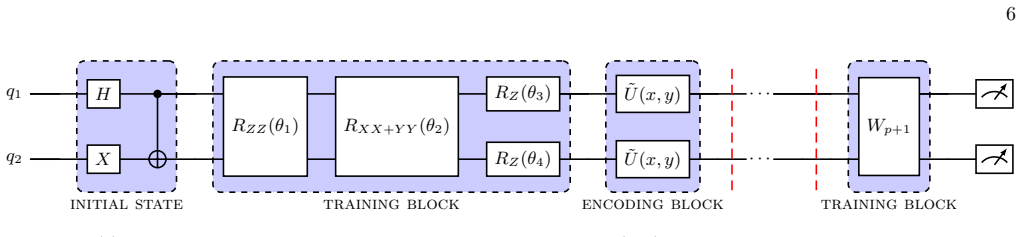
We construct parametrized circuits that encode finite-group and compact Lie-group symmetries as inductive biases through problem-specific equivariant generator sets. Using a twirling-based construction, we derive symmetry-preserving gates that ensure that the model predictions respect the symmetries of the governing equation whenever the boundary and initial data are symmetry compatible. Across these benchmarks, GQPINNs achieve improved solution accuracy, as quantified by lower mean absolute error, while requiring substantially fewer trainable parameters.
What carries the argument
The twirling-based construction of symmetry-preserving gates from equivariant generator sets, which embeds the geometric structure of the PDE as an inductive bias inside the quantum-circuit ansatz.
If this is right
- GQPINNs produce lower mean absolute error than standard QPINNs on the tested linear and nonlinear PDEs.
- The networks require substantially fewer trainable parameters than either standard QPINNs or classical symmetry-adapted PINNs under matched training protocols.
- Symmetry-aware quantum-circuit design supplies a systematic route to improved efficiency and generalization in quantum PDE solvers.
- Geometric inductive biases can be incorporated into quantum-enhanced scientific machine learning through problem-specific equivariant gates.
Where Pith is reading between the lines
- If the symmetry construction survives hardware noise, similar equivariant designs could reduce quantum resources needed for other symmetry-rich physics simulations.
- The same twirling approach might be combined with classical symmetry reduction techniques to handle larger or higher-dimensional PDEs.
- Testing the method on PDEs whose symmetries are only approximate would reveal how sensitive the accuracy gain is to exact symmetry compliance.
- Hybrid classical-quantum pipelines could use the GQPINN ansatz only on symmetry sectors where the quantum advantage is largest.
Load-bearing premise
That the chosen equivariant generator sets and twirling construction can be realized on quantum hardware without noise or approximation errors that erase the symmetry advantage.
What would settle it
A benchmark on actual quantum hardware in which the reported accuracy gain or parameter reduction disappears once device noise is present.
Figures




read the original abstract
Quantum physics-informed neural networks (QPINNs) have recently emerged as a promising framework for the solution of partial differential equations (PDEs), with several studies reporting improved convergence and accuracy relative to classical physics-informed neural networks (PINNs) at reduced training cost. Motivated by these advances, we introduce geometric quantum physics-informed neural networks (GQPINNs), a symmetry-aware extension of QPINNs in which the geometric structure of the underlying PDE is incorporated directly into the quantum-circuit ansatz. Building on the framework of geometric quantum machine learning, we construct parametrized circuits that encode finite-group and compact Lie-group symmetries as inductive biases through problem-specific equivariant generator sets . Using a twirling-based construction, we derive symmetry-preserving gates that ensure that the model predictions respect the symmetries of the governing equation whenever the boundary and initial data are symmetry compatible. We benchmark GQPINNs against standard QPINNs and symmetry-adapted classical PINN baselines under matched training protocols across a representative set of linear and nonlinear PDEs. Across these benchmarks, GQPINNs achieve improved solution accuracy, as quantified by lower mean absolute error, while requiring substantially fewer trainable parameters. These results identify symmetry-aware quantum-circuit design as an effective route toward improved efficiency and generalization in quantum PDE solvers and provide a systematic framework for incorporating geometric inductive biases into quantum-enhanced scientific machine learning.
Editorial analysis
A structured set of objections, weighed in public.
Referee Report
Summary. The manuscript introduces geometric quantum physics-informed neural networks (GQPINNs) as a symmetry-aware extension of QPINNs. It encodes finite-group and compact Lie-group symmetries of the target PDE directly into the quantum-circuit ansatz via problem-specific equivariant generator sets and a twirling construction that produces symmetry-preserving gates. The resulting model is claimed to respect the PDE symmetries whenever initial/boundary data are compatible, and benchmarks on representative linear and nonlinear PDEs are reported to yield lower mean absolute error together with substantially fewer trainable parameters than both standard QPINNs and symmetry-adapted classical PINN baselines.
Significance. If the quantitative claims hold under scrutiny, the work supplies a systematic route for injecting geometric inductive biases into quantum PDE solvers. This could improve sample efficiency and generalization in quantum-enhanced scientific machine learning while remaining compatible with existing geometric quantum machine learning toolkits.
major comments (2)
- [Abstract] Abstract: the headline claims of 'improved solution accuracy, as quantified by lower mean absolute error' and 'substantially fewer trainable parameters' are stated without any numerical values, error bars, statistical tests, or even a summary table. Because these quantities are the sole evidence offered for the central contribution, their absence prevents any assessment of effect size or robustness.
- [Twirling construction and equivariant generators] Twirling construction (methods): the symmetry preservation is derived under the ideal, noiseless, infinite-shot limit. The manuscript benchmarks only in noiseless simulation; no analysis or experiments are supplied on how depolarizing, readout, or sampling noise degrades the enforced equivariance. This is load-bearing for any claim of hardware relevance.
minor comments (2)
- [Notation and construction] The precise definition of the equivariant generator sets for both finite and Lie groups would benefit from an explicit equation or worked example for at least one symmetry.
- [Benchmarks] The benchmark section should list the exact PDEs, circuit depths, optimizer hyperparameters, and number of shots used so that the reported MAE and parameter counts can be reproduced.
Simulated Author's Rebuttal
We thank the referee for the constructive feedback. We address each major comment point by point below, proposing revisions where they strengthen the manuscript while maintaining the integrity of our contributions.
read point-by-point responses
-
Referee: [Abstract] Abstract: the headline claims of 'improved solution accuracy, as quantified by lower mean absolute error' and 'substantially fewer trainable parameters' are stated without any numerical values, error bars, statistical tests, or even a summary table. Because these quantities are the sole evidence offered for the central contribution, their absence prevents any assessment of effect size or robustness.
Authors: We agree that the abstract would benefit from explicit quantitative indicators to better convey effect sizes. The detailed benchmark results, including mean absolute errors, parameter counts, error bars from multiple independent runs, and comparisons, are already reported with full tables and statistical context in Section IV. In the revised version we will update the abstract to include representative numerical values (e.g., typical MAE reductions and parameter savings across the linear and nonlinear PDE examples) while preserving its concise style. revision: yes
-
Referee: [Twirling construction and equivariant generators] Twirling construction (methods): the symmetry preservation is derived under the ideal, noiseless, infinite-shot limit. The manuscript benchmarks only in noiseless simulation; no analysis or experiments are supplied on how depolarizing, readout, or sampling noise degrades the enforced equivariance. This is load-bearing for any claim of hardware relevance.
Authors: The referee is correct that the twirling construction and symmetry-preservation proof are derived in the ideal, noiseless, infinite-shot limit, and all reported benchmarks use noiseless classical simulation of the circuits. The manuscript does not claim immediate hardware readiness; it positions GQPINNs as an algorithmic framework whose symmetry bias is compatible with existing geometric quantum machine learning toolkits. We will add a dedicated paragraph in the discussion section that analytically examines how common noise channels (depolarizing, readout, finite-shot sampling) can degrade the enforced equivariance and will outline mitigation strategies. Full noisy simulations or hardware experiments lie beyond the present scope and resources. revision: partial
Circularity Check
No circularity: forward ansatz construction with independent benchmarks
full rationale
The paper constructs GQPINNs by extending QPINNs with symmetry encoding via equivariant generators and twirling drawn from the existing geometric quantum machine learning framework. This is presented as a direct methodological step, followed by empirical benchmarking on linear and nonlinear PDEs that reports lower MAE and fewer parameters. No derivation step reduces the claimed accuracy or efficiency gains to a fitted quantity inside the same paper, a self-citation that bears the central result, or a redefinition that makes the output equivalent to the input by construction. The chain remains self-contained as a proposal validated externally by simulation results.
Axiom & Free-Parameter Ledger
axioms (2)
- domain assumption Quantum circuits can be made equivariant under finite or compact Lie groups by suitable choice of generator sets.
- domain assumption When boundary and initial data are symmetry-compatible, the model predictions will respect the PDE symmetries.
invented entities (1)
-
GQPINN
no independent evidence
Lean theorems connected to this paper
-
Foundation/BranchSelection.lean (RCL coupling combiner / symmetry inputs)branch_selection unclearUsing a twirling-based construction, we derive symmetry-preserving gates that ensure that the model predictions respect the symmetries of the governing equation whenever the boundary and initial data are symmetry compatible.
Reference graph
Works this paper leans on
-
[1]
Promoting the application of advanced quantum technology platforms to social issues
To ensure a fair comparison despite the different parameter counts per trainable block, we report MAE as a function of the total number of trainable param- eters in Fig. 5. This allows us to assess whether the GQPINN ansatzes achieves improved accuracy even with fewer parameters. Figure 5 shows that both GQPINN ansatzes achieve substantially smaller MAE w...
-
[2]
T. Ayral, P. Besserve, D. Lacroix, and E. A. Ruiz Guzman, The European Physical Journal A59, 10.1140/epja/s10050-023-01141-1 (2023)
-
[3]
Blekos, D
K. Blekos, D. Brand, A. Ceschini, C.-H. Chou, R.-H. Li, K. Pandya, and A. Summer, Physics Reports1068, 1 (2024)
2024
-
[4]
Bauer, S
B. Bauer, S. Bravyi, M. Motta, and G. K.-L. Chan, Chemical Reviews120, 12685 (2020)
2020
-
[5]
Montanaro, npj Quantum Information2, 15023 (2016)
A. Montanaro, npj Quantum Information2, 15023 (2016)
2016
-
[6]
Grossmann, H.-G
C. Grossmann, H.-G. Roos, and M. Stynes,Numerical Treatment of Partial Differential Equations(Springer, Berlin, Heidelberg, 2007)
2007
-
[7]
N. A. Fallah, C. Bailey, M. Cross, and G. A. Taylor, Applied Mathematical Modelling24, 439 (2000)
2000
-
[8]
A. W. Harrow, A. Hassidim, and S. Lloyd, Physi- cal Review Letters103, 10.1103/physrevlett.103.150502 (2009)
-
[9]
A. M. Childs, J.-P. Liu, and A. Ostrander, Quantum5, 574 (2021)
2021
-
[10]
D. W. Berry and P. C. S. Costa, Quantum8, 1369 (2024)
2024
-
[11]
Ambainis, in29th International Symposium on Theo- retical Aspects of Computer Science (STACS 2012), Leib- niz International Proceedings in Informatics (LIPIcs), Vol
A. Ambainis, in29th International Symposium on Theo- retical Aspects of Computer Science (STACS 2012), Leib- niz International Proceedings in Informatics (LIPIcs), Vol. 14, edited by C. D¨ urr and T. Wilke (Schloss Dagstuhl – Leibniz-Zentrum f¨ ur Informatik, 2012) pp. 636–647
2012
-
[12]
A. M. Childs, R. Kothari, and R. D. Somma, SIAM Jour- nal on Computing46, 1920 (2017)
1920
-
[13]
Montanaro and S
A. Montanaro and S. Pallister, Phys. Rev. A93, 032324 (2016)
2016
-
[14]
Wang and Z
Q. Wang and Z. Zhang, Phys. Rev. A110, 012422 (2024)
2024
-
[15]
A. M. Childs and J.-P. Liu, Communications in Mathe- matical Physics375, 1427 (2020)
2020
-
[16]
S. Jin, N. Liu, and Y. Yu, Physical Review Letters133, 230602 (2024)
2024
-
[17]
D. W. Berry, Journal of Physics A: Mathematical and Theoretical47, 105301 (2014)
2014
-
[18]
D. W. Berry, A. M. Childs, and R. Kothari, in2015 IEEE 56th Annual Symposium on Foundations of Com- puter Science(2015) pp. 792–809
2015
-
[19]
P. C. S. Costa, S. Jordan, and A. Ostrander, Phys. Rev. A99, 012323 (2019)
2019
-
[20]
J.-P. Liu, H. Ø. Kolden, H. K. Krovi, N. F. Loureiro, K. Trivisa, and A. M. Childs, Proceedings of the National Academy of Sciences118, e2026805118 (2021)
2021
-
[21]
F. Oz, R. K. S. S. Vuppala, K. Kara, and F. Gaitan, Quantum Information Processing21, 10.1007/s11128- 021-03391-8 (2022)
-
[22]
Gaitan, npj Quantum Information6, 61 (2020)
F. Gaitan, npj Quantum Information6, 61 (2020)
2020
- [23]
-
[24]
Ljubomir, International Journal of Quantum Informa- tion20, 2150039 (2022)
B. Ljubomir, International Journal of Quantum Informa- tion20, 2150039 (2022)
2022
-
[25]
Preskill, Quantum2, 79 (2018)
J. Preskill, Quantum2, 79 (2018)
2018
-
[26]
Bharti, A
K. Bharti, A. Cervera-Lierta, T. H. Kyaw, T. Haug, S. Alperin-Lea, A. Anand, M. Degroote, H. Heimonen, J. S. Kottmann, T. Menke, W.-K. Mok, S. Sim, L.- C. Kwek, and A. Aspuru-Guzik, Rev. Mod. Phys.94, 015004 (2022)
2022
-
[27]
J. R. McClean, J. Romero, R. Babbush, and A. Aspuru- Guzik, New Journal of Physics18, 023023 (2016)
2016
-
[28]
Demirdjian, D
R. Demirdjian, D. Gunlycke, C. A. Reynolds, J. D. Doyle, and S. Tafur, Quantum Information Processing21, 322 (2022)
2022
-
[29]
Bravo-Prieto, R
C. Bravo-Prieto, R. LaRose, M. Cerezo, Y. Subasi, L. Cincio, and P. J. Coles, Quantum7, 1188 (2023)
2023
-
[30]
A. J. Pool, A. D. Somoza, C. Mc Keever, M. Lubasch, and B. Horstmann, Phys. Rev. Res.6, 033257 (2024)
2024
-
[31]
Lubasch, J
M. Lubasch, J. Joo, P. Moinier, M. Kiffner, and D. Jaksch, Phys. Rev. A101, 010301 (2020)
2020
-
[32]
M. Syamlal, C. Copen, M. Takahashi, and B. Hall, arXiv:2406.18749 (2024)
-
[33]
Pfeffer, F
P. Pfeffer, F. Heyder, and J. Schumacher, Phys. Rev. Res. 4, 033176 (2022)
2022
-
[34]
Pfeffer, F
P. Pfeffer, F. Heyder, and J. Schumacher, Phys. Rev. Res. 5, 043242 (2023)
2023
-
[35]
Kyriienko, A
O. Kyriienko, A. E. Paine, and V. E. Elfving, Physical Review A103, 052416 (2021)
2021
-
[36]
Siegl, S
P. Siegl, S. Wassing, D. M. Mieth, S. Langer, and P. Beke- meyer, CEAS Aeronautical Journal16, 63 (2025)
2025
-
[37]
Quantum-Enhanced Convergence of Physics-Informed Neural Networks
N. Klement, V. Eyring, and M. Schwabe, arXiv:2601.15046 (2026)
work page internal anchor Pith review Pith/arXiv arXiv 2026
-
[38]
Raissi, P
M. Raissi, P. Perdikaris, and G. E. Karniadakis, Journal of Computational Physics378, 686 (2019)
2019
-
[39]
S. Cai, Z. Mao, Z. Wang, M. Yin, and G. E. Karniadakis, Acta Mechanica Sinica37, 1727 (2021)
2021
-
[40]
Wassing, S
S. Wassing, S. Langer, and P. Bekemeyer, Computers & Fluids270, 106164 (2024)
2024
-
[41]
G. E. Karniadakis, I. G. Kevrekidis, L. Lu, P. Perdikaris, S. Wang, and L. Yang, Nature Reviews Physics3, 422 (2021)
2021
-
[42]
J. R. McClean, S. Boixo, V. N. Smelyanskiy, R. Babbush, and H. Neven, Nature Communications9, 4812 (2018), id: McClean2018
2018
-
[43]
H. Qi, L. Wang, H. Zhu, A. Gani, and C. Gong, Quantum Information Processing22, 435 (2023), id: Qi2023
2023
-
[44]
Larocca, S
M. Larocca, S. Thanasilp, S. Wang, and et al., Nature Reviews Physics7, 174 (2025)
2025
-
[45]
M. M. Bronstein, J. Bruna, Y. LeCun, A. Szlam, and P. Vandergheynst, IEEE Signal Processing Magazine34, 18 (2017)
2017
-
[46]
M. M. Bronstein, J. Bruna, T. Cohen, and P. Veliˇ ckovi´ c, arXiv:2104.13478 (2021)
work page internal anchor Pith review arXiv 2021
-
[47]
Cohen and M
T. Cohen and M. Welling, inProceedings of The 33rd In- ternational Conference on Machine Learning, Proceed- ings of Machine Learning Research, Vol. 48 (PMLR,
-
[48]
Representation theory for geometric quantum machine learning.arXiv preprint arXiv:2210.07980, 2022
M. Ragone, P. Braccia, Q. T. Nguyen, L. Schatzki, P. J. Coles, F. Sauvage, M. Larocca, and M. Cerezo, arXiv:2210.07980 (2023)
-
[49]
Larocca, F
M. Larocca, F. Sauvage, F. M. Sbahi, G. Verdon, P. J. Coles, and M. Cerezo, PRX Quantum3, 030341 (2022)
2022
-
[50]
Q. T. Nguyen, L. Schatzki, P. Braccia, M. Ragone, P. J. Coles, F. Sauvage, M. Larocca, and M. Cerezo, PRX Quantum5, 020328 (2024)
2024
-
[51]
J. J. Meyer, M. Mularski, E. Gil-Fuster, A. A. Mele, F. Arzani, A. Wilms, and J. Eisert, PRX Quantum4, 010328 (2023)
2023
-
[52]
Schuld, R
M. Schuld, R. Sweke, and J. J. Meyer, Phys. Rev. A103, 032430 (2021)
2021
-
[53]
P´ erez-Salinas, A
A. P´ erez-Salinas, A. Cervera-Lierta, E. Gil-Fuster, and J. I. Latorre, Quantum4, 226 (2020). 16
2020
-
[54]
Jerbi, L
S. Jerbi, L. J. Fiderer, H. Poulsen Nautrup, J. M. K¨ ubler, H. J. Briegel, and V. Dunjko, Nature Communications 14, 517 (2023)
2023
-
[55]
Helsen,Quantum Information in the Real World: Diagnosing and Correcting Errors in Practical Quantum Devices, Ph.D
J. Helsen,Quantum Information in the Real World: Diagnosing and Correcting Errors in Practical Quantum Devices, Ph.D. thesis, Delft University of Technol- ogy (2021),http://resolver.tudelft.nl/uuid: 312b719d-32bc-4219-82bb-8e6febc2abcc
2021
-
[56]
Huang, M
H.-Y. Huang, M. Broughton, M. Mohseni, R. Babbush, S. Boixo, J. R. McClean, H. Neven, M. Cerezo, and P. J. Coles, Science376, 1182 (2022)
2022
-
[57]
D. C. Liu and J. Nocedal, Mathematical Programming 45, 503 (1989)
1989
-
[58]
PennyLane: Automatic differentiation of hybrid quantum-classical computations
V. Bergholm, J. Izaac, M. Schuld, C. Gogolin, S. Ahmed, R. Sweke, A. Mari, S. Cao, W. J. Zeng, and N. Killoran, arXiv:1811.04968 (2018)
work page internal anchor Pith review arXiv 2018
-
[59]
S. Sim, P. D. Johnson, and A. Aspuru-Guzik, Advanced Quantum Technologies2, 10.1002/qute.201900070 (2019)
-
[60]
Safari (2026), unpublished manuscript, in preparation
R. Safari (2026), unpublished manuscript, in preparation
2026
-
[61]
P. J. Olver,Applications of Lie Groups to Differential Equations(Springer-Verlag, New York, 1993)
1993
-
[62]
L. Lu, P. Jin, G. Pang, Z. Zhang, and G. E. Karniadakis, Nature Machine Intelligence3, 218 (2021)
2021
-
[63]
S. Wang, H. Wang, and P. Perdikaris, Science Advances 7, eabi8605 (2021)
2021
- [64]
-
[65]
W. Zhu, W. Khademi, E. G. Charalampidis, and P. G. Kevrekidis, Physica D: Nonlinear Phenomena434, 133264 (2022)
2022
-
[66]
Zhang, J.-Y
Z.-Y. Zhang, J.-Y. Li, and L.-L. Guo, Journal of Com- putational Physics523, 113680 (2025)
2025
discussion (0)
Sign in with ORCID, Apple, or X to comment. Anyone can read and Pith papers without signing in.